

Just take a look at the following table and you will realize that the digestive tract of our dogs and cats is VERY different from ours. This explains you why any abrupt change in the diet they are fed can potentially lead to the development of gastro-intestinal upset. From a clinical standpoint, vomiting and diarrhea especially will be observed.

Differences between human and dog / cat digestive systems
A progressive dietary transition
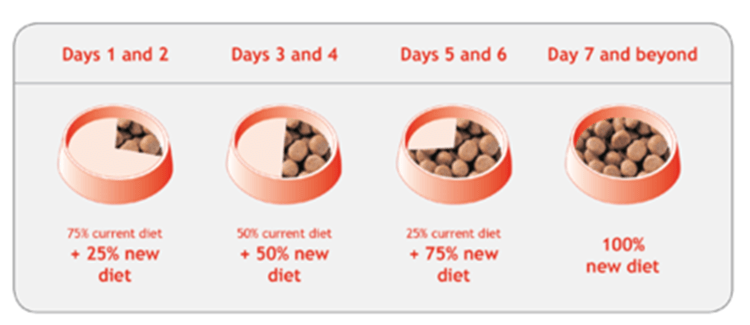
That’s why each time you need to switch a dog (or a cat) to a new diet, it is important to do what we call a dietary transition. This allows the digestive tract to “get used” to the new nutrients and improve its capacity to properly digest it. Key element here: this transition must be progressive! We usually recommend to do this over a 5 day period as described in the picture below. This is definitely an important thing to do in order to optimize the digestibility of the new diet in these animals.
But when we don’t have any history?
Sounds easy, right? In shelter environments however, it is not always that simple. For a simple reason: for many dogs and cats that enter the shelter unfortunately, we have no history at all… No idea where they come from, no idea what they went through, if they had been vaccinated or not… and obviously no idea what they were eating before. What to do in this kind of situation then, especially that now you know that “a dietary transition is required”?
Unfortunately there is no miracle recipe and no “one-fits-all” approach. The best approach today seem to start feeding the dog/cat with the most digestible diet you can offer it.
For sure it might be more expensive, but today this sounds like the best way to try to prevent GI upset in these dogs and cats. As soon as things are under control (a 10-day period may be required), you can then switch the animal under the “normal” maintenance diet you usually use for your dogs and cats inside your shelter. Obviously, a dietary transition will be required here as well!
Additional resource: we recently did a webinar focusing on the importance of nutrition in animal shelters. The video is right below, don’t hesitate to watch it to learn more about the zootechnical approach recommended in shelter environments.

 DR. EMMANUEL FONTAINE