
🇫🇷Lire en Français | 🇪🇸Leer en Español| 🇧🇷Leia em português
Is the miracle of canine birth a hidden danger?
Our four-legged friends, known for their ability to birth multiple puppies at once, carry an often overlooked risk with every parturition.
In the world of canines, giving birth is not always a smooth process.
Our research, conducted in 2007, revealed a startling truth: dystocia, or difficult labor, is far from rare in dogs. Out of 1614 bitches studied, a significant 13.7% experienced this complication during delivery.
The consequences of dystocia are severe. Prolonged labor can lead to hypoxia in puppies, a condition characterized by a lack of oxygen.
This oxygen deprivation triggers a chain reaction in their little bodies, leading to metabolic acidosis – an excessive production of acid. The result? Newborn puppies that are weak, lethargic, and struggle with each breath they take, a condition known as orthopnea.
The numbers speak for themselves. In cases of dystocia, the neonatal mortality rate soars to 34.7%, a stark contrast to the 10.7% in cases of normal birth, or eutocia.
The message is clear: for those running breeding kennels, managing parturition should be a top priority.
This blog aims to shed light on the hidden risks of canine birth and the crucial role of effective management in ensuring the health and survival of our beloved puppies.

Could early detection of risk factors be the key to safer canine births?
Veterinary medicine has made significant strides in this area, and we now have a clearer understanding of the factors that can influence the occurrence of dystocia.
The role of breed
Firstly, breed plays a significant role. English Bulldogs, French Bulldogs, and similar breeds with their characteristic large heads and small pelvises are often the subjects of dystocia studies. But they’re not alone.
Scottish Terriers, Chihuahuas, and English Bull Terriers also frequently experience difficult births.
Sometimes, it’s not just about the breed but the lineage.
For instance, certain Labrador lineages seem predisposed to uterine inertia, a condition where the uterus fails to contract during parturition.
Without considering lineage, we might miss crucial information to help these specific dogs.
The role of weight
Secondly, weight is a critical factor. Overweight dogs are more likely to experience dystocia.
While one might assume this isn’t a problem for breeding dogs, studies suggest otherwise, with up to 20% of show dogs now considered overweight.
Another common misstep is feeding breeding bitches a high-energy diet, like puppy food, from the start of pregnancy.
It’s crucial to remember that fetuses gain 70% of their final weight in the last 20 days of gestation.
Therefore, energy intake should only increase during this final third of pregnancy.
Starting a high-energy diet too early can lead to excess fat, which can negatively impact the strength of uterine contractions.
Understanding and monitoring these risk factors can significantly improve the management of canine parturition, leading to safer births and healthier puppies.

The Impact of Parity and Age on Canine Dystocia
First, let’s consider the factor of parity.
It’s often assumed that first-time mothers, or primiparous bitches, are more at risk.
However, research indicates that this risk significantly increases when bitches are bred for the first time after 4 years of age.
Thus, starting their reproductive journey earlier can help mitigate this risk.
Previous C-Sections and Future Risk
Secondly, a history of dystocia doesn’t necessarily doom a bitch to future C-sections.
The uterus can recover remarkably well from a C-section, and if the procedure was performed correctly without any noticeable abnormalities, there’s usually no reason to anticipate another C-section in the subsequent pregnancy.

Lastly, I strongly advocate for accurately determining the size of the litter in a pregnant bitch.
This factor is closely linked to the occurrence of dystocia.
Determining Litter Size: The Role of X-Rays and Ultrasounds
Is there a foolproof way to accurately determine the size of a canine litter?
The answer lies in X-rays, but timing is crucial.
Conducting X-rays before 45 days of pregnancy won’t yield reliable results, as the puppies’ skeletons are not yet calcified and thus invisible.
For optimal visualization and evaluation, we recommend X-rays at 50 days post-ovulation. Always ensure two different views – lateral and ventral – are taken for a comprehensive assessment.
Contrary to popular belief, ultrasounds are not the best tool for determining litter size.
They only provide sections of the abdomen, making it easy to miss a puppy or double-count one in larger litters.
While ultrasounds are excellent for assessing fetal vitality, they only offer an estimate when it comes to litter size.
Unique Challenges in Canine Parturition: ‘Single Puppy Syndrome’ and ‘Hyperfoetation
Two unique situations warrant special attention: the ‘single puppy syndrome’ and ‘hyperfoetation’.
The former refers to one or two puppies in a large-size bitch, often leading to dystocias, stillbirths, and C-sections due to insufficient uterine contractions.
In such cases, an elective C-section can be proposed to optimize the neonatal survival rate, especially when the puppy holds high genetic value.
‘Hyperfoetation’, on the other hand, involves very large litters of more than 12 puppies.
The overstretched uterus struggles to contract properly during parturition, leading to a higher likelihood of stillbirths, particularly among the last puppies to be expelled.
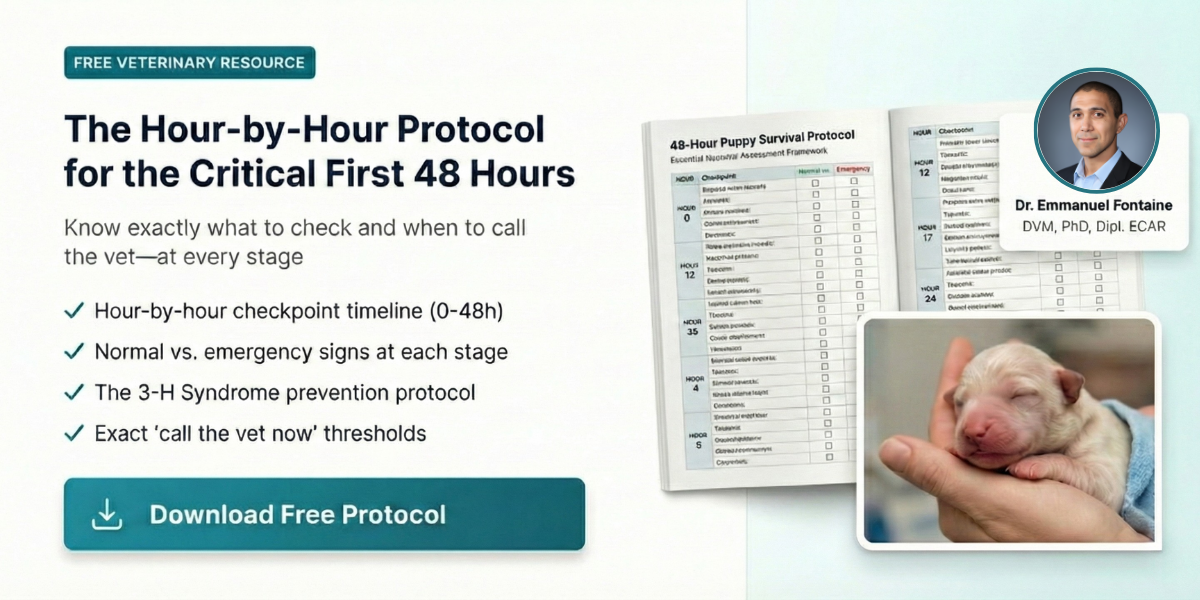
Recognizing potential risks before parturition is crucial in breeding bitches. This foresight enables your veterinarian to devise the most effective strategy for each unique case, significantly enhancing the puppies’ chances of survival. The silver lining? As we’ve explored, modern veterinary medicine provides us with straightforward methods to achieve this. So, let’s leverage these tools to ensure the health and safety of our beloved canine companions and their precious litters.
Interested to learn more about canine neonatology? Download my free ebook on the topic HERE!

 DR. EMMANUEL FONTAINE