
🇫🇷 Lire en Français | 🇪🇸Leer en Español | 🇧🇷Leia em português
In veterinary medicine, we usually find ourselves well-equipped to evaluate the health of adult pets.
We’re adept at recognizing clinical signs, understanding their implications, and acting accordingly.
However, when it comes to newborn kittens and puppies, we sometimes… falter.
It’s a common misconception to view these neonates as merely “smaller” versions of adults.
Which couldn’t be further from the truth!
Their vital signs, behaviors, and needs are distinctively different from their grown-up counterparts.
I am a big believer that in canine and feline neonatology, preparedness is paramount.
And this is where the APGAR scores shine brightly.

A Brief Dive into History: The Origin of APGAR Scores
The APGAR score, a tool initially developed for human neonates, owes its inception to the pioneering work of Virginia Apgar (1909-1974).
An American obstetrical anesthesiologist, Apgar was a trailblazer in anesthesiology, teratology, and neonatology.
Her most renowned contribution, however, remains the Apgar score, designed to swiftly assess the health of newborn children right after birth.
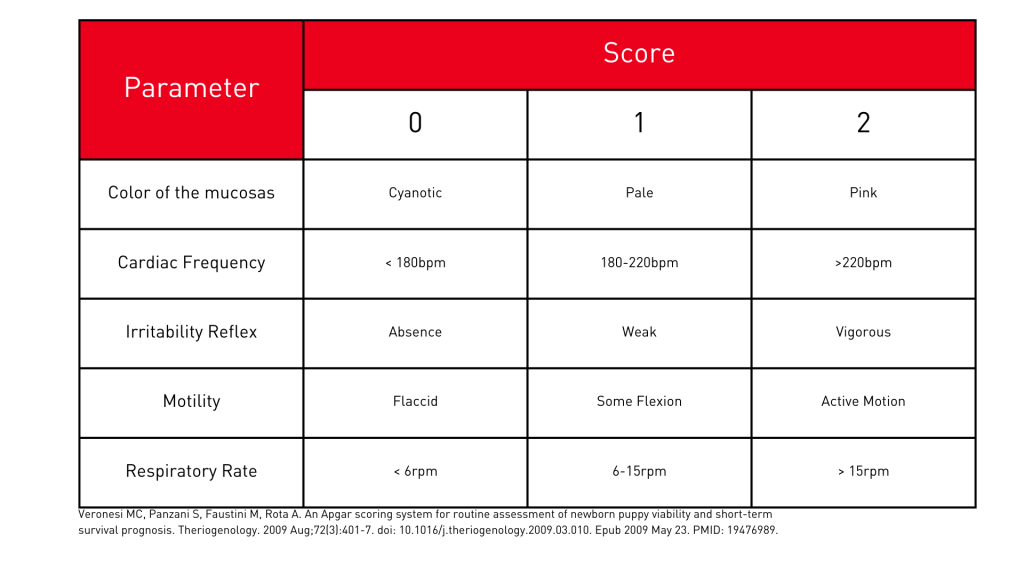
The Apgar scale evaluates newborns based on five criteria, each scored from zero to two.
The cumulative score ranges from zero to ten.
These criteria, cleverly forming a backronym, are:
– Appearance: The skin’s color, texture, and overall look, particularly the face.
– Pulse: Essentially the heart rate.
– Grimace or Reflex irritability: an involuntary response to stimuli.
– Activity: The movement and flexion/extension of limbs.
– Respiration: Respiratory effort and frequency.
Adapting APGAR to Veterinary Medicine
While APGAR scores are a staple in human maternities, their significance isn’t confined to just that.
In 2009, Veronesi and colleagues illuminated the veterinary world with a paper on the application of APGAR scores for assessing newborn puppy viability and prognosis for short-term survival.
This adaptation has since become a beacon for neonatal care in veterinary medicine.
During a recent canine neonatology webinar, I shared insights from my thorough review of the latest veterinary studies.
Many contemporary papers emphasized the use of specific health markers, such as umbilical cord blood gas and cardiac troponin I, for immediate post-birth neonatal health assessment.
And my readings led to an enlightening discovery: the traditional APGAR scores, when administered immediately post-birth, rival these advanced markers in efficacy!
In canine and feline neonatology, APGAR scores have proven their mettle as a trustworthy metric.
They’re straightforward, potent, and an indispensable tool for every veterinary clinic, breeding kennel, and cattery.
Here’s the APGAR scoring table for both puppies and kittens:
Interpreting the Scores
Scoring offers a snapshot, but the real art lies in its insightful interpretation.
And here is how we should interpret APGAR scores in newborn kittens and puppies.
– Scores < 7 => indicate the need for assistance.
– Scores < 4 typically necessitate immediate veterinary intervention.
– Scores between 4 and 7? Revisit resuscitation techniques if the APGAR was conducted right after birth. If later, it’s crucial to supplement with a dedicated canine/feline milk replacer and optimize the newborn’s environment.
Here’s a quick guide regarding this:
– 1st week of life: 30°C (86°F) in the nest
– 2nd week: 28°C (82.4°F)
– 3rd week: 25°C (77°F)
– Aim for a humidity level of 55±10% in the maternity. A compact weather station can be invaluable for monitoring and adjusting these parameters.
Recent research from 2022 highlighted that breed size plays a pivotal role in interpreting APGAR scores for dogs.
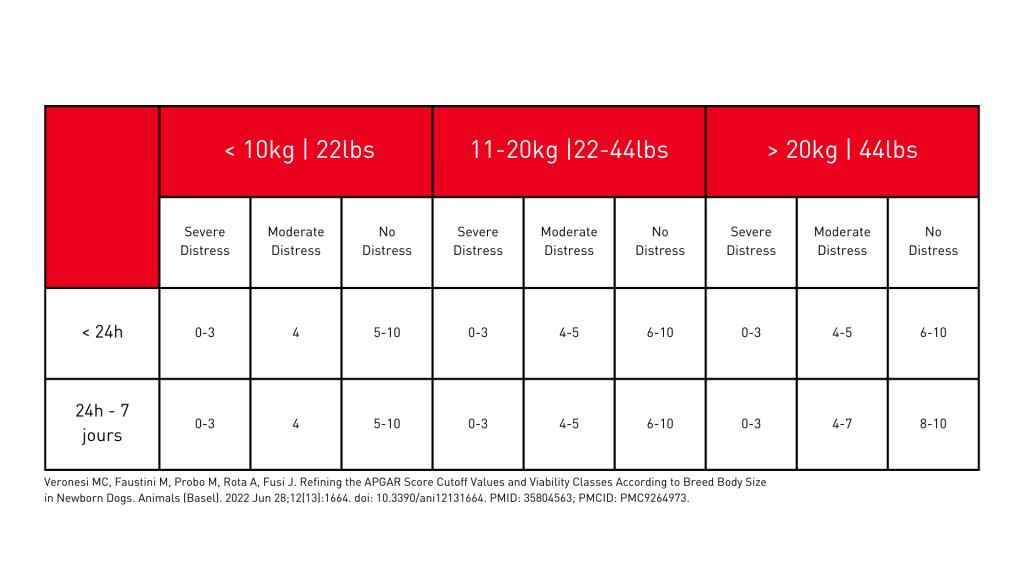
The significance of APGAR scores persists for up to 8 hours post-birth.

So, even if you’re slightly delayed, you can still aid the newborns.
The Time Investment: Worth Every Second
I’ve often encountered the argument that APGAR scores are time-consuming.
The reality? It takes less than a minute to conduct a comprehensive APGAR assessment on a newborn.
In this brief span, you obtain a quantitative health evaluation, guiding your subsequent actions.
This minute can be the difference between life and death, making it an invaluable investment.
In human neonatology, APGAR scores are typically performed right after birth and then five minutes later.
Veterinary medicine is still exploring the optimal timing, with some advocating for the human approach and others suggesting a single assessment within the first five minutes post-birth.
Regardless of the timing, the overarching goal remains consistent: widespread adoption of APGAR scores in clinics, kennels, and catteries.
I believe that the APGAR scores, this legacy of Virginia Apgar’s groundbreaking work, have revolutionized neonatal care in both human and veterinary medicine.
I have no doubt that embracing this tool can elevate the care we provide to our youngest patients.
With the insights shared here, I trust you’ll see the value of APGAR scores.
Here is a quantitative tool that can help ensure our kittens and puppies embark on a vibrant path of health and vitality.

 DR. EMMANUEL FONTAINE