
🇫🇷 Lire en Français | 🇪🇸Leer en Español | 🇧🇷Leia em português
During a recent webinar Q&A, I was posed with a question that I’ve often encountered in my field:
‘What to do when dealing with Fading Puppy Syndrome?’
I must admit: it’s a query I’m particularly fond of addressing.
When it comes to this term, I believe I have…quite a unique perspective, to say the least. 🙂
That’s why I thought I should write this blog.
It contains insights that I believe every dog breeder and veterinarian should consider, when approaching this Fading Puppy Syndrome.
What is Fading Puppy Syndrome?
#1 Here is an important truth: Fading Puppy Syndrome is NOT a singular disease, but a collection of symptoms. I think this is something key to remember here, because very often people use the term like it is a disease on its own. It is not. Essentially, it’s a catch-all container for every conceivable reason a newborn puppy might not survive.
#2 The term “syndrome” simply implies a group of symptoms. In the case of Fading Puppy Syndrome, as I just mentioned the exact cause often remains elusive, making it a term used when the precise reason for a puppy’s deterioration is unknown.
#3 So, when pondering Fading Puppy Syndrome, what symptoms come to mind? The stark reality is that ANY sign that can precipitate the abrupt downfall or demise of puppies in their initial weeks should be considered here. Which, you understand, makes it pretty vague from the start.
How common is Fading Puppy Syndrome?
#4 It’s a sobering fact that up to 20% of puppies may not see life beyond their first few weeks. The scientific literature on this matter is clear, and this one statistic resoundingly echoes throughout.
#5 Something crucial to understand and remember: the neonatal danger zone is most pronounced immediately post-birth and during the first week of existence.
#6 Recent findings highlight that 50% of 0-7 day old puppies can face fatal health troubles WITHOUT showing any prior clinical symptoms! This staggering statistic reminds us of something truly important: prevention and proactive care isn’t just advised- it’s VITAL!
#7 The neonatal mortality rate in dog breeding kennels demands our undivided attention.Vigilant monitoring of this parameter is a non-negotiable in my opinion. Every kennel should be equipped with a dedicated dashboard tracking this vital metric. Remember, measurement is the first step towards improvement. This is the gold standard in dog breeding which should all aim for.
What causes Fading Puppy Syndrome?
#8 One of the primary antagonists behind neonatal mortality in puppies is something I call the 3H Syndrome. This term encapsulates three conditions: Hypothermia, Hypoglycemia and Dehydration.
#9 Hypothermia: Puppies, especially during the first 3 weeks after birth, cannot regulate their body temperature. A significant drop can lead to various complications.
#10 A chilling truth: when a newborn puppy’s internal body temperature plunges below 34°C (93.2°F), digestion halts; and at 32°C (89.6°F), they tragically lose their vital suckling reflex.
#11 And here is a stark contrast in the canine world: while adult dogs maintain a body temperature of 38-39°C (100.4-102.2°F), newborns start at 35-36°C (95-96.8°F), gradually climbing to adult levels only three weeks post-birth.
#12 Temperature is actually a key predictor for life treating risks in 1-week old pups. Consistently, being below 36°C (96.8°F) at either 12 hours or 24 hours after birth poses a significant danger!
#13 Hypoglycemia: Low blood sugar can be detrimental to puppies, affecting their energy levels and overall health.
#14 Actually, blood glucose level extremes (<72mg/dL or >192mg/dL at 12 hours after birth; <79mg/dL or >180 mg/dL at 24 hours) is also now considered as significant risk factor!
#15 Dehydration: Adequate hydration is crucial for puppies. A lack of essential fluids can quickly lead to health concerns, which is to be expected in individuals basically made of 82% of water!
#16 The 3H syndrome is believed to be one of the most common cause of neonatal mortality in the canine species, and the reason is simple: those 3 conditions (Hypothermia, Hypoglycemia, Dehydration) are kind of interconnected. One can lead to another!
#17 While various factors can contribute to Fading Puppy Syndrome, infectious diseases can play a significant role.
#18 Canine brucellosis is always one to consider. Be aware that the disease is on the rise, particularly in regions like North America and Western Europe, where there have been some recent reports in the news and the scientific literature. So this one should always be a priority concern!
#19 Conversely, the canine herpes virus is frequently cited as a potential cause of Fading Puppy Syndrome. That being said, it is not as predominant a factor as previously believed, this virus being quite common actually in the canine population.
#20 Actually, any germ infecting a newborn puppy can actually potentially lead to this condition. And there are two sources to consider here: the mother and the environment.
#21 Never underestimate this fact: the umbilical stump in newborns is a major contamination hotspot. When it becomes inflamed, resulting in omphalophlebitis, it’s a significant trigger for mortality and morbidity in mammals.
#22 This is why taking care of the umbilical stump during the first week after birth is paramount and should never be overlooked. This is a simple measure that can be a true game changer! Check this blog here to find out more.
#23 Don’t forget: digestive parasites like roundworms (Toxocara canis) can also be a threat. They can weaken puppies from within, depriving them of essential nutrients.
#24 Virtually all newborn puppies are born carrying these parasites. So to decrease their negative impact, it is crucial to deworm the mother during gestation. Check out this blog for more information.
How to recognize (and prevent) Fading Puppy Syndrome
#25 As stated earlier, the moments following birth are critical for puppies. So that’s why it is important to assess the health and vitality of newborns as early as possible. And her, the APGAR scoring system is THE tool to leverage. I covered it in a previous blog, so check it out because this is also a neonatal game changer!
#26 Vigilant monitoring can make a world of difference in the life of a puppy. Key indicators include: temperature and blood glucose levels, as previously discussed; and one of outmost importance is weight!
#27 Rule of thumb: Healthy puppies should exhibit consistent weight gain. ANYTIME they lose weight, there might be a problem!
#28 Recent studies have actually defined what we should consider as alarming low growth rates: <1.5% on Day 1 after birth, and <2.7% on Day 2 after birth.
#29 In the maternity of a kennel therefore, there should always be the following 3 monitoring tools: a scale, a thermometer, and a glucometer!
#30 Something important as well: ensure colostrum intake! Colostrum, the mother’s first milk, is a potent elixir for puppies. Rich in antibodies, it fortifies the puppy’s immune system, offering protection against diseases the mother is vaccinated for and those she might have encountered.
#31 Colostrum is more than just an immunity enhancer; it’s a vital energy kickstarter! This potent blend, delivered immediately post-birth, skyrockets a puppy’s chances of thriving.
#32 Here is a key number: almost 20% of newborn puppies do not receive enough colostrum from their mother! Monitoring weight gain is your best bet to ensure they’re getting enough, as the two go hand in hand.
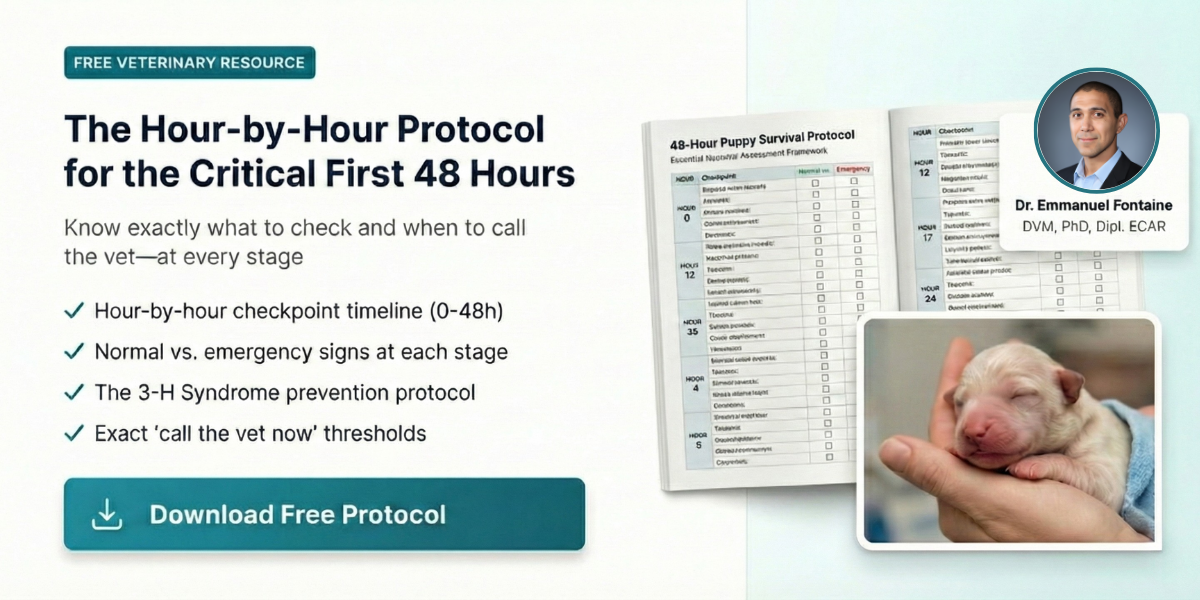
#33 Time is of the essence when dealing with Fading Puppy Syndrome. This is why it is important to identify those newborn puppies that are at risk as early as possible. I have detailed the protocol I am recommending in my free ebook on canine neonatology, you can access it here if you are interested.
Addressing Fading Puppy Syndrome
#34 Immediate intervention can be the difference between life and death. Two immediate imperatives: fortify with energy and optimize their environment.
#35 Spot an at-risk puppy? Act immediately! For those, bottle-feeding isn’t a mere supplement; it’s a vital energy conduit, and that even when the puppy is nursing naturally. That is why a quality canine milk replacer is a must-have in your maternity.
#36 I insist: it is a quality canine milk replacer that you need. Goat’s milk is NOT a recommended alternative.
#37 Bottle-feeding? Master the basics. Puppies aren’t human babies; so positioning is paramount here. And steer clear of the dreaded ‘recomposition mistake’—a common pitfall leading to constipation and/or diarrhea in newborn puppies. I cover all these in this blog if you want to learn more about this topic.
#38 For optimal environmental conditions, temperature takes the lead. Aim for 30°C (86°F) in the nest during week one, 28°C (82.4°F) in week two, and 25°C (77°F) in week three post-birth. Remember, this is for the nest, not the room—otherwise, the mother might abandon due to excessive heat.
#39 In the nest’s microclimate, humidity is king. The golden standard? 55±10%.
#40 Equip your maternity with a compact weather station to guarantee these conditions are consistently achieved.
#41 Here is something I often hear: “Nature can be both nurturing and ruthless. In some instances, mother dogs might instinctively abandon a puppy affected by Fading Puppy Syndrome. This behavior is a natural instinct, allowing the mother to focus her energies on the healthier offspring.” From where I stand, that’s a skewed perception. Mothers typically forsake cold puppies… So prioritize their environment, elevate their warmth, and, in my observations, it’s a game-changer here!
#42 Identify a vulnerable pup? Act on these measures and watch for a turnaround in a day. No signs of recovery? Rush to veterinary assistance. Every moment counts, and immediate intervention is paramount!
Fading Puppy Syndrome looms large in the realm of dog breeding, often casting a shadow of uncertainty.
Yet, clarity is within reach: it’s NOT a singular disease but a multifaceted condition.
Unravel its cause, and you’re instantly empowered to confront it.
Good news is: today, our arsenal of knowledge in this domain is unparalleled.
With actionable steps for at-risk puppies and a blend of awareness, expertise, and timely intervention, professionals can dismantle the threats of Fading Puppy Syndrome.
And therefore, crafting a safer world for each puppy birthed.

 DR. EMMANUEL FONTAINE