🇫🇷 Lire en Français | 🇪🇸Leer en Español | 🇧🇷Leia em português
Spaying (=standard spay surgery procedure) involves the removal of a female cat’s reproductive organs.
It is certainly the surgical procedure I performed the most during my days in clinic.
While between 77-91% of pet cats in the U.S. undergo this operation, this figure can be misleading.
Most domesticated cats are spayed or neutered, but feral or community cats—such as those in barn settings—have alarmingly low rates of these procedures, making the importance of spaying and neutering in pet health evident.
And this morning, I’ve uncovered a pioneering approach to feline spaying, indicating a potential transition from the traditional surgical methods to innovative medical alternatives.

What is thIS Spay Surgery Procedure?
Simply put, spaying is a medical procedure to sterilize female cats, ensuring they cannot reproduce.
In our veterinary clinics today, spaying is essentially a surgery.
And there are two surgical techniques to remember here.
Ovariohysterectomy
This procedure involves the removal of both the ovaries and the uterus.
It is the technique that is predominantly performed in North America.
Ovariectomy
In contrast, many parts of the world, especially Europe, favor the ovariectomy technique. This procedure focuses solely on the removal of the ovaries.
The rationale behind this technique hinges on the biological fact that without the hormones, especially progesterone produced by the ovaries, gestation becomes impossible.
I often hear that the uterus should be removed to mitigate reproductive disorders. One such disorder is pyometra, an infection of the uterus that can become life-threatening if not treated promptly.
However, it’s worth noting that disorders like pyometra are primarily instigated by the hormone progesterone. Therefore, by just performing an ovariectomy, the risks associated with progesterone-induced disorders are effectively curtailed.
Ovariohysterectomy vs. Ovariectomy?
In my opinion, at the end oft he day, the choice between the two procedures largely rests on a surgeon’s preference and proficiency with the chosen technique.
When we look at the scientific literature, it is good to note though that studies have highlighted that the “winner” here is actually… ovariectomy!
Notably, cats undergoing ovariectomy often experience reduced pain and enjoy a swifter recovery time in comparison to their ovariohysterectomy counterparts.
Again, in the end it is essentially the decision of the surgeon, but I always find it is good to know that both techniques can help achieve similar results (and as you probably guessed, I do have a favourite :)).
Learn more on “the rule of diestrus”, an important consideration when it comes to spaying females HERE
Exploring Medical Alternatives to Traditional Spaying
And it is good to know that surgical methods aren’t the only avenue.
There exist medical alternatives such as the use of GnRH agonist implants and melatonin implants.
However, it’s crucial to highlight that these methods provide only a transient effect on fertility; eventually, fertility does return.
While melatonin implants have a short-term impact and may primarily benefit cat breeders, GnRH agonist implants present a more extended, sometimes multi-year, respite from estrus behavior.
This prolonged effect can be maintained through subsequent implant administrations.
There is a comprehensive body of literature that sheds light on the usage and effectiveness of these implants in felines.
And here is where things get interesting: there is a noteworthy update in the field of feline contraception: the potential emergence of gene therapy as an alternative.
A recent article introduced me to AAV9-fcMISv2, a gene transfer construct.
Administered through intra-muscular injection, this construct is exhibiting promising results in the preliminary stages of research, possibly heralding a new age in feline population control methods.


The Indisputable ADVANTAGES of Spaying Female Cats
Historically, the benefits of spaying and neutering cats were emphasized primarily for medical reasons, and this viewpoint remains steadfast for a plethora of reasons:
Prevention of Mammary Cancer
One of the most compelling reasons to spay female cats lies in the prevention of mammary cancer.
These tumours rank among the top causes of cancer in unaltered cats. They are a significant reproductive disorder to consider!
From my personal experiences when I was doing consultations at the vet school in Paris, I’ve witnessed their aggressive nature… and it is not pretty for sure.
The outlook for affected felines is often bleak, painting a distressing picture of the potential consequences of neglecting this preventive measure.
Behavioral Improvements
A tangible change observed post-spay surgery procedure is the improvement in feline behaviour.
The inclination to roam diminishes significantly, reducing the risks associated with wandering, such as accidents or fights.
Moreover, the overt signs of estrus, or being ‘in heat’, disappear.
Fun Fact: Did you know that a female cat in season can rival the decibel levels of busy city traffic with her persistent vocalizations? If you want to sleep peacefully, quite a good reason to consider spaying I think. 🙂
Augmented Life Expectancy
A recent study I stumbled upon revealed a staggering fact about feline longevity.
Cats that undergo the spaying or neutering procedure tend to live nearly 10 times longer than their unaltered counterparts!
This significant increase in lifespan is a testament to the health benefits conferred by the procedure.
When we take all this into consideration, if a cat isn’t intended for breeding, the decision to spay or neuter is a no-brainer I think.
Beyond just the immediate medical and behavioral benefits, the overarching impact on the cat’s quality of life and longevity makes the case overwhelmingly clear.
Of course, as with any medical intervention, it’s crucial to remember that there are always two sides to every story.
Spaying offers undeniable advantages… but there are also side effects and potential drawbacks that warrant consideration and understanding.

Potential Risks and Side Effects of Spaying
While spaying and neutering are widely endorsed for their numerous benefits, it’s equally important to understand potential complications associated with these procedures:
Weight Gain
Historically, this was the primary concern post-spaying; and this was the one I’d discuss with my clients for sure.
Definitely something that we should keep in mind as the number of overweight and obese cats is sky-rocketing!
However, it’s important to note that spaying doesn’t directly cause weight gain.
Instead, it establishes conditions conducive to it.
Post-surgery, cats tend to increase their food intake by approximately 20%, while simultaneously experiencing a decrease in their daily energy needs by around 30%.
Coupled with some studies highlighting a reduction in physical activity by up to 52%, these factors create a perfect storm for weight accumulation as you can imagine!
Alterations in LH Concentration
Luteinizing hormone (LH) is a critical component in the reproductive system. It is produced by the brain and its secretion is influenced by the presence of the ovaries.
Remove them by spaying the animal, and those feedback mechanisms are impaired obviously.
Therefore post-spaying, there’s an increase in the concentration of LH.
And something to know here: elevated LH levels have been associated with certain disorders in dogs, especially tumours.
Same in cats? We don’t know for sure… [I’ve delved deeper into this in another blog, which you can explore here].
Cancer Concerns
This is something we discuss A LOT in dogs these days…
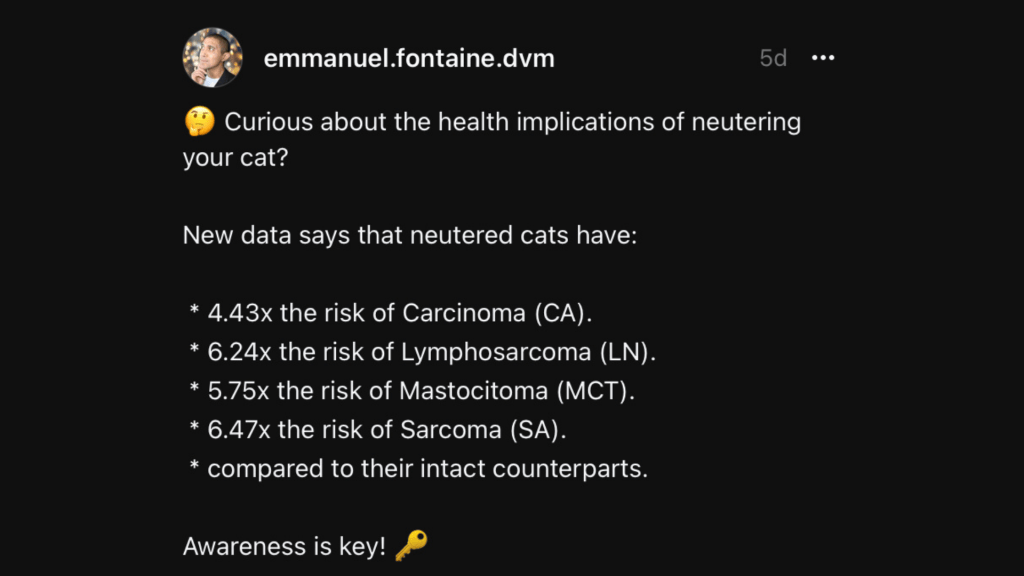
And recent data presented at a european veterinary reproduction conference has sparked interesting discussions about whether spaying might elevate the risk of specific cancers in cats as well actually.
While this connection is not definitively established, the possibility merits consideration.
Microbiome and Growth Impact
Spaying and neutering have also been shown to affect the gut microbiome, although the exact implications of these changes are still not clear.
Additionally, alterations in growth speed post-surgery have been observed. Kittens spayed will grow faster and gain more weigh than their entire counterparts for sure!
In summary, while the benefits of spaying and neutering are robust, it’s essential to be informed about potential risks and side effects.
And this is where I think this emerging gene therapy technique could bring a a transformative shift to feline population control in the near future.

AAV9-fcMISv2: The Forefront of Feline Contraception?
The realm of feline contraception is buzzing with an innovative revelation: AAV9-fcMISv2.

After reading this recently published paper, it’s evident that we stand on the brink of revolutionizing the conventional norms of spaying and neutering.
We are not there yet- but we are getting VERY close to it!
How does AAV9-fcMISv2 work?
The mechanism of action of this gene construct is centred around the Anti-Mullerian Hormone (aka AMH).
And AMH has been gaining traction within the circles of dog and cat reproduction. I have seen it mentioned in several studies and reports.
We use it for ovarian-remnant syndrome cases, but it is believed also to be useful as a marker for fertility and even potential diseases.
However, with the introduction of AAV9-fcMISv2, its potential is ascending to new heights.
An Innovative Mechanism
By inducing elevated AMH protein levels in the bloodstream, this technique is heralding uncharted territories in feline contraception.
And this where the magic happens so to speak.
Unlike some contraceptives, it neither suppresses comprehensive follicular activity nor nullifies reproductive behavior… This simply means that certain females will STILL exhibit heat behaviour AND accept mating.
I told you it wasn’t perfect (yet!)… but wait, there is much more here!
Instead, these elevated AMH levels proficiently prevent ovulation (so no gestation)… and the authors believe there are additional advantages here.
By preventing ovulation, you prevent progesterone secretion in females – so this is a potential defense against disorders linked to progesterone, like pyometra we mentioned earlier actually.
AND at the same time, you maintain the ovaries and a certain level of estrogens – which might help prevent some of the hormone-related side-effects we see with the current approach of spaying.
Of course, there is still a lot to learn… but I find this fascinating… because this is a radically different approach than what we have seen in the past for sure.
Visualize a world where a single, non-surgical dose of this gene construct promises multi-year prevention from pregnancies… without any health repercussions.
That is precisely the horizon AAV9-fcMISv2 gene therapy beckons.
Its potential to streamline contraception across veterinary clinics, shelters, and animal control initiatives is boundless… It could be a real game changer here.
We will see what the future brings… but I am hopeful, they are moving fast on this and as I said the first results are promising!
No doubt: the future of feline contraception is full of promises!

 DR. EMMANUEL FONTAINE