
🇫🇷 Lire en Français | 🇪🇸Leer en Español | 🇧🇷Leia em português
When I first embarked on my journey in the field of canine neonatology, I remember the common belief that shadowed those early days: bacterial infections were seen as THE predominant challenge in the neonatal period of puppies (for those unfamiliar, this is the critical phase stretching from birth to weaning). However, as years rolled by and experience deepened my understanding, a different picture started to emerge. While it’s true that bacterial infections pose a significant risk, I discovered that the challenges faced by newborn puppies often stem more frequently from aspects… of husbandry! And among these, a pivotal element, for sure, is clearly temperature!
- The Ideal Temperature Range for Newborn Puppies
- Newborn Puppy Temperature Control: Best Practices
- Temperature Monitoring
- How to Confirm It is The Optimal Temperature
- Nutrition for Newborn Puppies: The Impact of Temperature
- Signs of Temperature Stress in Newborn Puppies
Welcoming newborn puppies into the world is a delightful yet challenging experience. It demands careful attention and knowledge – which is probably why you ventured here! Puppies, in the first 3 weeks after birth, are extremely delicate and require a stable and nurturing environment to thrive. A key aspect of newborn puppy care revolves around maintaining an appropriate temperature. So this guide aims to provide essential insights into creating an optimal environment for newborn puppies, focusing on this critical element. And as we dive into this topic, we will explore a range of considerations from the ideal temperature range to monitoring techniques, ensuring your furry little ones receive the best possible start in life.
The Ideal Temperature Range for Newborn Puppies
Understanding the ideal temperature range for newborn puppies is crucial… because these little beings are HIGHLY predisposed to hypothermia! In the presentations I give on newborn puppy care, I talk about an entity I call the “3-H syndrome” – something I believe we should focus on more than the “famous” Fading Puppy Syndrome actually!
One thing you MUST remember:
Newborn Puppies Can NOT regulate their internal temperature during the first 3 weeks after birth.
This is very different from adult dogs. If adults are cold, they shiver… and this reflex helps increase their body temperature. Newborn puppies cannot do this. If they are cold, and nothing special is done to reverse the situation, well… they WILL get colder.
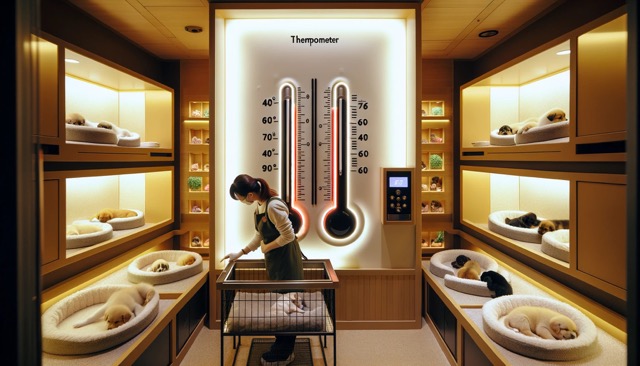
First take-away: if you breed dogs, in your maternity, you MUST have a thermometer. Because your newborn puppies’ temperature is definitely something you should monitor.
| 👉🏽 To ensure accurate temperature monitoring, I recommend using a pediatric digital thermometer like this one or an infrared thermometer like this one for a non-invasive option. Both are fast, reliable, and essential for tracking a newborn puppy’s health. |
And also, you need to know how to interpret those measures. Because newborn puppies temperature is DIFFERENT from what we observe in adults.
At birth, newborn puppies internal temperature is indeed 35°C (95°F). Quite different from the 38-39°C (100-102°F) we find in adult dogs, right?
This temperature progressively increases during the neonatal period and is similar to adults’ at 3 weeks of age. The table below will give you all the info you need (and much more!) in this regard!
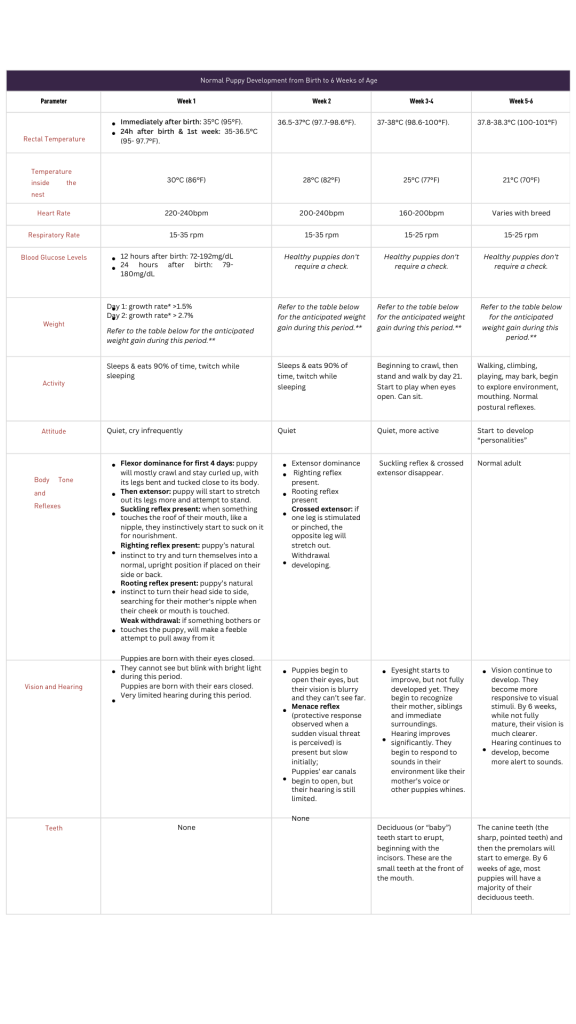
One key element to control here is therefore the temperature of the environment in which the puppies are kept.
These are the recommendations I typically give in this regard:
- 1st week after birth: 30°C (86°F)
- 2nd week after birth: 28°C (82°F)
- 3rd week after birth: 25°C (77°F)
After 3 weeks, a temperature of 21°C (70°F) is going to be enough.
Keep in mind these are the temperatures we should see in the nest, not in the maternity room! The maternity room should stay around 21°C (70°F).
This range is vital as newborn puppies lack the ability to generate their own body heat as we said earlier. The warmth in this temperature bracket mimics the comforting embrace of their mother. By maintaining this ideal temperature range, dog breeders and pet owners can significantly enhance the survival rate and health of newborn puppies.
| 👉🏽Maintaining the ideal temperature for newborn puppies is crucial for their survival and well-being. There are different options available, including a heating lamp for evenly distributed warmth (like this one), a heating pad with adjustable settings for targeted heat (like this one), or a pediatric incubator, which offers precise temperature and humidity control (like this one). Choosing the right option depends on your needs, but each plays a vital role in keeping your puppies warm and healthy. |
Newborn Puppy Temperature Control: Best Practices
After reading the first section of our blog, it must be clear now in your head: ensuring optimal temperature control for newborn puppies is a best practice that cannot be overstated. And the process begins right from the moment puppies are born!
Initially, the whelping box or nest where the puppies are kept should be heated at around 30°C (86°F). And as puppies grow older, and as their ability to regulate their body temperature gradually improves, we gradually decrease this temperature, as mentioned in the previous section.
First, you need to set up this temperature… and for that you have different options available.
Heat Lamps
Some people may consider heat lamps a bit old-fashioned, but to me, they remain my absolute favorites to this day. They are indeed simple and efficient, and they represent a cost-effective solution… which is exactly what dog breeders and pet owners need here.
Look for “heat lamps for chicken coops” – they work great in dog maternities – and you will find tons of options to choose from.

The 3 types that I’d recommend:
Smart Temperature Control heat lamps like this one
In our homes, smart devices have become the norm, and now they’re making a big impact in canine maternities, which I think is fantastic!
What I like with these options:
- They function like your typical heat lamp, but with the added benefit of being able to set the desired temperature for the environment. This feature alone makes them my top choice.
- Additionally, most come with built-in safety features to reduce the risk of fires, an essential consideration in my view.
What I don’t like:
- Some can be noisy, and I would avoid using one that’s too loud as it could stress the newborn puppies during a critical developmental period.
Radiant Heater like this one:
What I like with these options:
- They can be hung above the whelping box and provide heat over a larger area compared to classic heat lamps.
- Many offer various temperature settings for greater customization and can be controlled via a remote – a feature that I, as a tech enthusiast, really appreciate.
- They also have safety features like automatic shut-off to help prevent fires, which is a must-have.
What I don’t like:
- I haven’t yet found one that allows you to precisely control the environmental temperature; typically, you can only adjust the heater’s temperature and then need to check if it achieves the desired temperature in the surrounding area.
- Also, while some come with all the necessary cords and materials for installation above the whelping box, others do not, so that’s something to verify.
“Classic” Heat Lamps like this one
These are the ones I used for years until new options become available.
What I like with these options:
- They are the most affordable and have proven effective over time.
What I don’t like:
- They pose a risk of fire, so they require careful monitoring.
- Additionally, they don’t offer the option to set a specific temperature; you have to adjust their height to achieve the right temperature in the nest and change this as the puppies grow.
Heating Pads
A heating pad is a device designed to provide consistent, gentle warmth, and when placed in a whelping box, it can be an invaluable tool for supporting newborn puppies. It can indeed maintain a steady, comfortable temperature… and as we wrote earlier, this is crucial for their survival and healthy development in those early, vulnerable days of life.
Here again, there are plenty of heating pads you can choose from, but if I were to pick one, it would like one of those.

What I like about this option:
- It’s not only cozy but also waterproof and easy to clean and disinfect, which is crucial. Maintaining a clean environment in the whelping box is vital for the health of newborn puppies, so this feature is particularly important.
- Additionally, these come in various sizes, allowing you to choose the right fit for your breed.
What I don’t like:
- Unfortunately, you cannot set a specific temperature, a feature available in some other mats. However, those mats are often not as easy to clean and disinfect.
- Also, there’s always a concern about the mother chewing on the electric cord. Thankfully, most mats nowadays include safety features to prevent or at least mitigate this risk. Nonetheless, I believe they still require careful monitoring.
Incubators
An incubator for newborn puppies is a specialized device designed to create a controlled, stable temperature environment. It is a great tool for keeping these vulnerable young animals warm and promoting their healthy development in their earliest days.
This is something I’d like to see in EVERY canine maternity, there is no doubt it brings significant benefits. It used to be a challenge to have one, especially because of the financial considerations involved in it. But these days, there are plenty of options available actually!
This incubator is my top choice; it encompasses all the features desirable in a veterinary clinic, and I’ve even observed its use in some kennels! Although it comes with a considerable price, it ticks all the boxes for what I need:
- Precise control over both temperature and humidity
- The capability to connect a nebulizer and oxygen supply
- Sufficiently spacious to accommodate an entire litter
- Easy to clean and disinfect

Price can be a rightful concern obviously, and today there are other options that are available at a lower cost actually, like this one for instance. However, those have some limitations here compared to “traditional” incubators.
This model does offer temperature control through a heating pad, although my thoughts on that method are mixed (as previously discussed). However, it lacks the ability to precisely manage humidity, which is a crucial feature I seek in an incubator. In fact, this precise humidity control is what, in my opinion, sets it apart and makes it superior to the other methods I’ve mentioned before.
Keep in mind that incubators aren’t my go-to for everyday temperature management in a canine maternity; I primarily use them immediately after birth. This is when puppies transition from their mother’s warm womb to the cooler external environment, experiencing their most significant drop in temperature. I also use them for warming up puppies suffering from hypothermia (I’ll elaborate on this later). However, for “routine” temperature control, my preference leans towards heat lamps and/or heating pads.
| 👉🏽Maintaining the ideal temperature for newborn puppies is crucial for their survival and well-being. There are different options available, including a heating lamp for evenly distributed warmth (like this one), a heating pad with adjustable settings for targeted heat (like this one), or a pediatric incubator, which offers precise temperature and humidity control (like this one). Choosing the right option depends on your needs, but each plays a vital role in keeping your puppies warm and healthy. |
Temperature Monitoring
Monitoring and maintaining this temperature is as important as setting it.
I would always recommend to proceed like this:
1st: Choose the device you’ll use to maintain the correct temperature in the whelping box.
2nd: Conduct a test run before the whelping occurs to ensure you know the proper positioning and usage needed to achieve the desired temperature. Ideally, this should be done 1-2 weeks before the expected parturition.
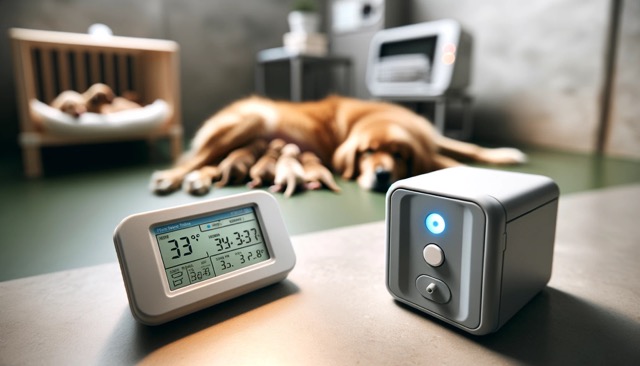
3rd: For this process, I suggest having a simple weather station handy. It doesn’t have to be anything elaborate; just something capable of monitoring both temperature and humidity levels in the environment.
Indeed, effective environmental control always involves considering humidity alongside temperature.
It’s important to remember that in kennels and maternities, the ideal humidity level is around 55% ± 10%.
If the humidity drops below this range, there’s an increased risk of dehydration, which is particularly concerning given that newborn puppies are composed of 82% water. Conversely, higher humidity levels can escalate the risk of bacterial growth and subsequent infections. So, in my view, regulating humidity is just as crucial as temperature control here!
How to Confirm It is The Optimal Temperature
As we discussed in the previous section, closely monitoring and maintaining the optimal temperature for newborn puppies is a critical aspect of their care. It’s essential to have kind of a strategy in place for regular temperature checks throughout the first three weeks of life of the puppies.
As mentioned earlier, I think this is where smart devices come in handy, but it means you should still have this weather station I mentioned as well somewhere need to do a quick check at least daily.
And you need to monitor the environment for sure… but you also need to monitor the puppies!
Don’t worry – I am not going to recommend you take their temperature several times a day, every day until the end of the 3rd week. However, based on recent studies, I definitely recommend you take it at least 3 times: at 12, 24 and 48h after birth actually. Those are the 3 crucial “temperature checkpoints” you need to integrate into your newborn puppy care protocols for sure.
Indeed, if puppies are found below 36°C (96.8°F) – at those 3 times, they are considered at significant higher risk for neonatal mortality. And measures will need to be taken there (check my blog on newborn puppy care to find out what should be done here).
Remember, the temperatures I’ve mentioned for newborn puppies are all rectal temperatures. I recommend taking their temperatures this way; as long as it’s done gently, the procedure will not harm them. I’ve been doing this for many years and never had a problem to date.
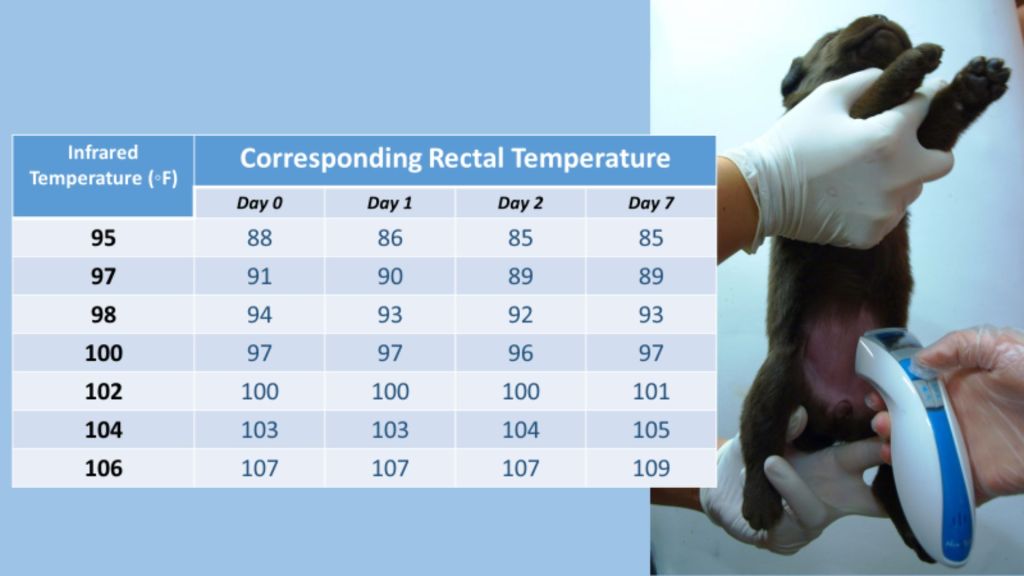
Some of you may opt to use an infrared thermometer instead. However, it’s important to note that temperatures taken with this method should be interpreted differently. To translate infrared temperature readings to the rectal measurements I’ve discussed, refer to the table below. Also, ensure you use the infrared thermometer as demonstrated in the accompanying picture.

Also observe the newborn puppies: signs of temperature stress in puppies can include excessive whining, lethargy, or reluctance to feed. On the other hand, a comfortable litter of puppies will be quiet, sleep peacefully, and have a good appetite.
Nutrition for Newborn Puppies: The Impact of Temperature
Feeding and providing proper nutrition for newborn puppies is integral to their growth and health. In the first few weeks of life, puppies primarily rely on their mother’s milk; and it’s important to ensure that the nursing dog is well-fed and hydrated, as her diet directly impacts the quality of her milk.
And here’s a key point to remember: a newborn puppy’s body temperature can significantly affect its nursing ability.
This is a crucial tip I always emphasize in my lectures:
If you find that a newborn puppy is struggling, the first step is to check its temperature.
That’s right – temperature comes first. Many might assume that the puppy needs immediate bottle-feeding, thinking it’s too weak to nurse properly from its mother. However, it’s essential to understand the link between temperature and nutrition in newborns.
When a newborn puppy’s body temperature falls below 34°C (93.2°F), it loses its ability to digest. Bottle-feeding under these circumstances means the milk would just sit in the stomach, potentially leading to bloating and the risk of false aspiration, which is dangerous.
Moreover, a critical point to note is that the suckling reflex, usually present in newborns, disappears when their body temperature drops below 32°C (89.6°F). So, if you’re only checking for this reflex and think bottle-feeding is safe, you could be making a mistake.
Therefore, always check a newborn puppy’s body temperature before considering bottle-feeding.
You see, newborn puppy nutrition isn’t just about feeding; it’s also about creating the right environment for feeding. The temperature plays a significant role here, as puppies need to be warm to digest their food properly.
For more information on nutrition in newborn puppies, read the following 2 blogs:
Why Goat Milk is No More a Valuable Alternative for Newborn Puppies
Puppy & Kitten Bottle Feeding: The Essentials
| 👉🏽One essential tool to have on hand to prevent the 3H syndrome (hypoxia, hypothermia, hypoglycemia) in puppies is a high-quality milk replacer, ensuring they receive proper nutrition and energy support. Here is the milk replacer I recommend. It is also available through a professional program. Learn more about options in the USA and Canada. |

If you encounter a puppy in a state of hypothermia, it’s crucial to warm it up before attempting bottle feeding, and this process must be done gradually. The puppy should be gently warmed for about 1 to 1.5 hours before you even consider feeding it. This is where the incubators previously discussed can be incredibly useful.
However, it’s important to be patient and not rush this process. Sometimes, there’s a tendency to quickly warm the puppy for just 10 minutes and then start bottle feeding, but this is not effective. The digestive system of a hypothermic puppy needs time to recover and function properly again, so allow at least an hour to an hour and a half of gradual warming before trying to bottle feed. This patience is essential for the puppy’s health and recovery.
Signs of Temperature Stress in Newborn Puppies
Recognizing the signs of temperature stress in newborn puppies is essential for their survival and well-being. As you understand now, puppies are particularly vulnerable to temperature fluctuations during their first few weeks.
Here are key indicators of temperature stress:
Whining and Restlessness: Continuous whining or restlessness can be a sign of discomfort. It often indicates that the puppies are either too cold or too hot.
Lethargy: If puppies are lethargic or less responsive, this could be a sign of overheating or hypothermia.
Huddling or Spreading Out: Observe the puppies’ sleeping patterns. If they are constantly huddled together, they may be cold. Conversely, if they are spread out and avoiding contact with each other or the heat source, they may be too warm.
Refusal to Feed: Puppies who are experiencing temperature stress may refuse to nurse or have difficulty feeding.
Changes in Skin Color: Extremely pale or blue-tinged skin can indicate a serious problem, sometimes related to cold stress.
Irregular Breathing: Rapid, shallow breathing or, conversely, slow, labored breathing can be signs of temperature stress.
If any of these signs are observed, immediate action should be taken to adjust the temperature and consult a veterinarian if necessary.
And you understand why regular monitoring and maintaining an optimal environment can prevent these issues and ensure the healthy growth of newborn puppies.
The care of newborn puppies is a delicate task that requires vigilance, knowledge, and compassion. The key to successfully raising healthy puppies lies in maintaining an optimal environment, especially regarding temperature control. I hope you now understand how critical this parameter actually is! By keeping the whelping area within the recommended temperature range and gradually adjusting it as the puppies grow, you provide them with the necessary warmth they need for their development. And this will make a big difference for sure!

 DR. EMMANUEL FONTAINE