🇫🇷 Lire en Français | 🇪🇸Leer en Español | 🇧🇷Leia em português
Imagine you have a three-year-old Doberman on day nine of her estrous cycle. Traditional day-counting says she should be ready to breed. But instead of guessing, you run a serum progesterone test and find her levels sitting at just 2.5 ng/mL — nowhere near ovulation. You wait, retest on day eleven, and her progesterone has spiked to 6.8 ng/mL, confirming ovulation has just occurred. Your vet advises insemination on day thirteen. The result? A healthy litter of nine puppies.
This scenario shows exactly why progesterone testing for dogs has replaced the guesswork of calendar-based breeding. Canine ovulation timing is not about landing on a single magic number. It is about reading a trend — a rising hormone curve that tells you precisely where your dog stands in her fertile window. In this article, you will learn how to interpret that curve, what tools you need, and which warning signs to watch for along the way.
- TL;DR: Key Takeaways
- What Should You Know About the Ovulation Timeline?
- What Should You Do to Time Breeding Accurately?
- What Warning Signs Should You Watch For?
- You Have the Tools — Now Trust the Process
TL;DR: Key Takeaways
- Progesterone testing for dogs works best as a trend — serial blood draws every two to three days reveal the LH surge and pinpoint ovulation far more accurately than a single snapshot.
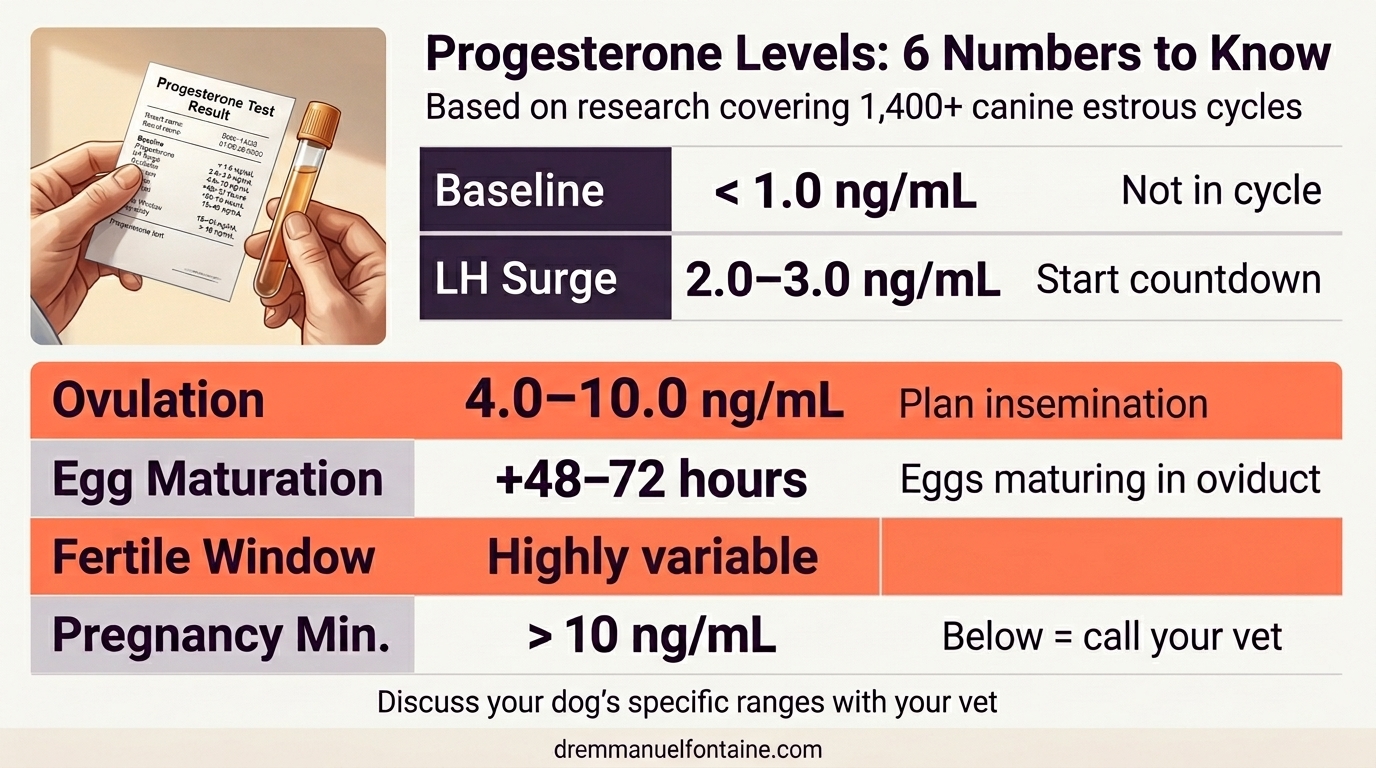
- Ovulation in dogs occurs roughly 48 to 72 hours after the LH surge, when progesterone reaches approximately 4.0 to 10.0 ng/mL.
- Dogs ovulate immature eggs that need an additional 48 to 72 hours to mature inside the oviduct, making the true fertile window four to six days after the LH surge.
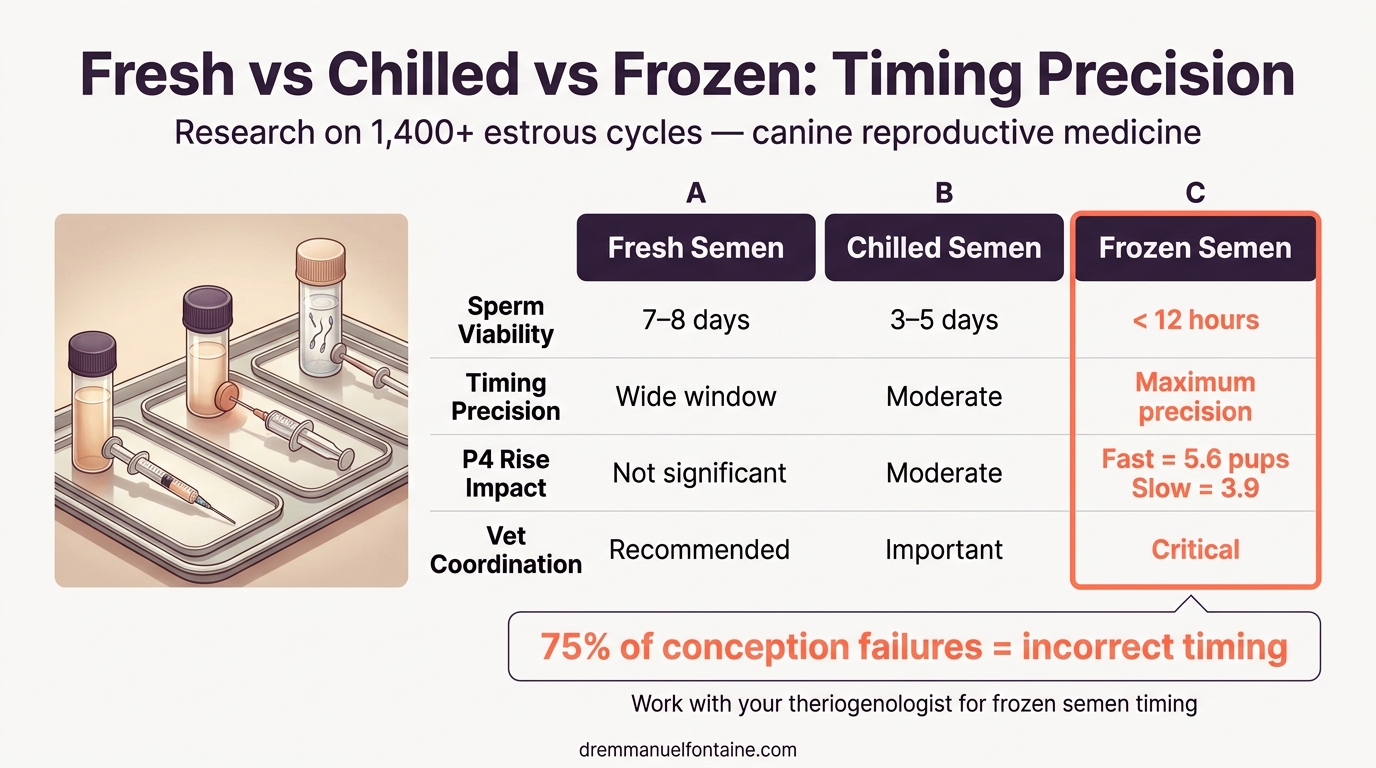
- The rate of progesterone rise matters — research on over 1,400 cycles showed that a slow rise with frozen semen resulted in an average of 3.9 puppies versus 5.6 with a fast rise.
- Fresh semen can survive up to seven to eight days in the reproductive tract, but frozen semen lasts fewer than 12 hours — making precise ovulation timing essential.
- Vaginal cytology, when combined with serial progesterone testing, gives your vet or theriogenologist (reproductive specialist) the most complete picture for breeding decisions.
- Up to 75% of conception failures are caused by incorrect timing — not true infertility.
What Should You Know About the Ovulation Timeline?
The Four Phases of the Canine Estrous Cycle
The canine reproductive cycle has four distinct stages: proestrus, estrus, diestrus, and anestrus. Dogs are monoestrous, meaning they typically cycle only once or twice a year, with an average gap of about seven months between heat cycles (though this can range from 4.5 to 13 months). Think of each cycle like a single seasonal window — miss it, and you wait many months for the next one.
One of the most important things happening before ovulation is called preovulatory luteinization. In plain language, this means the ovaries start producing progesterone while your dog is still in proestrus and estrus — before the eggs are even released. This early progesterone rise is exactly what makes serial progesterone testing for dogs so valuable. Your vet can track this gradual climb to predict exactly when ovulation is about to happen.
| Cycle Stage | What Happens | Duration |
|---|---|---|
| Proestrus | Vulvar swelling, bloody discharge, rising estrogen; males attracted but female refuses mating | Average 9 days (3–17 days) |
| Estrus | Female receptive; LH surge triggers ovulation; progesterone rises sharply | Average 9 days (3–21 days) |
| Diestrus | Corpus luteum (the hormone-producing structure on the ovary) maintains progesterone; lasts ~60–75 days whether pregnant or not | 60–75 days |
| Anestrus | Reproductive rest; progesterone at baseline; uterus recovers | Variable (months) |
How Hormones Drive the Ovulation Timeline
The transition from proestrus to estrus is driven by a peak in estrogen, followed by an immediate decline. This estrogen drop triggers a surge of luteinizing hormone (LH) — the biological starting gun for ovulation. Here is a fascinating detail from veterinary research: unlike most mammals that ovulate when estrogen is still climbing and progesterone is at its lowest, dogs ovulate when estrogen is falling and progesterone is already rising.
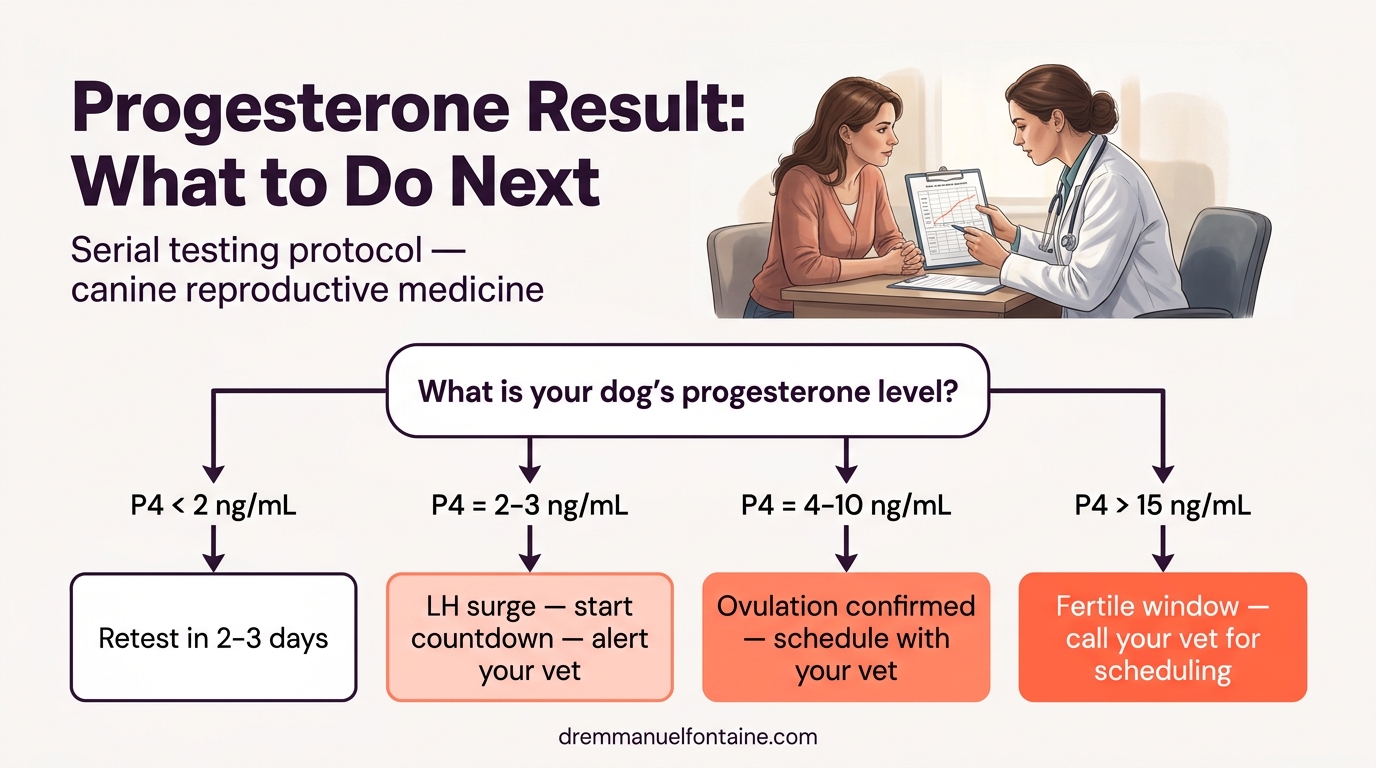
Your vet can track progesterone in blood samples to pinpoint the LH surge. At the LH surge, progesterone typically rises to about 2.0 to 3.0 ng/mL (a large-scale study found a mean of 2.7 ng/mL). Ovulation follows roughly 48 to 72 hours later, when progesterone reaches approximately 4.0 to 10.0 ng/mL (mean of 4.8 ng/mL at 48 hours post-LH). Think of progesterone like a rocket launch countdown — the LH surge is ignition, and ovulation is liftoff.
| Progesterone Level (ng/mL) | What It Means | What To Do |
|---|---|---|
| Less than 1.0–2.0 | Baseline — no ovulation activity yet | Retest in 2–3 days |
| 2.0–3.0 | LH surge detected — ovulation begins in 48–72 hours | Begin close monitoring; retest in 24–48 hours |
| 4.0–10.0 | Ovulation is occurring or just occurred | Work with your vet to schedule breeding |
| 15.0–40.0 | This just tells you the female has ovulated but you don’t know when. | Unfortunately just using these numbers is not accurate enough to determine the fertile window as there are huge variations between individuals. |
Why Dogs Are Unique: Immature Eggs and a Wide Fertile Window
Here is something that surprises many people when they first learn about canine reproduction. Dogs ovulate immature eggs (called primary oocytes) — eggs that are not ready to be fertilized right away. These eggs need an additional 48 to 72 hours of maturation inside the oviduct (the tube connecting the ovary to the uterus) before sperm can successfully fertilize them. Most other domestic mammals ovulate mature eggs that are immediately ready for fertilization. This unique canine trait is precisely why tracking the progesterone trend matters so much for timing breeding correctly.
The good news is that dogs have a uniquely wide fertile window — up to 11 days. Once matured, eggs remain viable for two to five days. Fresh canine sperm can survive in the reproductive tract for seven to eight days. Frozen semen, however, survives fewer than 12 hours, which is why precise timing with your vet becomes absolutely critical when using frozen semen. Another important detail: dogs are spontaneous ovulators (they ovulate on their own hormonal schedule), unlike cats, which are induced ovulators that require copulation to trigger their LH surge.
| Factor | Dogs | Most Other Mammals |
|---|---|---|
| Egg status at ovulation | Immature (primary oocyte) — needs 48–72 hours to mature in the oviduct | Mature (metaphase II) — immediately fertilizable |
| Ovulation trigger | Spontaneous (LH surge happens on its own) | Varies — some spontaneous, some induced by mating (cats) |
| Progesterone at ovulation | Already rising (4.0–10.0 ng/mL) | At baseline or near zero |
| Fresh sperm survival | 7–8 days | Varies; generally 1–5 days |
| Frozen semen survival | Less than 12 hours | Varies by species; generally 12–48 hours |
What Should You Do to Time Breeding Accurately?
Serial Progesterone Testing: Reading the Curve
The single most powerful tool for predicting ovulation in dogs is serial progesterone testing — not a one-time blood draw, but a series of tests every two to three days during your dog’s heat cycle. Ask your vet to begin progesterone testing as soon as you notice signs of proestrus (vulvar swelling, discharge). The first test establishes a baseline. Subsequent tests reveal the rise pattern.
A key insight from research on over 1,400 estrous cycles: the speed of progesterone rise directly affects litter size when using frozen semen. Dogs with a fast progesterone rise averaged 5.6 puppies, while those with a slow rise averaged just 3.9. This means tracking the trend is not just about finding ovulation — it actually helps predict reproductive outcomes. Work with your vet or theriogenologist to interpret the curve shape, not just the peak number.
| Step | What To Do | What Your Vet Is Looking For | Typical Timing |
|---|---|---|---|
| 1. Start testing | Ask your vet for the first blood draw when proestrus signs appear | Baseline progesterone (less than 1.0 ng/mL) | First days of visible heat signs |
| 2. Repeat every 2–3 days | Return for serial blood draws; keep a written log of each result | The upward trend — watching for the initial rise toward 2.0 ng/mL | Days 3–7 of heat |
| 3. Switch to daily testing | Once progesterone approaches 2.0 ng/mL, test every 24 hours | The LH surge (2.0–3.0 ng/mL) — ovulation countdown begins | Around days 7–11 |
| 4. Confirm ovulation | Continue daily testing until progesterone passes 5.0 ng/mL | Ovulation confirmed (4.0–10.0 ng/mL); egg maturation clock starts | 48–72 hours after LH surge |
| 5. Schedule breeding | Follow your vet’s insemination plan based on semen type and curve speed | Peak fertility window; assess fast vs. slow rise | 4–6 days after LH surge |
Combining Cytology With Progesterone for a Complete Picture
While serial progesterone testing is the gold standard, adding vaginal cytology gives your vet a second layer of confirmation. Cytology involves collecting cells from the vaginal wall and examining them under a microscope. As estrogen rises during proestrus, the vaginal cells change from small, round shapes to large, flat, cornified cells — like leaves drying and flattening in autumn.
When your vet sees peak cornification (the highest percentage of flat, mature cells), it confirms the estrogen peak that precedes the LH surge. Combined with rising progesterone levels, this gives a two-source confirmation of where your dog stands in the cycle. Ask your vet to perform cytology alongside the first few progesterone tests. This is especially helpful when behavioral signs are misleading — some dogs show receptive behavior days before or after their true fertile window.
| Diagnostic Tool | What It Measures | When It Helps Most | Limitation |
|---|---|---|---|
| Serial progesterone | Progesterone trend in blood | Pinpointing LH surge and ovulation | Requires multiple vet visits for blood draws |
| Vaginal cytology | Cell shape changes driven by estrogen | Confirming estrogen peak before LH surge | Does not directly detect ovulation timing |
| LH testing kits | Direct LH surge detection | Confirming the exact day of the LH surge | Short detection window; requires daily testing |
| Behavioral observation | Standing heat, flagging, receptivity | Initial screening to know when to start testing | Highly variable; does not reliably predict ovulation |
Timing Insemination Based on Semen Type
The type of semen used for breeding directly dictates how precisely you need to time insemination. As we discussed, dogs ovulate immature eggs that take 48 to 72 hours to mature. This delay is why the optimal breeding window is four to six days after the LH surge — when progesterone levels typically sit between 15 and 40 ng/mL.
For natural breeding or fresh semen artificial insemination, you have more flexibility because fresh sperm survives seven to eight days. Your vet may recommend two breedings spaced 48 hours apart. For fresh chilled semen, the window narrows because sperm viability drops. For frozen semen — and this is worth emphasizing because it is the single most time-sensitive scenario in canine breeding — sperm lasts fewer than 12 hours. As we noted, the rate of progesterone rise also influences outcomes with frozen semen. Work closely with your vet or theriogenologist to schedule frozen semen insemination at the precise moment of peak fertility. Remember: up to 75% of conception failures trace back to incorrect timing, not actual infertility.
| Semen Type | Sperm Survival Time | Timing Window | Recommended Approach |
|---|---|---|---|
| Natural mating / fresh semen | 7–8 days in the reproductive tract | Broad — breed 2–4 days after LH surge | Two matings 48 hours apart; work with your vet on timing |
| Fresh chilled semen | 3–5 days (reduced viability) | Moderate — breed 3–5 days after LH surge | Closer monitoring; your vet should confirm ovulation first |
| Frozen semen | Less than 12 hours | Narrow — inseminate 5–6 days after LH surge | Precise timing critical; theriogenologist involvement recommended |
What Warning Signs Should You Watch For?
Recognizing Progesterone Drops During Pregnancy
Once breeding is complete and pregnancy is confirmed, the progesterone story is not over. As we covered earlier, the corpus luteum continues producing progesterone for approximately 60 to 75 days. A healthy pregnancy requires progesterone to stay above roughly 10 ng/mL. If levels drop below this threshold prematurely, the condition is called hypoluteoidism (luteal insufficiency) — and it can lead to embryo resorption or abortion.
An early warning sign is a sudden decline of 10 to 15 ng/mL between days 20 and 35 of gestation. If progesterone falls below 10 ng/mL before day 55 to 60, your vet may recommend supplementation. One important detail: early embryonic death and resorption typically occur between days 28 and 36 of pregnancy, often with no outward clinical signs at all. This is why scheduling an ultrasound at day 28 to 30 is so valuable — your vet can confirm pregnancy, check for delayed embryonic development, and establish a baseline for fetal viability. Ask your vet to schedule serial progesterone checks every one to two weeks throughout pregnancy, especially if your dog has a history of unexplained pregnancy loss.
| Progesterone Level | Pregnancy Stage | Meaning | Action |
|---|---|---|---|
| Above 20.0 ng/mL | Days 10–30 | Healthy, normal range | Continue routine monitoring |
| Above 10 ng/mL | Days 30–45 | Acceptable but watch trend closely | Retest every 5–7 days |
| Below 10 ng/mL before day 55 | Mid-to-late pregnancy | Risk of pregnancy loss (hypoluteoidism) | Contact your vet immediately for supplementation evaluation |
| Below 2.0 ng/mL (premature) | Any point before day 60 | Critical — pregnancy cannot survive | Emergency vet intervention required |
| Below 2.0 ng/mL at term | Day 62–65 | Normal pre-whelping drop — labor within 24–48 hours | Prepare for whelping; monitor closely |
Distinguishing Normal Diestrus From Pseudopregnancy and Pyometra
Remember that all non-pregnant dogs go through a prolonged two-month luteal phase with elevated progesterone. This means every intact female experiences what veterinarians call physiological pseudopregnancy — a normal, mild hormonal state. However, some dogs develop clinical (overt) pseudopregnancy, an exaggerated condition with behavioral changes, nesting behavior, and mammary development or lactation. This happens when progesterone drops abnormally and a hormone called prolactin rises.
A more serious condition to watch for is pyometra — a life-threatening uterine infection. The extended two-month presence of progesterone naturally thickens the uterine lining and suppresses local immunity. This makes the uterus vulnerable to infection. Pyometra can mimic pregnancy due to abdominal enlargement and vaginal discharge, but it requires emergency veterinary treatment. If your dog shows signs of lethargy, fever, loss of appetite, vomiting, or abnormal vaginal discharge after her heat cycle, contact your vet immediately.
| Condition | Key Signs | Cause | What To Do |
|---|---|---|---|
| Normal diestrus | No outward symptoms; mild behavioral changes possible | Normal progesterone from corpus luteum (~60–75 days) | No action needed; routine observation |
| Physiological pseudopregnancy | Mild nesting, slight mammary changes | Normal hormonal decline in all intact non-pregnant females | Monitor; usually resolves on its own |
| Clinical (overt) pseudopregnancy | Exaggerated nesting, lactation, behavioral distress | Abnormal progesterone drop with elevated prolactin | Consult your vet — medical treatment may be needed |
| Pyometra | Lethargy, fever, vomiting, abnormal vaginal discharge, abdominal swelling | Bacterial infection of thickened, progesterone-primed uterus | Emergency — contact your vet immediately; surgery often required |
When Progesterone Supplementation Becomes Necessary — and When to Stop
If your vet determines that hypoluteoidism is threatening the pregnancy, progesterone supplementation may be recommended. The decision to supplement should only happen after infectious causes (such as Brucella canis and bacterial infections) have been ruled out.
Here is the critical safety point that is worth repeating: you must stop all progesterone supplementation two to three days before the estimated due date. Normal labor requires a progesterone drop below 2 ng/mL. If supplementation continues too long, the body cannot trigger labor, leading to prolonged gestation and fetal death. Your vet may also recommend monitoring rectal temperature two to three times daily starting around day 54 to 60 — the classic 1 °C (1.8 °F) temperature drop signals whelping will begin within 12 to 24 hours. If supplementation was accidentally extended, emergency intervention via cesarean section or antiprogestin medication (such as aglepristone) may be necessary.
| Supplementation Detail | Working Well | Red Flag — Contact Your Vet |
|---|---|---|
| Progesterone levels during treatment | Maintained at or above 10 ng/mL; clinical signs resolve | Levels continue dropping despite supplementation — may indicate infection or fetal death |
| Timing of supplementation start | After first trimester; infectious causes ruled out | Started during first trimester — risk of masculinizing female fetuses |
| Timing of supplementation stop | Discontinued 2–3 days before expected due date | Continued past due date — prevents natural labor; fetal death risk |
| Temperature monitoring near term | Temperature drop of ~1 °C (1.8 °F) signals labor within 12–24 hours | No temperature drop beyond expected due date — vet should evaluate for prolonged gestation |
Want to put all of this into action during your next breeding cycle? Inside the Breeder Vault, you’ll find the Canine Ovulation Timing Field Protocol — a printable monitoring checklist with decision trees, progesterone interpretation tables, emergency thresholds, and veterinary request scripts designed to be used in real time during your dog’s heat cycle. It’s the operational companion to everything you just learned.
You Have the Tools — Now Trust the Process
Predicting ovulation in dogs is not about finding one perfect progesterone number and building your entire breeding plan around it. It is about reading a story — the story your dog’s hormones are telling through a rising curve, confirmed by cytology, and interpreted alongside your veterinarian’s expertise. Serial progesterone testing for dogs, combined with vaginal cytology and a strong partnership with your vet or theriogenologist, gives you the power to transform breeding from guesswork into science.
You now understand how the LH surge sets the timeline, why immature eggs shift the fertile window, and how semen type dictates your timing precision. You know what equipment to keep on hand and which warning signs demand immediate attention. Most importantly, you know that your observations at home and your vet’s clinical expertise are two halves of the same team. Your dogs are counting on that team, and now you are ready.

 DR. EMMANUEL FONTAINE