
🇫🇷 Lire en Français | 🇪🇸Leer en Español | 🇧🇷Leia em português
When I first set foot on In North America, almost 13 years ago, I was introduced to an intriguing aspect of newborn puppy care – the use of Karo syrup. Back then, this was completely new to me, as it wasn’t something I had ever used or even heard of in Europe. So I did some research, and my initial unfamiliarity with Karo syrup gave way to a deeper understanding once I realized its connection to hypoglycemia – a common and dangerous condition I always mention in my talks on newborn puppy care. So in this blog, I aim to not only answer the question of “how much Karo syrup for a newborn puppy” (because I get this one quite a lot :)) but also to provide you with a comprehensive understanding of how to approach and manage hypoglycemia during the canine neonatal period. So, let’s embark on this journey together and explore how to integrate these aspects in your newborn puppy care protocols.
- What is Karo syrup?
- Understanding Hypoglycemia in Newborn Puppies
- How to Provide Energy to Newborn Puppies Requiring Extra Care
- Early Detection of Hypoglycemia in Newborn Puppies
- Preventive Measures for Hypoglycemia in Newborn Puppies
- The Importance of Monitoring and Managing Growth in Newborn Puppies
- Consulting a Veterinarian for Hypoglycemic Newborn Puppies
What is Karo syrup?

So, what exactly is Karo syrup? It’s a brand of light corn syrup, often used in cooking and baking for its ability to prevent crystallization and to soften the texture of food.
However, in the world of canine neonatology, Karo syrup serves a different purpose. It is frequently mentioned as a quick, readily available solution to address hypoglycemia in newborn puppies.
When we look into the nutritional makeup of Karo Syrup, it becomes fascinating to note that it’s composed purely… of carbohydrates! Now, this singular focus on carbs is particularly significant in the context of hypoglycemia management in newborn puppies. Why, you might ask? Well, carbohydrates are a quick and efficient energy source, which is exactly what a hypoglycemic puppy urgently needs.
Their little bodies require immediate energy to stabilize blood sugar levels, and the simple carbs in Karo Syrup provide just that – a rapid energy boost to counteract the dangers of low blood sugar.
And hypoglycemia, or low blood sugar, can have serious implications for these young canines if not promptly and properly addressed.
Grasping the true essence of Karo syrup marked a pivotal moment in my understanding of neonatal puppy care. Each time I encounter the query, ‘How much Karo syrup for a newborn puppy?’, it prompts me to think beyond the immediate question. It’s not just about the syrup’s dosage; it’s about framing the issue within a broader, more comprehensive perspective: How should we address hypoglycemia in newborn puppies?
This question isn’t just a query about a product; it’s a gateway to a deeper discussion on the critical aspect of managing a common health concern in these fragile early stages of a puppy’s life.
Understanding Hypoglycemia in Newborn Puppies

Hypoglycemia, or low blood sugar, is a condition that can significantly impact the health and survival of newborn puppies. It is part of this 3-H syndrome (Hypothermia, Hypoglycemia, Dehydration) that I always cover in my canine neonatology talks – because I believe it is a very common cause of neonatal mortality, probably more common than infectious diseases in my opinion. This condition arises due to various factors, each playing a crucial role in the puppy’s early life.
Impact of Maternal Nutrition During Gestation
One of the key determinants of a newborn puppy’s susceptibility to hypoglycemia is the mother’s diet during pregnancy.
In my previous blogs, I’ve extensively discussed the importance of proper nutrition for pregnant dogs.
The nutritional status of the mother directly influences the energy reserves of her puppies at birth. Ensuring that the pregnant female is adequately and appropriately fed during gestation is vital. A well-balanced diet, rich in essential nutrients, contributes significantly to the development of healthy puppies with adequate energy reserves.
| 👉🏽For the first part of gestation (0 to 42 days), this is the diet I recommend for small and large dogs. For the second part of gestation and throughout lactation, this is the diet I recommend for small, medium, large, and giant dogs. These nutritional solutions are also available through a professional program. Learn more about options in the USA and Canada. |
The Role of Litter Size
Litter size is another significant factor. Research has shown that in large litters, there’s a higher incidence of low birth weight puppies – up to 30% in some cases.
These puppies, due to their smaller size, have lower energy reserves and are more prone to developing hypoglycemia. This is a critical aspect to consider, especially when managing large litters.
Importance of Birth Weight
The birth weight of each puppy is a direct indicator of its risk for hypoglycemia. Low birth weight puppies are inherently predisposed to this condition.
This vulnerability arises from their inadequate energy stores, which are crucial for maintaining normal blood sugar levels. Monitoring the birth weights and growth progress of each puppy in a litter is essential for early identification of those at risk.
| 👉🏽It is crucial to weigh newborn puppies at birth and daily throughout the neonatal period (from birth to 3-4 weeks of age), as consistent weight monitoring is a key indicator of their health and development. I recommend starting with kitchen scales (like this one), but for serious accuracy, consider this lab-grade scale, perfect for tracking puppy weights up to 5kg. |
| 👉🏽Neonatal growth charts are an excellent tool to quickly identify puppies with low birth weight, helping breeders and veterinarians take early action. These charts include data from over 115 different puppy breeds. Download them here! |
Other Contributing Factors

Apart from these factors, there are additional aspects that can lead to hypoglycemia in newborn puppies.
These include:
- Poor lactation (or no milk production – aka agalactia) by the mother;
- Congenital defects like cleft palates for instance;
- Litter heterogeneity, where varying sizes of puppies in the same litter can lead to the larger ones outcompeting the smaller ones for nursing;
- Hypothermia and/or an environment that is too cold for the newborn;
- …
You see, given these varied factors, it becomes clear that preventing and managing hypoglycemia in newborn puppies requires a multifaceted approach. From ensuring the mother’s health during pregnancy to closely monitoring the puppies post-birth – each step is crucial in safeguarding the well-being of these young canines.
How to Provide Energy to Newborn Puppies Requiring Extra Care
When it comes to providing extra energy to newborn puppies, particularly those at risk of hypoglycemia, it’s crucial to think beyond just Karo syrup. The real question we should ask ourselves is: how do we bring extra energy to puppies that need it?
Karo syrup is indeed one option, but there are several other methods that can be equally effective.
Alternatives to Karo Syrup?
One alternative that’s often discussed is liver water. This is a homemade solution made by boiling liver in water, then using the nutrient-rich water to feed the puppies. It provides essential nutrients and energy in a form that’s easy for newborn puppies to digest.
However, now that you understand what liver water entails, it’s important for me to explain why it’s not my preferred option. From a bacteriological safety standpoint, homemade solutions like liver water can pose risks. Without proper sterilization techniques, there’s a potential for bacterial contamination, which could be harmful to vulnerable newborn puppies. Due to these safety considerations, liver water is not something I typically recommend for newborn puppy care.

I’d definitely prefer the following options then:
- Hypercaloric supplements : those typically contain energy AND amino-acids & vitamins; picture it as a “boosted” version of the Karo syrup we already presented;
- Puppy Milk Replacers: Milk replacers are my favorite option for energy supplementation in newborn puppies due to their balanced nutritional profile, which not only provides essential energy but also includes vital nutrients, vitamins, and minerals crucial for their overall growth and development.
| 👉🏽One essential tool to have on hand to prevent the 3H syndrome (hypoxia, hypothermia, hypoglycemia) in puppies is a high-quality milk replacer, ensuring they receive proper nutrition and energy support. Here is the milk replacer I recommend. It is also available through a professional program. Learn more about options in the USA and Canada. |
Insights from Recent Research
I recently came across a fascinating paper titled “Hypoglycaemia management with a hypercaloric supplementation in neonatal puppies delivered by caesarean section.” While the study focused on puppies born via C-section, the findings are applicable to all newborn puppies in my opinion.
And in this study, to provide energy supplementation to newborn puppies, a 10% glucose solution was used at a dosage of 0.5mL per 100g of body weight.
So I went to the Karo Syrup website… and did the math actually. 🙂 I wanted to find out how many mL of Karo syrup I should use to achieve this exact same posology that is published in the veterinary scientific literature.
Turns out… it is identical actually! From what I could gather, Karo syrup contains 10 grams of sugars per serving, which is comparable to the 10% glucose solution I previously mentioned.
Interesting fact: in this study, the glucose solution was administered to the newborn puppies… via tube feeding.
This method ensures that the glucose is directly delivered to the stomach, where it can be effectively utilized by the puppy’s body.
When it comes to tube feeding, I believe every dog breeder should be familiar with the technique.
It can come in quite handy, especially when dealing with hypoglycaemic newborn puppies. Definitely encourage you all to talk to your veterinarian about this.
Comparison of Energy-Providing Options
Interestingly, the study compared three different methods of providing energy to newborns:
1. This 10% glucose solution.
2. A hypercaloric supplement which as I said usually contains not just glucose but also vitamins and amino acids.

The results showed that all three methods were effective in providing the necessary energy.
However, if I had to choose as I wrote earlier, I’d lean towards using a milk replacer.
The reason is straightforward: milk replacers offer more than just energy. They contain a variety of nutrients that are beneficial for a newborn puppy’s growth – far more than what you’d find in a hypercaloric supplement. In essence, milk replacers support the overall growth and health of the puppy more comprehensively.
More information on the use of milk replacers in newborn puppies in my previous blogs:
Why Goat Milk is No More a Valuable Alternative for Newborn Puppies
Puppy & Kitten Bottle Feeding: The Essentials
Early Detection of Hypoglycemia in Newborn Puppies
The understanding and management of hypoglycemia in newborn puppies have evolved significantly over the years. There was a time when I viewed hypoglycemia primarily as a clinical disorder, diagnosable only when evident symptoms such as lethargy or seizures were observed in newborn puppies.
However, recent studies have highlighted that hypoglycemia can be more insidious than previously thought. In many cases, it goes undetected until it’s tragically too late.
The Insidious Nature of Hypoglycemia
Hypoglycemia can often fly under the radar, manifesting without any noticeable symptoms until the puppy’s condition becomes critical. This underscores the importance of proactive monitoring rather than waiting for clinical signs to appear.
The symptoms of hypoglycemia often overlap with those found in the dreaded “Fading Puppy Syndrome,” a condition I’ve discussed in several previous blogs. This similarity can make early detection challenging yet more crucial.

Utilizing Human Glucometers for Puppies
A game-changer in the approach to newborn puppy care has been the adaptation of human glucometers for veterinary use. This tool allows for the collection of a tiny drop of blood from a newborn puppy to evaluate its blood glucose level.

The process is analogous to how diabetic humans monitor their blood sugar: instead of pricking a finger, we prick the ear or the paw of the puppy. This small, simple act provides us with a drop of blood sufficient to assess the puppy’s glucose level.
I am often asked: which glucometer should be used there? And that’s a valuable question as there are plenty out there! Actually, I went back to the Material & Methods of the most recent publication on this topic… and here is the one they were actually using to get their results.
When to Test and What to Look For
The critical times for testing are at 12, 24, and 48 hours after birth.
But when should the results be a cause for concern? I’ve elaborated on this in a detailed Thread post that you can see below, which outlines the thresholds at which a newborn puppy is considered at risk for hypoglycemia. Understanding these levels is key to early detection and intervention.

The Importance of Early Detection
With the glucometer, assessing the risk of hypoglycemia in newborn puppies has become a relatively straightforward process. This early detection is vital in combating the onset of Fading Puppy Syndrome and other related complications.
If you’re a breeder or a pet owner who’s not confident in using a glucometer, don’t hesitate to seek guidance from your veterinarian. The technique is easy to learn – after all, millions of non-medical professionals successfully use it every day.
Your veterinarian can provide valuable assistance and ensure that you’re well-equipped to monitor the health of your newborn puppies effectively.
Preventive Measures for Hypoglycemia in Newborn Puppies
Preventing hypoglycemia in newborn puppies is a multifaceted approach that requires careful planning and vigilance. Here are some key preventive measures:
Proper Feeding of the Pregnant Female

– Energy Levels: Initially, feed a maintenance diet (or a diet meant for the first part of gestation) up until 42 days of gestation.
– Diet Transition: At 42 days, increase the energy intake by +10% per week until parturition. This is when you should switch the female to a growth diet, like a puppy diet, to ensure she’s getting adequate nutrients for her developing puppies.
| 👉🏽For the first part of gestation (0 to 42 days), this is the diet I recommend for small and large dogs. For the second part of gestation and throughout lactation, this is the diet I recommend for small, medium, large, and giant dogs. These nutritional solutions are also available through a professional program. Learn more about options in the USA and Canada. |
Getting an X-ray Around 45-50 Days of Gestation

– This timing is optimal for a clear count of the number of puppies expected.
– Detecting Large Litters: Large litters often mean up to 30% of newborn puppies will have low birth weights, a risk factor for hypoglycemia.
Knowing the litter size in advance allows you to prepare for potential challenges.
Equipping Your Maternity with Essential Tools

– Scale: For weighing puppies to detect those with low birth weights.
– Glucometer: As previously discussed, for monitoring blood glucose levels.
– Milk Replacer: A preferred option for supplementing puppies at risk. Canine milk replacers, especially those supplemented with maltodextrin, are ideal. Maltodextrin, used in premature human babies, supports growth and weight gain in puppies.
| 👉🏽 Here is the colostrum replacer I recommend for newborn puppies (where available). It’s especially beneficial for premature puppies, low birth weight puppies, and those born to females undergoing an elective C-section. It is also available through a breeder program. Learn more about options in the USA and Canada. |
| 👉🏽 Here is the milk replacer I recommend in newborn puppies. It is also available through a professional program. Learn more about options in the USA and Canada. |
APGAR Scoring and Initial Weight Check

– APGAR Score: Perform this immediately after birth to assess which puppies might be at risk.
– Weight Monitoring: This helps in early detection of puppies with low birth weight. Perform then daily until 3 weeks of age.
Regular Blood Glucose Monitoring
– Schedule: Check blood glucose levels at 12, 24, and 48 hours after birth.
| 👉🏽It is crucial to weigh newborn puppies at birth and daily throughout the neonatal period (from birth to 3-4 weeks of age), as consistent weight monitoring is a key indicator of their health and development. I recommend starting with kitchen scales (like this one), but for serious accuracy, consider this lab-grade scale, perfect for tracking puppy weights up to 5kg. |
| 👉🏽Neonatal growth charts are an excellent tool to quickly identify puppies with low birth weight and monitor their growth, helping breeders and veterinarians take early action. These charts include data from over 115 different puppy breeds. Download them here! |
Optimizing the Environment for At-Risk Puppies

– Temperature and Humidity: These are crucial to set, especially temperature. Hypothermic puppies are unable to digest properly.
– Supplementation: For puppies at risk, supplementation with a dedicated canine milk replacer is recommended. If available, choose milk replacers with maltodextrin.
Keep a close eye on puppies identified as at risk. The neonatal period, from birth to 3-4 weeks of age, is critical, and puppies can deteriorate quickly. Regular monitoring is the best preventive measure.
| 👉🏽 Here is the colostrum replacer I recommend for newborn puppies (where available). It’s especially beneficial for premature puppies, low birth weight puppies, and those born to females undergoing an elective C-section. It is also available through a breeder program. Learn more about options in the USA and Canada. |
| 👉🏽 Here is the milk replacer I recommend in newborn puppies. It is also available through a professional program. Learn more about options in the USA and Canada. |
The Importance of Monitoring and Managing Growth in Newborn Puppies
In the realm of newborn puppy care, monitoring is not just a precaution; it’s a cornerstone of ensuring their healthy development. A critical aspect of this monitoring involves tracking their growth, particularly their weight, which is a significant indicator of their overall health.
Identifying Low Birth Weight Puppies
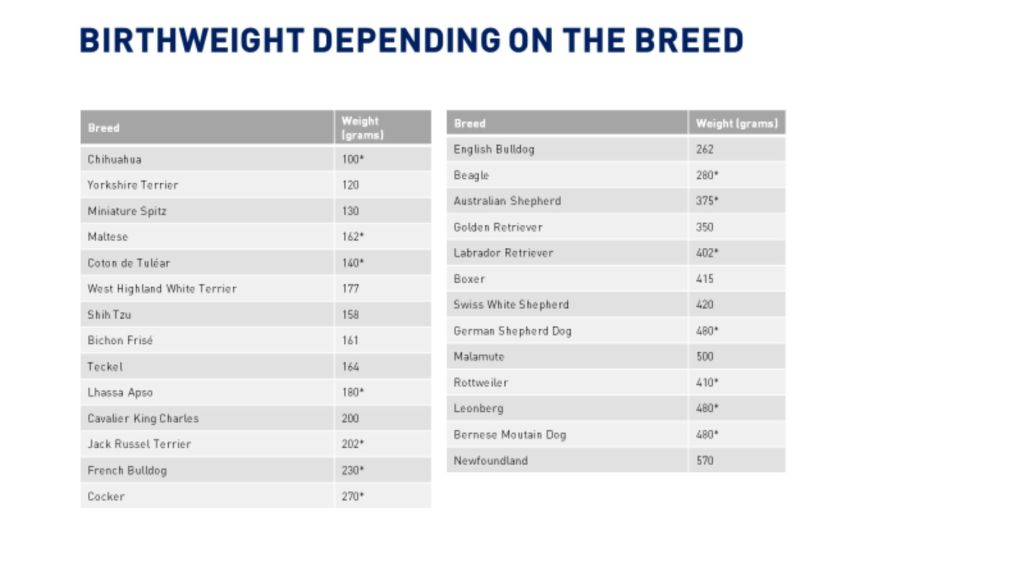
Detecting puppies with low birth weight is vital. Low birth weight is a major risk factor for hypoglycemia and other complications.
Great news is: studies have been done recently to better define what exactly is a low birth weight puppy, as obviously it will depend on its breed.
To aid in this, I’ve shared a table (see below) in some of my recent lectures that summarizes some of these results and helps determine what qualifies as a low birth weight in puppies.
This tool is invaluable for breeders and veterinarians alike, as it provides a clear benchmark for identifying at-risk puppies right from birth.
Daily Weight Gain: A New Paradigm
The traditional belief that it’s normal for newborn puppies to lose up to 10% of their birth weight in the first 24 hours is now being questioned.
The current understanding, backed by recent research, is that healthy puppies should gain weight daily. Any weight loss should be considered abnormal here.
This shift in perspective marks a significant departure from past beliefs and practices.
| 👉🏽It is crucial to weigh newborn puppies at birth and daily throughout the neonatal period (from birth to 3-4 weeks of age), as consistent weight monitoring is a key indicator of their health and development. I recommend starting with kitchen scales (like this one), but for serious accuracy, consider this lab-grade scale, perfect for tracking puppy weights up to 5kg. |
The DOHAD Concept in Canines
Recent studies on the Developmental Origins of Health and Disease (DOHAD) in dogs have shed light on the long-term impact of early life conditions on adult health.
DOHAD is a concept that explores how the environment during early development can influence the risk of diseases later in life.
In puppies, this means that both undernutrition and actually also overnutrition during the neonatal period can have lasting effects. For example, excessive weight gain in this critical phase can predispose puppies to obesity and overweight issues later in life, as it has been recently demonstrated.
Utilizing Neonatal Growth Charts
Neonatal growth charts have revolutionized how we track the growth of newborn puppies. These charts provide a visual representation of the ideal growth trajectory for puppies, allowing for more precise monitoring. By using these charts, breeders and caregivers can ensure that puppies are growing at an appropriate rate, neither too slowly nor too rapidly.

You can download the neonatal growth charts here to see what they entail. For me, these charts are a game-changer. They not only help in preventing issues related to hypoglycemia but also aid in averting other problems that could have lifelong consequences, such as obesity and overweight.
| 👉🏽Neonatal growth charts include data from over 115 different puppy breeds. Download them here! |
Consulting a Veterinarian for Hypoglycemic Newborn Puppies
When caring for newborn puppies, particularly those exhibiting signs of hypoglycemia, time is of the essence.
In my practice, I generally allow a 24-hour window to monitor the effectiveness of the initial measures we discussed earlier, such as feeding with milk replacers or using glucose solutions. If there’s no improvement in the puppy’s condition within this period, it’s crucial to seek veterinary consultation.
When to Seek Veterinary Assistance
If a newborn puppy identified as hypoglycemic does not respond to the initial interventions in the next 24 hours after those measures have been implemented, it may indicate an underlying issue that requires more advanced medical treatment.
In such cases, the expertise of a veterinarian is invaluable. They can conduct a thorough examination to diagnose any additional health problems and determine the best course of action.

Advanced Medical Treatments for Critical Cases
In cases of severe hypoglycemia, where the puppy is critically ill, veterinarians might need to administer glucose intravenously (IV) to rapidly elevate blood sugar levels.
However, in newborn puppies, especially those that are small and dehydrated, IV access can be challenging. As a result, veterinarians may resort to using intraosseous catheters.
Intraosseous Catheters: A Last Resort
An intraosseous catheter is inserted directly into the bone marrow, typically in the proximal tibia (just below the knee) or the distal femur (just above the knee). This method allows for the effective delivery of fluids and medications, including glucose, directly into the bloodstream. While the procedure might sound extreme, it’s often a life-saving intervention for puppies in critical condition.

Prevention is Key
It’s important to remember that such extreme measures are typically a last resort. By focusing on the preventive measures outlined earlier, such as proper monitoring, feeding, and environmental control, the likelihood of having to resort to invasive treatments like intraosseous catheters can be significantly reduced.
Prevention and early detection are vital in managing hypoglycemia in newborn puppies and ensuring their healthy development. If you’re ever in doubt or if your puppy’s condition worsens, don’t hesitate to consult with your veterinarian immediately. They are your best resource in providing the care and support your puppy needs.
You see, my initial curiosity about Karo syrup opened the door to a much larger and critical aspect of neonatal puppy care – the prevention and management of hypoglycemia. And I believe this condition to be a frequent cause of neonatal mortality. The journey has been enlightening, revealing that the challenge isn’t just about finding a quick fix like Karo syrup but involves a comprehensive strategy to prevent hypoglycemia in the first place. It’s about understanding the various risk factors, from the mother’s nutrition during gestation to the importance of monitoring litter size and the individual health of each puppy.
We are now better equipped than ever before to detect and address issues related to hypoglycemia in newborn puppies. This knowledge, combined with a proactive stance on monitoring and care, empowers us to safeguard the health of these vulnerable newborns more effectively.

 DR. EMMANUEL FONTAINE