
🇫🇷Lire en Français | 🇪🇸Leer en Español |🇧🇷Leia em português
For the past decade, I’ve been conducting lectures around the globe, honing my focus on a unique and under-explored niche within the veterinary world: canine neonatology.
My audiences have spanned from seasoned veterinarians to dog breeders, each of whom are invested in optimizing the health and well-being of newborn puppies – those precious beings between 0 and 3 weeks of age.
Despite having long been a nebulous sector of veterinary medicine, it’s remarkable how much we’ve advanced and the knowledge we’ve accrued over the years.
Yet, we still have plenty to uncover, as is the case with any field of study.
Among the many facets of canine neonatology that I explore in my talks, the “Fading Puppy Syndrome” is a concept I encounter often, and it’s one that tends to trigger a smirk on my face.
Why, you ask? Let me explain.
The tales are numerous, narrated by both breeders and veterinarians who recount with sorrow how they’ve lost entire litters to this so-called “Fading Puppy Syndrome”.
If you’ve ever attended one of my lectures, you’d notice how this topic is addressed in a way that deviates from common perception.
In fact, my current lectures commence with a stimulating question on this syndrome.
I challenge the audience by asking:
“What do you think is the percentage of puppies lost to Fading Puppy Syndrome?
Is it 5%, 10%, 20%, or does this syndrome even exist?”
Four alternatives that typically ignite thoughtful discussion.
Yet, the answer that I propose tends to provoke a stir amongst the attendees.
To the surprise of many, my assertion is quite straightforward – “Fading Puppy Syndrome” is not a real thing.
I know, this is quite a controversial stance… so allow me to unpack what I mean by this!

‘Fading Puppy Syndrome’: A Cardboard Box of Canine Concerns
You might be questioning why the image accompanying this post is a cardboard box, and I genuinely hope that sparks your curiosity!
In my view, this box is the perfect visual representation of what “Fading Puppy Syndrome” symbolizes.
Before we dive in, let’s take a step back and clarify what a ‘syndrome’ is.
Simply put, a syndrome refers to a collection of symptoms that frequently occur together, painting a common picture of a particular condition or disease.
So, what is “Fading Puppy Syndrome” supposed to mean? Essentially, it’s a term that paints a picture of newborn puppies who are failing to thrive – but it doesn’t indicate a single cause.
The cardboard box analogy serves to illustrate that this ‘syndrome’ is more like a catch-all container for the myriad of potential causes that can lead to puppies’ ill health (morbidity) and even death during their critical neonatal period.
Contained within this box are numerous potential culprits: congenital defects, infectious diseases, dystocia (a term used to denote difficult or abnormal birth), 3-H syndrome (hypothermia, hypoglycemia, dehydration), low birth weight, and more.
“Fading Puppy Syndrome” is not a distinct illness but a manifestation of one or more of these conditions.
Regrettably, in my professional encounters, this term is frequently misconstrued as a standalone clinical condition.
In reality, many people resort to it when they’re not sure what’s causing a puppy’s failing health, making it akin to what we in veterinary medicine call an ‘idiopathic’ disease – a fancy term for a condition where the cause remains unclear or unknown.
So, while “Fading Puppy Syndrome” points to a puppy’s failure to flourish, it doesn’t identify the root cause.
Rather than continually referring to this broad term, it’s more beneficial to focus on identifying and preventing the various contributing factors that can lead to a puppy’s decline.
In the fascinating field of biology, there is always more to learn. I am confident there are as-yet-unknown causes of neonatal mortality in puppies waiting to be discovered.
However, don’t get caught in the trap of viewing “Fading Puppy Syndrome” as a specific disease. Remember, it symbolizes a puppy’s struggle to thrive.
When confronted with this situation, the crucial task at hand is to delve into the root causes and tackle them head-on – this is the only viable route to combating this issue effectively.

Proactive Puppy Care: Outsmarting ‘Fading Puppy Syndrome
A common query that emerges when delving into this topic is: how can we better preempt and avert such health complications in puppies?
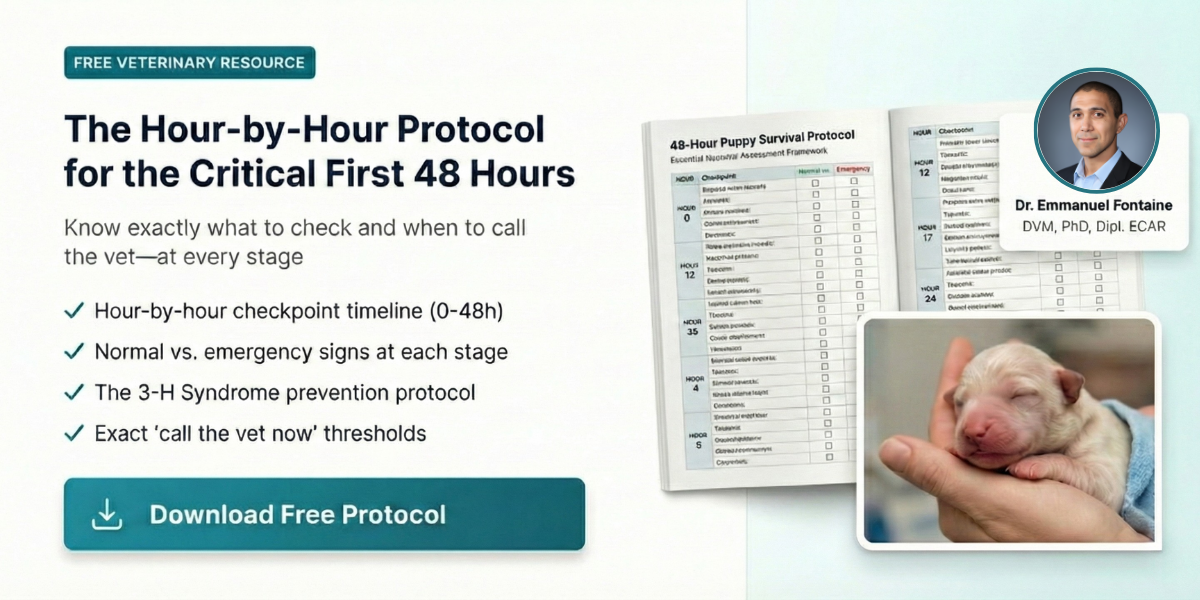
In my previous posts and lectures, I consistently recommended having a scale as an essential tool within your puppy maternity area.
This advice holds true even today, with a simple rule of thumb: a healthy puppy gains weight daily. Conversely, weight loss or a plateau often signifies the first red flag in a puppy’s failure to thrive.
But here’s the uplifting news: our protocols have greatly improved over recent years, allowing us to identify struggling puppies as early as possible.
The image above delineates my current recommendations for monitoring newborn puppies, particularly during the initial 48 hours post-birth—a period of utmost criticality.
While a scale remains indispensable, pairing it with a thermometer and a glucometer can significantly enhance your assessment of a newborn puppy’s health.
I would also suggest implementing the APGAR scores, a technique borrowed from human neonatology that has long been the gold standard for gauging neonatal health.
It involves a quick evaluation carried out after birth that examines a newborn’s Appearance, Pulse, Grimace, Activity, and Respiration.
The earlier you can identify at-risk puppies, the better equipped you are to provide the necessary help.
Over the last decade, I’ve persistently emphasized this: “An ounce of prevention is worth a pound of cure”, a sentiment that I believe resonates profoundly within the sphere of canine neonatology.
By adhering to such a robust protocol, you’ll be well-prepared to detect vulnerable puppies and swiftly initiate corrective actions to address their health issues.

‘Fading Puppy Syndrome’: Unmasking the Umbrella Term
By now, you’ve probably understood that I’m not a fan of using the term “Fading Puppy Syndrome” (even though I’ve mentioned it extensively in this post!).
This is purely a personal perspective, but I find it often misleads and fails to point out the genuine cause of the issue.
That being said, I understand why it’s widely used. When faced with the unfortunate instances of neonatal mortality in kennels, these situations can be deeply frustrating. It’s often challenging to definitively pinpoint what went wrong.
While I hope you never have to encounter such scenarios, the reality of breeding acknowledges the potential for such unfortunate events to occur.
If they do, my advice is to consult with your veterinarian as promptly as possible.
There are now methodologies to navigate such circumstances, and it’s crucial to collect samples quickly to enable potential necropsies, histology studies, bacteriology assessments, or PCR tests if needed.
Remember, understanding what happened is vital within a breeding environment. It’s this knowledge that allows us to develop robust prevention strategies for the future.
In addition, recognizing that “Fading Puppy Syndrome” is not a specific disease but an umbrella term for various health issues can empower you to act swiftly and effectively. You are not fighting a ghost disease, but identifiable conditions that can be addressed and managed.

 DR. EMMANUEL FONTAINE
3 thoughts on “Navigating Through the Enigma of Fading Puppy Syndrome”