
In a recent blog, I dived into the profound impact of optimizing gut health in puppies, revealing how it shapes their long-term health. I did a lot of reading and clearly became intrigued by this topic. I was convinced there would be some nuances when it comes to feline gut health… so I turned my attention to kittens. Here again, I found several studies focusing on the kitten microbiome and what can be done to optimize it. While it’s a trendy topic, its importance cannot be overstated. In this blog, I’m excited to share a treasure trove of simple, impactful tips and tricks. These insights are tailored for your kittens, ensuring they grow into healthy, happy adults.
- Kitten Gut Health: Probiotics, Prebiotics, and Microbiome Optimization
- Balancing the Kitten Microbiome: Probiotics, Prebiotics, and Diet
- Administering Probiotics and Prebiotics to Kittens
Kitten Gut Health: Probiotics, Prebiotics, and Microbiome Optimization

The Foundations of Feline Digestive Health
The gut microbiome in kittens is a fascinating and complex world within their tiny bodies.
It’s an intricate community of bacteria, fungi, viruses, and other microorganisms living in their digestive tract.
Recently, this topic has gained significant attention in both human and veterinary medicine, often hailed as an organ in its own right due to its extensive influence.
The gut microbiome indeed plays multiple pivotal roles, ranging from the development of the immune system to impacting behavior and managing weight.
It’s a delicate balance that’s crucial for overall health, underscoring the importance of nurturing it right from the start.
The key players in maintaining gut harmony in kittens are probiotics and prebiotics, each serving a unique and vital role.
Probiotics: The Beneficial Bacteria
Probiotics, often referred to as the ‘good bacteria,’ are live microorganisms that confer numerous health benefits when administered in adequate amounts.
These microscopic heroes aid in digestion, fight off potential pathogens, and maintain the integrity of the gut lining.
Prebiotics: Nourishing the Gut Flora
While probiotics are the live bacteria, prebiotics are the nourishment they need to thrive.
Prebiotics, often found in the form of FOS (Fructooligosaccharides) and MOS (Mannanoligosaccharides), are dietary fibres that fuel the beneficial bacteria in a kitten’s gut.
FOS fosters the growth of healthy bacteria, while MOS helps block harmful pathogens. Together, they synergistically support the kitten’s microbiome, enhancing digestive health and overall wellbeing.
The relationship between probiotics and prebiotics in the feline microbiome is symbiotic. Probiotics depend on prebiotics to flourish, and in turn, a healthy probiotic population ensures a well-functioning gut. This symbiosis is crucial for the overall health of your kitten, influencing everything from nutrient absorption to their ability to fight off diseases.
Microbiome Optimization: A Balancing Act
The term ‘microbiome optimization’ might sound complex, but it’s simply about maintaining the right balance of these microorganisms.
A healthy kitten microbiome isn’t just about the presence of good bacteria; it’s about ensuring these bacteria are thriving and in balance.
Disruptions to this balance can lead to digestive issues, weakened immunity, and more. Therefore, understanding and managing this delicate ecosystem is crucial for your kitten’s health.
I won’t sugarcoat it: we’re still unraveling the mysteries of microbiome optimization in kittens. However, the strides made in recent years have been significant, illuminating pathways to better understanding and care. While we anticipate more groundbreaking strategies in the future, it’s heartening to know that there are already effective measures we can implement today.
This journey of discovery is ongoing, but we’re well-equipped with current knowledge to make a positive impact on the health of our feline friends.
Balancing the Kitten Microbiome: Probiotics, Prebiotics, and Diet

Achieving a balanced microbiome in kittens is a multifaceted endeavour, intertwining the right mix of probiotics, prebiotics, and a carefully curated diet. Contrary to common belief though, optimizing a kitten’s gut health extends beyond focusing solely on the kitten itself. Recent studies in dogs and cats have revealed a broader approach, highlighting that this crucial development actually begins even before the kitten is born. This insight opens up new avenues in prenatal care, emphasizing the importance of a holistic approach to nurturing gut health right from the earliest stages of life.
Maternal Care for Kitten Gut Health
DOHAD, or the Developmental Origins of Health and Disease, is a groundbreaking concept beginning to reshape our understanding of veterinary medicine, especially in dogs and cats.
This theory posits that the environment and conditions during gestation, and even before conception, can significantly influence various aspects of an animal’s life, including the development of its gut microbiome.
Recent discussions have highlighted that this is not just a fleeting trend, but a new chapter in veterinary science.
It suggests that to optimize gut health in kittens – understanding its profound impact on their adult life – we must first focus on the health of their mother.
This holistic approach emphasizes the importance of maternal care and well-being as the foundational step in shaping a kitten’s lifelong health, making DOHAD a crucial element in feline healthcare.
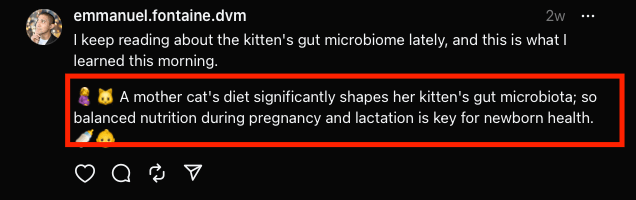
Evidence increasingly suggests that a mother’s nutrition during gestation directly shapes her kittens’ gut microbiome, making her diet a top priority.
- The first crucial step is to ensure breeding females are healthy, particularly free from chronic gastrointestinal disorders like inflammatory bowel disease or chronic enteropathy.
- Additionally, maintaining an optimal body condition score in breeding females is vital. In dogs, overweight mothers often have low birth weight puppies with underdeveloped gut microbiomes. While similar studies in cats are not available yet to my knowledge, it’s prudent to consider this a key rule for feline breeding.
- Once these fundamentals are in place, the focus shifts to a gestation diet optimized for microbiome support. This could involve supplementing with probiotics or choosing a diet enriched with prebiotics. Various approaches have shown benefits, but consistency is key.
Overdoing nutrition can disrupt the delicate balance, overstimulating the microbiome and potentially causing GI disorders. I always recommend picking an approach and sticking to it basically.
Colostrum: The First (and Best) Probiotic Boost for Newborn Kittens
I’ve always championed colostrum as an essential immunity and energy booster, crucial for optimizing newborn kitten survival. However, my recent learnings have added another dimension to its significance: colostrum as a microbiome booster.
This first milk is rich in bacteria that play a pivotal role in colonizing the kitten’s gut immediately after birth.
These bacteria originate from the mother’s skin and milk, with some even migrating from her digestive tract to the mammary glands, eventually finding their way into the colostrum.
This fascinating process reiterates the importance of the right nutritional approach during gestation in the mother.
Therefore, ensuring that kittens receive colostrum from their mother shortly after birth is paramount. It’s more than just a nutrient-rich first meal; it’s the ultimate probiotic boost, laying the foundation for a healthy gut microbiome, and, by extension, a robust start to life.

Ensuring Prebiotic Boosts Through Mother’s Milk
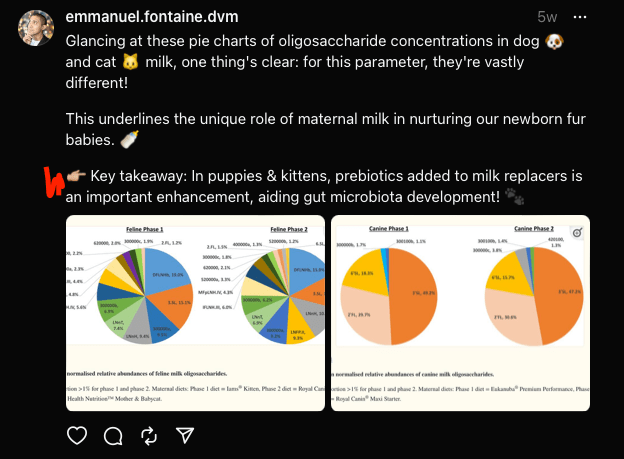
Kittens can also receive a vital prebiotic boost, simply through nursing on their mother.
Mother’s milk contains a variety of oligosaccharides, natural prebiotics that stimulate the developing gut microbiome of the kitten.
This highlights two top priorities:
- Firstly, the nutrition of the female cat during gestation directly influences lactation.
Unlike other mammals, cats need to build reserves during pregnancy to support their energy-intensive lactation period.
Proper feeding during gestation is crucial, as I explain in the video above, to ensure these reserves are sufficient.
- Secondly, the nutritional needs of the queen during lactation are paramount.
This is the only stage when I advocate free-feeding, as lactation demands high energy.
A growth diet, ideally the same that will be used for weaning the kittens, is recommended.
Despite making reserves, queens typically lose weight during lactation – a well-managed diet aims to minimize this loss to no more than 5-10% of their optimal body weight.
- In catteries, having a dedicated feline milk replacer on hand is wise, preferably one supplemented with prebiotics.
This ensures that if supplementation is necessary, the kittens still receive vital prebiotics they might miss from their mother’s milk.
Nutritional Weaning: Balancing Diets for a Healthy Kitten Microbiome
Nutritional weaning is a critical phase that significantly influences the microbiome development in kittens. This period, often marked by weaning diarrhea, poses a common challenge in breeding catteries.
Among the myriad pathogens causing weaning diarrhea in kittens, the Feline Panleukopenia Virus stands out as a crucial consideration – dive deeper into this critical topic on my blog here!
Nutrition plays a key role in this phase, both as a preventive tool against gastrointestinal issues and as a factor shaping the kitten’s microbiome.
Interestingly, while cats are obligate carnivores requiring high protein intake, studies suggest that diets with a moderate protein: moderate carbohydrate ratio may actually foster a healthier microbiome compared to a high protein: low carbohydrate diet.
This approach has been shown to better support health-promoting bacteria like Bifidobacterium, Megasphaera, and Lactobacillus. Such dietary optimization seems particularly beneficial during the weaning phase.
In terms of feeding practices, I also advocate for mixed feeding in cats, which involves offering both dry and canned food.
This approach not only prevents neophobia (a reluctance to try new foods) later in life and helps increase water intake but also modulates the microbiome differently than a single food type.
Mixed feeding stimulates diverse populations of beneficial bacteria, laying a foundation for a robust gut ecosystem. As we continue to learn, I am sure more sophisticated strategies may emerge, but for now, mixed feeding represents an important step in nurturing a healthy microbiome during the critical weaning stage.

Administering Probiotics and Prebiotics to Kittens

Navigating the world of probiotics and prebiotics for kittens involves more than just understanding their benefits; it’s also about knowing how to effectively administer these supplements.
The Importance of the Mother
Administering gut supplements to cats involves much more than simply adding them to their diet. The journey to optimal gut health starts with the mother’s nutrition.
It’s crucial to understand that for newborn kittens, the best source of probiotics and prebiotics, which are instrumental in shaping their adult microbiome, comes naturally from their mother’s colostrum and milk.
Therefore, our efforts must focus on optimizing this intake. Ensuring that the mother is in excellent health and that her diet is meticulously planned not only benefits her but also sets the foundation for her kittens’ lifelong gut health.
Administering Gut Health Supplements
When it comes to supplementing kittens with prebiotics and probiotics, there are two primary approaches:
- directly adding supplements to the kitten’s diet (usually during nutritional weaning)
- or using nutritionally enriched solutions designed for microbiome support, such as milk replacers with prebiotics and high-quality kitten foods.
Both methods have their merits, but as I’ve emphasized before, consistency is key.
In my opinion, it’s important to choose one approach and stick with it. In nutrition, more is not always better; it’s all about balance.
Combining too many microbiome-supporting nutrients haphazardly can overstimulate the gut, leading to digestive issues, which is precisely what we’re trying to avoid.
In some cases, even when feeding a high-quality diet, additional probiotic supplementation may be necessary. However, this should be done under veterinary guidance to ensure the approach is appropriate for the specific needs of the kittens.
Additionally, it’s vital to recognize that not all supplements are created equal. Some have proven efficacy, while others may not be as effective. Choosing well-researched, proven supplements is crucial for ensuring the health and well-being of the kittens as they grow.

There’s a quote from the WHO that I find myself repeating often these days: “If we change the beginning of the story, we change the whole story.” This resonates profoundly with me, especially in the context of the kitten microbiome. The development of this microbiome has lifelong implications, and it’s heartening to know that there are already numerous strategies we can implement to optimize it. The field of veterinary research on this topic is rapidly expanding, with each new publication offering invaluable insights. I’m committed to staying abreast of these developments, continually sharing my thoughts on Threads and writing here to keep you informed of the latest approaches. These advancements have the potential to significantly impact the health of our feline companions, and it’s exciting to be part of this journey, shaping the ‘beginning of the story’ for a healthier, happier future for our cats.

 DR. EMMANUEL FONTAINE