
🇫🇷 Lire en Français | 🇪🇸Leer en Español | 🇧🇷Leia em português
C-sections save lives—but they also interrupt nature’s first microbial gift. Research now shows that puppies and kittens born by C-section miss out on critical bacteria that influence lifelong health, growth, and immunity. The good news? You can help restore it. Inspired by breakthroughs in human medicine and guided by veterinary research, this blog reveals how to optimize microbiome transfer after surgical birth. Whether you’re a breeder or a veterinarian, you’ll discover simple, evidence-based strategies that make a measurable difference in your litters—starting from day one. From colostrum to contact, vaginal seeding to smarter antibiotic use, this is your practical guide to giving every newborn their microbial birthright.
- TL;DR
- What do C-sections mean for a newborn’s microbiome?
- What has human medicine taught us about microbiome restoration?
- Can microbiome seeding work in puppies and kittens?
- What can breeders do right now to optimize microbiome transfer?
- How can we track the impact of these interventions?
- Is microbiome-focused care the future of dog and cat breeding?
TL;DR
- C-section litters miss natural exposure to the dam’s beneficial vaginal and fecal bacteria.
- This leads to “cesarean-associated dysbiosis” — a delayed and less diverse microbiome.
- Human medicine has explored vaginal seeding, fecal microbiota transplants, and early colostrum feeding to help restore the microbiome.
- In puppies and kittens, vaginal seeding is under study but results so far are inconclusive; safety screening of the dam is essential.
- Colostrum remains the most critical tool for immune and microbial support—hand-express and feed if needed.
- Maternal grooming, skin contact, and exposure to the dam’s environment help with microbial colonization.
- Avoid unnecessary antibiotics post-surgery—they harm the fragile early microbiome.
- Supporting the dam’s microbiome through tailored nutrition during gestation enhances neonatal outcomes.
- Track neonatal growth rates as a practical marker of microbiome health and success.
- Microbiome-conscious care is the new frontier in breeding—simple, science-based interventions can create healthier litters.
What do C-sections mean for a newborn’s microbiome?
In the early 2000s, Dr. Maria Gloria Dominguez-Bello made a discovery that changed everything we thought we knew about birth. C-section babies weren’t just missing the physical journey through the birth canal—they were missing something invisible yet profound: their mother’s protective microbiota.
The invisible loss during surgical birth
The implications were staggering. These babies faced dramatically higher rates of allergies, asthma, and immune disorders throughout their lives. An entire generation was starting life with a compromised microbial foundation, and we were completely blind to this hidden cost.
Here’s what happens during a C-section that we didn’t fully understand before. Vaginal birth naturally seeds babies with crucial bacteria like Lactobacillus and Bacteroides from mom’s birth canal. C-section babies? They get colonized by whatever’s floating around the sterile operating room instead—mostly skin bacteria that don’t offer the same protective benefits.
But Dr. Dominguez-Bello dared to ask: What if we could manually restore what C-section babies missed? Her radical experiment of “seeding” newborns with maternal microbes opened our eyes to an ancient truth—nature’s first gift isn’t just warmth or milk, but an invisible coat of protective bacteria.
The results from her pilot studies were fascinating. Seeded babies developed gut communities that actually resembled vaginally-born infants, with early dominance of beneficial bacteria. Some recent research even suggests these babies might show improved neurodevelopment scores in their first year.
As a vet, I see similar patterns in puppies and kittens—those early bacterial exposures matter more than we ever imagined.
Why this matters for breeders and vets
I’ve performed countless C-sections during my time at veterinary school in Paris. We even wrote protocols still used today for scheduling elective C-sections in breeding bitches, focused entirely on preventing neonatal mortality.
But here’s what haunts me: we completely ignored the microbiome transfer. It wasn’t even on our radar actually.
Cesarean section delivery fundamentally changes everything. By bypassing the birth canal in that sterile surgical environment, C-section newborns miss contact with mom’s beneficial vaginal and fecal microbiota. Instead, their initial colonization comes from the operating room and our hands as caregivers.
This leads to what we call “cesarean-associated dysbiosis” – basically, C-section puppies and kittens get a delayed, less diverse microbiome. Their gut bacteria become dominated by skin microbes like Staphylococcus rather than the beneficial Lactobacillus and Bifidobacterium from natural birth.
Studies show C-section puppies have less diverse intestinal microbiota and slower early growth compared to naturally whelped litters. Without proper early microbial exposure, these babies miss crucial immune system “training” during a critical developmental window.
The consequences? In humans, research links C-section birth to higher rates of asthma, allergies, and metabolic disorders later in life. While definitive long-term data in dogs and cats is still emerging, the principles are compelling across species.
Today, understanding these microbiome-conscious strategies puts breeders at the forefront of neonatal care evolution.
What has human medicine taught us about microbiome restoration?
“I was struck by how different everything seemed with microbes in mind,” writes microbiome researcher Ed Yong, capturing the paradigm shift that’s transformed both human and veterinary medicine.
Human medicine has pioneered several approaches to restore what C-sections remove, each with promising results—and important limitations:
Vaginal seeding: Potential and limitations
As a veterinarian, I find the human research on vaginal seeding absolutely fascinating—and it’s giving us incredible insights into what might be happening with our puppies and kittens too.
Here’s the basic idea: when human babies are born via C-section, they miss out on all those beneficial bacteria they’d normally pick up during a vaginal delivery. So researchers started “vaginal seeding”—basically wiping C-section babies with mom’s vaginal fluids right after birth to give them those missing microbes.
The results? Pretty impressive, honestly. Studies from 2023 showed that seeded babies developed gut bacteria much more similar to naturally-born infants, with early colonization of Lactobacillus and Bacteroides. Even more interesting—these babies showed better neurodevelopment scores at 3 and 6 months.
But here’s where it gets complicated. This technique is still highly experimental because of serious safety concerns. We’re talking about potential transmission of dangerous pathogens like Group B Strep or herpes—stuff that can cause life-threatening infections in newborns.
The American College of Obstetricians actually advises against it outside research settings. Even when it’s done, it requires extensive maternal screening and strict protocols.
There’s also some scientific controversy about long-term benefits. Some studies suggest that by 1-2 years old, most kids’ microbiomes converge regardless of birth method. One small study didn’t even find significant differences at one month, which makes you wonder about the lasting impact.
Fecal microbiota transplants: Promising but risky
Recently, I’ve been following some groundbreaking research on fecal microbiota transplants (FMT) for C-section babies that has me pretty excited about future possibilities.
Here’s what caught my attention: researchers found that giving newborns a tiny dose of their own mother’s processed stool within hours of a C-section birth creates gut microbiomes that are virtually identical to vaginal births. We’re talking about a complete microbiome reset in just days.
The results from that landmark 2020 study were honestly striking. All seven babies who received maternal FMT developed gut bacteria profiles that matched naturally delivered infants perfectly. They acquired important bacteria like Bacteroides that C-section babies typically miss out on entirely.
But here’s the thing – this intervention comes with some serious safety concerns that keep me up at night thinking about it:
- Pathogen transmission risk – even with rigorous screening, there’s always a chance of transferring harmful bacteria or parasites
- Immature immune systems – newborns are incredibly vulnerable to infections
- Regulatory hurdles – the FDA treats stool as an investigational drug, limiting use to research settings
Right now, routine neonatal FMT isn’t available outside research studies. But I’m watching these ongoing trials closely because the potential to normalize C-section babies’ gut health is just too promising to ignore. Sometimes the most exciting advances come with the biggest question marks.
Breastfeeding and microbiota: Helpful but not complete
Looking at what they’re doing in human medicine, I can tell you that enhanced breastfeeding protocols are becoming the standard for C-section babies—but even pediatricians admit it’s not a complete fix.
Here’s what human hospitals are prioritizing:
They’re pushing for immediate colostrum intake within hours of C-section delivery, ensuring early and frequent feeding to maximize that critical microbial transfer. The data is pretty impressive—studies show that about 28% of gut bacteria in one-month-old babies comes directly from breast milk, with another 10% from maternal skin contact.
What’s fascinating is how they’re treating breast milk almost like a probiotic delivery system. The colostrum and mature milk carry live maternal bacteria, plus those special prebiotics called oligosaccharides that basically feed the good microbes once they’re in the baby’s gut.
But here’s what human doctors are finding—it’s helpful but incomplete.
Even with perfect breastfeeding protocols, C-section babies still show that delayed colonization pattern, especially missing key bacteria like Bacteroides that normally comes from birth canal exposure. One neonatologist I spoke with explained that while nursing provides Bifidobacterium and Lactobacillus, it can’t replicate that immediate, comprehensive microbial bath from vaginal delivery.
The reality in human medicine?
They’re still refining these techniques because no single intervention perfectly replicates natural birth. Safety protocols are evolving, and they’re combining enhanced breastfeeding with other interventions like vaginal seeding.
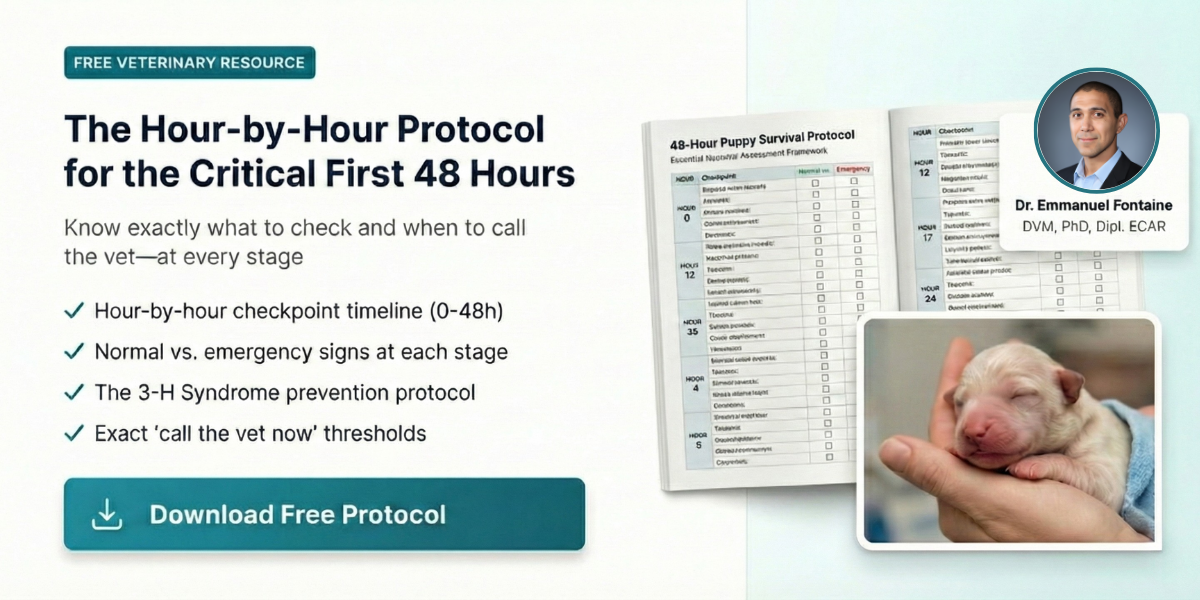
| Feeding newborn puppies and kittens is absolutely vital during the neonatal period—mother’s milk is truly liquid gold. Read what I wrote on this for both puppies and kittens to learn more. |
Can microbiome seeding work in puppies and kittens?
Based on human and pig research, veterinary trials are exploring vaginal seeding for puppies and kittens. The concept is simple: collect vaginal fluid from the dam using sterile gauze before surgery, then gently wipe it on newborns’ muzzles, mouths, and fur immediately after delivery.
What current studies are telling us
I’ve been really interested in a recent canine study that looked at vaginal seeding. Basically, researchers took half a litter of C-section puppies and swabbed them with their mother’s vaginal fluids right after birth—kind of like giving them a “microbial bath” to mimic what happens during natural delivery.
The results were both encouraging and humbling at the same time. The study confirmed that maternal transmission absolutely influences puppy gut microbiota—so we know the dam’s microbes are crucial for her offspring’s early colonization. But here’s the kicker: under the specific conditions they tested, the vaginal seeding didn’t significantly change the puppies’ microbial counts by 2 weeks of age.
Now, before you write this off completely, I think there’s more to the story. The researchers didn’t say this approach is useless—they suggested we might need to optimize our timing, increase the bacterial load, or use larger sample sizes to see meaningful results. It’s like we’re on the right track, but we haven’t quite figured out the perfect recipe yet.
Key safety considerations before trying it
If you’re thinking about trying this experimental approach with a litter, there are some non-negotiables I always discuss with breeders. The dam must be thoroughly screened for pathogens—especially canine herpesvirus and harmful bacteria like toxigenic E. coli. I’ve seen too many preventable infections to take this lightly.
Critical safety rule: If there’s any doubt about the dam’s health, skip this step entirely. It’s considered low-cost and potentially low-risk if the dam is healthy, but that’s a big “if” that requires proper veterinary screening.
Timing matters enormously—you need to do this immediately after birth when the gut is most receptive to colonization. I tell breeders this is something you plan for ahead of time, not a last-minute decision in the whelping room.
What can breeders do right now to optimize microbiome transfer?
The reality is that cesarean delivery bypasses crucial exposure to the dam’s vaginal and intestinal microbiota, potentially leading to less diverse gut bacteria and slower early growth in puppies and kittens.
But here’s what I tell every breeder I work with—we’re not powerless. While experimental approaches like fecal transplants are still being researched, there are proven strategies you can implement right now to maximize beneficial microbiome transfer.
Immediate steps post-surgery
Colostrum is your secret weapon, and I cannot emphasize this enough. Within that critical 12-16 hour window, colostrum delivers a triple punch: immunity through antibodies, beneficial bacteria from the dam, and prebiotics that feed good gut flora. One breeder I know learned this the hard way when her first litter didn’t get adequate colostrum—the difference in thriving between that litter and subsequent ones was night and day.
If the dam is slow to recover from anesthesia, hand-express that liquid gold immediately. I’ve shown countless breeders how to gently milk out colostrum and either bottle-feed it or rub it on the neonates’ gums. Every drop counts during this narrow absorption window.
First days: Grooming, contact, and colostrum
Once mom’s awake and stable, enable natural grooming behavior. That maternal licking isn’t just cleaning—it’s transferring her saliva and skin microbes directly onto the babies’ skin and mucous membranes. I always supervise these early reunions to ensure the dam isn’t too groggy, but this “manual seeding” is invaluable.
Your environmental management needs to be smart, not sterile. Here’s what works:
- Keep whelping areas clean but not hospital-sterile
- Allow contact with the dam’s bedding and scent
- Avoid harsh disinfectants in the immediate post-birth period
- Remember that some environmental bacteria actually help healthy colonization
Maximize skin-to-skin contact between dam and neonates. Just like with human babies, this close contact allows colonization by her beneficial skin flora. If the dam can’t care for her litter, I’ve seen foster mothers from the same species successfully introduce alternative adult microbiomes.
| 👉🏽 This is the type of whelping box I trust and recommend— sturdy, easy to clean, and designed with newborn puppy/kitten safety in mind (and available in different sizes). |
Long-term habits that protect the microbiome
This is where many breeders unknowingly sabotage their efforts. Limit unnecessary antibiotics like your litters depend on it—because they do. Those broad-spectrum antibiotics can wipe out whatever beneficial bacteria the babies have managed to acquire.
I reserve antibiotic use for when it’s medically essential, not as a “just in case” measure. The developing microbiome is delicate, and we need to protect whatever colonization we’ve achieved through our natural transfer methods.
The bottom line? While C-section babies start at a disadvantage, strategic intervention during those first few days can significantly improve their microbial foundation. Focus on maximizing natural transfer opportunities rather than trying experimental techniques, and you’ll give these little ones the best shot at developing robust, healthy gut bacteria that will serve them throughout their lives.
How can we track the impact of these interventions?
Better growth rates—that’s what you should watch for with optimized microbiome transfer. Indeed, the hypothesis here is that puppies and kittens provide us with measurable indicators of microbiome health through their growth patterns.
Remember our previous discussion about neonatal growth charts? This is where that monitoring becomes crucial. C-section babies with improved microbiome seeding consistently show better weight gain in their first weeks of life. If you’ve been tracking growth using neonatal charts (as we’ve discussed before), you’ll have the data to see whether these interventions are making a real difference in your litters.
As microbiologist Scott C. Anderson observes: “Millions of years ago, bacteria and animals struck up a deal. In return for a moist bed and a warm buffet, beneficial bacteria took up the job of defending us against the madly proliferating pathogens in the world.” When we restore this ancient partnership through proper microbiome transfer, we see it reflected in stronger, faster-growing puppies and kittens.
| 👉🏽Neonatal growth charts include data from over 115 different puppy breeds. Download them here! |
| 👉🏽Neonatal growth charts include data from over 30 different kitten breeds. Download them here! |
Is microbiome-focused care the future of dog and cat breeding?
Research in human medicine is exploring even more advanced techniques like maternal fecal microbiota transplants for C-section babies. While we’re not there yet in veterinary medicine, the principles are clear: we can no longer view C-sections as simply mechanical procedures—they’re opportunities to consciously restore what nature intended.
The transformation in my approach reflects the broader evolution happening in veterinary medicine. In the past, I focused solely on surgical technique and immediate survival, never considering microbiome implications, and sent breeders home with standard post-op instructions. Today, I view each C-section as a microbiome restoration opportunity, provide specific seeding and contact recommendations, and consider long-term health implications, not just immediate survival. “The care of animals is an integral part of the ethical code of veterinary medicine,” as Dr. Leon Whitney reminds us—and that care now includes understanding these invisible partnerships that shape lifelong health.
Microbiome medicine isn’t coming to veterinary practice—it’s already here. Every breeding decision, every antibiotic prescription, every C-section is now a microbiome decision. As Nobel Laureate Joshua Lederberg defined it, the microbiome represents “the ecological community of commensal, symbiotic, and pathogenic microorganisms that literally share our body space and have been all but ignored as determinants of health and disease.”
The future of breeding isn’t just about genetics—it’s about giving every newborn, regardless of delivery method, their evolutionary birthright of protective microbes.

 DR. EMMANUEL FONTAINE