🇫🇷 Lire en Français | 🇪🇸Leer en Español | 🇧🇷Leia em português
Every teat on a bitch produces colostrum. Not every teat produces the same colostrum, and you cannot tell which one is best by looking at it.
That asymmetry sat in the literature as a vague assumption for years. A team at the Toulouse National Veterinary School tested it properly by sampling every teat, one pair at a time, on 44 bitches across 13 breeds. The headline finding: a 42% average variation in IgG between teat pairs on the same bitch, with no consistent positional pattern. The same architecture appears to apply to queens, although feline data are sparser.
The practical takeaway is simpler than the science. You will not reliably pick the best teat. You can do something better: get every newborn nursing in the first 8 hours, watch them rotate across teats, and weigh them daily. That sequence is what protects litters.
- TL;DR
- The 42% Finding That Reframes the Question
- What This Means in the Whelping Box
- The Real Lever: Time, Not Teat Choice
- The Tool That Tells You the Truth: Daily Weighing
- When to Bring in Your Veterinarian
- A Note for Cat Breeders
- Conclusion
TL;DR
- Colostrum IgG varies by an average of 42% between teat pairs on the same bitch. The richest teat is different for each individual and cannot be predicted by position.
- Time matters far more than teat choice. Gut closure begins at 4 to 8 hours after birth and is complete by 16 to 24 hours.
- Puppies naturally suckle from 5 ± 2 teats in the first 12 hours. That rotation is the immune lottery working in your favour.
- Daily weighing from birth is the most reliable signal you can collect. A puppy losing more than 4% of birth weight by Day 2 needs immediate attention.
- Use a 1 g resolution kitchen scale, record each puppy’s weight in a notebook, and weigh at the same time every day for the first three weeks.
The 42% Finding That Reframes the Question
What the Variation Actually Looks Like
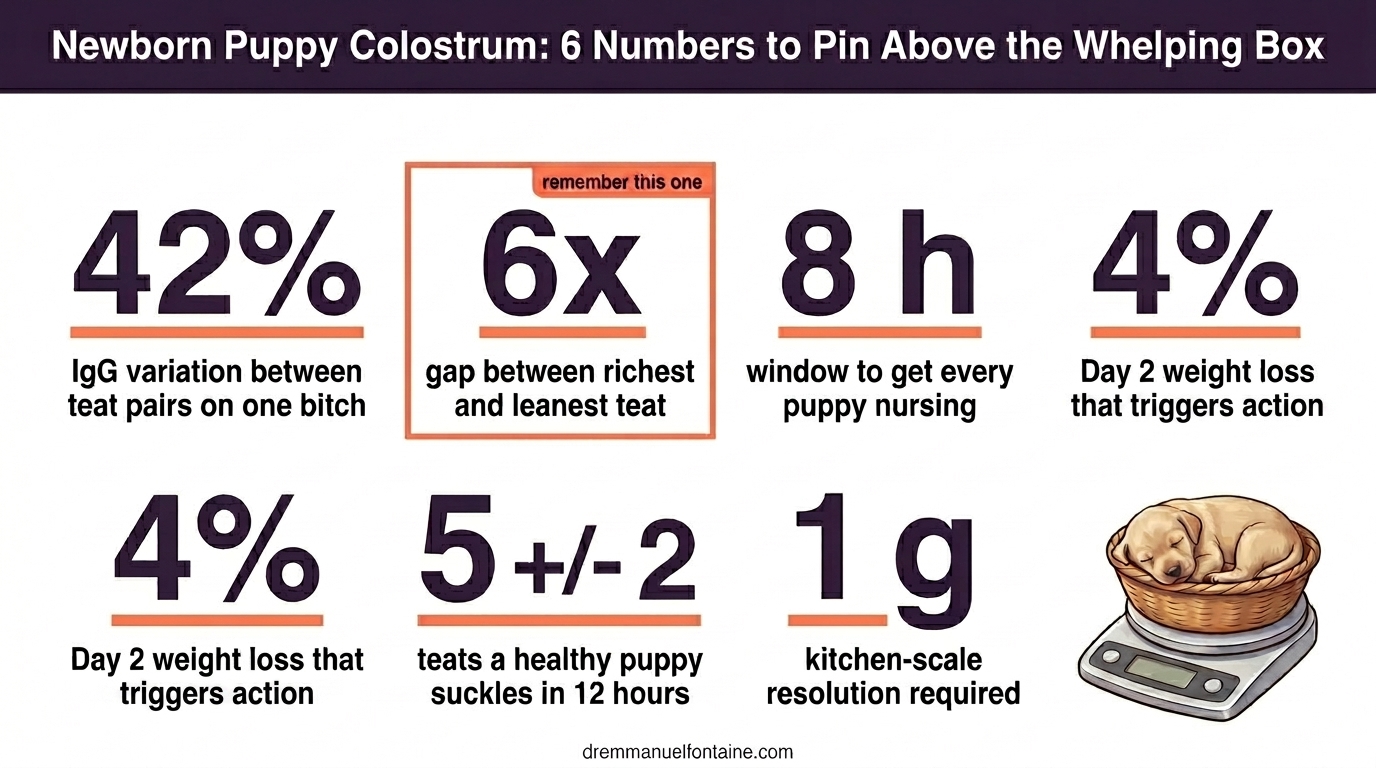
The Mila et al. 2015 study measured IgG separately in each pair of mammary glands across 44 bitches, generating 180 colostrum samples. The mean coefficient of variation between teat pairs on the same bitch was 42 ± 32.1%. In simpler terms: when you compare any two teat pairs on the same bitch, the difference is rarely small. The highest- and lowest-IgG teat pairs within one bitch differed by nearly 6-fold on average.
That number sounds abstract until you place it next to a litter. If a bitch’s richest teat carries 30 g/L of IgG and her leanest teat carries 5 g/L, a puppy that nurses only on the leanest teat in the first 8 hours starts life with a fraction of the antibody load of a sibling that latched onto the richest teat. The biology is invisible and unforgiving.
Table 1: What 42% Variation Means at the Whelping Box
| Concept | Number | What it means for the breeder |
|---|---|---|
| Mean coefficient of variation between teat pairs | 42 ± 32.1% | Teat pairs on the same bitch routinely differ by a third or more in IgG content |
| Average highest-vs-lowest gap on one bitch | Nearly 6-fold | One teat can carry roughly six times the IgG of another on the same dam |
| Predictable best position | None found | M5 inguinal is not richer than M1 thoracic. The best teat varies bitch by bitch |
| Range of mean IgG across all bitches | 8.0 to 41.7 g/L | Even within a healthy population, colostrum quality is highly variable |
What Does Not Predict Colostrum Quality
The Toulouse team also tested four factors that breeders and veterinarians had long suspected might matter: breed size, litter size, dam age, and the dam’s own serum IgG. None of them predicted colostrum IgG concentration. That finding rules out a lot of folk knowledge. A toy-breed maiden is not automatically inferior. A heavy-litter Labrador is not diluted. An older proven dam is not finished.
Table 2: What Doesn’t Predict Colostrum Quality
| Factor | Effect on colostrum IgG | Practical implication |
|---|---|---|
| Breed size | None detected | Toy and giant breeds produce comparable IgG ranges |
| Litter size | None detected | A bitch with 10 puppies is not diluting her colostrum |
| Dam age | None detected | An older proven dam is not automatically inferior |
| Dam’s own serum IgG | No correlation | A bitch’s blood antibody level does not predict her colostrum quality |
What This Means in the Whelping Box
Stop Looking for the Best Teat
If you cannot predict which teat carries the richest colostrum, the strategy of placing the weakest puppy on the best teat collapses. The only way to know which teat is the best on a given bitch is to send a sample to a laboratory, and that is not a tool you have at the whelping box. What replaces the strategy is simpler: maximise the number of teats each puppy samples in the first 8 hours.
This connects back to the variation finding above. Because the best teat is randomised within each bitch, the only way to load the dice in the puppy’s favour is to give that puppy as many draws of the lottery as possible before the gut closes.
Table 3: Why Picking the Best Teat Doesn’t Work
| Old advice | Why it fails | What to do instead |
|---|---|---|
| Place weak puppy on M5 inguinal teat | M5 is not consistently richer than other pairs | Encourage rotation across all teat pairs |
| Use refractometry to grade colostrum | Correlation in the bitch is too weak to act on | Use daily weight gain as the verification signal |
| Trust dam’s body condition as a proxy | Body condition does not predict colostrum IgG | Trust the daily scale over visual judgment |
| Save the dam’s first litter for elite teats | There are no elite teats with predictable position | Treat all teats as part of one rotation system |
The First 24 Hours, Hour by Hour
The window for passive immune transfer is short and fixed. Once gut closure happens, no amount of colostrum will compensate. A clear timeline lets you act inside the window rather than chase it after the fact.
Table 4: The First 24 Hours: Hour-by-Hour Action Plan
| Window after birth | What is happening biologically | What you do |
|---|---|---|
| 0 to 2 hours | Gut is wide open. Absorption is at its peak | Get every puppy latched, even briefly. Dry the puppy, place at a teat, confirm a strong suckle |
| 2 to 8 hours | Absorption rate is beginning to fall | Watch for rotation. Gently redirect any puppy stuck on one teat for more than 30 minutes |
| 8 to 16 hours | Absorption is declining sharply | Verify each puppy has nursed across multiple teats. Flag any puppy still fixated on one teat |
| 16 to 24 hours | Gut closure is complete in most puppies | Stop chasing the window. Move the focus to daily weighing as the verification step |
The Real Lever: Time, Not Teat Choice
Gut Closure Is the Clock You Cannot Reset
The Chastant-Maillard et al. 2012 paper measured how IgG absorption changes by hour in puppies. At 4 hours, absorption is near 40%. By 8 hours it has dropped to roughly 20%. By 24 hours it is effectively zero. This is the clock every breeder should picture during whelping. The richness of the teat matters far less than whether the puppy is on a teat at all during the first 8 hours.
Table 5: IgG Absorption Rate by Age in Puppies
| Age after birth | IgG absorption rate | Practical reading at the whelping box |
|---|---|---|
| 0 to 4 hours | Approximately 40% | Peak window. Every minute on a teat counts |
| 4 to 8 hours | Approximately 20% | Still useful, but the slope is steep. Push for rotation |
| 8 to 16 hours | 5 to 10% | Late draws are partial. Verify, do not assume |
| 16 to 24 hours | Near zero | Window effectively closed. Move to weight monitoring |
Watch for the Rotation, Not the Best Teat
The Chastant-Maillard et al. 2019 review captured how puppies actually use the udder. On average, a puppy suckles 5 ± 2 teats during the first 12 hours of life. That rotation is the biology compensating for variation. A puppy that visits five teats has averaged out the IgG lottery across multiple draws. A puppy fixated on one teat is sampling from one draw of the lottery instead of five, and that is the warning sign you want to catch quickly.
Table 6: Puppy Suckling Behaviour in First 12 Hours
| Behaviour | Average across litters | What it tells you |
|---|---|---|
| Number of teats visited | 5 ± 2 | Healthy puppies sample broadly across the udder |
| Single-teat fixation | Uncommon | Flag this puppy. Redirect gently to a different teat |
| Total nursing bouts in 12 hours | Multiple short sessions | Frequency confirms latch strength and stamina |
| Puppy initiating contact with dam | Spontaneous | A puppy that does not seek out the dam is the early warning |
Protecting the Rotation Behaviour
You will not outsmart a 42% coefficient of variation by visual inspection. The dam’s biology has already solved the problem: her puppies move across teats. Your role is to protect that behaviour, not override it. The most useful interventions are small and gentle.
Table 7: Protecting the Rotation Behaviour
| If you see | Action | Why |
|---|---|---|
| Puppy stuck on one teat for more than 30 minutes | Lift gently and place on a different teat | Forces a fresh draw from the lottery before the window closes |
| A strong puppy hogging an active teat | Reposition while a weaker littermate latches | Prevents one puppy from monopolising any single teat |
| A quiet, fading puppy at the edge of the litter | Place on a teat with active milk flow first, then rotate | Get any colostrum in before targeting variety |
| All puppies nursing calmly across the litter | Do nothing. Observe | The system is working. Interference is unhelpful |
The Tool That Tells You the Truth: Daily Weighing
Why Weight Is the Field Signal
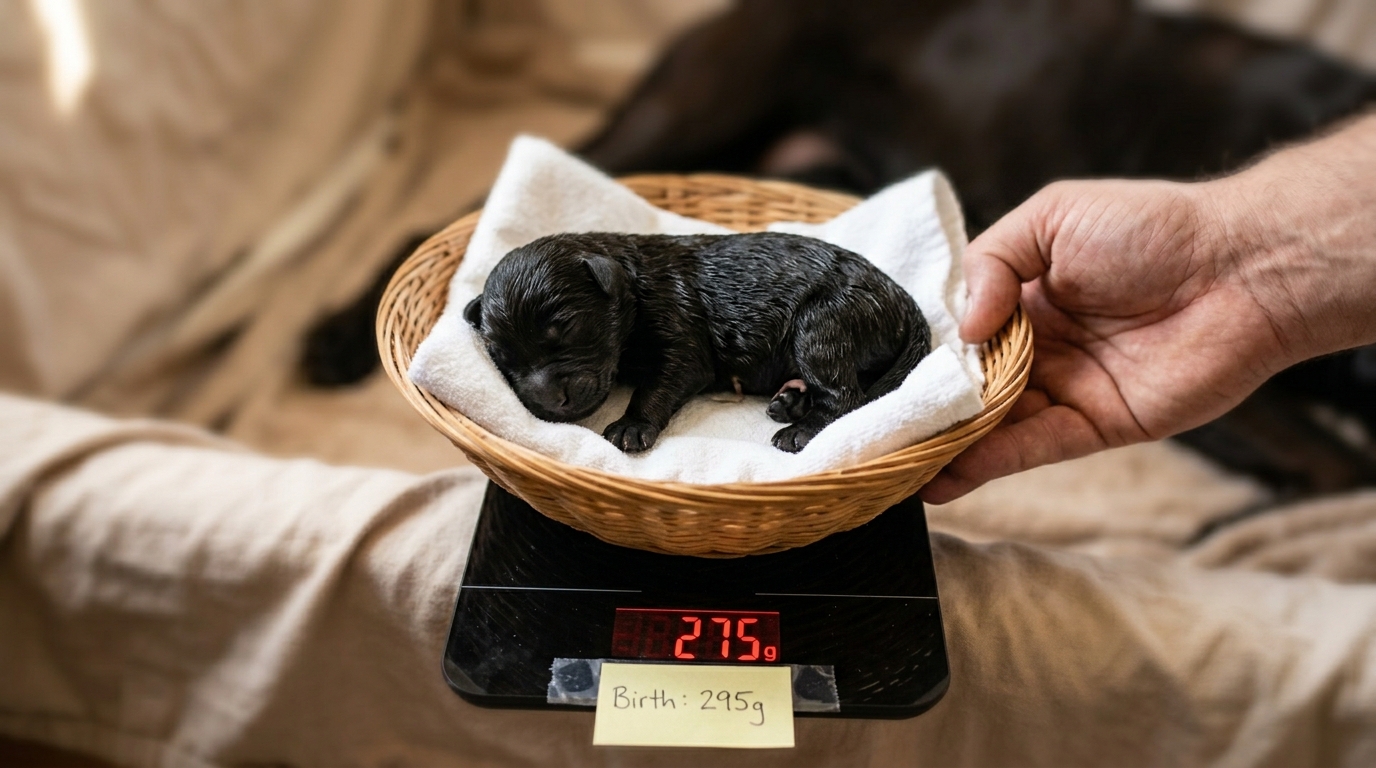
You cannot measure IgG at the whelping box. Refractometry in dogs is too imprecise to be a kennel-side tool, and laboratory testing is not a routine option in clinical practice. What you can measure, with a kitchen scale, is body weight. A puppy that absorbed adequate colostrum and is nursing well will lose minimal weight in the first 48 hours, then begin a steady upward curve. A puppy that did not will tell you in numbers, on Day 1 or Day 2, before any obvious clinical sign appears.
Daily weighing is not optional. It is the verification step for everything that happened in the first 24 hours, and it is the earliest objective signal you have for the rest of the neonatal period.
Table 8: Daily Weighing Setup Checklist
| Item | Specification | Notes |
|---|---|---|
| Scale | Digital kitchen scale, 1 g resolution, capacity at least 5 kg (11 lb) | A 1 g resolution is essential for small breeds and kittens |
| Container | Small basket or bowl lined with a clean towel | Tare the scale with the basket on it before each weighing |
| Logbook | Notebook or printed chart, one row per puppy per day | Paper beats memory. Always write it down |
| Routine | Same time every day, before nursing if possible | Consistency in timing matters more than the exact hour |
| Identification | Coloured collars or non-toxic markers | Never weigh “the black one” without an ID system |
What the Numbers Mean
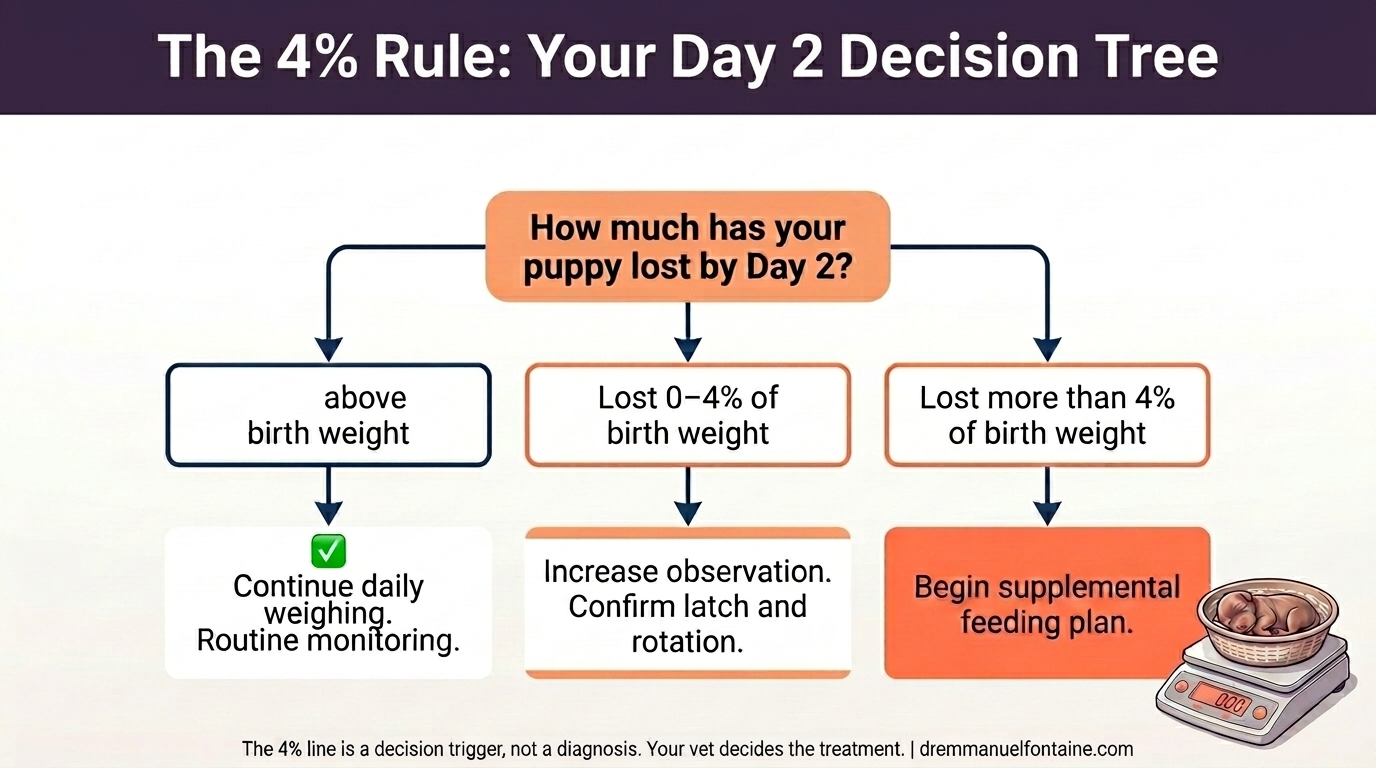
A small weight loss in the first 24 hours is normal. After that, weight gain should be steady. The single most important threshold is the 4% mark: a puppy that has lost more than 4% of birth weight by Day 2 is at meaningful risk and needs immediate attention. The 4% rule is simple, easy to apply at the whelping box, and the most reliable practical signal of inadequate colostrum intake.
Table 9: Weight Loss Thresholds and Action Steps
| Day 2 status | Risk level | Action |
|---|---|---|
| At or above birth weight | Low | Continue daily weighing. Routine monitoring |
| Lost between 0 and 4% of birth weight | Watchable | Increase observation frequency. Confirm latch and rotation across teats |
| Lost more than 4% of birth weight | High | Call your veterinarian the same day. Begin a supplemental feeding plan |
| Continued loss after Day 2 | Critical | Veterinary intervention required. Do not wait for the next morning |
Daily Tracking, Not Just Birth Weight
A single weight is a snapshot. A daily curve is a story. The pattern that emerges across the first three weeks tells you which puppies are thriving, which are coasting, and which are slipping. Many breeders catch problems on Day 3 or Day 4 simply because the line on the chart bends the wrong way. The rotation behaviour you protected during the first 24 hours becomes visible, days later, as a steady weight curve.
Table 10: Birth Weight and Daily Tracking Log Example
| Puppy ID | Birth weight | Day 1 | Day 2 | Day 3 | Pattern read |
|---|---|---|---|---|---|
| Red collar | 320 g (11.3 oz) | 315 g | 322 g | 340 g | Healthy. Steady upward curve |
| Blue collar | 280 g (9.9 oz) | 270 g | 268 g | 265 g | Concerning. Vet call. More than 4% below birth weight |
| Green collar | 310 g (10.9 oz) | 305 g | 310 g | 325 g | Healthy. Brief loss, clean recovery |
| Yellow collar | 295 g (10.4 oz) | 288 g | 295 g | 312 g | Healthy. Recovered to birth weight by Day 2 |
When to Bring in Your Veterinarian
The Signals That Cross the Line
Weight is the early signal, but it is not the only one. A puppy with poor passive immune transfer is also more likely to feel cold to the touch, vocalise weakly, and lose suckling reflex. Any of these alongside a weight curve that is not climbing is a same-day veterinary visit. Your veterinarian’s role here is not to run laboratory IgG panels at the whelping box. It is to assess hydration, body temperature, blood glucose, and overall stability, and to guide you on supplemental feeding if it is required.
Table 11: Signs That Need a Vet Call
| Sign | What it suggests | Urgency |
|---|---|---|
| More than 4% weight loss by Day 2 | Inadequate colostrum intake or nursing failure | Same day |
| Cool to the touch (below 35.5 °C / 96 °F rectally in first week) | Hypothermia. Gut motility shuts down at low temperatures | Immediate |
| Weak suckling reflex | Energy deficit. Risk of cascade into hypoglycaemia | Immediate |
| Constant crying or unusual silence | Pain, hypoglycaemia, or hypothermia | Immediate |
| Failure to gain by Day 3 | Compounding deficit. Curve bending the wrong way | Same day |

The Backup Plan: Colostrum Banking
If the dam is unavailable, unable to nurse, or producing visibly poor colostrum, donor colostrum is the best substitute. The Chastant-Maillard team and others have documented that colostrum collected from a donor bitch during early lactation, frozen in small aliquots, retains useful IgG concentration for several months. Build the bank with your veterinarian during the breeding season so that the question of “what now” never has to be answered in panic. The same principle applies to queens, with cat-specific dosing guidance from your vet.
Table 12: Colostrum Banking Quick Reference
| Step | Detail |
|---|---|
| Source | Healthy donor bitch in early lactation, ideally Day 1 to Day 2 post-whelping |
| Collection | Hand-stripping, all mammary pairs, into a clean syringe |
| Storage | 2 mL aliquots, frozen at minus 20 °C (minus 4 °F), labelled by date and dam ID |
| Shelf life | Up to 6 months at minus 20 °C without significant IgG loss |
| Thawing | Warm-water bath. Never microwave. Use within 24 hours of thawing |
| Dosing | Approximately 1 mL per 100 g of puppy body weight, split across the first 8 hours |
| Veterinary partnership | Build the bank before the season. Discuss dosing protocols in advance |
A Note for Cat Breeders
The Mila study was conducted on dogs. Feline colostrum data are sparser, but the available work (Chastant-Maillard et al. 2016) suggests the same architecture applies. Queens produce colostrum with substantial between-teat variation, kittens have a similarly narrow absorption window, and weight monitoring remains the most reliable kitten-side signal. Cat breeders running their own kitten weight charts on Day 1 and Day 2 are catching the same problems for the same reasons. The 4% rule, the daily scale, and the rotation principle all carry over. Your veterinarian can advise on cat-specific colostrum banking and supplemental feeding.
Conclusion
The 42% variation between teats on the same bitch is not a problem you can solve by picking better. It is a biological reality with a built-in compensation mechanism, namely puppies that rotate across teats during the critical window. Your role is to make that window count.
Get every puppy nursing in the first 8 hours. Watch for rotation across multiple teats, not for any single best teat. Weigh every puppy daily on the same scale, at the same time, recorded on paper. If a puppy has lost more than 4% of birth weight by Day 2, that is the line. Call your veterinarian then, not later.
Daily weighing is the practice that turns invisible biology into a number you can read. It is the most powerful tool you have at the whelping box, and it costs less than a bag of kibble.