
🇫🇷 Lire en Français | 🇪🇸Leer en Español | 🇧🇷Leia em português
Picture a devoted mother dog who has just delivered a large litter. She is panting excessively, pacing restlessly, and seems unusually reluctant to let her newborn puppies nurse. When they approach her belly, she flinches or turns away. You assume she is simply exhausted — after all, labor is tiring, and a quiet recovery seems normal.
But what if she is not tired? What if she is in genuine, excruciating pain? Every time a puppy latches on, the nipple stimulation triggers oxytocin release, which causes her uterus to contract — producing intense cramping known as afterpains. Because she cannot tell you, her suffering goes completely unrecognized. And here is the part that should stop every breeder in their tracks: this unmanaged pain silently impairs her colostrum and milk production, disrupts her bonding with the litter, and puts every single neonate’s survival at risk. As a veterinarian, I want to challenge the idea that birth pain is simply part of the process — and show you exactly how to manage it.
- TL;DR: Key Takeaways
- What Should You Know About Birth Pain in Dogs and Cats?
- What Should You Do to Manage Birth Pain?
- What Tools and Supplies Should You Have Ready?
- What Warning Signs Should You Watch For?
- She Cannot Tell You It Hurts — But Now You Know
TL;DR: Key Takeaways
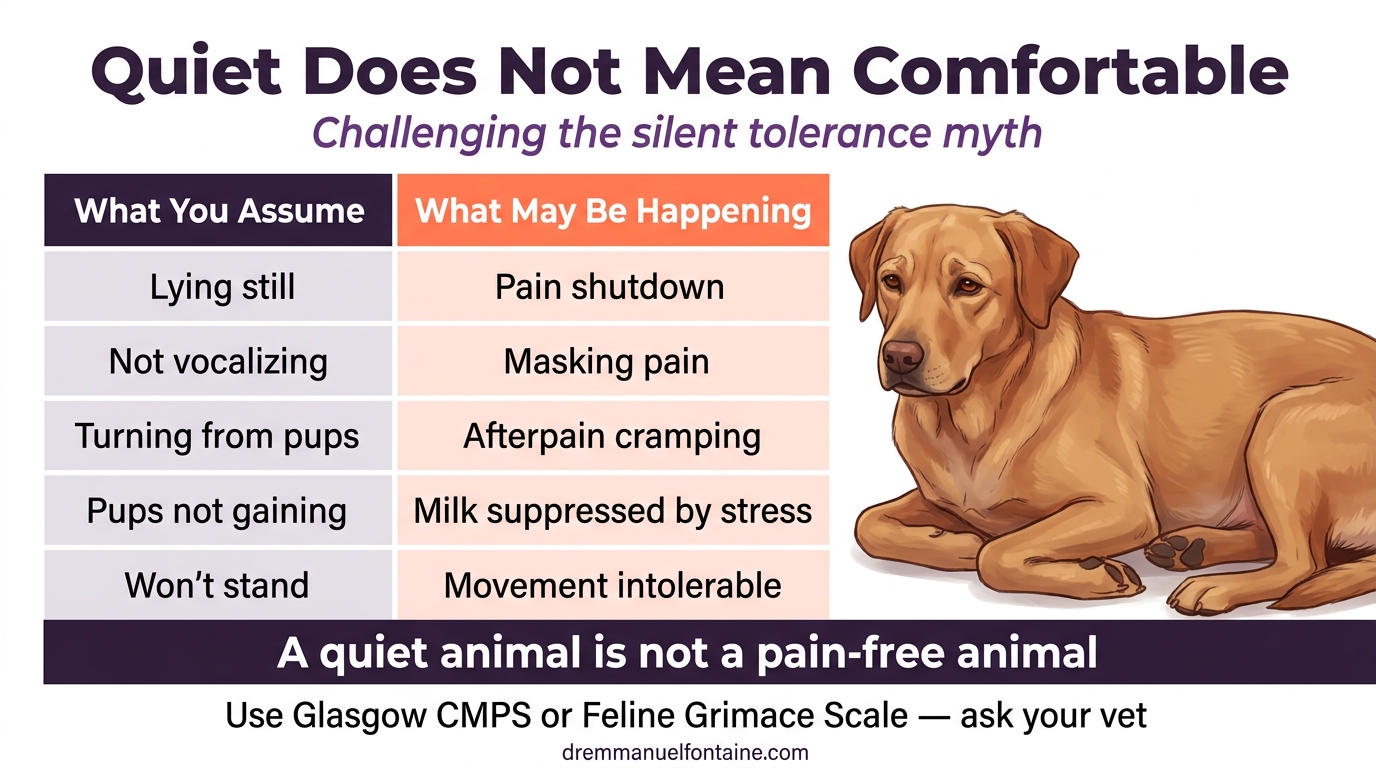
A quiet animal is not a pain-free animal — dogs and cats are masters at hiding pain, and assuming silence equals comfort is the single most dangerous mistake breeders make during whelping.
Unmanaged birth pain directly impairs colostrum and milk production by triggering stress hormones that interfere with prolactin and oxytocin, putting the entire litter at immediate nutritional risk.
Afterpains (postpartum uterine cramping) are real, intense, and get worse with each subsequent litter — multiparous dams need more pain support, not less.
Never administer any medication without your veterinarian’s guidance — many over-the-counter painkillers transfer through milk and can cause serious toxicity in nursing neonates.
Discuss a postpartum pain management plan with your vet before the birth — scheduled veterinary-approved NSAIDs every 6 to 8 hours for the first 24 to 72 hours can transform maternal comfort and litter survival.
Environmental control is your most powerful non-pharmacological tool: dim lighting, quiet space, pheromone diffusers, freedom of movement, and the calm presence of a trusted human all measurably reduce pain.
What Should You Know About Birth Pain in Dogs and Cats?
The Science of Labor Pain Nobody Talks About
Labor pain in dogs and cats follows the same physiological pattern as in humans, yet veterinary medicine has historically treated it as an afterthought. During the first stage of active labor, pain originates from visceral sources — specifically the rhythmic contractions of the uterus and the dilation of the cervix. These waves of pain are dull, deep, and relentless. As labor progresses into the second stage (delivery), the pain shifts to somatic sources: the intense stretching and distension of the perineum as each puppy or kitten passes through the birth canal.
But the pain does not end at delivery. In the hours and days that follow, the mother experiences postpartum cramping — afterpains — caused by the uterus contracting to return to its pre-pregnancy size. Here is the detail that every breeder needs to understand: these afterpains intensify during nursing because nipple stimulation triggers oxytocin, which directly causes the uterus to contract. This means that every single time a puppy or kitten latches on, the mother’s uterus cramps. In multiparous females (those who have delivered previous litters), these afterpains are classically more pronounced. The pain typically peaks within the first 2 to 3 days postpartum and gradually subsides over the following week.
| Pain Phase | Source | Timing | Character |
|---|---|---|---|
| First stage (active labor) | Visceral: uterine contractions and cervical dilation | Throughout active labor | Rhythmic, wave-like, dull, and deep |
| Second stage (delivery) | Somatic: perineal stretching and distension | During expulsion of each neonate | Intense, sharp, localized pressure |
| Post-delivery (perineal trauma) | Tissue damage: vaginal or perineal lacerations | First 24–72 hours postpartum | Sharp, localized, worsened by movement |
| Afterpains (postpartum cramping) | Uterine involution triggered by oxytocin during nursing | Peaks in first 2–3 days; subsides over 1 week | Dull, diffuse, cramping; intensified by each nursing session |
Why Birth Pain Has Been Invisible for So Long
If birth pain is real and measurable, why has veterinary medicine done so little about it? The answer lies in a combination of historical tradition and a fundamental communication barrier. Veterinary obstetrics has long operated under a hands-off philosophy: if there is no dystocia (obstructed labor), the assumption is that the mother is fine. Pain management in veterinary obstetrics has improved over the past decade, but almost exclusively for post-operative C-section recovery — spontaneous vaginal births have been left behind.
The deeper problem is the assumption of silent tolerance. Because dogs and cats cannot verbalize their pain on a 0-to-10 scale, there is a pervasive — and dangerous — tendency to equate a lack of obvious vocalization with an absence of pain. Cats are especially notorious for masking discomfort. A mother lying still and quiet may not be resting comfortably; she may be in so much pain that she has simply shut down. Veterinarians have also historically hesitated to use analgesics during labor out of concern that medications might cross the placenta and sedate the newborns, or interfere with uterine contractions. These concerns are valid for certain drugs, but they have created a blanket reluctance that leaves many mothers suffering unnecessarily.
| Barrier | What Breeders Assume | What the Science Shows |
|---|---|---|
| Hands-off tradition | Normal birth needs no intervention | Pain is a physiological certainty even in uncomplicated deliveries |
| Silent tolerance myth | A quiet animal is comfortable | Animals hide pain; silence can indicate severe distress, not comfort |
| Fear of medication risks | Analgesics will harm the neonates or stop contractions | Veterinary-approved NSAIDs have low milk transfer and do not suppress labor |
| C-section focus | Only surgical births need pain management | Spontaneous vaginal births generate equivalent visceral and somatic pain |
How Unmanaged Pain Threatens Your Entire Litter
This is the connection that changes everything: unmanaged maternal pain does not just affect the mother — it directly threatens the survival of her litter. High levels of pain and stress trigger the release of catecholamines (stress hormones like adrenaline and cortisol), which interfere with two critical hormones: prolactin (which drives milk production) and oxytocin (which controls milk letdown). When these hormones are suppressed, the onset of copious milk production — called lactogenesis II — is delayed.
The consequences cascade rapidly. A mother in uncontrolled pain may refuse to let her neonates nurse, become agitated when they approach, or simply lack the energy and willingness to adopt comfortable nursing positions. In severe cases, extreme pain or distress can trigger aggression toward the litter. Even when the mother does nurse, impaired oxytocin release means the milk may not let down properly — the puppies or kittens are latched but receiving inadequate nutrition. Meanwhile, pain delays the mother’s own recovery, reduces her food and water intake, and prevents her from performing essential caregiving behaviors like grooming and waste elimination for the neonates. As we will cover later in this blog, proactive pain management is not a luxury — it is a direct investment in neonatal survival.
| Consequence of Unmanaged Pain | Mechanism | Impact on the Litter |
|---|---|---|
| Delayed milk production | Stress hormones suppress prolactin and oxytocin | Neonates miss critical early colostrum; risk of malnutrition |
| Nursing refusal or agitation | Mother associates nursing with afterpain cramping | Reduced nursing frequency; neonatal weight loss |
| Impaired milk letdown | Oxytocin suppressed by catecholamines even when nursing occurs | Puppies/kittens latch but receive inadequate volume |
| Aggression toward litter | Extreme pain or distress triggers protective/defensive behavior | Risk of physical harm to neonates; maternal rejection |
| Delayed maternal recovery | Pain reduces food/water intake and mobility | Mother unable to groom, warm, or stimulate neonates |
What Should You Do to Manage Birth Pain?
Create a Pain-Reducing Environment Before Labor Begins
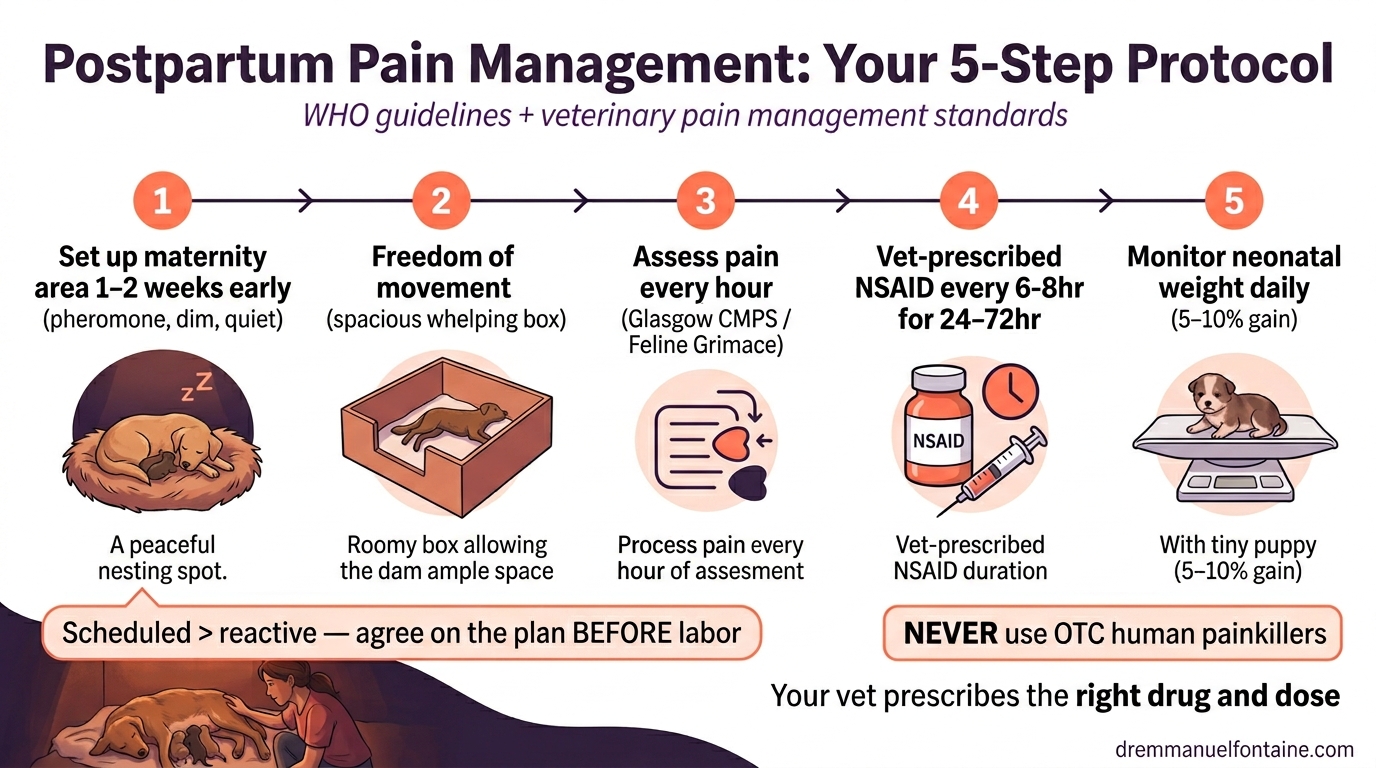
Your most powerful pain management tool requires no prescription: the whelping environment itself. Introduce the mother to her designated maternity area 1 to 2 weeks before her expected due date. This is not a suggestion — it is essential. Familiarity with her surroundings significantly reduces fear and anxiety, which directly lowers pain sensitivity. Research from human home births confirms what every experienced breeder knows intuitively: comfort in familiar surroundings measurably reduces pain perception.
The space should be warm, dim, quiet, and private. Install a pheromone diffuser (Adaptil for dogs, Feliway for cats) to establish a calming baseline. The whelping box itself must be large enough for the mother to stand, circle, stretch, and freely change positions without restriction — freedom of movement is one of the most effective non-pharmacological pain reducers. Place a covered heating pad under only part of the box to provide a warmth gradient: the neonates get the heat they need, and the mother gets ambient muscle relaxation and comfort without overheating. During labor, if the mother is receptive to touch, gentle calming strokes can help. If she prefers solitude, respect her space and observe from a distance.
| Environmental Factor | What to Do | Why It Reduces Pain |
|---|---|---|
| Familiarization | Introduce mother to maternity area 1–2 weeks early | Reduces fear and anxiety, which directly lowers pain sensitivity |
| Lighting | Dim or indirect lighting during labor and recovery | Reduces cortisol production; promotes relaxation |
| Sound | Quiet environment; minimize disturbances and visitors | Loud noise amplifies stress, which increases pain perception |
| Pheromone diffuser | Install Adaptil (dog) or Feliway (cat) in maternity area | Establishes calming baseline; reduces anxiety-driven pain |
| Freedom of movement | Whelping box large enough to stand, circle, stretch | Unrestricted movement is a proven non-pharmacological pain reducer |
| Targeted warmth | Covered heating pad under part of the box only | Provides muscle relaxation and neonatal warmth without overheating |
Monitor Pain Systematically During and After Birth
Because your dog or cat cannot tell you where it hurts, you must become her voice. Adopt a systematic approach: assess the mother’s pain every hour during the birth process, just as human midwives monitor laboring women. Look for the behavioral indicators of pain: excessive panting, restlessness, reluctance to settle, frequent changes in posture, attention to the abdominal or vulvar area, and vocalization (whining, crying, or groaning).
For dogs, familiarize yourself with the Glasgow Composite Measure Pain Scale (CMPS), which scores posture, mobility, vocalization, and demeanor. A short-form score above 6 out of 24 indicates a likely need for additional analgesia. For cats, the Feline Grimace Scale is your most reliable tool — it objectively measures pain through subtle facial changes: ear position, orbital tightening, muzzle tension, whisker position, and head position. Physiological signs like elevated heart rate, blood pressure, and pupil dilation can also indicate pain, though these are non-specific and can be caused by stress alone. The key message: monitor actively, record what you observe, and share your findings with your veterinarian.
| Assessment Method | Species | What It Measures | Action Threshold |
|---|---|---|---|
| Glasgow CMPS (short form) | Dogs | Posture, mobility, vocalization, demeanor | Score > 6/24 → veterinary intervention for analgesia |
| Feline Grimace Scale | Cats | Ear position, orbital tightening, muzzle tension, whisker and head position | Elevated score → consult vet for pain management |
| Behavioral observation | Both | Panting, restlessness, posture changes, vocalization, nursing reluctance | Any persistent behavioral change → assess and record |
| Physiological signs | Both | Heart rate, blood pressure, pupil dilation | Non-specific; use alongside behavioral cues, not alone |
Work With Your Vet to Establish Scheduled Pain Relief
This is the single most important conversation you will have with your veterinarian before a litter arrives: discuss and agree on a postpartum pain management plan. Do not wait until the mother is in visible distress. The research from human obstetrics is clear: scheduled pain relief is far more effective than reactive treatment. In human postpartum care, NSAIDs are administered on a fixed schedule every 6 to 8 hours for the first 24 to 72 hours because they pass minimally into breast milk.
The same principle applies to veterinary medicine. A short course of a veterinary-approved NSAID, administered on a scheduled basis for the first 24 to 72 hours postpartum, can dramatically improve maternal comfort, restore normal mobility, and allow the mother to nurse, groom, and bond with her litter without the interference of pain. One critical rule: never administer any medication without explicit veterinary instruction. Many over-the-counter human painkillers — including acetaminophen in cats and ibuprofen in dogs — transfer through milk and can cause serious toxicity or central nervous system depression in nursing neonates. Your vet will prescribe the right drug, at the right dose, for the right duration. For localized perineal discomfort, warm compresses applied gently to the area (with your vet’s guidance) can soothe tissue without affecting the nursing young.
| Approach | Method | Timing | Safety Note |
|---|---|---|---|
| Scheduled NSAID (vet-prescribed) | Veterinary-approved NSAID (e.g., carprofen) | Every 6–8 hours for first 24–72 hours postpartum | Low milk transfer; safe for nursing neonates when vet-prescribed |
| Warm compresses (perineal) | Gentle application to perineal area | As needed in first 24–72 hours | Non-invasive; does not affect nursing |
| Pheromone therapy | Adaptil (dog) or Feliway (cat) diffuser | Continuous from 1–2 weeks before birth | No drug interactions; reduces anxiety-amplified pain |
| Environmental control | Dim, quiet, warm, private maternity area | Continuous from setup through recovery | No contraindications; foundational pain management |
| NEVER: OTC human painkillers | Ibuprofen, acetaminophen, aspirin | NEVER without vet approval | Toxic to neonates via milk; potentially fatal |
What Tools and Supplies Should You Have Ready?
Pain Assessment Tools and Behavioral References
Pain is sometimes called the fourth vital sign, alongside temperature, pulse, and respiration. To treat it as such, you need the right assessment tools on hand. The Glasgow CMPS (dogs) and the Feline Grimace Scale (cats) are your two validated scoring systems. Print or download these reference charts and post them in your maternity area where you can consult them quickly during and after labor. Having them physically visible — not buried in a phone app — transforms you from a passive observer into an active advocate for your dam’s welfare.
Beyond the formal scales, train yourself to recognize the behavioral vocabulary of pain in your specific breed and species. Excessive panting, restlessness, reluctance to settle, frequent changes in posture, attention to the vulvar area, and vocalization are all signals. Cats present a particular challenge because they hide pain with stillness and silence — which is exactly why the Feline Grimace Scale focuses on facial expressions rather than vocalizations. Track your observations hourly during labor and at least every 4 to 6 hours during the first 72 hours postpartum.
| Tool | Species | What It Assesses | How to Use It |
|---|---|---|---|
| Glasgow CMPS (short form) | Dogs | Posture, mobility, vocalization, demeanor | Score every 1–2 hours during/after birth; > 6/24 = call vet |
| Feline Grimace Scale | Cats | Ear position, orbital tightening, muzzle tension, whisker and head position | Assess facial expression every 1–2 hours; elevated score = call vet |
| Behavioral monitoring log | Both | Panting, restlessness, posture changes, nursing behavior | Record hourly during labor; every 4–6 hours for first 72 hours |
| Physiological baseline | Both | Resting heart rate, respiratory rate | Establish baseline before labor; compare during/after birth |
Medical Supplies and Environmental Equipment
Have your veterinarian prescribe a lactation-safe analgesic before the due date so it is on hand when you need it. Research supports carprofen as a veterinary NSAID with low milk transfer that can significantly improve maternal comfort and care behaviors. Never stockpile or self-prescribe medications — the dosing, drug choice, and duration must come from your vet.
For physical comfort, stock warm compresses that can be applied to the perineum to soothe localized pain, reduce tissue trauma, and relax muscles. Prepare your maternity area with a pheromone diffuser installed 1 to 2 weeks before the expected birth. Have safe heating pads ready — covered and placed under only part of the whelping box so the mother and neonates can self-regulate temperature. A spacious, dim, quiet nesting box is not optional equipment; it is foundational pain management infrastructure.
| Category | Items | Purpose |
|---|---|---|
| Vet-prescribed analgesic | Carprofen or other lactation-safe NSAID (vet-prescribed only) | Scheduled postpartum pain relief for first 24–72 hours |
| Physical comfort | Warm compresses, covered heating pad | Perineal soothing and ambient muscle relaxation |
| Environmental | Pheromone diffuser (Adaptil/Feliway), dim lighting, quiet space | Anxiety reduction; non-pharmacological pain management |
| Monitoring | Printed pain scales (Glasgow CMPS, Feline Grimace Scale), observation log | Systematic pain tracking; data for veterinary consultations |
| Neonatal support | Colostrum backup, neonatal bottles, digital scale | Ensure neonatal nutrition if maternal pain impairs nursing |
Your Veterinary Relationship and Pain Plan
Your veterinarian is not a last resort — they are your proactive partner in every birth. Schedule a prenatal consultation specifically to discuss postpartum pain management. Bring up afterpains, especially if your dam has had previous litters (multiparous females experience significantly worse postpartum cramping). Ask about scheduled medication protocols versus reactive treatment. Agree on a plan before the first contraction begins.
Establish clear thresholds for when to call. If the mother scores above 6 out of 24 on the Glasgow CMPS, if she refuses to nurse or becomes aggressive toward her litter, if she refuses food and water for more than 12 hours postpartum, or if she shows signs of immobility (lying still and whining rather than recovering actively) — these are the moments when your vet’s expertise is essential. Also discuss trauma evaluation: your vet should examine the mother for vaginal or perineal tears that might require specific localized or systemic pain relief beyond the standard postpartum protocol.
| Timing | Discussion Topic | Outcome |
|---|---|---|
| Before birth (prenatal visit) | Postpartum pain plan; medication choice; afterpain management | Written protocol with drug, dose, and schedule agreed upon |
| During labor | Hourly pain assessment updates if needed | Vet available for phone guidance or emergency visit |
| First 24–72 hours postpartum | Pain score trends; nursing behavior; medication efficacy | Adjustment of analgesic if initial protocol is insufficient |
| Post-recovery (1 week) | Trauma check; perineal healing; medication discontinuation | Confirm recovery; document any complications for future litters |
What Warning Signs Should You Watch For?
Subtle Early Signs of Pain You Might Be Missing
The most dangerous pain is the kind you do not recognize. Watch for subtle behavioral changes that precede obvious distress: restlessness, reluctance to settle, and frequent changes in posture. These early signals are easy to dismiss as normal post-birth adjustment, but they are often the first indicators that the mother’s pain is building. Non-specific physiological shifts — an increase in heart rate, blood pressure, pupil dilation, and panting — are additional clues.
Cats deserve special attention because they are masters of concealment. A cat in pain may simply become still and withdraw rather than vocalize. Use the Feline Grimace Scale you posted in your maternity area and watch specifically for changes in ear position, orbital tightening, and muzzle tension — these are often the only visible clues. For both species, assess pain every hour during and immediately after birth. If you observe any persistent behavioral change, record it and contact your veterinarian.
| Species | Subtle Sign | What It Suggests | Action |
|---|---|---|---|
| Both | Restlessness and reluctance to settle | Building pain or discomfort | Assess pain score; monitor closely every 30 minutes |
| Both | Frequent posture changes | Searching for a comfortable position | Ensure freedom of movement; check warmth and bedding |
| Both | Increased panting (outside of labor) | Pain or stress response | Differentiate from normal panting; assess hourly |
| Dogs | Whining, groaning, or crying | Moderate to significant pain | Score using Glasgow CMPS; contact vet if > 6/24 |
| Cats | Flattened ears, orbital tightening, muzzle tension | Moderate to significant pain (hidden) | Score using Feline Grimace Scale; contact vet |
Emergency Danger Signs That Demand Immediate Veterinary Care
Some pain signals cross the line from concerning to emergency. Excessive vocalization (loud, persistent whining or crying) during delivery or in the postpartum period is a red flag that the animal may be experiencing severe pain or a complication. Maternal rejection or aggression toward the litter — especially a mother who was previously calm and attentive — strongly suggests intense, unmanaged pain, potentially from engorged mammary glands, a retained placenta, or a severe uterine complication.
A mother that refuses to get up and instead lies completely still while whining is showing a major danger sign. This immobility indicates pain so severe that movement has become intolerable. A complete refusal of food and water is another critical threshold. If you are using the Glasgow CMPS for dogs, a score above 6 out of 24 is the formal indicator that veterinary intervention and additional analgesia are required. Do not wait for the score to reach the maximum — at 6/24, your vet needs to be involved.
| Danger Sign | What It Indicates | Immediate Action |
|---|---|---|
| Excessive, persistent vocalization | Severe pain or active complication (dystocia, retained placenta) | Contact your vet immediately |
| Maternal aggression toward litter | Pain so intense it triggers defensive/aggressive behavior | Separate neonates safely; call vet; assess for uterine or mammary pathology |
| Immobility with whining | Pain too severe for voluntary movement | Emergency veterinary evaluation; do not delay |
| Refusal of all food and water | Systemic distress; potential infection or severe pain | Contact vet; assess for metritis or retained placenta |
| Glasgow CMPS > 6/24 (dogs) | Formal pain threshold indicating need for analgesia | Administer vet-prescribed analgesic; contact vet for evaluation |
Signs That Pain Management Is Working — or Failing
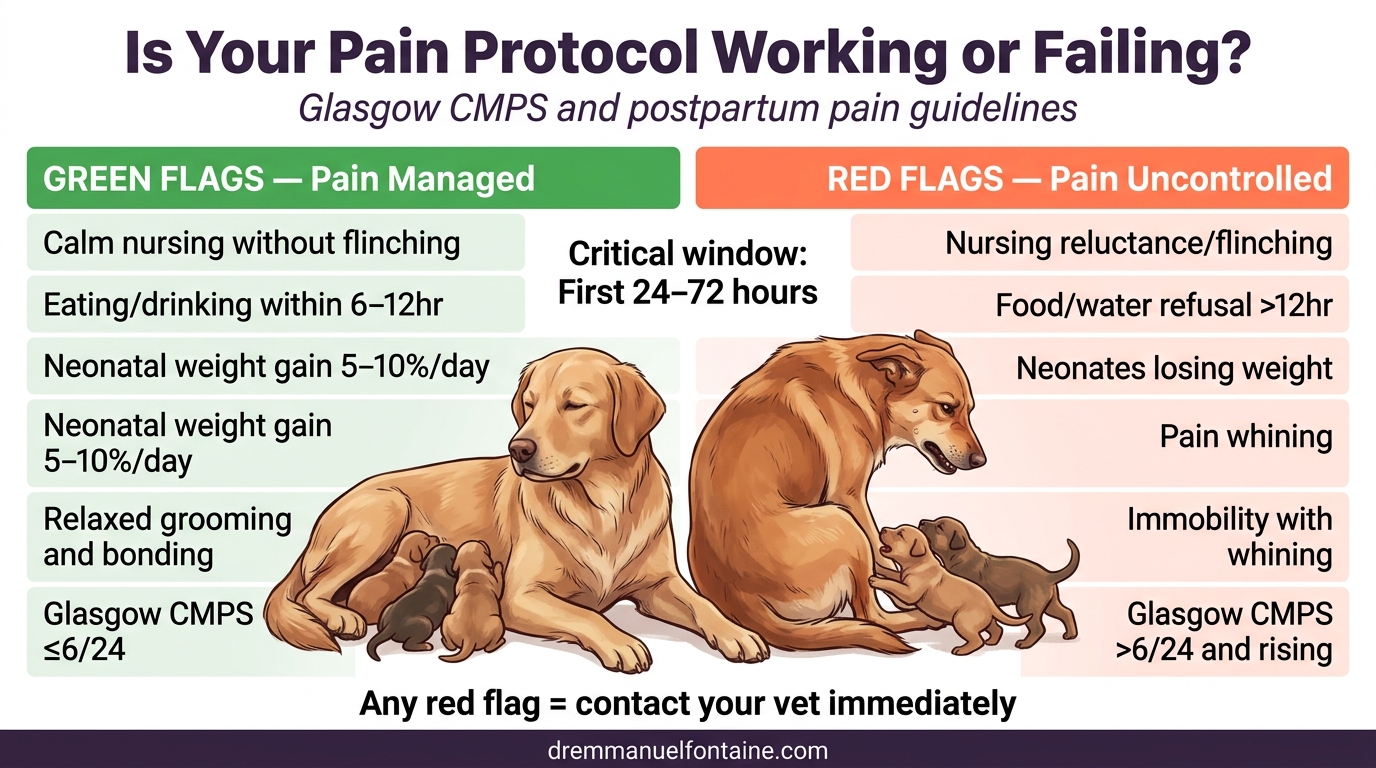
When your pain management protocol is working, you will see a clear return to normal maternal behavior. The mother will willingly stand to eat and drink, go outside to eliminate, and settle calmly with her litter. She will adopt comfortable nursing positions without flinching, and she will actively groom and bond with her neonates. Her appetite will return, and her overall demeanor will shift from tense or withdrawn to relaxed and engaged. These behavioral improvements are your confirmation that the pain is under control.
When the protocol is failing, the signs are equally clear. The mother remains distracted, distressed, and unable to focus on her newborns. A hidden physiological signal that pain management is failing is impaired colostrum and milk production — you may notice neonates who are nursing but not gaining weight, or who are crying persistently between feedings. The critical evaluation window is the first 24 to 72 hours postpartum, when perineal trauma and afterpains are at their peak. If scheduled pain relief is not controlling the mother’s discomfort during this window, she may need a veterinary evaluation for complications or a short course of stronger analgesics. For future litters, remember that multiparous dams experience progressively stronger afterpains with each delivery — plan accordingly by discussing enhanced pain protocols with your vet before each subsequent birth.
| Indicator | Pain Management Working | Pain Management Failing |
|---|---|---|
| Mobility | Mother stands, eats, eliminates voluntarily | Mother immobile; refuses to stand or move |
| Nursing behavior | Calm, comfortable nursing; no flinching | Nursing reluctance; flinching; aggression when pups approach |
| Appetite and hydration | Eating and drinking within 6–12 hours postpartum | Refusal of food and water beyond 12 hours |
| Neonatal weight gain | Steady daily weight gain (5–10% per day) | Neonates stagnant or losing weight despite nursing |
| Maternal demeanor | Relaxed, engaged; grooming and bonding with litter | Distracted, withdrawn, tense, or aggressive |
| Pain score trend | Glasgow CMPS ≤ 6/24; Feline Grimace stable or decreasing | Scores increasing or persistently elevated |
Want to put all of this into action during your next whelping or queening? Inside the Breeder Vault, you’ll find the Birth Pain Management Field Protocol — a printable pain assessment checklist with Glasgow CMPS and Feline Grimace Scale scoring guides, scheduled medication tracking sheets, emergency decision trees, and veterinary request scripts designed to be used in real time during labor and the postpartum period. It’s the operational companion to everything you just learned.
She Cannot Tell You It Hurts — But Now You Know
The myth that birth pain is just part of the process has persisted for too long. Your whelping or queening dam experiences real, measurable pain during labor, delivery, and the days that follow. That pain is not harmless. It suppresses the hormones that drive milk production, disrupts the maternal bond, and puts every neonate in the litter at nutritional risk. And because she cannot tell you, the responsibility falls entirely on you to see it, measure it, and act on it.
You now have the tools. You understand the physiology of afterpains and why they intensify with each litter. You know how to set up an environment that reduces pain before it starts. You have the assessment scales to quantify what your dam cannot verbalize. And you have the framework to work with your veterinarian on a proactive, scheduled pain management plan that protects both the mother and her litter. The next time you sit beside your whelping box, you will not be guessing. You will be observing, assessing, and advocating — and that is the difference between a breeder who accepts pain and one who manages it.

 DR. EMMANUEL FONTAINE