🇫🇷 Lire en Français | 🇪🇸Leer en Español | 🇧🇷Leia em português
Picture this: you are carefully monitoring your pregnant bitch, and a mid-gestation blood test reveals a terrifying result. Her progesterone has plummeted by more than 15 ng/mL, falling far below the commonly cited safe baseline of 10 ng/mL. Your first instinct is to rush to the clinic for synthetic progesterone supplementation to save the litter.
But here is a fascinating detail from veterinary research: in a clinical study of nearly 100 pregnant bitches, dozens experienced this exact hormone plunge—yet every one of them delivered healthy puppies at the expected time without supplementation. The key insight is that a sudden drop in progesterone does not automatically mean she is losing the litter. An ovulation timing worksheet helps you see these trends clearly and respond with your vet’s guidance instead of panic. In this guide, you will learn how to build and read a progesterone tracking worksheet, follow trends across the cycle and pregnancy, and know exactly when to call your veterinarian.
- TL;DR: Key Takeaways
- What Should You Know About Progesterone and Ovulation Timing?
- How Should You Build and Read Your Breeding Worksheet?
- What Tools Should You Have for Progesterone Tracking?
- What Warning Signs Should You Watch for on Your Worksheet?
- Your Worksheet, Your Confidence
TL;DR: Key Takeaways
- An ovulation timing worksheet helps you track progesterone trends across multiple blood draws so you can spot the LH surge, ovulation, and the ideal breeding window—and avoid panic over a single number.
- In dogs, progesterone rises before ovulation (unlike most species), reaching roughly 5 ng/mL at ovulation and 15–40 ng/mL during the fertile window 2–4 days later.
- Cats are induced ovulators—they need the physical stimulus of mating to trigger an LH surge and progesterone rise, which changes how you time breeding entirely.
- A single progesterone number means very little on its own. The trend across several days is what tells the real story on your worksheet.
- Quantitative lab assays (chemiluminescence or radioimmunoassay) are more precise than semi-quantitative point-of-care kits for critical timing decisions.
- A mid-pregnancy progesterone drop can look alarming but may be completely normal—research shows many bitches deliver healthy litters despite steep declines.
- Your veterinarian or a theriogenologist (reproductive specialist) is your essential partner—share your worksheet at every visit so they can confirm timing and adjust the plan.
What Should You Know About Progesterone and Ovulation Timing?
How Progesterone Drives the Canine Estrous Cycle
Progesterone (P4) is the hormone that makes pregnancy possible. In dogs, it is produced by structures in the ovaries called corpora lutea (the small glands that form after each egg is released). Think of progesterone as the construction crew that builds and maintains the nursery inside the uterus. Without it, embryos have no safe place to grow.
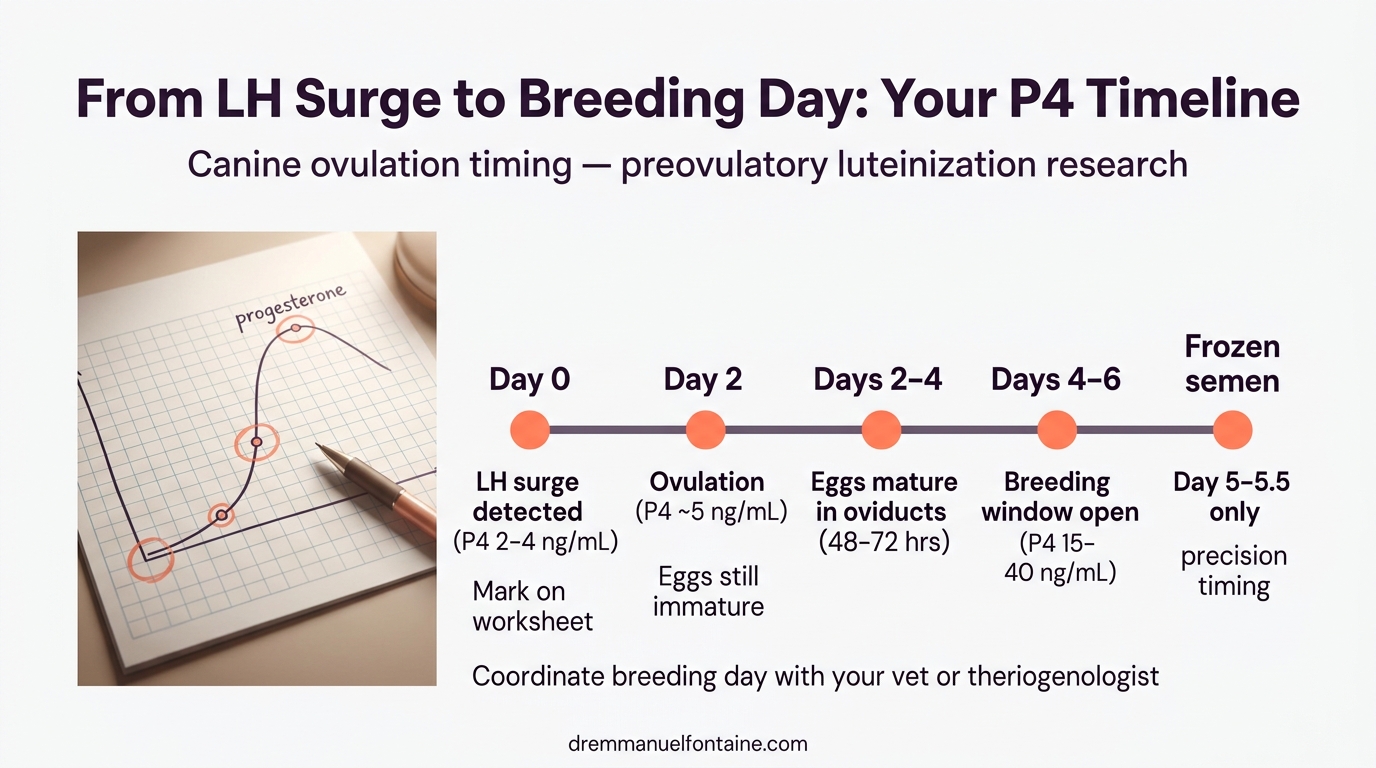
Here is what makes dogs unique: progesterone starts rising before ovulation even happens. This is called preovulatory luteinization, meaning the ovary begins producing progesterone at the same time as the LH surge (the hormonal trigger that tells the ovaries to release eggs). In most other mammals, progesterone only kicks in after ovulation. Recording each value on your ovulation timing worksheet lets you see this distinctive rise unfold in real time. Your vet can help you interpret whether the trend signals that ovulation is approaching or has already passed.
| Cycle Stage | Progesterone Level | What It Means |
|---|---|---|
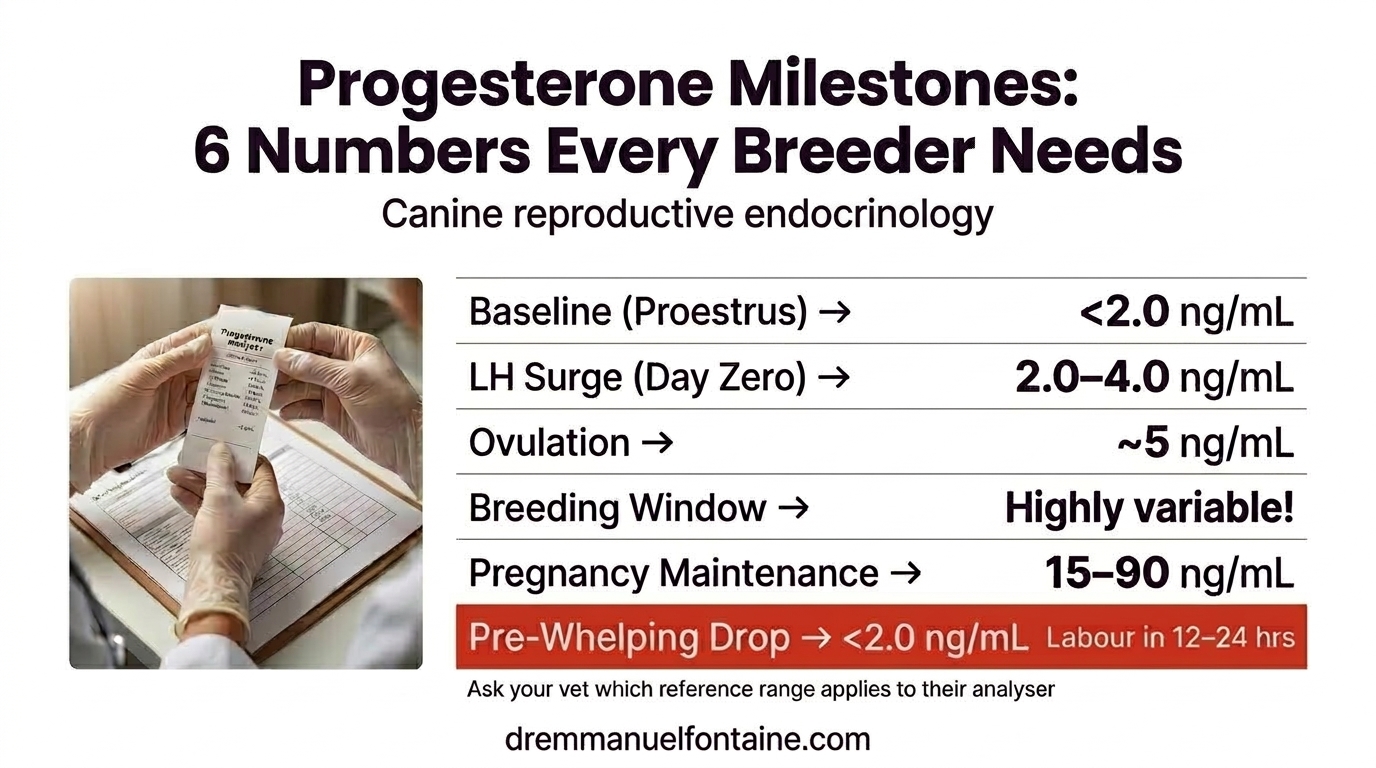
| Proestrus (early heat) | Less than 1.0–2.0 ng/mL | Baseline — ovulation has not started yet |
| LH Surge | 2.0–4.0 ng/mL | Ovulation will happen in roughly 48 hours |
| Ovulation | 4.0–10.0 ng/mL (typically ~5 ng/mL) | Eggs are released, but they are not yet mature |
| Optimal Breeding Window | Highly variable, 15–40 ng/mL (2–4 days post-ovulation) | Eggs are mature and ready for fertilization |
| Pre-whelping drop | Less than 2.0 ng/mL | Labour begins within 12–24 hours |
Why Dogs Ovulate Immature Eggs (And Why That Changes Timing)
Most mammals release eggs that are ready to be fertilized the moment they leave the ovary. Dogs are different. Your bitch ovulates primary oocytes, which are immature eggs still paused in their earliest stage of development. They need another 48–72 hours inside the oviducts (the tubes connecting the ovaries to the uterus) to finish maturing. Imagine baking bread: the dough comes out of the mixing bowl (the ovary) still raw, and it needs time in the proving drawer (the oviduct) before it is ready to bake.
This delayed maturation is the single biggest reason why the most fertile period in dogs is not the day of ovulation itself but rather 2 to 4 days after ovulation. On your worksheet, that translates to the window when P4 is between 15 and 40 ng/mL (as you can see this number is highly variable!). If you breed too early—right at ovulation—the eggs may not be ready. If you breed too late, the eggs may have aged past their prime. Your vet can combine the progesterone trend with other tools like vaginal cytology to detect the day of ovulation and then pinpoint the ideal day for breeding.
| Species | Egg Stage at Ovulation | Maturation Time After Ovulation | Ovulation Trigger |
|---|---|---|---|
| Dog | Immature (primary oocyte) | 48–72 hours in the oviduct | Spontaneous LH surge |
| Cat | Mature and fertilizable | Minimal — ready almost immediately | Induced by mating |
| Human | Mature and fertilizable | Minimal | Spontaneous LH surge |
| Cow | Mature and fertilizable | Minimal | Spontaneous LH surge |
Dogs vs. Cats: Key Species Differences for Breeders
If you breed both dogs and cats, you need two different mental models. Dogs are spontaneous ovulators—the LH surge and ovulation happen on their own schedule, regardless of whether the bitch mates. Cats are induced ovulators—the queen requires the physical stimulus of mating to trigger the LH surge and the subsequent rise in progesterone. This means that without mating, a queen will not ovulate at all.
One more thing to keep in mind: progesterone profiles look virtually identical in pregnant and non-pregnant bitches. A bitch in diestrus (the post-ovulation phase) or experiencing pseudopregnancy will maintain elevated P4 for about two months whether she conceived or not. So high progesterone alone cannot confirm pregnancy—your vet needs ultrasound for that.
| Feature | Dog (Bitch) | Cat (Queen) |
|---|---|---|
| Ovulation type | Spontaneous (happens on its own) | Induced (triggered by mating) |
| Egg maturity at ovulation | Immature — needs 48–72 hours to mature | Mature — ready almost immediately |
| P4 profile: pregnant vs. not pregnant | Nearly identical — cannot confirm pregnancy by P4 alone | Different — P4 stays elevated only if mating induced ovulation |
| Split heats (false starts) | Possible — P4 stays below 2.0 ng/mL (no true ovulation) | Less common |
How Should You Build and Read Your Breeding Worksheet?
Setting Up Your Worksheet Step by Step
Your ovulation timing worksheet is a simple log with columns for the date, the progesterone value, the lab method, behavioural observations, and veterinary notes. Start drawing blood samples at the beginning of proestrus, when you first notice vulvar swelling and discharge. Ask your vet to run a quantitative progesterone assay—methods like chemiluminescence or radioimmunoassay give you precise numeric values. Semi-quantitative point-of-care tests can estimate ranges, but they may lack the precision needed for critical decisions.
Record every result on your worksheet as soon as you get it. Plot the values on a simple line graph if possible. The trend is your compass—a single number in isolation means very little. What matters is whether the values are climbing steadily, have jumped sharply, or are holding flat. Share this worksheet with your vet at every visit so they can guide the next step.
| Worksheet Column | What to Record | Why It Matters |
|---|---|---|
| Date | Day of blood draw | Tracks the timeline of the cycle |
| Progesterone (ng/mL) | Exact numeric value from the lab | Shows the rising trend toward ovulation |
| Lab Method | Chemiluminescence, RIA, or in-house kit | Different methods can give slightly different numbers |
| LH Test Result (if done) | Positive or negative | Confirms Day Zero — the LH surge |
| Behavioural Signs | Standing heat, flagging, receptivity | Confirms hormonal data with real-world behaviour |
| Vet Notes | Vet interpretation, planned next draw | Keeps the entire team on the same page |
Reading the Trend: From LH Surge to Breeding Day
Once your worksheet has two or three values, you can start reading the story. A baseline value below 2.0 ng/mL means the cycle is still early. When you see the first rise to 2.0–4.0 ng/mL, that marks the LH surge. Write it in bold on your worksheet—this is Day Zero of your countdown. Ovulation typically follows roughly 48 hours after the LH surge, at a P4 of about 5 ng/mL. An in-house LH detection kit (like the Witness LH test) can confirm the surge if you want extra certainty.
The optimal breeding window for natural mating or fresh semen insemination is 2 to 4 days after ovulation. For fresh-chilled semen, which has a shorter survival time, most specialists recommend inseminating about 2-3 days after ovulation. For frozen semen, which survives only hours, timing must be even more precise. Work with your vet or theriogenologist to pick the exact day based on your progesterone chart for breeding.
| Semen Type | Best Breeding Time (Relative to Ovulation) | Why This Timing |
|---|---|---|
| Natural mating / fresh semen | 2–4 days after ovulation | Sperm survive several days; eggs are mature and waiting |
| Fresh-chilled semen | ~2-3 days after ovulation | Shorter sperm lifespan requires tighter timing |
| Frozen semen | ~3-3.5 day after ovulation | Sperm survive only hours; timing must be pinpoint precise |
Monitoring Progesterone During Pregnancy
Once breeding is complete, progesterone monitoring does not stop. During pregnancy, P4 levels remain elevated between 15 and 90 ng/mL. As we discussed already, the corpora lutea are the only source of progesterone in pregnant dogs. That means if those structures falter, the pregnancy is at risk. Your vet may recommend drawing blood weekly starting 5–7 days after the last breeding.
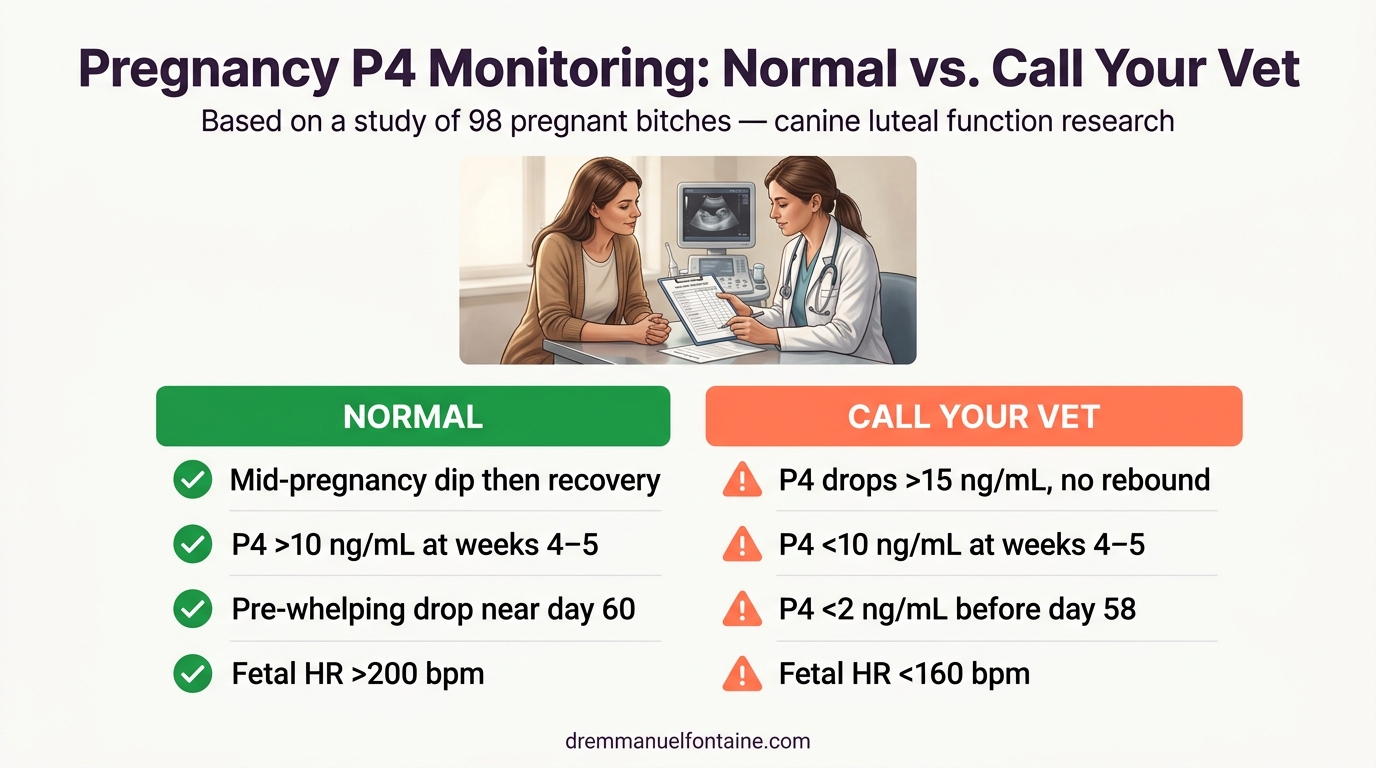
A condition called hypoluteoidism (luteal insufficiency) occurs when the corpora lutea do not produce enough progesterone to maintain the pregnancy. A steep drop in P4—more than 15 ng/mL—between days 20 and 35 can look alarming. However, a landmark study found that 28 out of 98 pregnant bitches experienced this exact drop yet delivered healthy litters without any supplementation. This is a key myth-busting insight: a sudden drop does not automatically equal a lost litter. Do not panic. Share your worksheet data with your vet, who can confirm fetal viability with ultrasound before making any treatment decisions.
| Pregnancy Stage | Expected P4 Range | Concerning Sign | Action |
|---|---|---|---|
| Days 10–30 | Greater than 20 ng/mL | Rapid drop of more than 15 ng/mL | Contact your vet; confirm fetal viability on ultrasound |
| Days 30–45 | Greater than 10 ng/mL | P4 falling below 10 ng/mL | Vet may consider natural progesterone in oil (not synthetic progestins) |
| Days 45–58 | Greater than 5 ng/mL | P4 below 5 ng/mL before day 58 | Urgent vet visit — risk of premature labour |
| Days 58–65 (near term) | Drops below 2.0 ng/mL | This is normal and signals labour | Prepare your whelping supplies |
What Tools Should You Have for Progesterone Tracking?
In-House Analysers and Lab Options
Getting your progesterone results quickly can make or break your breeding timing. Commercial labs often take 12–24 hours to return results, which may be too slow when you are counting hours around ovulation.
Popular machines include the Catalyst One (IDEXX), Vcheck V200 (Bionote), Mini VIDAS, Wondfo Pro DX, Finecare, Cube Vet, and Anbio 100C. Each machine has its own reference ranges, so your vet can help you understand the numbers specific to their device. Always record the method on your worksheet so your vet knows which reference range to use.
| Equipment Type | Examples | Speed |
|---|---|---|
| In-house analyser (quantitative) | Catalyst One, Mini VIDAS, Vcheck V200 | 10–30 minutes |
| In-house analyser (semi-quantitative) | Wondfo Pro DX, Finecare, Anbio 100C, Cube Vet | 10–20 minutes |
| Commercial laboratory | Chemiluminescence, radioimmunoassay | 12–24 hours (or same-day at some clinics) |
| LH detection kit | Witness LH test (Zoetis) | ~10 minutes |
How to Visualize Trends: Graphing Your Progesterone Curve
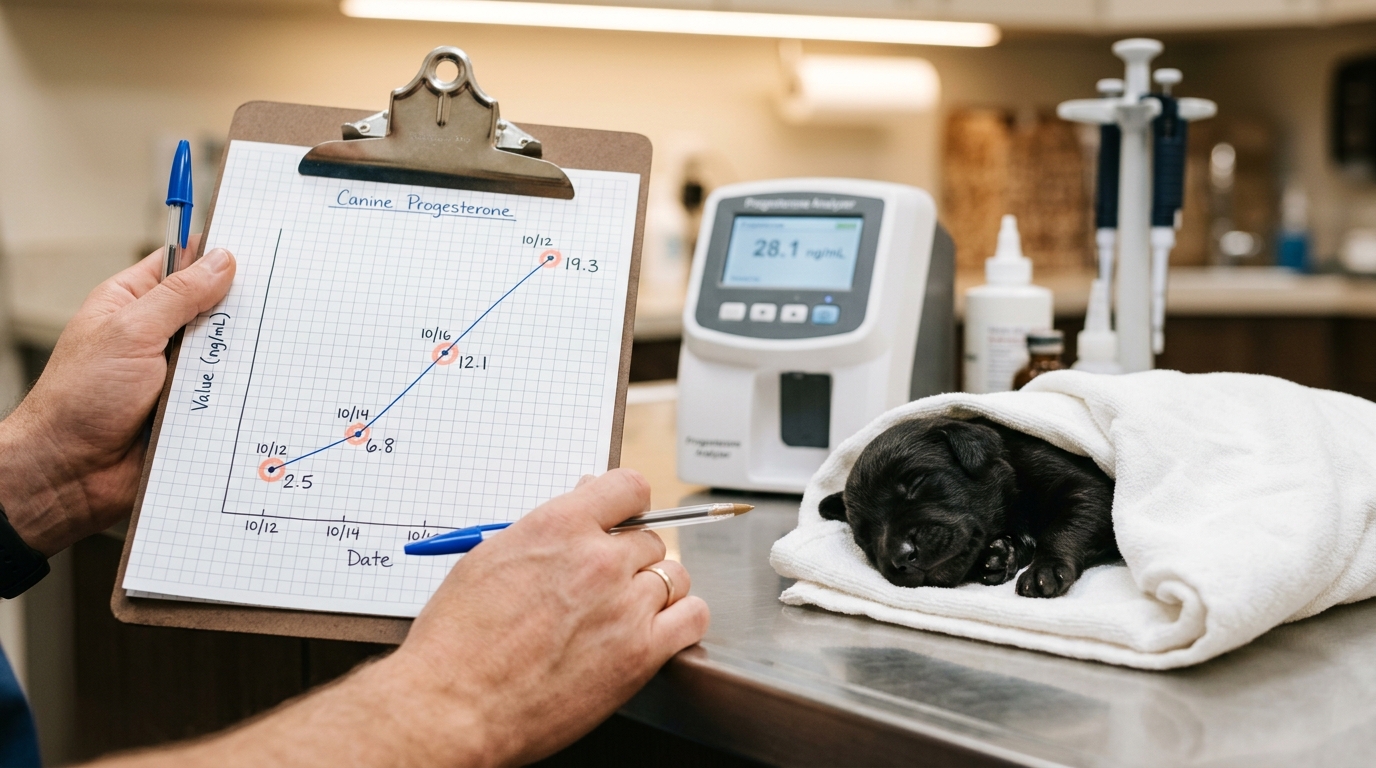
As we covered previously, the trend is your compass. But a list of numbers in a table can be hard to interpret at a glance. The next step is to turn your worksheet into a simple line graph. Plot the date on the horizontal axis and the progesterone value on the vertical axis. Even a hand-drawn graph on grid paper works beautifully—the goal is to see the shape of the curve.
A healthy pre-breeding curve shows a gradual rise from baseline (less than 2 ng/mL), a sharper climb through the LH surge zone (2–4 ng/mL), and then a steep ascent past ovulation (5+ ng/mL) into the breeding window. During pregnancy, the curve plateaus and then drops steeply near term. Bring your graph to every vet appointment—a visual trend is often easier for both you and your vet to discuss than a column of raw numbers. Your vet can also compare the curve shape against expected patterns to flag anything unusual early.
| Curve Pattern | What You See on the Graph | What It Likely Means | Next Step |
|---|---|---|---|
| Steady low baseline | Flat line below 2 ng/mL | Cycle is still in early proestrus | Retest in 2–3 days |
| First upward bend | Rise from ~1 to 2–4 ng/mL | LH surge — Day Zero of your countdown | Mark it on your worksheet; retest in 24–48 hours |
| Steep climb | Jump from 5 to 15+ ng/mL over 2–3 days | Ovulation has occurred; breeding window is opening | Coordinate breeding with your vet |
| High plateau | Sustained 15–90 ng/mL during pregnancy | Normal pregnancy maintenance | Continue weekly monitoring with your vet |
| Sudden mid-pregnancy dip | Sharp drop of 10–15+ ng/mL between days 20–35 | May be normal variation OR early luteal insufficiency | Contact vet; do not panic—ultrasound confirms fetal status |
| Pre-whelping plunge | Rapid fall below 2 ng/mL near day 60–65 | Labour is approaching within 12–24 hours | Prepare whelping area; notify your vet |
What Warning Signs Should You Watch for on Your Worksheet?
Early Warning Signs of Progesterone Problems
A single progesterone value is just a snapshot. The real red flag is a pattern: if your worksheet shows a rapid decline of 10–15 ng/mL between days 20 and 35 of pregnancy, contact your vet right away. Similarly, if P4 drops below 10 ng/mL during weeks 4–5 or below 5.0 ng/mL before day 58, something may be going wrong with the corpora lutea.
Historical clues also matter. If your bitch has a known history of short inter-oestrous intervals (unusually short gaps between heat cycles), confirmed short luteal phases, or unexplained repeated pregnancy losses, flag this before you even start testing. Certain breeds—particularly the German Shepherd—appear to be at higher risk for luteal insufficiency, suggesting a possible genetic component. Also watch for split heats (false starts), where a young bitch shows early signs of heat that subside without ovulation—P4 stays below 2.0 ng/mL, confirming no true cycle occurred. Your vet can tailor the monitoring schedule based on all of these risk factors.
| Warning Sign | When It Typically Appears | What to Do |
|---|---|---|
| P4 drops more than 15 ng/mL suddenly | Days 20–35 of pregnancy | Contact your vet immediately; ultrasound confirms fetal viability |
| P4 below 10 ng/mL at weeks 4–5 | Mid-pregnancy | Increase testing frequency to every 1–2 weeks |
| P4 below 5.0 ng/mL before day 58 | Late mid-pregnancy | Urgent vet visit — supplementation may be needed |
| P4 stays below 2.0 ng/mL (no rise) | During expected heat cycle | Possible split heat (false start) — no true ovulation occurred |
| History of repeated pregnancy losses | Before the cycle even starts | Establish a weekly monitoring plan with your vet from day 1 |
| Breed predisposition (e.g., German Shepherd) | Known before breeding | Discuss proactive monitoring with your theriogenologist |
Emergency Danger Signs That Require Immediate Veterinary Help
Some situations cannot wait. If your bitch’s progesterone falls below 2.0 ng/mL for more than 24 hours before the expected whelping date, the uterus can no longer maintain the pregnancy. This leads to increased uterine contractions and cervical dilation—in plain language, the body begins to expel the puppies too early.
Clinical symptoms to watch for include dark red or coloured vaginal discharge (especially around week 4), lethargy, decreased appetite, restlessness, and a tense abdomen. On ultrasound, normal fetal heart rates should be above 200 beats per minute (bpm). Rates below 160 bpm mean intervention is needed, and rates below 130 bpm mean the puppies should be delivered within 1–2 hours. Remember the progesterone thresholds—those numbers are your first line of defence. Dystocia (difficult birth) can also develop if Stage I labour lasts more than 24 hours or if your bitch has strong contractions for 60 minutes without delivering a puppy. In all of these emergencies, your vet is the decision-maker.
| Danger Sign | Threshold | Urgency | Action |
|---|---|---|---|
| P4 below 2.0 ng/mL (before due date) | Sustained more than 24 hours | Emergency | Rush to your vet — pregnancy cannot be maintained |
| Dark red vaginal discharge | Especially around week 4 | Urgent | Call your vet same day for assessment |
| Fetal heart rate below 160 bpm | On veterinary ultrasound | High | Vet will evaluate for immediate intervention |
| Fetal heart rate below 130 bpm | On veterinary ultrasound | Critical | Delivery needed within 1–2 hours |
| Stage I labour beyond 24 hours | No puppies delivered | Urgent | Contact your vet — possible dystocia |
| Strong contractions 60+ min with no puppy | Active Stage II labour | Emergency | Rush to vet — possible obstruction |
Signs That Treatment Is Working or Failing
If your vet prescribes progesterone supplementation for confirmed luteal insufficiency, you need to know what success and failure look like. Treatment options include natural progesterone in oil (given by injection) or oral micronized natural progesterone. When treatment is working, clinical signs like restlessness and vaginal discharge resolve. Your worksheet should show P4 stabilizing above safe thresholds—typically around 10 ng/mL. Ultrasound will confirm that the fetuses remain viable with strong heartbeats.
When treatment is failing—or causing harm—the picture is very different. As we discussed already, the corpora lutea are the only progesterone source in dogs. Synthetic progestins like medroxyprogesterone (MPA) carry serious risks if given during the first trimester: research shows they can cause masculinization of female puppies, cryptorchidism (undescended testicles) in males, and even congenital heart defects. Equally critical: all progesterone supplementation must be stopped 2–3 days before the expected whelping date. If it is not withdrawn, the normal pre-labour progesterone drop cannot happen, which can lead to prolonged gestation, difficult birth, and stillborn puppies. Your vet will manage this timing precisely—this is not a decision to make on your own.
| Indicator | Treatment Working | Treatment Failing or Harmful |
|---|---|---|
| Vaginal discharge | Resolves after supplementation begins | Persists or worsens |
| Progesterone on your worksheet | Stabilizes around 10 ng/mL or above | Continues to decline despite supplementation |
| Fetal heart rates on ultrasound | Above 200 bpm (healthy range) | Dropping below 160 bpm (distress) |
| Bitch‘s behaviour | Returns to normal appetite and energy | Continued restlessness, lethargy, or straining |
| Near-term management | Vet withdraws supplementation 2–3 days before due date; normal labour begins | Supplementation not withdrawn — risk of prolonged gestation and stillbirth |
Want to put all of this into action during your next pregnancy? Inside the Breeder Vault, you’ll find the Ovulation Timing Worksheet Field Protocol — a printable progesterone tracking checklist with decision trees, emergency thresholds, and veterinary request scripts designed to be used in real time during breeding and pregnancy. It’s the operational companion to everything you just learned.
Your Worksheet, Your Confidence
Progesterone numbers do not have to be confusing. When you track them on a structured worksheet—recording dates, values, lab methods, and behavioural signs—those scattered numbers become a story with a clear beginning, middle, and end. You can see the LH surge building, watch ovulation unfold, identify the perfect breeding window, and monitor the pregnancy with intention rather than anxiety. Even a mid-pregnancy dip that once might have sent you into a panic now fits into a pattern you can understand.
The worksheet is your tool. Your veterinarian is your partner. Together, you bring the science of progesterone trends and the art of clinical judgement into every breeding decision. Whether you breed dogs, cats, or both, the principles are the same: test, record, trend, and collaborate. You now have the knowledge to read your progesterone chart for breeding with confidence. Your dogs and cats are counting on you—and you are ready.

 DR. EMMANUEL FONTAINE