🇫🇷 Lire en Français | 🇪🇸Leer en Español | 🇧🇷Leia em português
I remember a talk I used to give years ago about how mother dogs act with their puppies. I’d spend maybe five minutes on temperament. Five minutes. Looking back now, after diving deep into the latest research, I see how much I missed. The science has caught up to what many skilled breeders sensed all along: your dog’s temperament isn’t just about training—it’s written in their DNA,built into the physical shape of their brain.
This matters because too many breeders still believe that “any puppy can be turned into a good dog with enough effort.” The research tells a different story. We now know that 131 or more genetic markers shape how a dog’s brain grows. When you pick breeding stock based on temperament, you’re not just choosing a personality—you’re picking the blueprint that builds the brain itself. And just like you wouldn’t breed a dog with hip dysplasia, you shouldn’t breed one with a built-in tendency toward fear or aggression.
- TL;DR: Key Takeaways
- What Makes Behavior Inherited in Dogs?
- How Do You Test and Track Temperament the Right Way?
- What Tools and Resources Support Smart Selection?
- What Warning Signs Point to Genetic Temperament Problems?
TL;DR: Key Takeaways
- At least 14 behavior traits are strongly inherited—trainability, aggression, social behavior, and different types of fear are all shaped by genes, not just the world around the dog
- 131+ genetic markers affect brain growth—these genes control how brain cells form, how nerve fibers connect, and how the brain’s structure takes shape
- Social Fear is partly genetic (27–32% from genes)—when a dog shows lasting fear of people that doesn’t get better with socialization, it’s a brain-based red flag, not a training failure
- Startle Response has very low genetic influence—a dog jumping at sudden noises can be trained out of it, unlike deep-rooted social fear
- Standard temperament testing is a must—tools like C-BARQ for adults and Campbell/Volhard tests for puppies give you the hard data you need to track genetic patterns
- Good record-keeping drives genetic progress—writing down behavior scores across generations lets you spot which parents keep producing stable temperaments
- Take dogs with resistant fear out of breeding—a dog with a high genetic load for anxiety has a brain-based disorder as real as hip dysplasia
What Makes Behavior Inherited in Dogs?
The shift from “behavior is mostly training” to “behavior is brain biology” is one of the biggest leaps in breeding science. When I work with breeders who are upset that puppies show anxiety despite great socialization, I often find they haven’t made this mental shift yet. They’re blaming themselves or the puppy buyers when the real issue is genetic.
Fourteen Behavior Traits Show Strong Genetic Influence
Large-scale studies looking at more than 14,000 dogs have backed up what many breeders saw for themselves. Certain behaviors run in families because they’re coded in genes. These aren’t vague quirks—they’re traits you can measure, with specific genetic markers behind them.
| Behavior Trait | What It Means | Why It Matters for Breeding |
| Trainability | How fast a dog learns and responds to cues | Genes tied to this trait also link to how the brain processes new info |
| Aggression | Tendency toward aggressive responses | Tied to genetic markers also found in studies of human aggression |
| Social Behavior Toward People | Warmth and interest in humans | Linked to the oxytocin receptor gene—the “bonding hormone” system |
| Social Fear | Lasting fear of people | Partly genetic—a brain-based red flag if it doesn’t respond to socialization |
| Non-Social Fear | Fear of objects, noises, or new places | Also partly genetic with known gene links |
In my practice, I’ve seen breeders turn their programs around once they grasp this data. A dog that shows great trainability isn’t just “a good dog”—it’s a dog whose genes build brain pathways that support learning. That’s the genetic material you want in your foundation stock.
The research linking canine trainability to brain growth patterns shows these aren’t random outcomes. When you breed for behavior traits, you’re breeding for specific brain design.
Brain Growth Genes: The 131+ Genetic Markers That Matter
Here’s where it gets really interesting: scientists haven’t just proven that behavior is inherited—they’ve found the exact genetic spots that drive it. These 131 or more markers aren’t scattered at random. They’re packed into genes that build the brain while it’s forming.
| Brain Growth Process | What These Genes Control | What It Means for Breeding |
| Making new brain cells | How many brain cells form and where they go | Dogs inherit the genetic plan for brain cell production |
| Moving brain cells into place | Getting new cells to the right brain regions | Faulty placement can throw off how the dog handles emotions and fear |
| Wiring nerve fibers | How nerve fibers find their way to make links | Poor wiring = mixed signals between brain areas = behavior problems |
| Growing signal branches | Building the branches that receive signals from other cells | Branch structure decides how well brain cells talk to each other |
Think of it this way: if you’re building a house, the genes are the blueprint for the foundation, wiring, and framing. Training and socialization are like picking the paint color and placing the furniture. You can’t fix a bad foundation with better decor.
Research on the genetic design of behavior traits shows these aren’t abstract ideas—they’re real genetic differences that create physical differences in brain structure.
The Key Split: Genetic Fear vs. Trainable Startle
This one point has changed how I work with breeders. Not all fear is the same. Some fear is deeply genetic (hard-wired into the brain’s structure), while other fear comes from experience (and training can change it).
| Fear Type | How Much Is Genetic | What It Means | Breeding Call |
| Social Fear | Moderate | 27–32% driven by genes | TAKE OUT of breeding—this is a brain-based disorder |
| Non-Social Fear | Moderate | Fear of objects/places with a genetic piece | Weigh how bad it is; stubborn cases should be removed |
| Startle Response | Very low | Reaction to sudden noise—mostly from experience | Trainable—not a genetic worry |
When breeders ask me, “How do I know if a dog’s shyness is genetic or just needs more socialization?” this is the framework I share. A dog that jumps at a loud noise and bounces back fast—that’s a startle response with very low genetic influence. You can work with that through training. But a dog that shows lasting, deep fear of new people despite good socialization? That’s Social Fear with 27–32% genetic influence. That’s a brain-based red flag.
How Do You Test and Track Temperament the Right Way?
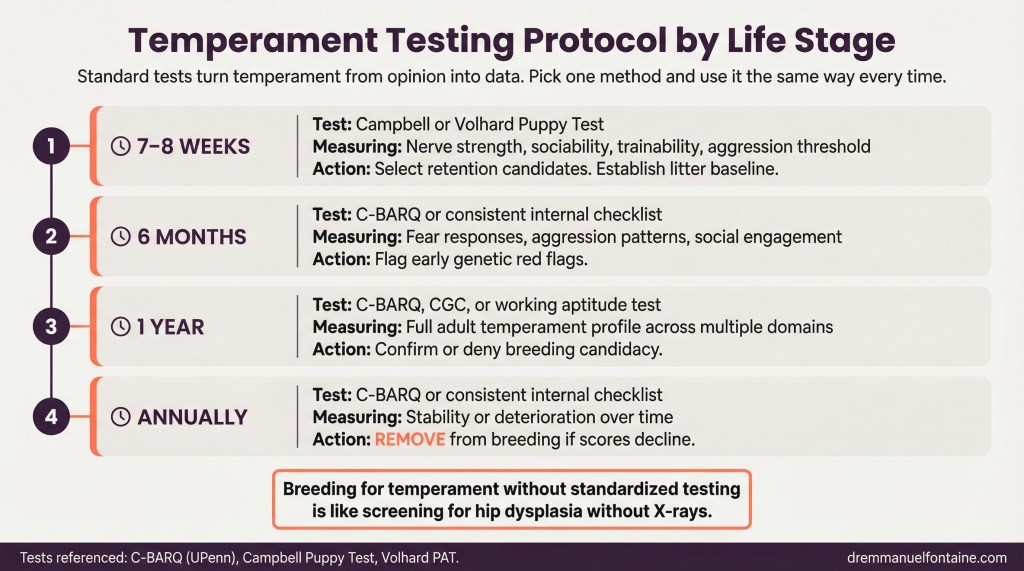
The challenge most breeders face isn’t grasping that temperament is inherited—it’s figuring out how to measure it fairly. In my work, I see too many breeders going on gut feelings or stories. That’s like trying to breed away from hip dysplasia without ever taking X-rays.
Use Standard Temperament Tests at Key Life Stages
The first step is moving from guesswork to real measurement. This means using the same test, done the same way, at the same ages, for every dog you check. Without this, you can’t compare results across litters or spot genetic patterns.
| Life Stage | Test to Use | What You’re Measuring | What to Do With Results |
| 7–8 weeks | Campbell or Volhard puppy test | Nerve strength, sociability, trainability, aggression threshold | Pick which puppies to keep; set a baseline for the litter |
| 6 months | C-BARQ or your own consistent checklist | Fear responses, aggression patterns, social engagement | Flag early genetic issues |
| 1 year | C-BARQ, CGC, or working aptitude test | Full adult temperament profile across many areas | Confirm if this dog is breeding quality |
| Every year | C-BARQ or consistent checklist | Stability over time | Track changes; remove if the dog gets worse |
For puppies I plan to check as possible breeding stock, I use a simple version of the Campbell Puppy Test around seven weeks. This isn’t about guessing whether a puppy will win ribbons—it’s about catching brain-based red flags early. A puppy that panics when gently held down or can’t bounce back from a startling sound is showing you something built in, not just caused by its surroundings.
For adult dogs, the C-BARQ (Canine Behavioral Assessment and Research Questionnaire) gives you scores across many behavior areas. This tool was built by vet behavior experts to create standard, number-based data. When looking at a stud dog, I tell breeders to ask for C-BARQ scores or similar standard data—not just the owner saying “he’s friendly.”
The key point: standard tests turn temperament from opinion into data. Data you can track. Data you can compare across generations. Data that shows genetic patterns.
Remove Dogs Showing Genetic Fear That Won’t Respond to Socialization
This is the hardest talk I have with breeders, but it’s the most important one. When a dog shows lasting Social Fear—fear of people that doesn’t get better with proper socialization—you’re looking at a genetic weak spot. This isn’t a training failure. It’s a brain issue coded into the genes that build the brain.
| What You See | What It Means | Breeding Call |
| Puppy startles at loud noise, bounces back in seconds | Startle Response | Safe to breed if sound in other ways |
| Adult dog fears strangers despite lots of proper socialization | Social Fear | REMOVE from breeding—genetic flaw |
| Dog shows fear-based aggression that doesn’t match gentle handling | Anxiety-driven aggression | REMOVE from breeding—brain-based disorder |
| Dog has one panic moment in a truly scary situation, then recovers fine | Normal fear response (one-time event) | Look at the context—one-off vs. pattern |
In my experience, breeders who grasp this idea make better calls right away. They stop blaming themselves for “not socializing enough” when a dog shows genetic fear. They stop thinking “the right home can fix this” when placing a puppy with built-in anxiety. Most importantly, they stop breeding these dogs and passing on brain-based weakness to the next generation.
Think about it: if a dog needs a lifetime of expert handling to stay stable, that’s a welfare problem. You’re producing dogs that need drugs or constant behavior work just to cope. That’s not ethical breeding. That’s creating suffering.
Track Behavior Scores Across Generations to Find Genetic Merit
Here’s where good record-keeping turns breeding from an art into a science. Every time you run a standard temperament test, you’re creating data. When you write down those scores across many litters and tie them to specific parents, patterns show up. Those patterns reveal genetic merit.
| What to Write Down | Why It Matters | What It Shows You |
| Each puppy’s temperament scores (1–5 scale for specific traits) | Puts numbers on what you observe | Which puppies show genetic strengths or flaws |
| Average scores per litter | Spots patterns at the litter level | Whether a pairing produced steady temperaments |
| Scores grouped by sire/dam | Shows each parent’s input | Which parents pass on superior vs. weaker genetics |
| Multi-generation pedigree with scores | Reveals how traits pass down | How strong the genetic influence is within your specific line |
I tell breeders to build a simple spreadsheet tracking each puppy’s scores for key traits. Those traits include: nerve strength (bounces back fast from a startle), social confidence (goes up to strangers warmly), trainability (focuses on the handler), and aggression threshold (handles restraint calmly). Use a 1–5 scale where 1 is a genetic red flag and 5 is outstanding.
After a few litters, you can dig into the data: Does Sire X keep producing puppies that score 4–5 on social confidence while Sire Y’s puppies land at 2–3? That gap is genetic merit. Sire X is passing on better brain structure. Sire Y is passing on genetic weakness.
This kind of tracking is what research on complex trait selection calls building a “reference population”—dogs with both genetic data and solid behavior scores. One breeder alone can’t build full genomic breeding values, but by collecting this data step by step, you feed the larger datasets needed for breed-wide genetic tools.
The vet’s view: I think of this record-keeping as running your breeding program like a research study. Every litter is a data point. Every behavior test is a measurement. Over time, you’re not guessing which dogs have genetic merit for stable temperament—you’re proving it with evidence.
What Tools and Resources Support Smart Selection?
Moving from gut-feel breeding to evidence-based selection takes specific tools. These aren’t nice-to-haves—they’re the bedrock of modern genetic management. Just as you wouldn’t breed for structure without knowing the breed standard, you can’t breed for temperament without standard tests and good records.
Standard Test Methods Create Data You Can Compare
The problem with judging temperament has always been consistency. What one person calls “shy” another calls “cautious.” What one breeder accepts as “normal puppy behavior” another spots as a genetic flaw. Standard methods fix this by spelling out exactly what to test and how to score it.
| Test Tool | Best Used For | What It Gives You | Main Advantage |
| C-BARQ | Adult dogs (breeding picks, studs) | Scores across 14+ behavior areas | Built by vet behavior experts; widely proven |
| Campbell Puppy Test | 7-week-old puppies | Social draw, following, restraint, elevation, retrieving | Quick screen for brain-based soundness |
| Volhard Puppy Test | 7-week-old puppies | Similar to Campbell with some changes | Another solid option with the same goals |
| Canine Good Citizen (CGC) | Adult dogs | Pass/fail on basic manners and stability | Standard outside check |
When I work with breeders looking at a stud dog, I ask for C-BARQ profiles by name. This test breaks behavior into scorable areas like aggression toward strangers, aggression toward the owner, fear around other dogs, and problems when left alone. Each area gets a number score, making it easy to compare dogs fairly.
For puppies, the Campbell Puppy Test takes about 10 minutes per puppy and checks five key behaviors: social draw (does the puppy come to the tester?), following (does it follow when called?), restraint (does it accept being held?), social response (how does it react to petting?), and elevation (does it panic when lifted?). A puppy that fights hard during restraint or panics completely when lifted is showing possible genetic weak spots worth looking into further.
The Volhard Puppy Test covers similar ground with some method differences. The key is to pick one and use it the same way for every litter.
What matters most isn’t which tool you pick—it’s that you pick one and use it the same way every time. This consistency creates data you can compare across litters, parents, and years. Without it, you’re collecting stories, not building a genetic database.
Record-Keeping Systems Turn Data Into Breeding Choices
Standard tests make data, but data alone doesn’t improve your program. You need a system to sort, analyze, and act on that data. This is where good record-keeping becomes the key to genetic progress.
| Record Type | What to Track | How to Use It |
| Each dog’s profile | Birth date, parents, test scores at each life stage, health events | Find dogs with top genetic merit across many traits |
| Litter summaries | Average scores, range (best to worst), outliers, health issues | See if a pairing produced steady quality or wide swings |
| Pedigree database with behavior data | Three+ generation pedigree tied to temperament scores | Figure out how traits pass down within your line; spot patterns |
| Breeding outcomes review | Which pairings produce the best temperaments? | Guide future breeding calls with proof, not hunches |
I suggest building a spreadsheet (or using breeding software) laid out like this: Each row is one dog. Columns include name, registration number, sire, dam, birth date, then separate columns for temperament scores at 7 weeks, 6 months, 1 year, and yearly after that.
Add extra columns for specific traits you’re watching—maybe “social confidence score,” “trainability score,” “fear response score,” and “aggression threshold score.” Use the same 1–5 scale every time, where 1 is a deal-breaker and 5 is outstanding.
After a few litters, you can filter and compare: Show me all of Dam A’s puppies—what’s her average offspring temperament score? Stack that against Dam B. The difference shows genetic merit. If Dam A keeps producing puppies averaging 4.2 on social confidence while Dam B’s average 2.8, you have hard proof that Dam A passes on better genetics for this trait.
This kind of steady tracking is what research on complex trait management says is the biggest missing piece. The block to getting better at complex traits like temperament isn’t a lack of genetic testing tools. It’s the lack of good behavior data tied to pedigrees.
By carefully writing down every temperament test and linking it to your breeding records, you’re building the data set needed to figure out how traits pass down in your line. This lets you calculate basic breeding values. You can find which parents keep passing on genetic strengths versus genetic weak spots.
What Warning Signs Point to Genetic Temperament Problems?
Knowing the science is one thing. Spotting genetic red flags in your program is another. In my vet consulting, I’ve watched breeders struggle over whether a behavior issue should mean pulling a dog from their program. The answer comes down to telling genetic weak spots apart from trainable responses.
Fear, Anxiety, or Aggression That Doesn’t Match the Situation
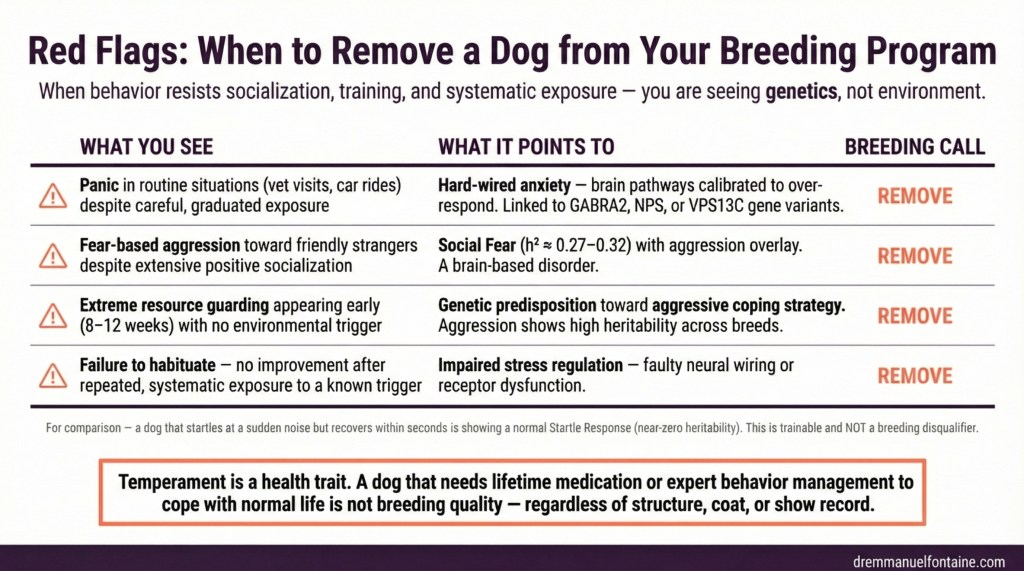
The clearest red flag is behavior that doesn’t fit what’s happening around the dog. This is a dog that reacts with extreme fear or aggression in situations that don’t call for it—and the behavior stays despite good socialization and training.
| Behavior Pattern | What It Points To | Genetic Weight |
| Panic in everyday situations (vet office, car rides) despite slow, careful exposure | Hard-wired anxiety—brain pathways are set too sensitive | Moderate to high genetic influence; likely tied to GABRA2, NPS, or VPS13C genes |
| Fear-based aggression toward friendly strangers despite lots of positive socialization | Social Fear with aggression layered on top | Partly genetic (h²≈0.27–0.32); a brain-based disorder |
| Extreme resource guarding showing up early (8–12 weeks) with no trigger | Genetic tendency toward aggressive coping | Aggression shows high genetic influence across breeds |
| Can’t calm down even after repeated exposure to a trigger | Broken stress response—poor brain regulation | Points to faulty nerve wiring or receptor problems |
The key word is “resistant.” Resistant to socialization. Resistant to training. Resistant to step-by-step exposure. When behavior doesn’t budge after proper work, you’re looking at a genetic weak spot, not a world-caused problem.
In my practice, I see this most often with Social Fear. A breeder brings me a young adult dog—12 to 18 months old—raised with care, socialized the right way, slowly exposed to new people and places. Yet the dog still shows strong fear of strangers or panic in new settings. That’s a brain-based red flag.
The research on Social Fear and genetics clearly shows this trait has moderate genetic influence. When you see it in a dog with good upbringing, you’re seeing the genetic piece at work. This dog has inherited a brain that processes fear in a different way. It’s likely tied to problems in GABA signaling, the brain’s main system for calming itself down.
Compare this with a dog that startles at a sudden loud noise but bounces right back and goes on with normal behavior. That’s a Startle Response—very low genetic influence, very trainable. Not a genetic worry.
Multiple Puppies From the Same Parent Show the Same Problems
When you see the same behavior pattern repeating across several puppies from the same sire or dam, you’re watching genetic passing-down in action. This is one of the clearest signs that you’re dealing with inherited traits, not just bad luck.
| Pattern | What You’re Seeing | What It Means Genetically |
| Three+ puppies from same dam show lasting Social Fear | Steady passing-down of a genetic weak spot | Dam is handing on brain-building genes tied to fear |
| Multiple litters by same sire produce reactive, aggressive dogs | Sire carries heavy genetic load for aggressive coping | Aggression-related genes being passed on reliably |
| Littermates show similar fearful responses at the same age | Litter-wide genetic effect | The mix of sire + dam genetics creates a vulnerable brain design |
| Puppies from one line always need more socialization to reach normal confidence | Lower genetic merit for stable temperament | Not enough selection pressure; genetic drift toward anxiety |
In my work, I ask breeders to track results the right way: “Show me all the puppies from Dam X—how many ended up with serious behavior issues?” If three out of four puppies from Dam X show stubborn Social Fear, that’s not bad luck. That’s genetic passing-down.
Research on behavior genetics in breeding groups confirms real litter-level effects. Studies found that how the dam acts during pregnancy links to how the puppies turn out—bolder dams produced bolder puppies. But here’s the breeding takeaway: when these patterns repeat across many litters, you’re seeing genetic influence, not just mothering style.
This is where good records become priceless. Without notes, patterns fade into memory and stories. With notes, patterns become data: “Dam A has produced 12 puppies across three litters. Average temperament score: 4.2. Dam B has produced 14 puppies across three litters. Average temperament score: 2.6.” That’s not opinion—that’s genetic merit shown through offspring results.
The breeding call becomes clear: Dam A has high genetic merit for stable temperament and should be a priority in your program. Dam B has low genetic merit and should be removed from breeding, no matter how great her structure or other qualities. Temperament is a health trait. Cutting corners on temperament cuts corners on welfare.
Telling Hard-Wired Fear Apart From Trainable Responses
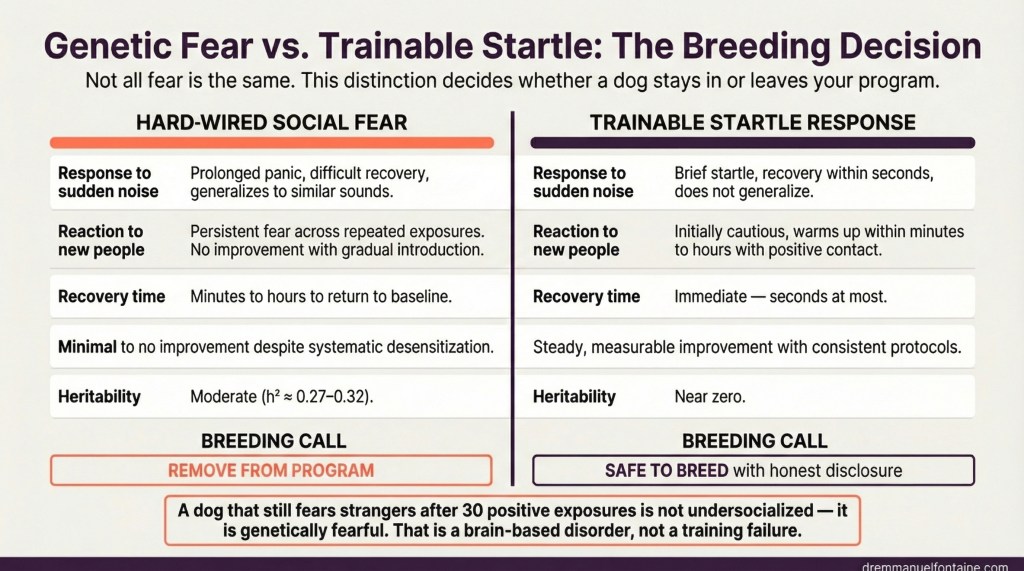
The last warning sign—and maybe the most important split for breeders—is knowing the difference between genetic, “hard-wired” fear and normal, trainable startle responses. This split decides whether a behavior concern should pull a dog from breeding or just calls for more training.
| What You Watch | Hard-Wired (Genetic) Fear | Trainable Startle Response |
| Response to sudden noise | Long panic, hard to recover, spreads to similar sounds | Brief startle, quick recovery (seconds), doesn’t spread |
| Reaction to new people | Lasting fear across many meetings, no progress with gradual exposure | Starts cautious, warms up within minutes to hours with positive contact |
| Recovery time | Takes minutes to hours to get back to normal | Gets back to normal right away or within seconds |
| Response to training protocols | Little to no progress despite step-by-step exposure work | Steady progress with consistent training |
| How much is genetic | Moderate (h²≈0.27–0.32 for Social Fear) | Very low (h²≈near zero for Startle Response) |
I teach breeders to look for how long it lasts and whether it resists change. A dog that still fears strangers after 10, 20, 30 positive meetings—that’s not a socialization gap. That’s genetic fear. The brain pathways handling social input are built differently. Research has tied this to specific genes. GABRA2 is a GABA receptor affecting anxiety control. NPS is a brain chemical tied to arousal and fear. VPS13C is a protein that moves materials inside nerve cells.
On the other hand, a dog that startles when a metal bowl drops but then walks over to check it out—that’s a normal startle response with very low genetic influence. It’s a reaction to what happened, not a genetic flaw.
What this means for breeding is huge. When I go over behavior concerns with breeders, this split sets the outcome. Trainable responses are fine in breeding stock with honest disclosure. Hard-wired genetic fear is an automatic deal-breaker.
Think of it this way: every dog has a baseline anxiety “set point” shaped by brain structure. Dogs with low genetic load for fear have a low set point—they stay calm in new situations naturally. Dogs with high genetic load for fear have a high set point—they feel anxiety easily and strongly. Training can nudge the set point a little, but you can’t train a genetically anxious brain into a genetically calm one.
The genomic research linking brain genes to behavior outcomes proves this isn’t just theory—it’s real, measurable biology. The genes that affect brain cell growth, nerve wiring, and signal branching physically shape how fear circuits form. Breeding against inherited fear is breeding for a different brain design.
The shift in your breeding program starts when you stop seeing temperament as a training problem and start seeing it as an inherited health trait rooted in the brain. The dogs you breed are passing on the genetic blueprint that builds their puppies’ brains. That means the pathways for processing fear, the chemical systems that regulate anxiety, and the structural links that allow confident social behavior.
This isn’t about perfection. Every dog carries some genetic load for various traits. But when you spot dogs with high genetic load for fear or aggression—dogs showing Social Fear with 27–32% genetic influence—the evidence-based call is clear. These dogs have a brain-based disorder as real as hip dysplasia.
You wouldn’t knowingly breed a dog with severe hip dysplasia because it hurts welfare and function. The same rule applies to inherited behavior disorders. A dog that needs lifetime drugs or expert behavior management to get through normal life is not breeding quality. That’s true no matter how great its structure, coat, or show record.
Start with standard temperament testing. UseC-BARQ for adults, Campbell or Volhard tests for puppies. Write down the scores. Track patterns across litters. Figure out which parents pass on genetic strengths for stable temperament.
And when the data shows a dog with inherited fear that won’t respond to socialization—take that dog out of your breeding program. You’re not giving up on a good dog. You’re making a science-based choice to put welfare first in the next generation. You’re breeding for the brain structure that allows confident, stable, well-adjusted companions.
That’s not just better breeding. That’s vet medicine applied to the genetics of whole groups. That’s science working for animal welfare. That’s the future of responsible breeding—where temperament selection is as careful, data-driven, and evidence-based as structural selection has become.
Your dog’s behavior is brain structure. Choose the design wisely.

 DR. EMMANUEL FONTAINE