🇫🇷 Lire en Français | 🇪🇸Leer en Español | 🇧🇷Leia em português
Imagine you have a valuable purebred queen housed with your other females. She has shown every sign of heat — the calling, the rolling, the lordosis posture — and you have carefully introduced her to your best tom. Yet when you bring her for mating, she refuses his advances, or she accepts him but never conceives. After months of frustration, you start wondering if she is infertile.
But here is the truth: your queen may not be infertile at all. She may be spontaneously ovulating before she ever meets the tom. Research shows that 35% to 87% of group-housed queens ovulate without mating, triggered by something as subtle as another female’s grooming or the distant smell of a male. Once this silent ovulation occurs, your queen enters a 40- to 50-day pseudopregnancy where she cannot conceive — and you have no idea it happened. So let’s walk you through the science of the queen’s estrous cycle, how it fundamentally differs from what you know about dogs, and exactly how to take control of your breeding program.
- TL;DR: Key Takeaways
- What Should You Know About the Feline Estrous Cycle?
- What Should You Do to Optimize Breeding Success?
- What Tools and Supplies Should You Have Ready?
- What Warning Signs Should You Watch For?
- The Feline Estrous Cycle Is a System You Can Master
TL;DR: Key Takeaways
Queens are not strictly induced ovulators — 35% to 87% of group-housed queens spontaneously ovulate from environmental cues alone, triggering hidden 40- to 50-day pseudopregnancies.
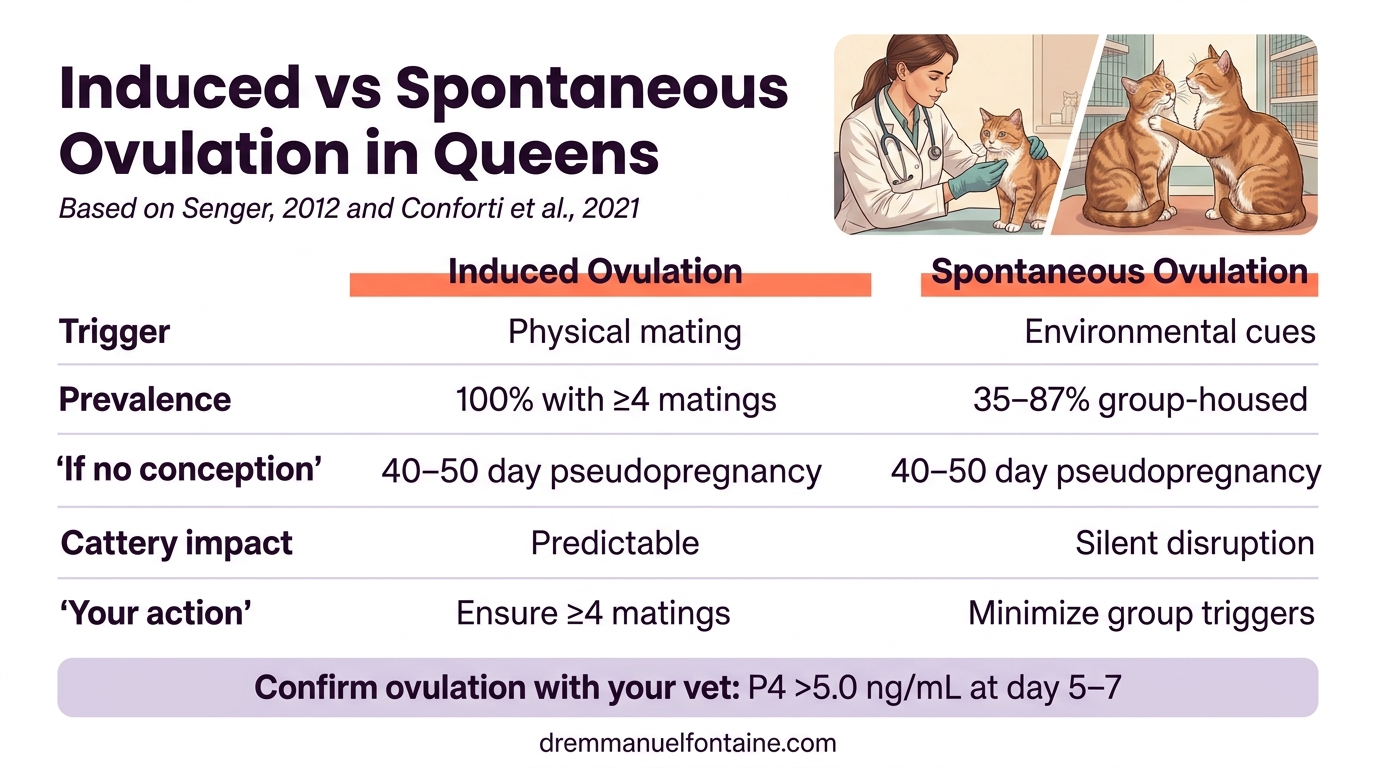
A single mating only triggers ovulation 50% of the time. You need a minimum of 3 to 4 matings over consecutive days to reach near 100% ovulation rates.
Queens show absolutely no vaginal bleeding during heat — waiting for blood (as with dogs) will cause you to miss every cycle entirely.
Confirm ovulation with a serum progesterone test 5 to 7 days after mating: a value above 2.0 ng/mL means she ovulated successfully.
Always bring the queen to the tom’s territory, never the reverse. Males need territorial confidence to breed effectively.
Never sedate a nervous queen for mating — sedatives block the neurological pathway that triggers the LH surge, preventing ovulation even if mating occurs.
What Should You Know About the Feline Estrous Cycle?
How Light Controls Your Queen’s Reproductive Season
Understanding the feline estrous cycle starts with one essential fact: the queen is a seasonally polyestrous, long-day breeder. This means her reproductive cycles are driven by the length of daylight, not by an internal hormonal clock like a dog. The pineal gland in her brain produces the hormone melatonin during dark hours. When days are short (late autumn and winter), high melatonin levels suppress ovarian activity, causing an anestrus phase — a complete seasonal shutdown of her reproductive system.
In a cattery environment, you can override this seasonal shutdown entirely by providing 12 to 14 hours of continuous bright artificial light daily, at approximately 1,500 lux (roughly equivalent to a well-lit office). This suppresses melatonin production and keeps her cycling year-round. However, do not go to the other extreme: constant 24-hour lighting actually decreases cycle frequency. Your queen needs a distinct light-dark rhythm to cycle normally.
| Stage | Duration | What Happens | Behavioral Signs |
|---|---|---|---|
| Estrus | 5–7 days (average) | Mature follicles (2–3 mm); queen is receptive to mating | Lordosis, vocalization, rolling, treading, tail deflection |
| Interestrus | 7–9 days (average) | If no ovulation: estrogen drops; ovaries rest briefly before next cycle | No sexual behavior; completely unresponsive to the tom |
| Diestrus | 40–50 days | Only occurs if queen ovulates; corpora lutea form and secrete progesterone | If pregnant: weight gain. If pseudopregnant: no obvious signs |
| Anestrus | Variable (seasonal) | Complete reproductive shutdown triggered by short days and high melatonin | No cycling behavior; ovaries inactive |
Induced Versus Spontaneous Ovulation: Shattering the Myth
Cat breeders are universally taught one golden rule: queens only ovulate when mated. The tomcat‘s penis has 120 to 150 keratinized, backward-pointing spines that rake the vaginal wall during withdrawal, sending a neural signal to the hypothalamus that triggers a surge of Luteinizing Hormone (LH). Ovulation then occurs 24 to 50 hours after this LH surge. This is called induced ovulation, and it is real — but it is not the complete story.
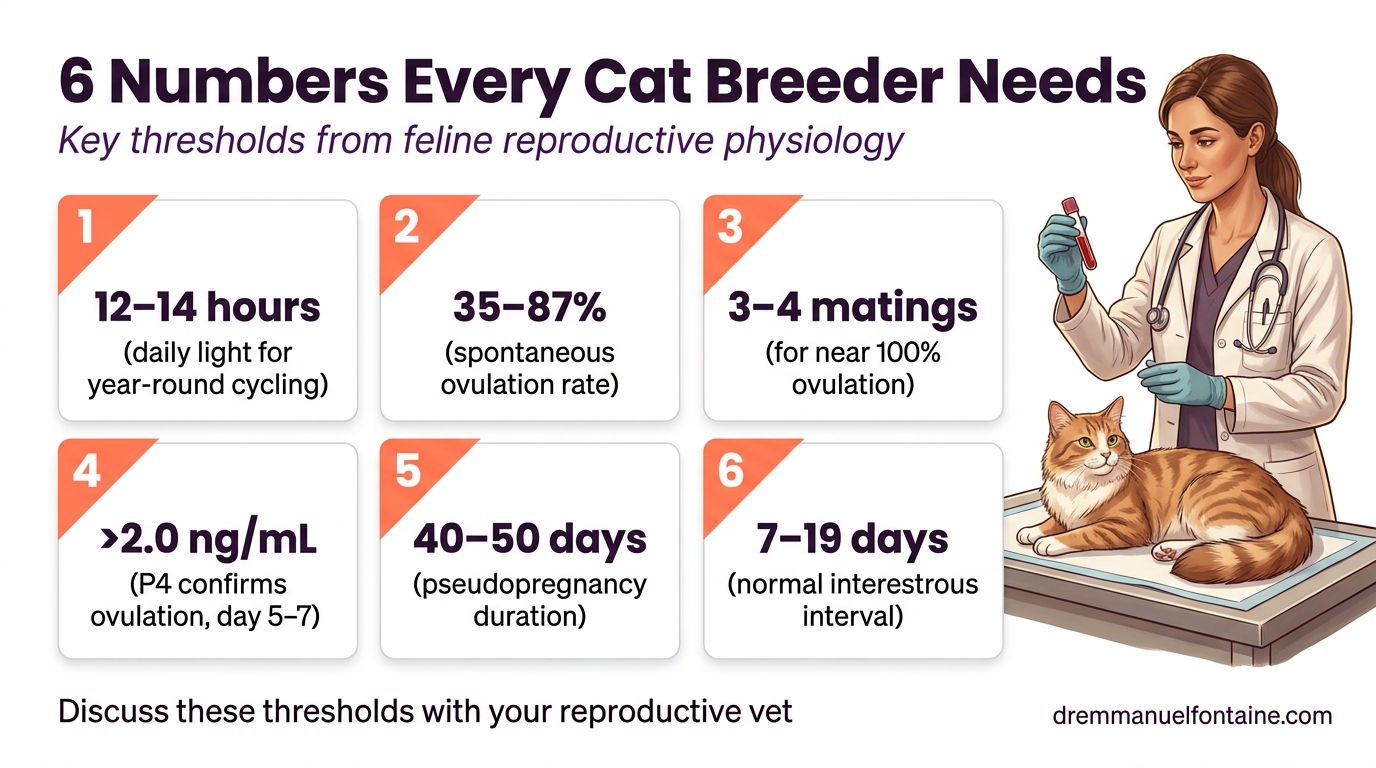
Modern research has revealed that spontaneous ovulation — where a queen ovulates without any mating at all — is far more common than previously believed. Studies report that 35% to 87% of queens ovulate spontaneously. Group housing triggers it: mutual grooming, mounting behaviors between females, and even the visual, auditory, or olfactory presence of a tomcat nearby can lower the neural threshold required for the LH surge. Queens with a higher body weight also tend to ovulate spontaneously more often. Once she ovulates without conceiving, she enters a 40- to 50-day pseudopregnancy where progesterone blocks all new follicle development. She is effectively out of service and will not return to heat.
| Feature | Induced Ovulation | Spontaneous Ovulation |
|---|---|---|
| Trigger | Physical mating (penile spine stimulation of vaginal wall) | Environmental cues: grooming, mounting, male proximity, visual/olfactory stimuli |
| LH surge mechanism | Neural signal from vaginal stimulation → hypothalamus → pituitary → LH | Same hormonal cascade, but triggered by sensory cues alone |
| Prevalence | Expected in all mated queens (100% with ≥4 matings) | Occurs in 35–87% of group-housed queens |
| Consequence if no conception | 40–50 day pseudopregnancy | Same: 40–50 day pseudopregnancy |
| Cattery impact | Predictable when managed | Silent schedule disruption; unexplained “missed” cycles and apparent infertility |
What Should You Do to Optimize Breeding Success?
Set Up Your Lighting and Monitor Behavioral Signs
Your first step is environmental control. Install a programmable timer connected to bright bulbs that deliver approximately 1,500 lux at the cat’s level. A smartphone lux meter app can help you verify intensity. Run the lights for 12 to 14 hours daily to maintain year-round cycling. Avoid going beyond 14 hours, and never leave lights on 24 hours — the queen needs a clear dark period to cycle at optimal frequency.
Once your lighting is set, learn to read your queen. Estrus lasts an average of 5 to 7 days, and the hallmark signs are persistent vocalization (the unmistakable calling), rolling and rubbing against objects, and the lordosis posture: front end lowered, hindquarters elevated, tail deflected to the side, with rhythmic treading of the hind legs. Keep in mind that some queens, especially those lower in the social hierarchy, may experience silent heats where hormones cycle normally but behavioral signs are absent. As a backup, vaginal cytology (showing more than 75% to 80% cornified superficial cells) can objectively confirm estrus. This is something worth discussing with your veterinarian.
| Action | Specification | Why It Matters |
|---|---|---|
| Install programmable lighting | 12–14 hours at ~1,500 lux daily; verify with a lux meter | Suppresses melatonin; maintains year-round estrous cycling |
| Monitor behavioral signs daily | Lordosis, calling, rolling, treading, tail deflection | Identifies estrus onset for optimal mating timing |
| Perform vaginal cytology | > 75–80% cornified superficial cells confirms estrus | Detects silent heats when behavioral signs are absent |
| Maintain calm environment | Minimize handling; reduce cattery stress | High cortisol suppresses reproductive hormones and causes silent heats |
Time the Introduction and Manage Multiple Matings
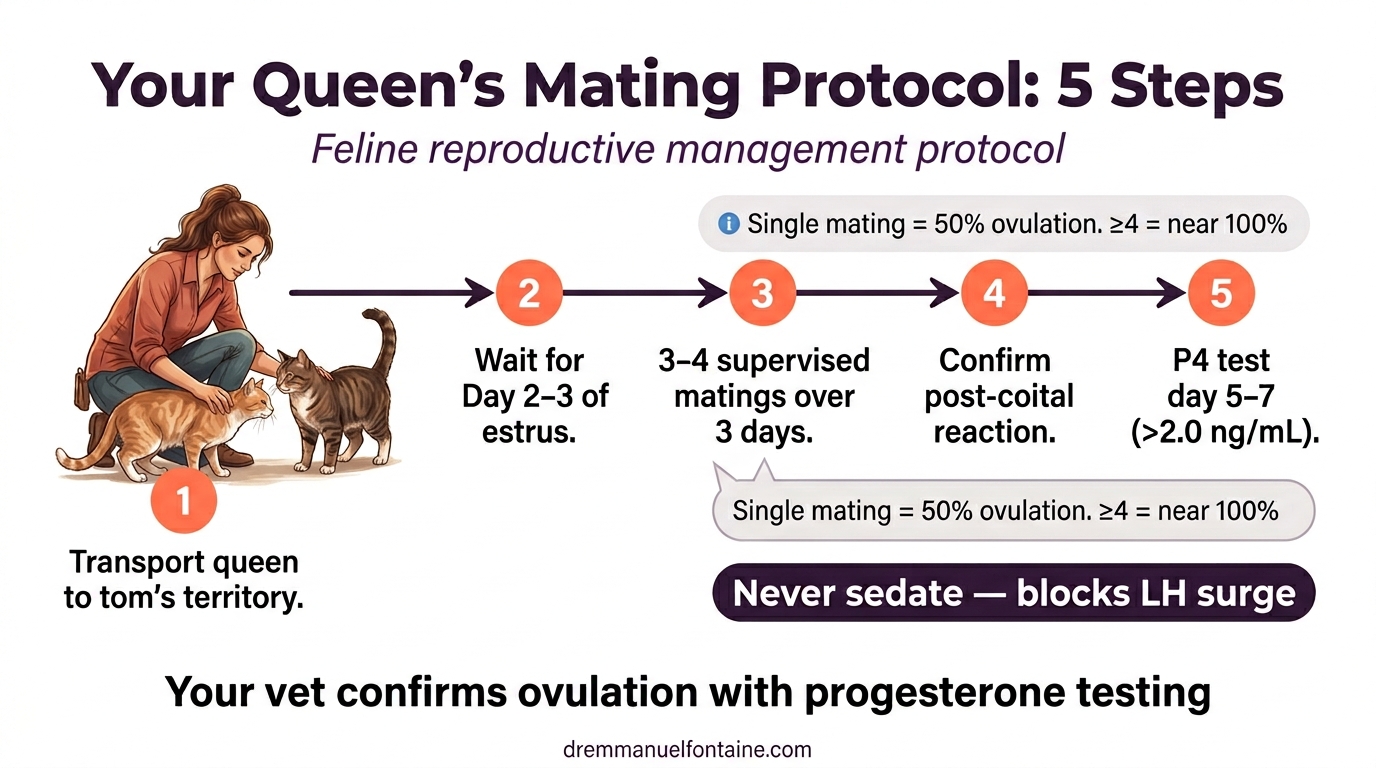
Location matters more than you might think. Always bring the queen to the tom’s territory — male cats need the confidence of familiar surroundings to breed effectively. Bringing a tom into the queen’s space often results in hesitation, distraction, or outright refusal. For young or anxious queens, transport her during interestrus (the resting phase between heats) so she has several days to acclimate before her next estrus begins.
Do not breed at the very first sign of heat. Wait until the second or third day of estrus, which allows estrogen to fully prime the pituitary gland and for follicles to reach their maximum mature size of 2 to 3 mm. A single mating only triggers ovulation in about 50% of queens, so you must arrange multiple matings. The proven protocol is 3 to 4 supervised breedings over 3 consecutive days. Alternatively, allow 3 matings daily at 4-hour intervals on the second and third days of estrus. Confirm that intromission occurred by watching for the post-coital reaction: the queen will emit a loud cry, aggressively swat at the tom, and then roll frantically on the floor while licking her vulva.
| Step | Timing | Action | Key Detail |
|---|---|---|---|
| Transport queen to tom | During interestrus (for nervous queens) or Day 1 of estrus | Move queen to tom’s territory | Never bring the tom to the queen — males need territorial confidence |
| Wait for estrus Day 2–3 | Second or third day of behavioral signs | Begin supervised matings | Estrogen must prime the pituitary before LH can be properly released |
| Supervised matings | 3–4 matings over 3 consecutive days | Monitor for post-coital reaction (cry, swat, roll) | Single mating = 50% ovulation; ≥4 matings = near 100% |
| Record all matings | Each mating event | Log time, date, and behavioral response | Accurate records enable precise gestation calculations (65–67 days) |
Confirm Ovulation and Manage Post-Mating Outcomes
After mating, do not assume ovulation occurred just because the queen stops showing estrus behavior. Queens may continue displaying receptive behavior for 3 to 4 days after ovulation, so behavior alone is unreliable. The gold standard is a serum progesterone test performed 5 to 7 days after mating (or 72 hours after the last mating). A progesterone value above 2.0 ng/mL confirms the presence of corpora lutea and successful ovulation. Values below 1 to 2 ng/mL indicate ovulation failure.
If your queen fails to mate, check several factors with your veterinarian. Verify the tom has penile spines — their absence signals severely low testosterone and an inability to trigger ovulation. If natural mating fails entirely, artificial insemination could be an option… However, this option is not routinely offered by most veterinarians and is currently available only through a small number of specialists worldwide. One critical warning: never use sedatives to calm a nervous queen for natural breeding. Sedative drugs directly block the neuroendocrine pathway required for LH release, meaning she will not ovulate even if mating occurs. Discuss this and all pharmacological options with your veterinarian.
| Outcome | Progesterone (Day 5–7) | What Happened | Next Step |
|---|---|---|---|
| P4 > 2.0 ng/mL, queen stops cycling | > 2.0–5.0 ng/mL | Ovulation confirmed | Confirm pregnancy via ultrasound at 21–30 days; begin reproductive diet |
| P4 > 2.0 ng/mL, no pregnancy at 30 days | > 2.0 ng/mL | Ovulated but failed to conceive → pseudopregnancy (40–50 days) | Wait for pseudopregnancy to end; re-breed on next cycle |
| P4 \< 1–2 ng/mL | \< 1–2 ng/mL | Ovulation failed despite mating | Re-evaluate mating protocol; increase mating frequency; consult your vet |
| Queen returns to heat in 7–19 days | Baseline | No ovulation occurred | Retime matings to Day 2–3 of next estrus; ensure ≥4 copulations |
What Tools and Supplies Should You Have Ready?
Monitoring Equipment and Diagnostic Supplies
Start with lighting — the foundation of feline reproductive management. Use programmable timers connected to bright bulbs delivering approximately 1,500 lux at cat level. Verify the intensity with a lux meter or a smartphone light-measuring app. This is not optional: queens deprived of adequate light will simply stop cycling.
Keep a breeding logbook — physical or digital — to record mating counts, behavioral cues, dates, and body condition scores. A webcam or remote monitoring camera allows you to supervise matings without the stress of human presence inhibiting natural behavior.
| Equipment | Purpose | Key Specification |
|---|---|---|
| Programmable light timer + bright bulbs | Maintain year-round cycling via photoperiod control | 12–14 hours daily at ~1,500 lux; verify with lux meter |
| Breeding logbook (physical or digital) | Track mating dates, counts, behavioral responses | Record body condition score alongside breeding data |
| Remote monitoring camera | Supervise matings without inhibiting behavior | Position in mating room; minimize human interference |
| Digital scale | Track queen’s weight during pregnancy | Accurate to ±5 g; weigh weekly once pregnant |
Veterinary Diagnostics and Medical Supplies
Establish a relationship with a veterinarian experienced in feline reproduction before you need one urgently. Your vet will perform quantitative serum progesterone assays 5 to 7 days post-mating to confirm ovulation (above 2.0 to 5.0 ng/mL). They will also provide diagnostic ultrasounds (ideal at 21 to 30 days post-breeding) and radiographs (to count fetuses after 45 days).
Blood typing is essential before breeding — especially in breeds with high Type B prevalence — to prevent neonatal isoerythrolysis, a fatal condition that occurs when a Type B queen nurses Type A kittens. Keep neonatal resuscitation supplies ready: bulb syringes for airway clearing, an incubator set to 32 °C (90 °F) at 50% to 60% humidity, hemostats and chlorhexidine for umbilical care, and a pediatric stethoscope. Discuss your emergency whelp protocol with your veterinarian well before the due date.
| Category | Items | When Needed |
|---|---|---|
| Ovulation confirmation | Quantitative serum progesterone assay (via vet) | 5–7 days post-mating |
| Pregnancy diagnosis | Witness Relaxin test kit; ultrasound; radiographs | 20–25 days (relaxin); 21–30 days (ultrasound); 37–45 days (radiographs) |
| Blood typing | In-house typing cards or commercial lab service | Before breeding — prevents neonatal isoerythrolysis |
| Neonatal resuscitation | Incubator (32 °C / 90 °F, 50–60% humidity), bulb syringes, dextrose, stethoscope | Day of parturition; have ready before due date |
| Nutrition | Reproduction or kitten diet | Throughout pregnancy and lactation |
Emergency Preparedness for Parturition
Pregnant queens gain weight linearly, reaching approximately 140% to 150% of their pre-breeding weight by parturition. Feed a highly palatable commercial diet labeled for reproduction, lactation, or kitten growth.
Two weeks before the expected due date, isolate the queen in a quiet, warm space with a nest box maintained at 27 to 32 °C (80 to 90 °F). Have your veterinarian’s emergency contact posted visibly.
| Preparation | Timing | Details |
|---|---|---|
| Switch to reproduction diet (ad libitum) | From mating confirmation | High-energy, taurine-adequate; queen needs 50–300% more calories |
| Set up isolated nesting area | 2 weeks before due date | Quiet room; nest box at 27–32 °C (80–90 °F); minimize disturbances |
| Post vet emergency contact | 2 weeks before due date | Visible in whelping area; include after-hours number |
| Neonatal resuscitation station | Assembled before due date | Warmed towels, bulb syringes, hemostats, dextrose, stethoscope, scale |
What Warning Signs Should You Watch For?
Subtle Indicators of Cycle or Fertility Problems
The first signal that something is off often hides in the timing. Track your queen’s interestrous intervals carefully. When a non-ovulating queen returns to heat, the normal gap is 7 to 19 days (average 7 to 9 days). If she returns after exactly 10 days, she likely failed to ovulate on her last cycle. If the interval stretches to 40 to 50 days, she has ovulated but failed to conceive — she is in pseudopregnancy. This distinction is critical because it tells you whether the problem lies with mating management (insufficient matings) or with male fertility.
Watch for silent heats, where the queen experiences normal hormonal cycling (estrogen above 20 pg/mL and active follicular growth) but shows no behavioral signs at all. This is especially common in queens lower in the cattery’s social hierarchy or those under chronic stress. If estrus behavior lasts significantly longer than 7 days, suspect overlapping waves of maturing follicles or an estrogen-producing ovarian cyst. Also observe the mating itself: if the queen shows indifference after copulation rather than the typical aggressive after-reaction (crying, swatting, rolling), the mating likely did not provide sufficient stimulation to trigger the ovulation reflex.
| Observation | What It Suggests | Action |
|---|---|---|
| Returns to heat in 7–19 days | Normal interestrus (no ovulation occurred) | Increase mating frequency; ensure ≥4 copulations on next cycle |
| Returns to heat after 40–50 days | Ovulated but failed to conceive (pseudopregnancy) | Evaluate male fertility; semen analysis; consult your vet |
| No behavioral signs despite cycling age | Silent heat (hormonal estrus without behavior) | Perform vaginal cytology weekly; manage social hierarchy and stress |
| Estrus lasting > 7 days continuously | Overlapping follicular waves or estrogen-producing ovarian cyst | Veterinary evaluation with ovarian ultrasound |
| No post-coital reaction after mating | Inadequate vaginal stimulation; ovulation unlikely | Verify tom has penile spines; ensure proper intromission |
Indicators for Future Breeding Decisions
Some observations should directly inform whether you continue breeding a particular queen or retire a tom from your program. If a tom successfully mates a queen, triggering the post-coital reaction, but the queen repeatedly undergoes 40- to 50-day pseudopregnancies instead of conceiving, the male is successfully inducing ovulation but is likely subfertile or sterile. He needs an immediate breeding soundness examination and when possble, semen evaluation. Also check his penile spines — their absence indicates severely low testosterone and a physical inability to trigger the ovulation reflex.
Queens that experience frequent spontaneous ovulations or repeated infertile matings are subjected to prolonged, non-pregnant progesterone exposure. This strongly predisposes them to cystic endometrial hyperplasia (CEH) and pyometra — a progressive, highly recurrent condition (up to 14% recurrence even after medical treatment). Also consider age: queens should ideally be retired by 5 to 8 years of age, as older queens suffer from declining fertility, smaller litters, and an increased risk of spontaneous abortions and congenital defects. Queens that exhibit recurrent maternal failure — cannibalism, litter rejection, or persistent failure to produce milk — should be removed from the program. Discuss all of these decisions with your veterinarian.
| Observation | What It Indicates | Recommended Decision |
|---|---|---|
| Tom triggers mating but repeated pseudopregnancies | Male induces ovulation but sperm is subfertile or abnormal | Breeding soundness exam and semen evaluation for the tom |
| Absence of penile spines in tom | Severely low testosterone; unable to trigger ovulation reflex | Remove from breeding program; veterinary evaluation |
| History of CEH or pyometra in queen | Progressive uterine disease; 14% recurrence after medical treatment | Retire and spay at earliest opportunity |
| Queen older than 5–8 years | Declining fertility, smaller litters, higher risk of fetal defects | Carefully evaluate with your vet; consider retirement |
| Recurrent maternal failure | Cannibalism, litter rejection, or persistent agalactia | Remove from breeding program after veterinary evaluation |
Want to put all of this into action in your cattery? Inside the Breeder Vault, you’ll find the Queen Estrous Cycle Field Protocol — a printable monitoring checklist with photoperiod schedules, mating timing worksheets, ovulation confirmation decision trees, and veterinary request scripts designed to be used in real time during your queen’s breeding season. It’s the operational companion to everything you just learned.
The Feline Estrous Cycle Is a System You Can Master
The feline estrous cycle is unlike anything in canine reproduction. It is light-driven, mating-triggered, and vulnerable to silent disruption by spontaneous ovulation. But that complexity is not a barrier — it is an opportunity. Once you understand that your queen is both an induced and a spontaneous ovulator, that a single mating is a 50-50 gamble, and that progesterone testing confirms what has already happened rather than predicting what will, every decision becomes clearer.
You now have the knowledge to control her photoperiod, time your matings precisely, manage the tom introduction correctly, confirm ovulation objectively, and recognize both the subtle and emergency warning signs that demand action. Most importantly, you know when to involve your veterinarian — not as a last resort, but as your proactive partner in every breeding decision. The queens that succeed in your program will be the ones whose breeders understood their biology, respected their unique physiology, and built a management strategy around science rather than assumption.

 DR. EMMANUEL FONTAINE