🇫🇷 Lire en Français | 🇪🇸Leer en Español | 🇧🇷Leia em português
Seya was a stunning Labrador Retriever and an exceptional mother. Her first three litters were textbook perfection — smooth whelpings, excellent milk production, and incredibly healthy puppies. But after her fourth litter, something subtly shifted. Her coat became dull, she struggled to maintain her body weight, and she seemed emotionally distant from her puppies. Her breeder stopped asking, “Can she have another litter?” and started asking the question that truly matters: “Should she?”
As a veterinarian specializing in reproduction, I see this crossroads regularly. The answer is never a simple number. It depends on the individual dog, her breed, her recovery between litters, and the science of reproductive aging. In this post, I will walk you through the biology behind the breeding career timeline, the surprising truth about skipping heat cycles, and how to build a data-driven retirement plan for your best females.
- TL;DR: Key Takeaways
- What Should You Know About the Breeding Career Timeline?
- What Should You Do to Plan a Safe Breeding Career?
- What Tools and Records Should You Have Ready?
- What Warning Signs Should You Watch For?
- Her Legacy Is Bigger Than Her Last Litter
TL;DR: Key Takeaways
- Skipping a heat cycle does not “rest” the uterus — it actually ages it, because a pregnant uterus is biologically healthier than an empty one cycling through progesterone.
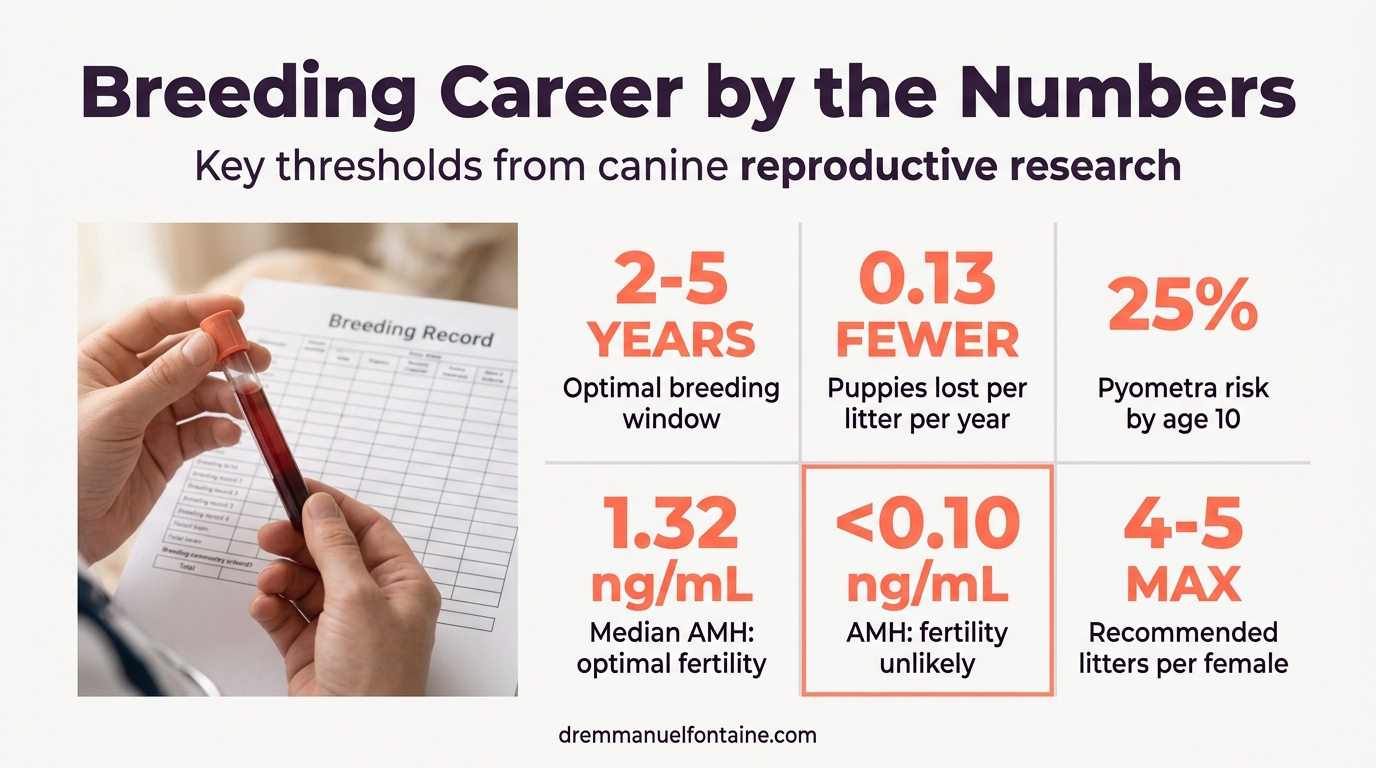
- The optimal breeding window is between 2 and 5 years of age. Neonatal mortality nearly doubles from 7.1% in 2-year-old dams to 13.4% in 8-year-old dams.
- Most veterinary reproduction specialists recommend a maximum of 4 to 5 litters per female, with strict retirement after 2 to 3 C-sections.
- Anti-Müllerian Hormone (AMH) testing gives you an objective measure of ovarian reserve — when levels drop below 0.10 ng/mL, breeding success becomes unlikely.
- Pyometra (a life-threatening uterine infection) affects approximately 25% of intact females by age 10, making retirement timing a genuine safety decision.
- Use a Breeding Wellness Scorecard tracking five metrics to make retirement decisions based on data, not guesswork. Work with your vet or theriogenologist to set thresholds.
What Should You Know About the Breeding Career Timeline?
How the Canine Reproductive System Ages
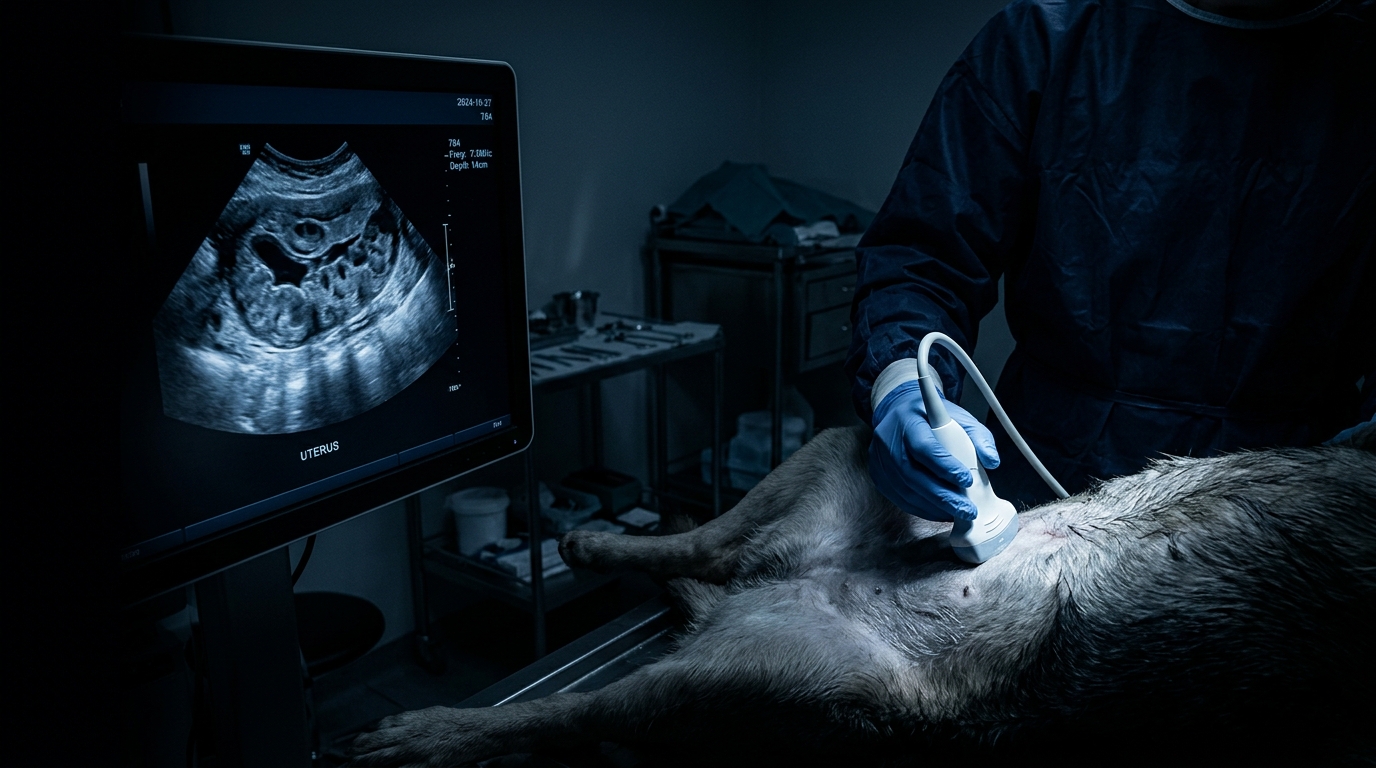
Understanding how a dog’s reproductive system ages is the foundation of smart career planning. Unlike many other mammals, the canine estrous cycle features a prolonged period of progesterone dominance called diestrus that lasts about 60 days — and this happens whether or not the bitch is pregnant. Think of progesterone like a painter who repaints a wall every two months. Over time, the layers build up.
This repeated hormonal exposure causes progressive changes to the uterine lining called [[Cystic Endometrial Hyperplasia (CEH)]{.underline}](https://www.mdpi.com/2306-7381/12/1/1). The endometrial glands proliferate, thicken, and form cysts. This damaged environment suppresses local immunity and becomes a breeding ground for bacteria — most commonly E. coli. The result is pyometra, a life-threatening uterine infection that affects approximately 25% of intact females by age 10.
| Stage | What Happens | Impact on Breeding |
|---|---|---|
| Each estrous cycle | Estrogen primes the uterus, followed by 60 days of progesterone (diestrus) | Cumulative hormonal exposure regardless of pregnancy |
| Progressive CEH | Uterine glands thicken, form cysts, suppress local immunity | Increasing risk of infection with each non-pregnant cycle |
| Pyometra development | Bacteria (usually E. coli) colonize the damaged uterine lining | Life-threatening emergency; affects 25% of intact females by age 10 |
| Ovarian aging | Follicular pool gradually depletes; fewer viable eggs per cycle | Smaller litters, lower conception rates, higher neonatal mortality |
Why Skipping Heat Cycles Does Not Rest the Uterus
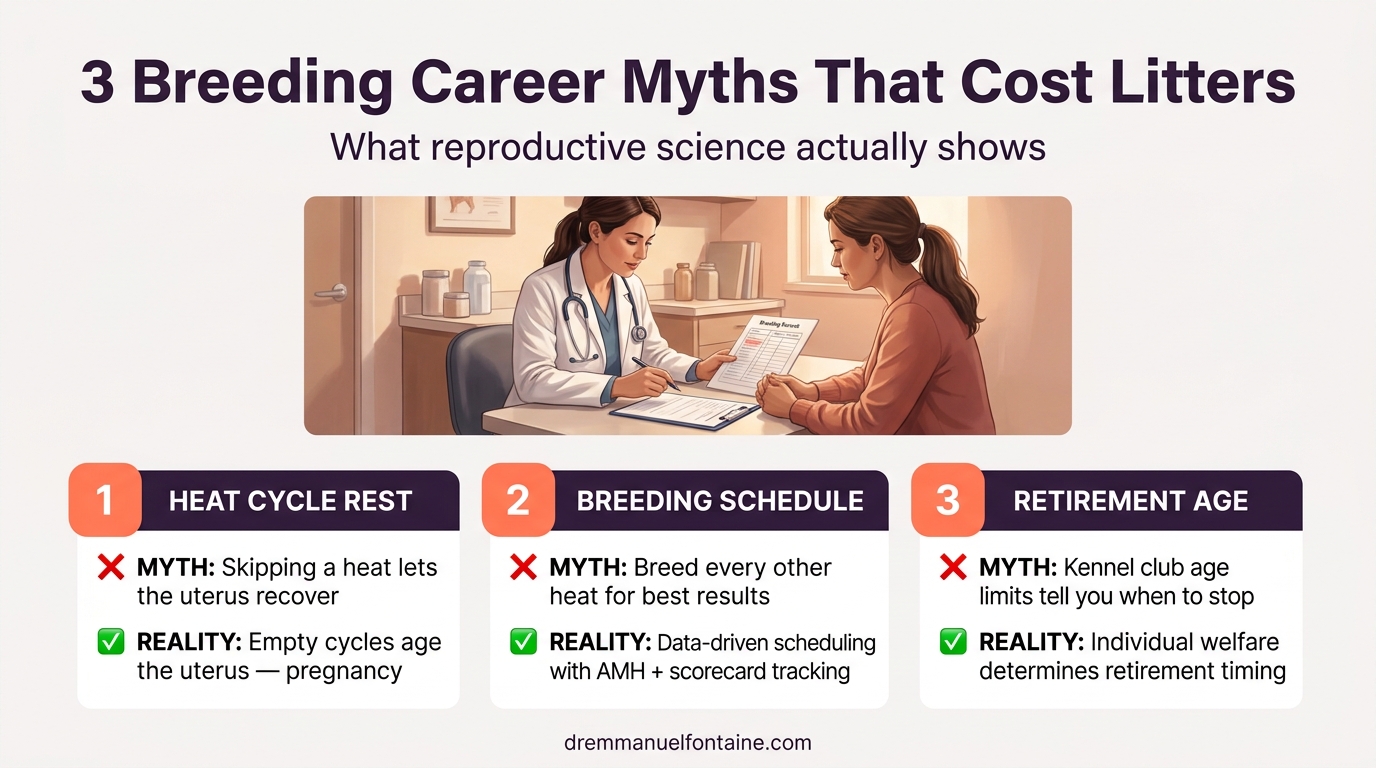
Here is a fascinating detail that surprises most breeders: skipping a heat cycle does not “rest” your dog’s uterus. It actually ages it. Every time a bitch enters diestrus, her uterus undergoes progesterone-driven changes to support a pregnancy — whether or not she was bred. When she cycles without becoming pregnant, the hormonal effects are additive, forming cysts and predisposing her to CEH and pyometra.
Paradoxically, a pregnant uterus is healthier than a sterile one. Research shows that gestation effectively “resets” the uterine environment and provides a protective “sparing” effect against uterine disease. Strategic back-to-back breeding can therefore be acceptable and beneficial if the bitch is in optimal body condition, because it limits the number of sterile cycles she experiences over her lifetime. This allows her to produce her litters and then be spayed and retired early, before cumulative damage sets in.
| Common Belief | What Research Shows |
|---|---|
| Skipping a cycle gives the uterus a rest | Non-pregnant diestrus causes additive hormonal damage (CEH) with each cycle |
| Breeding back-to-back is harmful | Can be safer if the bitch is in optimal condition; limits cumulative sterile cycle damage |
| The uterus recovers between heats | Progesterone effects are permanent and cumulative; only pregnancy provides a “reset” |
| A dog should breed until she stops cycling | Dogs never go through menopause — cycling is not the same as being fit to breed |
The Optimal Breeding Window and Age-Related Decline
Biology defines a very specific optimal breeding window: between 2 and 5 years of age. Outside this window, the risks climb measurably. Fertility declines by an average of 0.13 fewer puppies per litter for every year beyond her first. A large-breed dog might peak at an average of 7.2 puppies at age 3 but drop to 4.0 puppies by age 10.
The neonatal mortality data is equally clear. Puppies born to 2-year-old dams face a 7.1% mortality rate, while those born to 8-year-old dams face 13.4% — nearly double. First-time mothers over 6 years old face dystocia (difficult birth) rates approaching 50%, and the risk of requiring a C-section skyrockets after 7 to 8 years of age. These are not hypothetical risks. They are measured outcomes that you and your vet can plan around.
| Dam’s Age | Average Litter Size Impact | Neonatal Mortality Rate | Dystocia Risk |
|---|---|---|---|
| 2–3 years | Peak fertility; largest litters | 7.1% | Baseline risk |
| 4–5 years | Slight decline begins | Gradually increasing | Moderate; manageable with monitoring |
| 6–7 years | 0.13 fewer pups per year decline | Approaching 10%+ | First-time mothers: up to 50% |
| 8+ years | Significantly smaller litters (e.g., 4.0 vs. 7.2) | 13.4% | C-section risk skyrockets |
What Should You Do to Plan a Safe Breeding Career?
Build a Data-Driven Breeding Schedule
The most important shift you can make is moving from a calendar-based approach (“breed every other heat”) to a data-driven one. Work with your veterinarian or theriogenologist to establish baseline diagnostic profiles for your breeding females at each life stage. Track estrous cycle regularity, post-whelping recovery speed, milk production, body condition scores, and emotional engagement with the puppies.
Use progesterone testing to accurately pinpoint ovulation and optimize breeding timing. Consider Anti-Müllerian Hormone (AMH) testing as an objective marker of your dog’s remaining ovarian reserve. The median AMH value for an optimal intact bitch is 1.32 ng/mL. When levels decline to the senescent range — typically below 0.10 ng/mL — it signals that even if she continues to cycle and show signs of heat, her probability of successful conception and delivering a healthy litter is severely reduced. Your vet can run this test and help you interpret the results.
| Metric | What It Tells You | When to Measure | Action Threshold |
|---|---|---|---|
| Progesterone | Pinpoints ovulation timing | Each breeding cycle | Work with your vet for breed-specific targets |
| AMH (Anti-Müllerian Hormone) | Remaining ovarian egg reserve | Annually after age 4 | Below 0.10 ng/mL = retirement recommended |
| Body Condition Score (BCS) | Recovery between litters | Before and after each litter | Not returning to pre-pregnancy BCS = concern |
| Litter size trend | Fertility trajectory over time | Track across all litters | Consistent decline = discuss retirement with your vet |
Recognize When Pyometra Threatens the Timeline
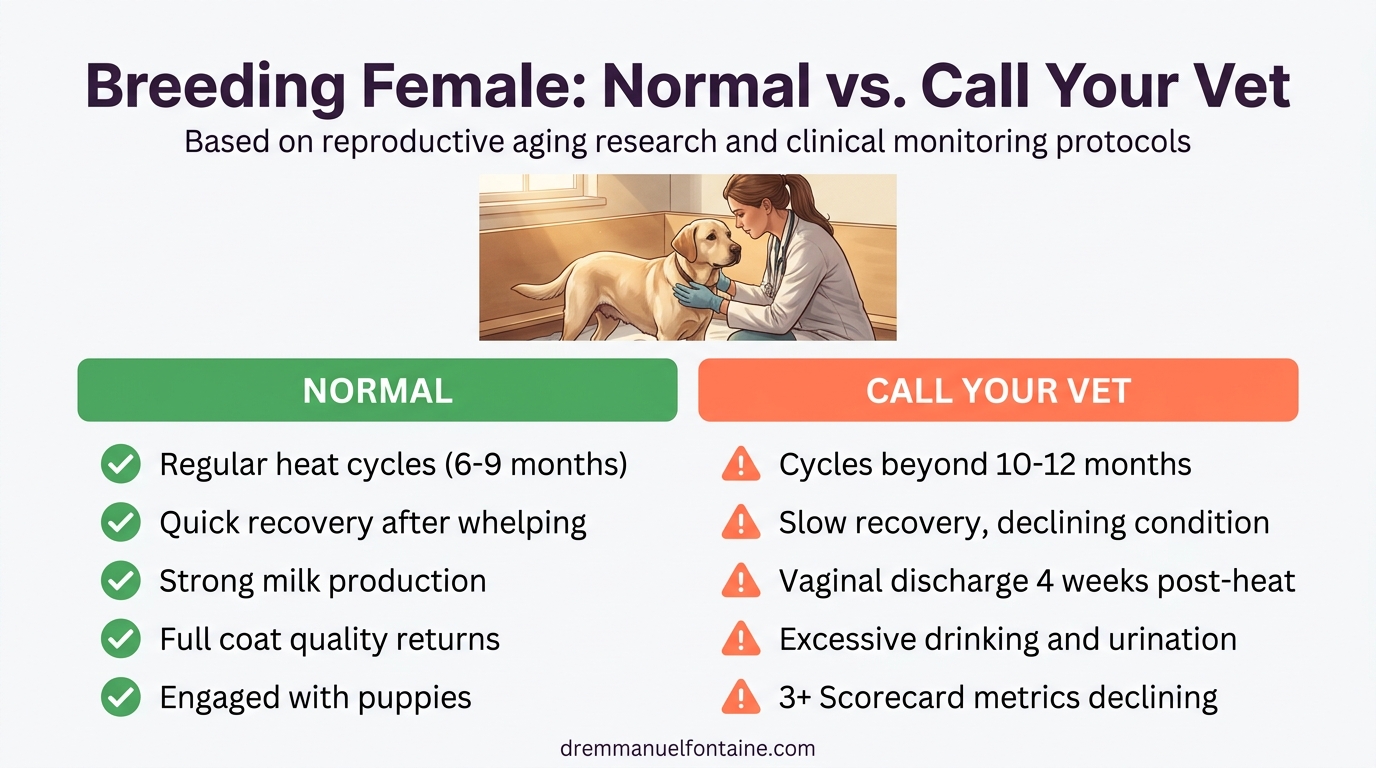
Pyometra is the breeding career’s most dangerous adversary, and it typically strikes during diestrus — 4 weeks after a heat cycle. As we already covered, every non-pregnant cycle adds cumulative uterine damage that sets the stage for this infection. Watch for vaginal discharge (which may look like tomato soup or light chocolate brown), increased water intake and urination, lethargy, and decreased appetite.
Pyometra is a medical emergency that requires immediate veterinary intervention. The treatment of choice is an emergency ovariohysterectomy (spay), which removes the source of infection and guarantees zero recurrence. Medical management is only appropriate for young, valuable breeding females who are not systemically ill, and only under strict veterinary oversight. If medical management does not show major improvement within 48 hours, emergency surgery becomes mandatory. If a bitch is successfully treated medically, she must be bred at the very first estrus following treatment, because recurrence rates exceed 50% during non-pregnant cycles.
| Pyometra Sign | What to Look For | Urgency Level |
|---|---|---|
| Vaginal discharge | Purulent, mucoid, or “tomato soup” appearance; 4 weeks to 4 months post-heat | Urgent — contact your vet immediately |
| Polydipsia/polyuria | Drinking and urinating excessively | High — classic indicator of renal problem |
| Lethargy and anorexia | Depression, refusal to eat (seen in 60–83% of cases) | High — systemic infection likely |
| Abdominal distention | Closed-cervix pyometra; uterus filling with pus without draining | Emergency — risk of uterine rupture; seek care now |
| Fever or hypothermia | Hypothermia specifically indicates severe toxemia | Emergency — endotoxemic shock possible |
Plan the Succession Before You Need It
Rather than squeezing “just one more litter” out of a proven female, the smartest breeding strategy is lineage planning. Identify a genetically superior daughter early in your dog’s career to replace her in the program. This allows the dam to retire while she is still thriving — not after a crisis forces your hand.
Most veterinary reproduction specialists recommend a maximum of 4 to 5 litters per female, with strict retirement after 2 to 3 C-sections due to progressive uterine scarring. These are not arbitrary numbers — they reflect the point at which cumulative metabolic and reproductive stress begins to outweigh the benefits. Remember that Seya’s story from our introduction is common: every pregnancy is a metabolic marathon that depletes calcium, protein, and essential fatty acids like DHA. Planning the succession early is how breeders who care deeply protect their best dogs.
| Career Planning Step | Timing | Key Action |
|---|---|---|
| Select successor | After the dam’s 2nd or 3rd litter | Identify a genetically superior daughter from the program |
| Track cumulative performance | After every litter | Monitor BCS, recovery time, milk quality, litter size trends |
| AMH testing | Annually after age 4 | Objectively assess remaining ovarian reserve |
| Set retirement threshold | Before breeding begins | Agree with your vet: max 4–5 litters or 2–3 C-sections |
| Execute retirement | When thresholds are met OR Wellness Scorecard declines | Spay the female; transition the successor into the program |
What Tools and Records Should You Have Ready?
The Breeding Wellness Scorecard
Your most important decision-making tool is not a blood test — it is a simple scorecard you maintain across your dog’s entire career. The Breeding Wellness Scorecard tracks five metrics after every litter: body condition and coat quality, recovery speed post-whelping, milk production, emotional engagement with puppies, and estrus regularity combined with litter size trends.
If three or more of these metrics begin to slip, your dog should be retired regardless of her age or registration eligibility. This is worth repeating because it transforms retirement from an emotional guess into a data-driven decision. Kennel club registration limits are legal floors, not ethical ceilings — your Wellness Scorecard sets the real ceiling.
| Scorecard Metric | What “Healthy” Looks Like | Warning Sign |
|---|---|---|
| Body condition and coat | Returns to pre-pregnancy BCS within 4–6 weeks; glossy coat | Dull coat, slow weight recovery, visible muscle loss |
| Recovery speed | Eating, active, and nursing well within 48 hours post-whelping | Prolonged exhaustion, slow appetite return, reluctance to stand |
| Milk production | Consistent, adequate supply for the full nursing period | Declining volume, early drying up, puppies losing weight |
| Emotional engagement | Attentive, calm, nurturing maternal behavior | Distant, anxious, ignoring or rejecting puppies |
| Cycle regularity and litter size | Predictable heat intervals; stable or growing litter sizes | Lengthening intervals (>10–12 months), shrinking litters |
Diagnostic Testing and Health Records
Maintain a complete diagnostic profile for each breeding female. This includes baseline bloodwork at each life stage, genetic health testing, and reproductive hormone tracking. As we discussed, progesterone testing optimizes breeding timing, and AMH testing objectively measures ovarian reserve.
Keep detailed records of every estrous cycle, every breeding, every whelping, and every litter outcome. These records are invaluable for identifying subtle trends that might not be obvious litter by litter but become clear over the arc of a career. Your vet or theriogenologist can review these records with you to make collaborative decisions about timing, spacing, and retirement.
| Record Type | What to Track | Frequency |
|---|---|---|
| Estrous cycle log | Dates, duration, interestrous intervals, behavioral signs | Every cycle |
| Breeding records | Dates, method (natural/AI), progesterone values at ovulation | Every breeding |
| Whelping records | Duration, complications, number born alive/dead, C-section if applicable | Every litter |
| Neonatal outcomes | Birth weights, daily weights, mortality events | Daily for first 3 weeks per litter |
| AMH and bloodwork | Ovarian reserve, organ function, infection markers | Annually after age 4 |
What Warning Signs Should You Watch For?
Subtle Signs of Reproductive Decline
The earliest indicators of reproductive decline are often invisible to breeders who are not tracking data systematically. Watch for prolonged interestrous intervals — if the gap between heat cycles stretches beyond 10 to 12 months, it may indicate hypothalamic-pituitary-gonadal dysregulation (a hormonal signaling problem). Silent estrus, where the dog cycles hormonally but shows no behavioral signs, is another subtle red flag.
Remember the Breeding Wellness Scorecard. Declining coat quality, slower recovery after each litter, reduced milk production, emotional withdrawal from puppies, and shrinking litter sizes are all cumulative signals. Any single metric slipping might not be alarming, but when three or more decline together, the data is telling you something important. Listen to it.
| Subtle Indicator | What It Suggests | Next Step |
|---|---|---|
| Interestrous interval > 10–12 months | Hormonal dysregulation; uterine disease risk rising | Consult your vet; consider AMH testing |
| Silent estrus (no behavioral signs) | Cycling hormonally without external signs | Vaginal cytology and progesterone testing with your vet |
| Declining coat/body condition | Cumulative metabolic depletion from repeated pregnancies | Assess BCS; review nutrition; consider retirement |
| Shrinking litter sizes | Ovarian reserve declining; fewer viable eggs | AMH testing; discuss career timeline with your vet |
Emergency Danger Signs in the Breeding Female
As we covered earlier, pyometra is the most dangerous emergency a breeding female can face. The classic presentation includes vaginal discharge 4 weeks after heat, excessive drinking and urination, and lethargy. But [[closed-cervix pyometra]{.underline}](https://www.vet.cornell.edu/departments-centers-and-institutes/riney-canine-health-center/canine-health-topics/pyometra) is particularly treacherous because there is no visible discharge — the pus accumulates inside the uterus with nowhere to drain, creating a risk of rupture, sepsis, and death.
Other emergency signs include abdominal distention, tachycardia (rapid heart rate), rapid breathing, pale mucous membranes, and fever or hypothermia. Hypothermia is specifically associated with severe toxemia and endotoxemia. Contact your veterinarian immediately if you observe any of these signs.
| Emergency Sign | Clinical Significance | Immediate Action |
|---|---|---|
| Vaginal discharge post-heat | Open-cervix pyometra (seen in 84% of cases) | Emergency veterinary visit within hours |
| Abdominal distention without discharge | Closed-cervix pyometra; rupture risk | Emergency veterinary visit immediately |
| Hypothermia with systemic illness | Severe toxemia; endotoxemic shock | Emergency stabilization with IV fluids |
Knowing When to Retire — Before a Crisis Decides for You
The final and most important decision in every breeding career is retirement timing. Kennel club rules set legal limits (the UK Kennel Club stops registering at age 8; the AKC allows registrations to 12 with special approval), but these rules do not account for breed-specific aging. Giant breeds reach their senior years by age 5 to 6 — breeding them up to a registry’s 8-year limit is risky.
Your retirement decision should be based on the individual dog’s welfare indicators, not arbitrary age limits. If the Breeding Wellness Scorecard shows three or more declining metrics, if AMH levels have dropped below 0.10 ng/mL, or if the dog has reached 4 to 5 litters or 2 to 3 C-sections — it is time. Spay her, let her live out her years as a beloved companion, and transition the successor you planned for into the program. This is how responsible breeders honor their best dogs.
| Retirement Trigger | Threshold | What to Do |
|---|---|---|
| Breeding Wellness Scorecard | 3 or more metrics declining | Retire and spay; transition successor into program |
| AMH level | Below 0.10 ng/mL (senescent range) | Breeding success unlikely; retire with veterinary guidance |
| Total litter count | 4–5 litters maximum | Plan final litter; schedule spay |
| C-section count | 2–3 C-sections maximum | Uterine scarring makes further pregnancies high-risk |
| Age (breed-adjusted) | Giant breeds: 5–6 years; others: varies | Discuss breed-specific limits with your theriogenologist |
Want to turn this knowledge into a real-time decision-making tool? Inside the Breeder Vault, you’ll find the Canine Breeding Career Field Protocol — a printable scorecard, decision tree, and emergency checklist with every threshold, every warning sign, and veterinary request scripts designed to be used throughout your dog’s entire breeding career. It’s the operational companion to everything you just learned.
Her Legacy Is Bigger Than Her Last Litter
A breeding career is not measured by the number of litters produced. It is measured by the health of the mother, the vitality of her offspring, and the wisdom of the decisions made along the way. You now understand the science behind reproductive aging, the surprising truth about uterine health, and the specific tools — from AMH testing to the Breeding Wellness Scorecard — that transform guesswork into confident, data-driven planning.
Your best female gave you exceptional puppies. She trusted you with her body and her health through every pregnancy. The greatest honor you can give her is a retirement timed by science, not by crisis. Work with your veterinarian, track the data, plan the succession early, and let her live out her golden years knowing she was valued for far more than her last litter. That is the mark of a breeder who truly understands this work.

 DR. EMMANUEL FONTAINE