🇫🇷 Lire en Français | 🇪🇸 Leer en Español | 🇧🇷 Leia em português
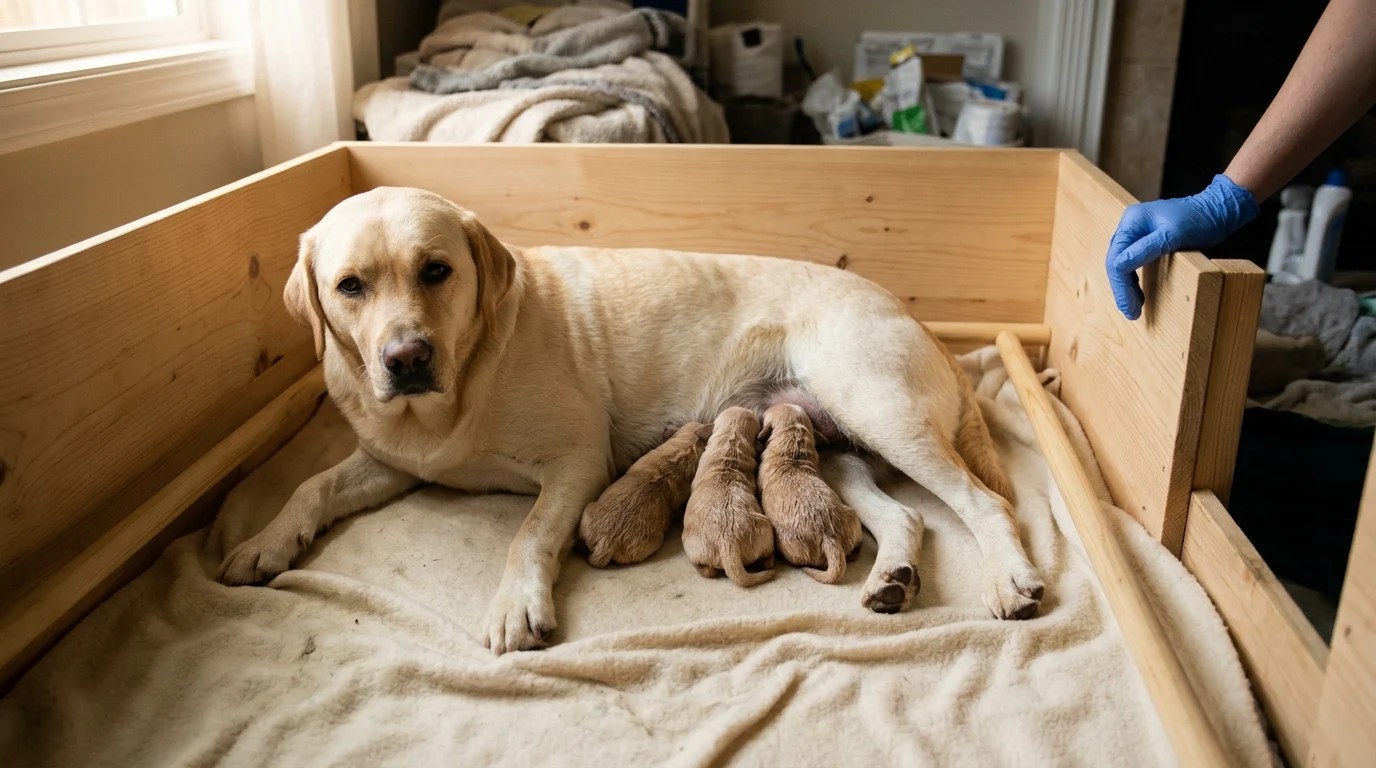
Picture a female dog in the middle of her whelping. She has delivered three puppies, she is cleaning them, and she looks perfectly comfortable. Ninety minutes go by, then two hours. She is resting peacefully, and you know there are still puppies inside, because the X-ray taken before the birth showed six. So do you keep waiting, or do you pick up the phone?
Here is how I answer that question. A mother is allowed to pause between two puppies, but a pause is no reason to stop watching the clock. Recent studies give us critical thresholds by size: about 1 hour 16 minutes between two puppies in small dogs, and about 1 hour 29 minutes in large dogs. Beyond that, the risk of losing a puppy at birth starts to climb. And a female lying calmly on her side, nursing her puppies, can be in a labor that has stalled, because what you see from the outside does not always match what is happening in her uterus.
This article is the written version of my video Dog in Labor: How Long Between Puppies Is Too Long?, so you can watch it, read it, or keep both open before your next whelping. It brings together what I have written on prolonged labor and the placenta, calcium during labor and pain during whelping, in six practical steps.
TL;DR
- Whelping has three stages, and the first one is already labor. It usually lasts 6 to 12 hours, up to 24 hours in a first litter.
- Once strong pushing starts, the first puppy should usually arrive within 2 to 4 hours.
- Critical thresholds between two puppies: about 1 h 16 min under 10 kg (22 lb), about 1 h 29 min over 30 kg (66 lb).
- A calm female can hide a stalled labor. Only the heartbeats of the puppies still inside, checked by ultrasound, tell a normal pause from a uterine inertia.
- 30 minutes of strong pushing with no puppy, green discharge before the first puppy, or a puppy stuck halfway means you contact your veterinarian now.
- Oxytocin only ever under veterinary supervision, after an examination confirms the way out is open.
- Look at every placenta. Violet or yellow areas mean that puppy had a harder labor than it looked.
Step One: Know When the Whelping Has Really Started
This is the first question that matters, because it starts the first clock. Many people use the word labor only for the moment she pushes, and they misread the hours before it. In reality, whelping happens in three stages, and the first one is already labor. During that first stage, her uterus is contracting and her cervix, the muscular gate of the uterus, is slowly opening. Those contractions are invisible to the naked eye, so what you see instead is a change in her behavior.
She becomes restless, gets up and lies down again and again, digs in her bed, pants and may shiver. Some females follow you everywhere, others look for a hidden corner. Many refuse their meal, and some vomit or keep licking their vulva. In some females these signs are so discreet that they go unnoticed, which is one more reason to know her ovulation date: birth usually happens about 63 days after ovulation, within a day or two. When her signs are discreet, the calendar speaks for her, and I explain how to pin that date down in canine ovulation timing beyond the progesterone number.
Once you have seen those changes, the first clock is running. This first stage usually lasts 6 to 12 hours, and a female having her first litter can stay in it for up to 24 hours. If the first stage goes beyond that and nothing seems to be happening, she requires a veterinary check. That picture has a name, primary uterine inertia, and we will come back to it in step three.
| Stage | What happens | What you see | Usual duration |
|---|---|---|---|
| First stage | Invisible uterine contractions, the cervix opens | Restless, digging, panting, shivering, refusing food | 6 to 12 hours, up to 24 hours in a first litter |
| Second stage | Expulsion of the puppies | Visible abdominal pushing | First puppy usually within 2 to 4 hours of strong pushing |
| Third stage | Delivery of the placenta | The placenta comes out with or after its puppy | Usually within about 15 minutes |
Step Two: Watch the Clock Through the Second and Third Stages
The second stage begins when you see her push. Once strong pushing has started, the first puppy should usually arrive within 2 to 4 hours, and that is your first clock in this stage. The third stage is the delivery of the placenta, which can come out almost with its puppy and usually follows within about 15 minutes. Stages two and three then alternate, puppy after puppy, until the uterus is empty.
The critical thresholds
For years, the classic answer to “how long between two puppies?” was 30 to 60 minutes, and I used to say the same thing myself. Today, studies that timed whelpings give us a critical threshold: the duration beyond which the risk of losing a puppy at birth starts to climb. In practice, it is the moment when a normal pause stops being reassuring. The thresholds I use come from a French study, and they depend on her size.
In small dogs, under 10 kg (22 lb), the critical threshold between two puppies is 1 hour 16 minutes. In large dogs, over 30 kg (66 lb), it is 1 hour 29 minutes. The same study gave a threshold for the entire whelping, from the first strong push to the last puppy: 4 hours 17 minutes in small dogs, and 10 hours 23 minutes in large dogs. The clock itself is simple. It starts at the birth of each puppy, and it starts again at the next one.
One breed has even more precise data, the Labrador Retriever. When the interval between two puppies goes beyond 55 minutes, the next puppy’s risk of being stillborn is about four times higher. When the entire whelping goes beyond 6 hours 20 minutes, the risk of a stillborn puppy is more than three times higher. To my knowledge, the Labrador is the only breed with data like this today, and I hope every breed will one day have its own numbers.
| Female | Between two puppies | Entire whelping (first strong push to last puppy) |
|---|---|---|
| Small dogs, under 10 kg (22 lb) | 1 h 16 min | 4 h 17 min |
| Large dogs, over 30 kg (66 lb) | 1 h 29 min | 10 h 23 min |
| Labrador Retriever | Beyond 55 min: about 4 times the stillbirth risk | Beyond 6 h 20 min: more than 3 times the stillbirth risk |
A normal pause, or a uterus that has stopped?
A mother is allowed to rest, and a pause can be perfectly normal. But from the outside, you often cannot tell a normal pause from a uterus that has stopped working. In both cases, she lies down, nurses her puppies and seems comfortable. It is very easy to mistake a uterine inertia for a normal pause.
The way to find out is to check the heartbeats of the puppies still inside, which your veterinarian does with an ultrasound. A healthy unborn puppy has a heart rate of about 160 to 200 beats per minute. When he runs short of oxygen, his heart does the opposite of what most people expect: an adult’s heart beats faster, but an unborn puppy cannot breathe to get more oxygen, so his body switches to saving it and his heart slows down. Below about 130 beats per minute, that puppy is in severe distress, and the waiting is over, even when the mother looks completely relaxed.
Step Three: Read Her Contractions
The clock tells you when to act, and her contractions tell you why. A whelping can stop in two very different ways, and you tell them apart by watching how she pushes. In the first pattern, she lies on her side or squats with her back arched and her tail lifted. Her belly tightens hard, she holds her breath and strains for several seconds, the pushes come in waves, and still no puppy appears.
Strong pushing with no puppy: an obstruction
That pattern points to an obstruction. The puppy may be too large for the birth canal, or turned in a way that blocks him. After 30 minutes of strong pushing with no puppy, she requires veterinary attention right away. The puppy engaged in the birth canal is squeezed with every contraction and his oxygen supply drops quickly, the uterus is under enormous strain and in rare cases can tear, and after a long fight the uterine muscle becomes exhausted. A caesarean section is often how this ends, but it is the consequence. The emergency is the puppy and the uterus.
Weak or fading pushes: uterine inertia
In the second pattern, her flank ripples now and then with a small, half-hearted push, and nothing builds. Long minutes pass with no effort at all, and she may even doze. The way out is open, but her uterus is barely working, which veterinarians call uterine inertia. It comes in two forms, and they are two different problems.
In primary uterine inertia, the uterus never really gets going: she goes through the first stage, and the strong pushing of the second stage never comes. It is more common in very large litters, in litters of only one or two puppies, and in older or overweight females. In secondary uterine inertia, the uterus starts well and then runs out of steam, which is the classic picture at the end of a large litter or after a long fight against an obstruction.
You do not need to count every push. What you need is a general impression of how often she pushes, and whether the pushes are getting closer together or further apart. Strong labor builds, with efforts that come more often and look more intense. Fading labor does the opposite. When you see that second pattern with puppies still inside, an hour of weak pushing without a puppy, or a gap beyond the critical threshold for her size, means you contact your veterinarian.
| Pattern | What you see | What it points to | When to call |
|---|---|---|---|
| Strong pushing, no puppy | Back arched, belly hard, straining in waves | Obstruction: puppy too large or badly turned | After 30 minutes of strong pushing |
| Primary uterine inertia | First stage signs, strong pushing never comes | Uterus never gets going | First stage beyond 12 to 24 hours with nothing happening |
| Secondary uterine inertia | Good start, then weaker, rarer pushes | Uterus running out of steam | 1 hour of weak pushing, or a gap beyond her critical threshold |
Step Four: Look at How Each Puppy Presents
When a puppy reaches the vulva, the way he presents tells you a lot about the next few minutes. In an anterior presentation he comes head first, like a diver, with his nose resting on his front paws. In a posterior presentation he comes hind legs first. Many people think a hind-first puppy is a problem, and it is not: in the dog, about 60 percent of puppies are born head first and about 40 percent hind legs first. A simple trick helps when only the feet are visible, because on a puppy lying the right way up, the pads of the front paws face downward and those of the hind paws face upward.
Hind-first births still deserve a little more attention, because of the umbilical cord. As his chest passes through her pelvis, his cord gets pinched and his oxygen supply drops, but his head is still inside, so he cannot take his first breath yet. This is why a hind-first puppy who stops halfway, hind legs out and head still inside, has to come out quickly.
Abnormal presentations, and the manoeuvres
Some presentations are abnormal. In a true breech, you see the tail and the rump, with both hind legs folded forward under the body. Another classic problem is a head turned back along the body, so you see one or two front legs with no nose behind them. In both cases, folded legs or a turned head make the part trying to come through wider than her pelvic canal, and her pushing only wedges him in further.
The idea behind the manoeuvres is simple: you gently push the puppy back a little to make room to bring a leg or the head into position, then you ease him out with her pushes, never against them. Use plenty of sterile, water-based obstetric lubricant and clean gloves, and never pull hard on a leg or on the head, because a newborn’s joints and bones are fragile. In a small female such as a Chihuahua, there is often no room for a finger. I know it sounds much easier than it is, so if you have never done it, or have any doubt, do not improvise and seek veterinary assistance.
What you learn from all this is reassuring as much as it is useful. A normal presentation that moves forward with each push is a good sign. When part of a puppy stays visible and stops progressing over several strong pushes, she requires veterinary help immediately, because that puppy is losing oxygen while you watch.
| Presentation | What you see | What it means |
|---|---|---|
| Anterior (head first) | Two front paws, pads down, nose right behind | Normal, about 60 percent of puppies |
| Posterior (hind legs first) | Two hind paws, pads up | Normal, about 40 percent; must not stop halfway |
| True breech | Tail and rump, hind legs folded forward | Usually cannot pass alone |
| Head turned back | One or two front legs, no nose | Usually cannot pass alone |
| Puppy stuck halfway | Part visible, no progress over several strong pushes | Veterinary help immediately |
Step Five: Read the Discharge
During a whelping you will see several kinds of discharge, so let me start with what is normal. A clear or slightly pink discharge, in a female who keeps progressing, is exactly what a normal whelping looks like. Once the first puppy is born, you will often see a dark green discharge as well. That color comes from a pigment called uteroverdin, stored at the edges of the canine placenta, and it is released when a placenta begins to separate from the wall of the uterus.
Before the first puppy, that same green means something very different. A placenta has separated while its puppy is still inside, so he is losing his oxygen supply, and this is a reason to contact your veterinarian now. Two other discharges call for the same response at any point of the whelping: heavy, bright red bleeding, which can mean an injury to the uterus or the birth canal, and a thick discharge with a foul smell, which can point to an infection or to a puppy who has died inside.
| Discharge | When | What to do |
|---|---|---|
| Clear or slightly pink | Any time, female progressing | Normal, keep watching |
| Dark green | After the first puppy | Normal: placentas are separating |
| Dark green | Before the first puppy | Contact your veterinarian now |
| Heavy, bright red bleeding | Any time | Contact your veterinarian now |
| Thick, foul-smelling | Any time | Contact your veterinarian now |
Step Six: Support Her Contractions
So what can you do when her contractions slow down? More than most people think. Your role during a whelping is to give her uterus the best possible conditions to work, and it starts with the room. Stress hormones such as adrenaline work against labor and can slow her contractions or stop them for a while, which is why a female often pauses when strangers arrive or the house gets noisy. A calm, familiar room, with few people and no unnecessary comings and goings, is already a treatment.
Stress management matters even more in a female having her first litter. I like to install a pheromone diffuser in the maternity as soon as she moves in. It releases a synthetic copy of the appeasing pheromone that a mother dog naturally produces in the first days after giving birth, and a study at the veterinary school of Alfort found that females exposed from about a week before whelping paid more attention to their puppies, first-time mothers most of all. When her contractions slow down, a short walk on a leash is the first thing I suggest, because movement often helps the next puppy settle into the birth canal, and the pressure he puts on her cervix triggers the release of her own oxytocin.
Calcium and energy
The uterus is a smooth muscle, and every contraction needs two ingredients. Calcium is the trigger, and energy, in the form of a molecule called ATP, is the fuel. With too little calcium, the contraction never starts properly. With too little energy, it starts and cannot be sustained. A whelping puts pressure on both: she has often refused food for hours, and she pants a lot, which blows off carbon dioxide, makes her blood slightly more alkaline and leaves less of her calcium in the free, ionized form that can trigger a contraction. One study found that drop in about four in ten females with a difficult birth.
Energy is the easier of the two. Anytime she takes a pause between two puppies, I offer her something to eat, her usual food or a very palatable canned food, as an energy snack. Calcium is different, and I consider it only when her contractions clearly weaken or the gaps between puppies get longer. I then give an oral calcium supplement made for dogs and judge the effect over the next 30 to 45 minutes. If nothing changes in that window, the next decision belongs to your veterinarian. I go further on this in are you using calcium wrong during dog labor?
Oxytocin, only under veterinary supervision
People keep asking me how they should use oxytocin during a whelping. In my opinion, oxytocin should only ever be used under veterinary supervision. It is the hormone that orders the uterus to contract, and as a drug it is powerful. Given at the wrong moment or at the wrong dose, it forces the uterus to squeeze harder against a puppy who cannot pass, and it can make contractions so strong and long that the puppies barely recover their oxygen between them.
Pig medicine shows this very clearly. In one study in sows, oxytocin cut farrowing time roughly in half, and yet about twice as many piglets died during birth, three out of four of them with a ruptured umbilical cord. In dogs, a large German study of difficult births points to the same thing. This is why the examination comes first: a veterinarian checks that the way out is open, that the puppy can pass and that the heartbeats are strong, and only then is oxytocin even part of the discussion.
| Support | When | Why |
|---|---|---|
| Calm, familiar room | From the first stage | Adrenaline slows or stops contractions |
| Pheromone diffuser | As soon as she moves into the maternity | More maternal attention, especially in first-time mothers |
| Short walk on a leash | When contractions slow down | Helps the next puppy engage and triggers her own oxytocin |
| Food as an energy snack | During the pauses between puppies | Contractions need energy (ATP) |
| Oral calcium for dogs | Only when contractions clearly weaken | Judge the effect over 30 to 45 minutes, then your veterinarian decides |
| Oxytocin | Only under veterinary supervision, after an examination | Against an obstruction, it harms the puppies and the uterus |
Keep a Whelping Record on Your Phone
One good habit ties all of this together: a simple record kept on your phone. Note the time you first saw the signs of the first stage, because that is your first alert. Then note the time each puppy is born, which gives you every interval and the total duration of the whelping, and add any discharge, with its color and the time you saw it.
You can compare each interval with her critical threshold as you go. And if you need to go to the clinic, that record goes with you, so your veterinarian sees in seconds what you lived through in hours. My whelping checklist covers everything else to have ready before the puppies arrive.
What the Placenta Tells You
In many whelpings, nobody really looks at the placenta. Yet each puppy arrives with his own placenta, which has spent the whole labor between him and his mother, so it keeps a record of what he went through. A healthy placenta is a band of tissue with a uniform color and a smooth texture. Each time you recover one, take a few seconds to look for violet or deep purple areas, where blood has pooled in the tissue (congestion), and for yellow, ochre-colored patches, where part of the tissue has died (necrosis).
A research team that examined placentas after difficult births observed that congestion became more severe with every extra hour of difficult labor. Violet areas tell you that the exchange of oxygen with that puppy was struggling, and yellow patches tell you that part of the placenta had stopped working altogether. An earlier study found that puppies whose placentas showed these dead patches were less likely to double their weight in their first ten days. I go deeper into this in what prolonged labor does to the placenta and the puppies.
When you find a placenta like that, two things follow. The puppy who came with it deserves extra care in his first days, because he has been through more than his littermates. And the puppies still inside are living through the same labor, which is a reason to look at the clock again and to contact your veterinarian sooner rather than later.
| What you see on the placenta | What it means | What follows |
|---|---|---|
| Uniform color, smooth texture | A healthy placenta | Nothing special |
| Violet or deep purple areas | Congestion: oxygen exchange was struggling | Extra care for that puppy; look at the clock again |
| Yellow, ochre-colored patches | Necrosis: part of the placenta had stopped working | Extra care and close weighing; call your veterinarian sooner |
Conclusion
So here is the whole thing in one breath. Your first clock starts with the behavior changes of the first stage. Once she pushes, the critical thresholds for her size tell you when a pause stops being reassuring, between two puppies and for the entire whelping. And the way she pushes, the way each puppy presents, the discharge and the placenta tell you whether the whelping is really going well. Agree on the plan with your veterinarian before the due date, including who to call at night, because an article is education, not a diagnosis.
Think again of the female from the beginning, resting comfortably with her puppies. Looking fine is an impression, and a clock and a placenta are evidence. If you want to see what to do at the exact moment a puppy is born and slow to breathe, my video Newborn Puppy or Kitten Not Breathing? Don’t Suction First and my article on how to resuscitate newborn puppies and kittens are the perfect continuation.
Want to go further? Inside the Breeder Vault, the library where I add the expanded edition of my newsletter every week, you will find the protocols and the deeper science behind articles like this one, in dogs and in cats.
Tell me in the comments below: when your female takes a long pause between two puppies, what makes you think it is a rest and not a problem? I read every one, and your answers help other breeders. And if you want the next article in your inbox, join my free newsletter, every Saturday, in English, French, Spanish and Portuguese.


