🇫🇷 Lire en Français | 🇪🇸 Leer en Español | 🇧🇷 Leia em português
Two out of three bitches give birth in the middle of the night. So the hardest decisions of the whole litter usually land on someone tired, in a dim room, at three in the morning. Unless you make them now.
Here is the whole answer. Ten things ready before her due date, in three waves. The plan, a few weeks before. The room and the box, two weeks before. And the night itself, in the last week. Item ten is a card you write this week that does your thinking for you at three in the morning.
This article is the written version of my video Whelping Checklist: 10 Things to Have Ready Before Puppies, so you can watch it, read it, or keep both open while you prepare. It brings what I have written over the years about the whelping box, the room and the night into one checklist. If you breed cats, the queen notes sit inside each wave, because a kittening needs the same plan, the same place and the same calm night.
TL;DR
- Count her due date from ovulation, not from the breeding. About 63 days from ovulation, against a two-week fog of 58 to 72 days from the first breeding.
- Turn her risk profile into one of three birth plans with your veterinarian. A planned cesarean is a tool for the female whose risk is real, not a routine.
- Book an X-ray around day 50. It gives you the puppy count, and that number tells you on the night whether she is resting or still has work to do.
- Move her into a quiet room one to two weeks early, with the humidity between 55 and 65 percent.
- Size the box to her, test the floor, fit pig rails, and warm half the floor so the puppies can choose.
- Measure the temperature where the puppies lie, not on the wall. The wall can show a comfortable room while the floor sits 10 °C (18 °F) below the week-one target.
- Write your four red lines on a card, taped to the box, with the clinic number, who drives and the puppy count from your X-ray.
Wave One: The Plan, a Few Weeks Before
The first wave happens weeks before anything goes into the room. It is three decisions you make on paper, with your veterinarian, while everyone is rested and nobody is watching the clock. By the end of it, the night has a date, a plan and a number.
1. Count her due date from ovulation, not from the breeding
A pregnancy lasts about 63 days from ovulation, give or take a day, a little earlier in small breeds and a little later in large ones. Counted from the first breeding, the same pregnancy can land anywhere from 58 to 72 days. That is a two-week fog, and you cannot prepare well inside a fog.
If you timed her ovulation with progesterone, you already have your date. If you did not, your veterinarian can still estimate it from ultrasound measurements of the puppies. In the queen it is simpler, because mating triggers ovulation, so her breeding dates already give you a real window.
Write the date down, then mark the day one week before it. That is when your watch starts. And mark two days after it as well. If she reaches that day with no labor, call your veterinarian that day, because a pregnancy that runs past its window needs checking, not waiting.
| Mark on your calendar | What it means |
|---|---|
| Her due date, counted from ovulation | About 63 days, give or take a day |
| The same pregnancy, counted from the first breeding | Anywhere from 58 to 72 days: a two-week fog |
| One week before the due date | Your watch starts |
| Two days after the due date, with no labor | Call your veterinarian that day |
| A queen | Her breeding dates already give you a real window |
2. Turn her risk profile into a birth plan
In a study we ran on more than 1,600 bitches, about one whelping in seven was difficult. That risk is not random. It gathers around a few things you can see weeks ahead.
The size of the litter, especially a very small one. Her body condition, because extra fat can weaken contractions. Her age, especially a first litter after four years old. Her history. And her conformation, with brachycephalic breeds high on the list.
Take those five to your veterinarian during the pregnancy, and choose one of three plans together. A natural whelping. A natural whelping with a backup plan you both agreed on in advance. Or a planned cesarean. That last one is not giving up. In a study my former team published, puppy losses after a planned cesarean were under 3 percent, against 20 to 40 percent after an emergency one. It is a tool for the female whose risk is real. Not a routine.
| Her risk factor | What to look at |
|---|---|
| Litter size | Especially a very small litter |
| Body condition | Extra fat can weaken contractions |
| Age | Especially a first litter after four years old |
| History | Her history: take it to your veterinarian with the other four |
| Conformation | Brachycephalic breeds are high on the list |
| The plan you choose with your vet | Natural, natural with an agreed backup, or a planned cesarean |
3. Book the day-50 X-ray for the puppy count
Ultrasound is excellent for checking that the puppies are alive, but it sees the belly in slices, so in a big litter it can miss a puppy or count one twice. An X-ray around day 50, once the skeletons are visible, gives you the number.
And that number is what tells you, on the night, whether she is resting between puppies or still has work to do. Write it down where you will see it. You will need it again in item ten, on your red lines card.
| Ultrasound | X-ray around day 50 | |
|---|---|---|
| What it does best | Checks that the puppies are alive | Gives you the puppy count |
| How and when it works | Sees the belly in slices | Around day 50, once the skeletons are visible |
| In a big litter | Can miss a puppy or count one twice | Gives you the number |
Wave Two: The Room and the Box, Two Weeks Before
This is the wave I learned the hard way. My first litter, as a veterinary student in France. Nine puppies born. Five dead within 48 hours. The box was cardboard, pushed against a stone wall, at the beginning of March.
For years I told that story as a lesson about cold. It was. But that box failed on everything at once. No warm side. A floor that soaked up every fluid. No rails. And nothing measuring what the puppies actually felt.
4. The room, two weeks early
Pick the quietest spot you have. Low traffic, away from other pets and noisy machines, with soft light instead of bright overhead lights. A spare room works, even a bathroom. The kitchen does not.
Move her in one to two weeks before her due date, so she can explore it, nest, and claim it as her own. Start a dog appeasing pheromone diffuser the day she moves in, or the feline version for a queen.
Then put a hygrometer in the room. You want the humidity between 55 and 65 percent, because air that is too dry raises the risk of dehydration in a newborn, and air that is too damp feeds bacteria.
| The room | What you want |
|---|---|
| Where | The quietest spot you have: a spare room works, even a bathroom; the kitchen does not |
| Around her | Low traffic, away from other pets and noisy machines |
| Light | Soft light instead of bright overhead lights |
| When she moves in | One to two weeks before her due date |
| Calm | A dog appeasing pheromone diffuser from day one, or the feline version for a queen |
| Humidity | Between 55 and 65 percent, checked with a hygrometer |
5. The box itself: size first
Size first. Measure her from the nose to the base of the tail, and make the box one and a half to two times that, in length and in width. If you are building one, my guide on how to make a whelping box goes through it step by step.
Bigger is not safer. In an oversized box, a newborn can crawl away from the heat and from its mother, and it chills faster than people expect. For a queen, give her a covered box, the den she is looking for, and even there a low rail is usually better than none.
| Measure | Rule |
|---|---|
| Her length, from the nose to the base of the tail | Make the box 1.5 to 2 times that, in length and in width |
| An oversized box | Bigger is not safer: a newborn can crawl away from the heat and from its mother, and chills faster than people expect |
| A queen | A covered box, the den she is looking for; even there, a low rail is usually better than none |
The box itself: the floor test and the pig rails
Then the floor. Pull the bedding back and pour about 15 mL (1 tablespoon) of water on the actual floor of the box. Wait five minutes. If it soaks in, the floor is porous, and a warm, porous floor turns birth fluid, urine and milk into a bacterial culture within a day or two. Cardboard and raw wood fail this test. Hard plastic panels pass it.
Then the rails. Put her in the box, let her lie on her side, and look along the walls. Is there anywhere a puppy can be where she cannot pin it? A pig rail creates that space. For a small to medium dam, about 8 to 10 cm (3 to 4 in) off the floor, and about the same distance out from the wall, scaled up or down with her size.
In the first week a puppy cannot get out of the way, and you cannot watch every minute of every night. A rail can.
| Test | How you run it | Pass or fail |
|---|---|---|
| The floor test | About 15 mL (1 tablespoon) of water on the bare floor, wait five minutes | Soaks in: the floor is porous. Cardboard and raw wood fail; hard plastic panels pass |
| The rail check | Let her lie on her side and look along the walls | Is there anywhere a puppy can be where she cannot pin it? A pig rail creates that space |
| Rail height, small to medium dam | About 8 to 10 cm (3 to 4 in) off the floor | Scaled up or down with her size |
| Rail distance | About the same distance out from the wall | Scaled up or down with her size |
Wave Two, Continued: Heat, Bedding and Hygiene
A box can pass all three of those tests and still fail on the one thing that took most of my first litter. Heat. This is where the room, the floor and the bedding either protect the newborns or quietly work against them, and most of it comes down to measuring the right spot.
6. Heat as a gradient, not a single temperature
For their first two to three weeks, newborns cannot regulate their own body temperature. Below about 35 °C (95 °F), the gut stops working and the drive to nurse disappears. So you warm one side, not the whole room.
Put a pet heating pad with a thermostat under half the floor. Never a human heating pad, those get dangerously hot. In the first week, the warm side should read 30 °C (86 °F) at floor level, and the cool side about 5 °C (9 °F) lower, so the mother has somewhere to cool down.
Then the puppies choose. Too warm, they move away. Too cold, they move closer.
| Target or rule | |
|---|---|
| Newborn body temperature | Below about 35 °C (95 °F), the gut stops working and the drive to nurse disappears |
| Heat source | A pet heating pad with a thermostat, under half the floor. Never a human heating pad |
| Warm side, first week | 30 °C (86 °F) at floor level |
| Cool side | About 5 °C (9 °F) lower, so the mother can cool down |
| How you read it | The puppies choose: too warm, they move away; too cold, they move closer |
The wall thermometer trap
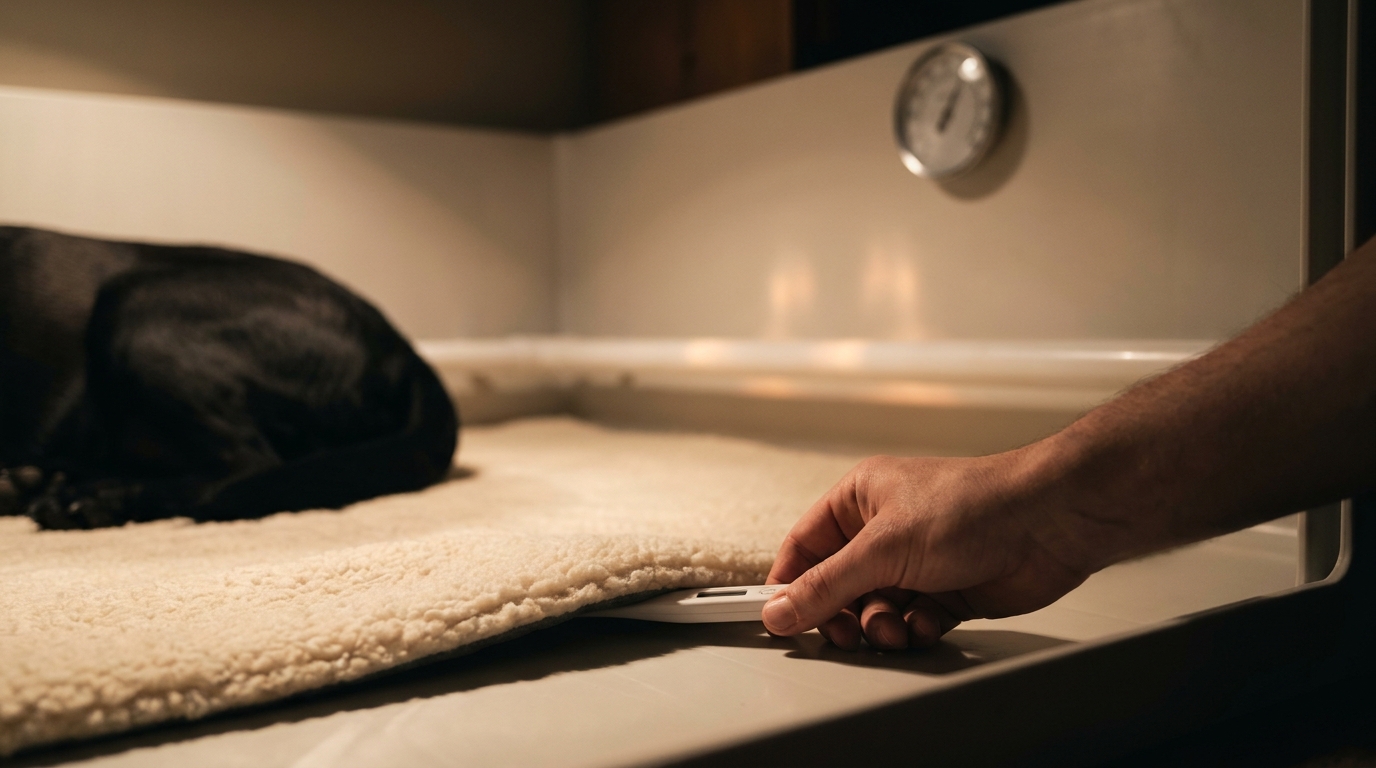
And here is the trap. A thermometer on the wall can show a perfectly comfortable room, while the floor under the bedding sits a full 10 °C (18 °F) below that week-one target. So put your thermometer where the puppies lie, not where it is easy to read. And do a test run with the heating pad a week or two before she is due, so whelping night is not your first try.
| Where you measure | What it tells you |
|---|---|
| A thermometer on the wall | The air in the room, which can look perfectly comfortable |
| A thermometer under the bedding, where the puppies lie | What the puppies actually feel |
| The gap you can find | The floor can sit 10 °C (18 °F) below the week-one target |
| The test run | A week or two before she is due, so whelping night is not your first try |
7. Bedding and hygiene
Use veterinary fleece, and have several sets. It stays dry on top, it gives the puppies grip, and it insulates. Towels look kind, but once they are wet they turn slippery, and puppies that cannot grip can develop swimmer syndrome, with legs that splay outward. Wet bedding is also cold bedding. Dry bedding is warm bedding.
Next to the box, set up a small hygiene station. Gloves, hand sanitizer, clean towels. Your hands are the first thing that touches these newborns. For cleaning, use an accelerated hydrogen peroxide disinfectant, because the common quaternary ammonium cleaners are not reliable against parvovirus or panleukopenia. Clean the soiled spots, not the whole nest. Clean does not mean sterile.
Every table behind this wave, the box sizes, the rail heights by her weight, and the temperatures week by week, is in my article on how to set up a whelping box that actually protects newborn puppies and kittens. Keep it open while you build.
| Choice | Use | Avoid |
|---|---|---|
| Bedding | Veterinary fleece, several sets: dry on top, grip, insulation | Towels: slippery when wet, a risk of swimmer syndrome |
| Moisture | Dry bedding is warm bedding | Wet bedding is cold bedding |
| Hygiene station | Gloves, hand sanitizer, clean towels next to the box | Forgetting that your hands are the first thing that touches the newborns |
| Disinfectant | Accelerated hydrogen peroxide | Common quaternary ammonium cleaners: not reliable against parvovirus or panleukopenia |
| Cleaning | The soiled spots | The whole nest: clean does not mean sterile |
Wave Three: The Night Itself, in the Last Week
Everything so far was about the place. This wave is about you. It is the kit you lay out, the watch you keep and the lines you write down, so that on the night you follow a card instead of guessing.
8. The kit, laid out in the order you will use it
First, a stack of warm, clean towels. Under the 2025 RECOVER guidelines, that towel is your first resuscitation tool, because firm rubbing along the ribs triggers breathing more effectively than suction does. Then a neonatal bag and mask, for the newborn that stays limp. The bulb syringe stays close, but not in your hand. It is only for fluid you can actually see.
Then chlorhexidine or iodine for the cords, and a digital gram scale accurate to 1 g, because every newborn gets weighed at birth. Milk replacer, and a backup source of colostrum in case a newborn cannot nurse.
And one fast-acting oral calcium gel. That is the one supplement that earns its place on whelping night, and it is not a reason to add calcium during the pregnancy. Add a camera, so you can watch without hovering.
| Item | Why it is there |
|---|---|
| A stack of warm, clean towels | Your first resuscitation tool: firm rubbing along the ribs triggers breathing |
| Neonatal bag and mask | For the newborn that stays limp |
| Bulb syringe, close but not in your hand | Only for fluid you can actually see |
| Chlorhexidine or iodine | For the cords |
| Digital gram scale, accurate to 1 g | Every newborn gets weighed at birth |
| Milk replacer and a backup source of colostrum | In case a newborn cannot nurse |
| One fast-acting oral calcium gel | The one supplement for whelping night, not for the pregnancy |
| A camera | So you can watch without hovering |
9. The watch, starting one week before her date
Start taking her temperature. Before labor it usually drops, sometimes by less than 1 °C (1.8 °F), and often 12 to 36 hours ahead. But in about one bitch in five, you will never see that drop. So never watch the thermometer alone. Watch her too: nesting, restlessness, panting.
When the thermometer and her behaviour start to agree, the window is opening. That is not the moment to phone anyone. It is the moment to warm the towels, charge your phone, and settle in close to the box.
For a queen, skip the thermometer. It is not reliable in cats, and repeated checks stress her. Watch her behaviour instead.
| What you watch | What to know |
|---|---|
| Her temperature, from one week before the date | Usually drops before labor, sometimes by less than 1 °C (1.8 °F), often 12 to 36 hours ahead |
| The missing drop | In about one bitch in five, you will never see it |
| Her behaviour | Nesting, restlessness, panting |
| Both agree | The window is opening: warm the towels, charge your phone, settle in close |
| A queen | Skip the thermometer, it is not reliable in cats and stresses her. Watch her behaviour |
10. Your red lines, written down while you are calm
Two out of three bitches whelp in the middle of the night. So decide at noon what you will do at three in the morning.
On one card, taped to the box, write four lines. Strong, regular pushing for 30 minutes with no puppy: call. Green discharge before the first puppy, or green with no puppy following: the placenta has separated early, so go. Two hours since the last puppy, with more still expected from your X-ray, and any doubt at all: call. You do not need certainty. Doubt is enough. And a mother who seems sick, with fever, tremors or collapse: call.
For a queen, there is no green. Her warning sign is a dark brown to black discharge before the first kitten.
Under those lines, write the number of your nearest emergency clinic, who drives, and the puppy count from your X-ray. Because when you call, the questions are always the same. When did the last puppy arrive, how many are still inside, what is she doing now, and what discharge have you seen. With that card, you answer in seconds.
| On your card | What you do |
|---|---|
| Strong, regular pushing for 30 minutes with no puppy | Call |
| Green discharge before the first puppy, or green with no puppy following | Go: the placenta has separated early |
| Two hours since the last puppy, more expected from the X-ray, any doubt at all | Call. Doubt is enough |
| A mother who seems sick: fever, tremors or collapse | Call |
| A queen: dark brown to black discharge before the first kitten | Her warning sign (there is no green) |
| Underneath | Your nearest emergency clinic’s number, who drives, the puppy count from the X-ray |
Conclusion
So here is the whole checklist in one breath. Plan it weeks ahead, build the place two weeks ahead, and write the night down before it comes. Build your birth plan, and the exact lines for calling, with the veterinarian who knows your female, because a checklist is education, not a diagnosis.
This week, do one thing. Put a thermometer on the floor of your whelping box or kittening area, under the bedding, and compare it with the one on the wall. And for the first minute of a newborn’s life, where that stack of towels matters most, my video on why you should not suction first is the one to watch next.
I often say the art of whelping is knowing how to wait. The real question is how long. Write that answer down before she starts.
Want to go further on item one? Inside the Breeder Vault, the library where I add the expanded edition of my newsletter every week, you will find the expanded edition of Do you know her ovulation day?, on the one date that plans the birth, in dogs and in cats.
Once you have compared your two thermometers, tell me in the comments below how far apart the two readings were. I read every one, and your numbers help other breeders see why the floor is the reading that counts.
And if you want the next article in your inbox, join my free newsletter. It arrives every Saturday, in English, French, Spanish and Portuguese.