🇫🇷 Lire en Français | 🇪🇸Leer en Español | 🇧🇷Leia em português
Your female has delivered three puppies. She settles, grooms the newborns, and looks comfortable. Ninety minutes pass. Then two hours. She is not straining. The radiograph you had done at day 50 of gestation told you three more puppies were still to come. The question writes itself: do you wait, or do you call?
Until recently, the honest answer relied on experience and instinct. A 2026 study changed that. Researchers tracked what happens inside the placenta (the tissue that supplies oxygen and nutrients to each unborn puppy) when labor stalls. What they found is clear: every hour of stalled birth, called dystocia, raises the risk of serious damage to that tissue. The clock your puppy depends on is the same clock you are watching.
- TL;DR
- What Prolonged Labor Does to the Placenta and the Puppies
- How to Read the Warning Signs and Time Your Vet Call
- The Records and Plans That Protect Every Litter
- The Signals That Mean It Is Time to Call or Transport
TL;DR
- Every hour of stalled labor increases the risk of serious damage to the placenta, the tissue supplying oxygen to each unborn puppy.
- At the point where you have any doubt, call your vet. You do not need certainty to make that call.
- Green vaginal discharge with no puppy delivered shortly after is a placental emergency, not a phase of labor.
- Your role at the whelping box: observe, time, and call when in doubt. Your vet’s role: diagnose and act.
What Prolonged Labor Does to the Placenta and the Puppies
The 2026 finding that put a number on the cost of waiting
She looks fine. That is the most reassuring thought you can have at the whelping box. It is also the most dangerous one. Because the tissue feeding each puppy still inside the uterus is not fine. It cannot tell you what is happening to it. A 2026 study measured what prolonged labor does to that tissue: for every additional hour labor remained stalled, the risk of serious placental damage increased. At three hours past the safe window, that risk was roughly three times higher than at the start of the window.
The placenta is the disc of tissue that connects each puppy to the uterine wall. It transfers oxygen, nutrients, and waste in both directions. When labor stalls, that transfer comes under strain. You cannot see the placenta from the outside, but the damage accumulates with every hour on the clock.
The study tracked three types of damage. All three moved in the same direction: more time, more damage.
| What can happen inside the placenta | What it looks like on the placenta surface | What it means for the puppy |
|---|---|---|
| Serious blood pooling | The placental ring turns dark purple to near-black, deeply congested, heavier than normal. Looks bruised and saturated. | The placenta can no longer exchange oxygen efficiently with the puppy |
| Patches of dead tissue | Yellowish, pale, or discolored zones on the surface. The normal burgundy-red color goes flat or gray in those areas. | Localized loss of function in the placental tissue |
| Chalky deposits | Small firm white or gray spots you can feel when you press the surface. Gritty texture under your fingers. | Sign of older or cumulative stress accumulating in the tissue |
This is one of the most practical things the 2026 study teaches: when each placenta passes, look at it. A placenta from a smooth, well-timed delivery looks burgundy-red, intact, with a defined darker ring around the middle. A placenta from a delivery that followed a long stall may look different. Very dark or near-black color, pale or yellowish patches, firm chalky spots on the surface: these are visible signals that the tissue was under stress. You are not diagnosing anything by looking. But what you see tells you which puppies need closer watching in the first 48 hours.
Why the canine placenta is particularly vulnerable
The placenta in dogs forms a band-shaped ring around the middle of each fetus, different from many other species where the placental surface spreads more broadly. This concentrated design is efficient for oxygen and nutrient exchange, and it also means any sustained disruption (a pause in blood flow, a prolonged contraction) hits a smaller and more critical target.
There is a second feature that matters at the whelping box: puppies do not receive any immune protection through the placenta before birth. They arrive without circulating antibodies. Their only source of early immunity is colostrum in the first hours of life. A puppy weakened by prolonged oxygen deprivation in the uterus may struggle to nurse effectively, which makes early colostrum access even more critical after a difficult delivery.
| Feature of the canine placenta | Under normal labor | When labor stalls |
|---|---|---|
| Band-shaped ring around each fetus | Concentrated, efficient oxygen and nutrient exchange | Small surface under sustained mechanical stress, leaving little margin |
| No immune protection transferred before birth | Compensated by early colostrum intake after delivery | Weakened puppies may be less able to absorb colostrum when they need it most |
How your puppy responds when oxygen falls short
A healthy fetus can handle brief, normal dips in oxygen during labor. What it cannot handle is a prolonged period with an inadequate supply. When oxygen falls below what the puppy needs, the body makes a temporary adjustment: blood flow redirects toward the brain and heart and away from less critical organs. This response buys a few minutes, not hours.
If the shortfall continues, the puppy’s body shifts to a backup energy system that generates acid. The blood becomes acidic, organ function begins to deteriorate, and by the time the puppy is born from a severely stalled labor, it may be slow to breathe, unresponsive, or too weak to nurse.
Several factors compound the problem. Pain and stress cause the release of hormones that narrow blood vessels in the uterus. Overheating has the same effect. Dehydration and blood loss lower the delivery pressure across the placenta. A quiet, familiar, temperature-controlled environment reduces the environmental burden on an already stressed system. Oxytocin is never a home tool: administered without a clinical indication, it can cause uterine complications that accelerate the very damage you are trying to prevent. This is where the monitoring thresholds matter, and where the field protocol carries the exact decision rules for each scenario.
How to Read the Warning Signs and Time Your Vet Call
The 2-hour window and the doubt rule
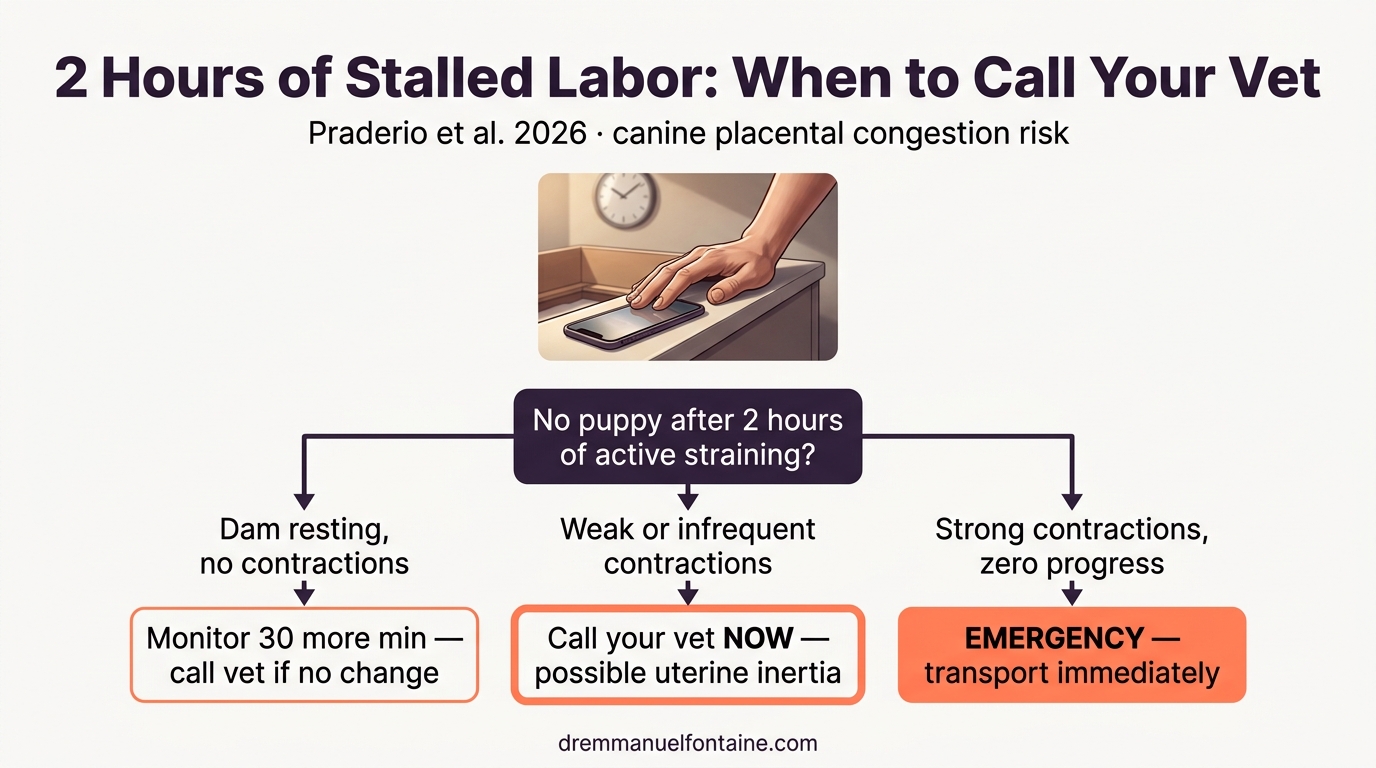
Females naturally rest between puppies. This is normal and expected. She may groom her newborns, nurse, or lie quietly for a stretch. The concern is not that she is resting. The concern is when 2 hours pass from the last delivery with no new puppy arriving.
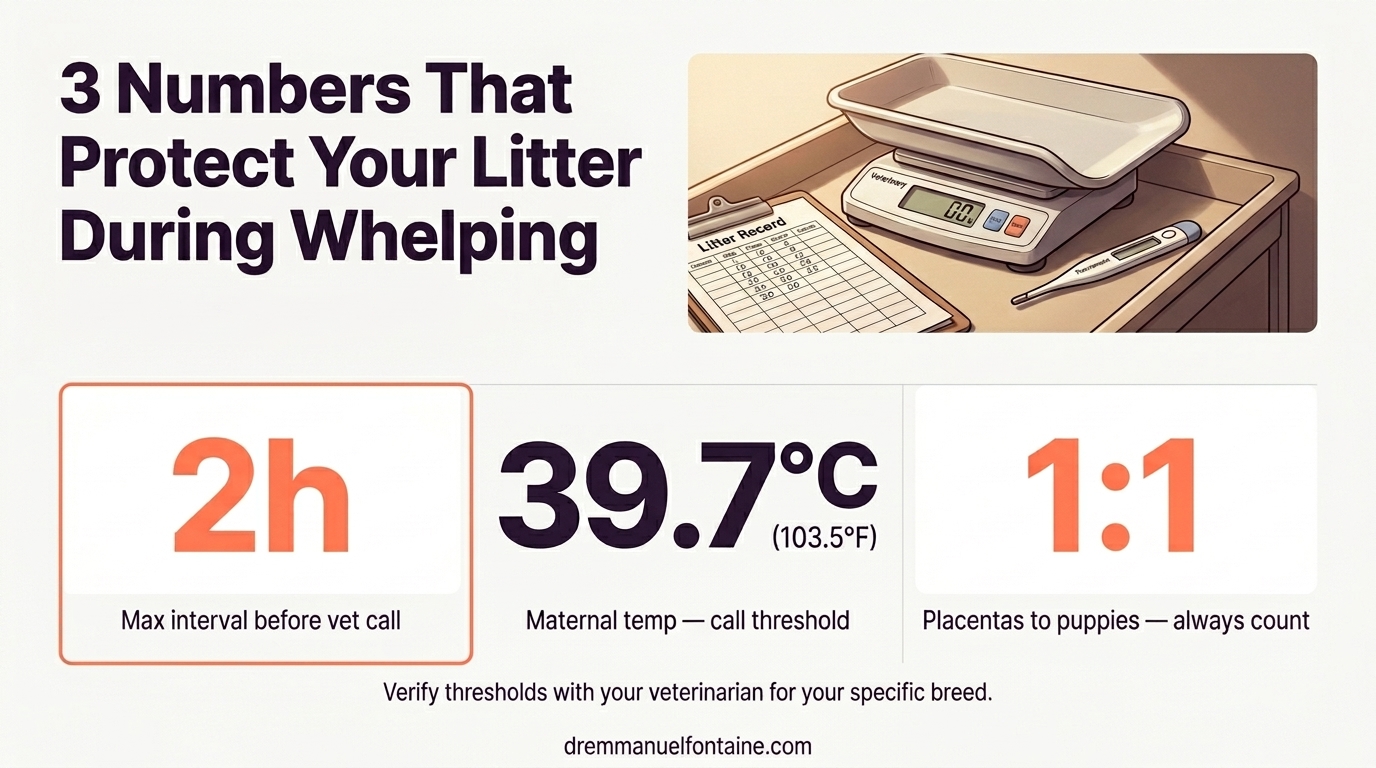
The 2-hour mark is not a panic trigger. It is the moment when, if you have any doubt at all about how things are going, you call your vet. You do not need certainty. You do not need a visible problem. Doubt is enough. Many breeders have heard that females can rest for several hours between puppies, and that is true. But what the 2026 research established is that each additional hour of a genuine stall adds measurably to the risk. At 2 hours, the cost of waiting is still recoverable. At 4 hours, it may not be.
The 2-hour clock starts at the last delivery, not at the first sign of a pause. She can rest, nurse, and groom. What matters is: when did the last puppy arrive? If the answer to that question makes you hesitate, that hesitation is the signal.
Reading the vaginal discharge
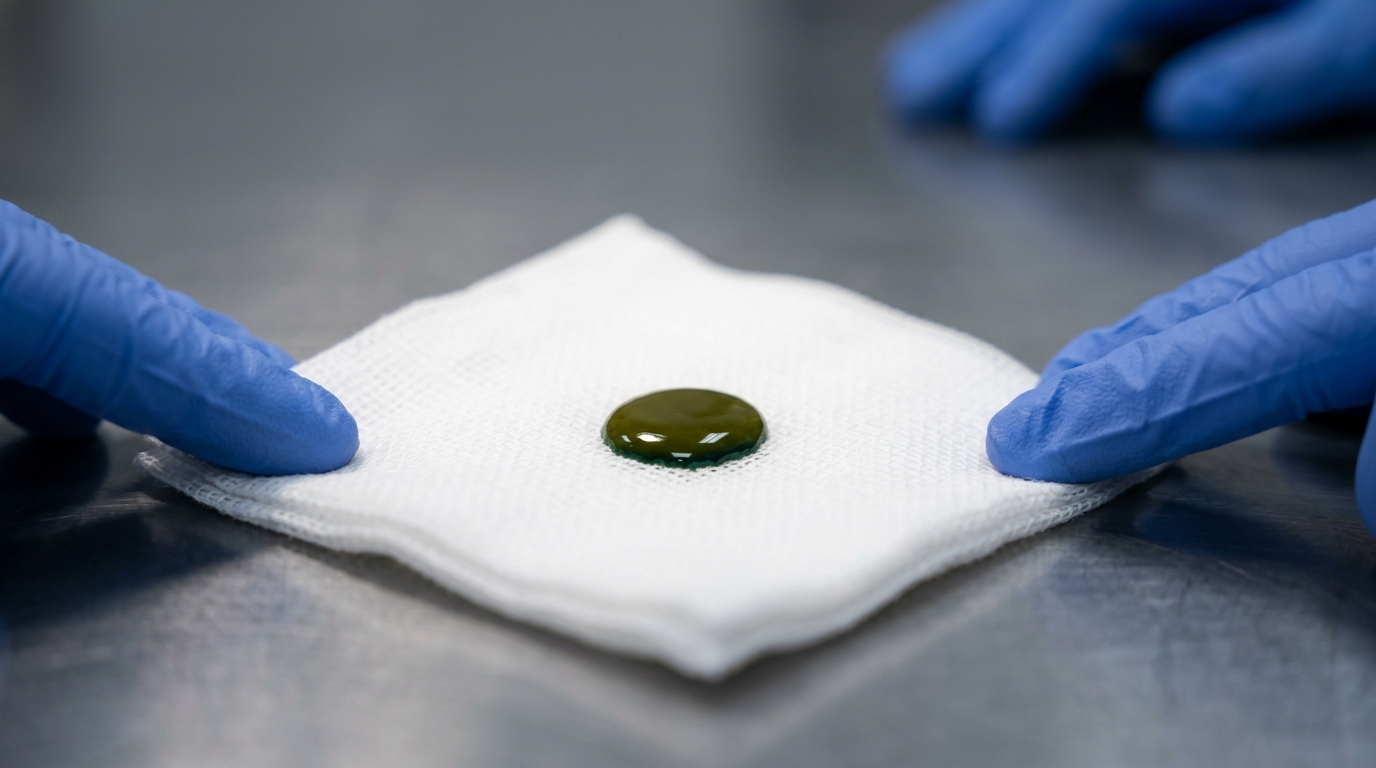
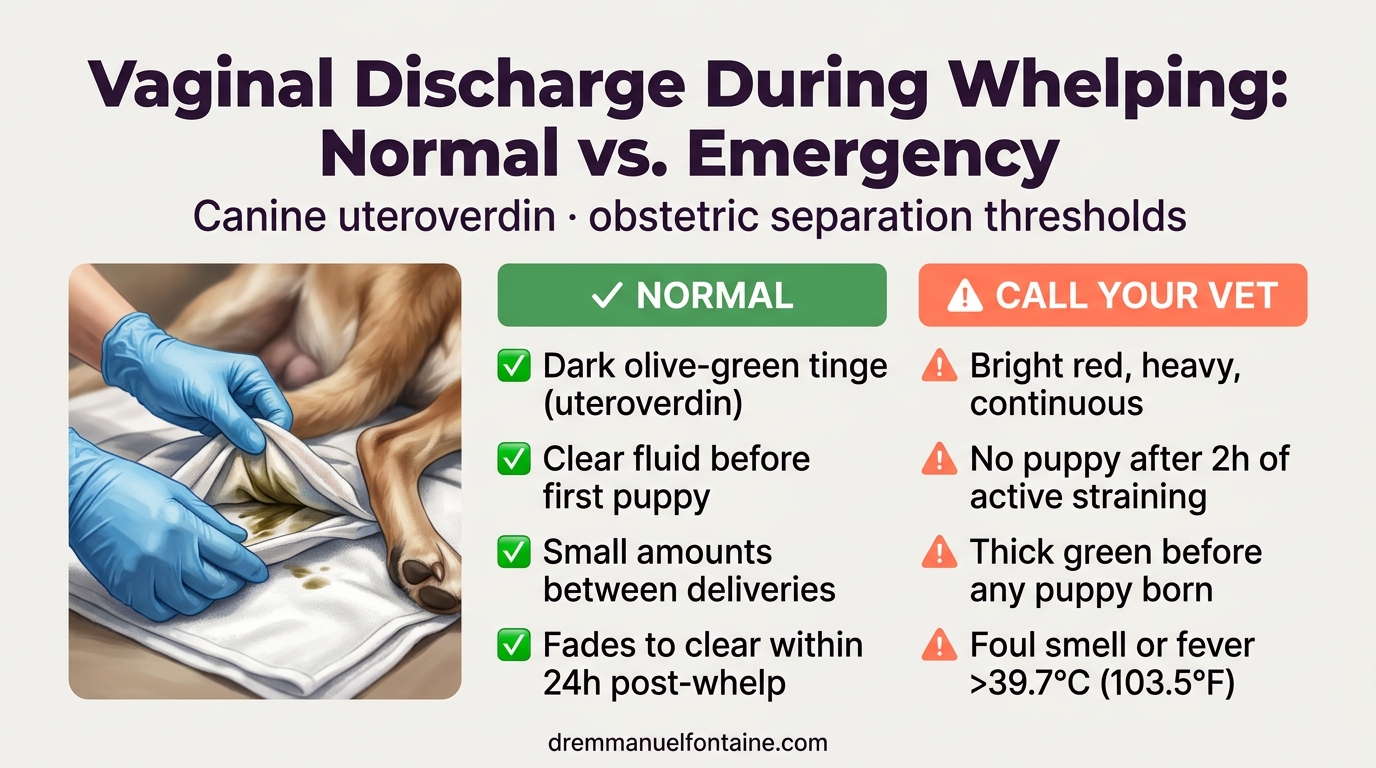
Green to dark-green discharge during whelping is a normal signal, but only when a puppy follows it within a short window afterward. This discharge comes from the breakdown of tissue in the zone where the placenta attaches to the uterine wall. It signals that the placenta for the next puppy is separating as the delivery happens. The discharge and the puppy belong together.
If green discharge appears before the very first puppy, or if it appears and no puppy follows, the placenta has separated too early. The puppy it was supplying is no longer receiving oxygen. This is not a phase of labor. It is an obstetric emergency.
| Discharge and timing | What it signals | What to do |
|---|---|---|
| Clear or light pink; no discharge | Normal labor | Continue monitoring |
| Green discharge, puppy follows shortly after | Normal placental separation during delivery | Continue monitoring; log the time and the delivery |
| Green discharge before the first puppy, or with no puppy following | Premature placental separation; the puppy is losing oxygen | Immediate transport to your veterinarian |
Heavy bright-red bleeding or thick, foul-smelling discharge are separate warning signals that also require immediate veterinary attention. These are not phases of labor.
Making the call: what to tell your vet
The most useful call you make is not the emergency call at hour four. It is the proactive call at the 2-hour mark, when something feels off. When you call, tell your vet the time of the last delivery, how many puppies your day-50 radiograph showed were still inside, what the dam is doing right now, and any discharge you have seen.
A prepared caller gets a better answer than an anxious one. “Her last puppy came at 6:42 PM. She has been resting quietly since. No straining. The radiograph from day 50 showed three more puppies inside. I am not sure if I should be concerned yet.” That question gives your vet the timeline, the situation, and a clear opening to guide you. The exact scripts for each scenario, including what to say and what information to have on hand, are part of the field protocol.
The Records and Plans That Protect Every Litter
The whelping log
A written log at the whelping box, filled in as events happen, is the most useful thing you can bring to a vet conversation. Under stress, memory compresses time and reorders events. A written record does not.
At minimum, capture delivery times and discharge color changes as they happen. Those two inputs alone give your vet the inter-puppy intervals and the discharge timeline, the two highest-yield decision inputs they will ask for. If you can log more (each placenta passed, behavior shifts, early labor onset), each additional entry adds another layer of context. The full logging framework and what to do with each entry in real time are part of the field protocol.
The pre-whelping radiograph at day 50
Knowing how many puppies are inside before labor begins gives you a specific target. Without that number, you can only guess whether she is done. With it, you count deliveries against the number and know exactly when to expect the last puppy.
The radiograph is done at day 50 of gestation, late enough for the fetal skeletons to be clearly visible, early enough to allow time to prepare. Write the count on the cover of your whelping log. It anchors the entire evening: every delivery closes the gap, and the gap tells you when a pause becomes something to think about. Your vet can also use the image to flag any fetal size or positioning concerns before labor starts.
Your emergency contact plan
When a situation escalates, the time you spend looking for a phone number is time you do not have. The plan (where to go, who to call, how long the drive takes) should be made before the litter arrives, ideally before the breeding. Your regular vet’s number and your emergency clinic‘s number should be written somewhere you can read without searching your phone.
A few specific questions are worth resolving early: whether the emergency clinic performs cesarean sections in-house or refers out, and what the drive time is at night. Your vet is your partner in this. The clearer the path to them is before whelping starts, the better the outcome when something goes wrong.
The Signals That Mean It Is Time to Call or Transport
The dam: when early labor has gone too long
Early labor in dogs includes nesting behavior, restlessness, panting, and uterine contractions that are not yet producing puppies. There is an upper range for this phase. When the dam moves past that range without progressing to active contractions and delivery, a vet call is warranted. The rectal temperature drop is one supporting signal, but it is not reliable on its own. Not every female shows a clear drop, and when it occurs, the timing varies. Use it as one input among several.
The signals that require immediate transport, rather than just a call, are distinct: extended forceful straining with no delivery, heavy bright-red bleeding, collapse, persistent vomiting, or unresponsiveness. These are not moments to observe and log. They are moments to drive.
The litter pattern: late puppies carry more risk
In larger litters, the risk profile shifts as the whelping progresses. The uterus has been contracting for hours. Each puppy still inside has been exposed to intermittent oxygen dips during the delivery of its littermates. By the time the last few puppies arrive, the tissue supplying them has been working under stress longer than the tissue that supplied the first puppy.
The doubt-based call rule applies through the final puppy. Do not assume the last one will come when she is ready. The clock that has been running since the first delivery is still running, and if you have any doubt, you call. A single puppy noticeably larger than its littermates is worth flagging to your vet before the delivery attempt begins.
After each puppy: what to track in the first half hour
After each delivery, you are watching for three things: whether the placenta passes, what the discharge does afterward, and how the dam is doing. Each placenta should pass within a reasonable window after the puppy it served. Count them. A retained placenta does not cause an immediate crisis, but it can lead to a uterine infection in the days that follow.
If the discharge turns dark, thick, or foul-smelling after delivery is complete, contact your vet. The dam’s behavior between deliveries should return to calm nursing. Persistent panting, restlessness with no progress, or any sign of systemic compromise is a vet call.
You already know your female better than any clinician does. You see the way she settles between puppies, the way her breathing changes, the moment when calm rest tips into something quieter and more concerning. Your experience and your eyes are the first line of observation. What a 2026 research team gave us is a number to go with that experience: every hour of stalled labor carries a measurable cost to the tissue supplying your unborn puppies.
Two hours with any doubt: call. Green discharge with no puppy following shortly after: transport. Early labor that stalls past the upper normal range: call. These are the signals, and they are your tools. Your vet is the partner for the moments when a decision needs medical hands. The clearer you are on the timing, the discharge, and what you are seeing, the better that conversation goes, and the better the outcome for the puppies still waiting inside.
Get the next issue on Saturday morning
Every Saturday, my free newsletter brings you one piece of science on reproduction and newborn care in dogs and cats, written for breeders and their veterinarians. Read it in English, French, Spanish or Portuguese.
Free. Unsubscribe anytime.


