
Over the years, I’ve delved deeply into the topic of colostrum through various blogs, reflecting the burgeoning scientific interest and publications that have emerged over the past decade. This surge in research has revolutionized our approach to newborn puppy care in kennels and veterinary settings alike. And recently, I discovered an intriguing method known as the “weigh-suckle-weigh technique”. This discovery not only piqued my curiosity but also inspired a practical idea that I am excited to share here. If you’re keen on understanding the benefits of colostrum, ways to support immunity in puppies, and strategies for optimal colostrum intake to foster long-term health and growth, keep reading!
What is Colostrum and How Does It Benefit Puppies?

Defining Colostrum and Its Importance in Canine Health
Colostrum, often heralded as the ‘first milk’, is a vital form of nourishment that mother dogs provide during the initial hours after a puppy’s birth.
This golden fluid is not just food; it’s a potent elixir rich in antibodies, growth factors, nutrients, and bacteria (!) essential for laying the foundation of a puppy’s health.
But what exactly makes colostrum so crucial for canine health?
The benefits of colostrum for puppies extend well beyond basic nutrition.
It is packed with high concentrations of immunoglobulins—specifically IgA, IgG, and IgM—which are critical for its immune system development.
It also influences long-term health outcomes by promoting robust growth and development.
It contains growth hormones and other bioactive compounds that foster organ development and overall vitality.
Colostrum also plays a pivotal role in introducing beneficial bacteria to newborn puppies.
These initial bacteria are essential, as they begin to colonize the puppy’s digestive tract, establishing a foundational microbiome.

This microbial colonization not only aids in the digestion and absorption of nutrients but also fortifies the puppy’s defenses against pathogens, shaping a robust immune response that supports the puppy throughout its early life and beyond.
The Nutritional Content of Colostrum

Colostrum is a supercharged nutritional powerhouse essential for the early stages of a puppy’s life.
This initial secretion from mother dogs is far more nutrient-dense than regular milk, designed specifically to jumpstart the health and development of newborn puppies.
The nutritional spectrum of colostrum is impressive, featuring a high concentration of proteins, essential fats, vitamins, and minerals. These components are critical for energy and the building of tissues.
The presence of growth factors, like insulin-like growth factors (IGFs), further supports tissue development and organ maturation, laying the foundation for robust health.
Additionally, colostrum is a source of various bioactive compounds with anti-inflammatory properties (lactoferrin is always one that comes to my mind), which help protect the delicate digestive system of the newborn puppy.
These compounds ensure that the gut effectively absorbs nutrients while maintaining a healthy balance of flora, which is essential for long-term digestive health.
The Role of Colostrum in Puppy Immunity
Colostrum stands as the first line of defense in building a robust immune system in newborn puppies.
Packed with vital immunoglobulins, colostrum provides the antibodies necessary to combat various infectious diseases.
It’s important to note, however, that not all of a puppy’s initial antibodies are derived from colostrum; approximately 90% are transferred through colostrum after birth, with the remaining 10% being passed during gestation through the placenta.
This is due to the specific type of placentation in dogs, which allows a small but crucial transfer of immunity before birth, ensuring that puppies are not entirely defenseless upon arrival.
The immunity that puppies acquire from colostrum is directly reflective of their mother’s immune history.
It includes antibodies against diseases for which the mother has been vaccinated, as well as those she has naturally encountered. Furthermore, antibodies against potential environmental pathogens to which the mother has been exposed are also transferred.
This underscores the critical importance of optimizing colostrum production through proper maternal nutrition and vaccination. Such measures are essential to enhance the immune transfer to newborn puppies and to safeguard their early days.
Dog breeders sometimes conduct a test known as a “nomograph” during gestation.
This test assesses the immune status of the mother and helps predict the optimal timing for vaccinating puppies based on their expected immunity gap.
However, research in canine colostrum reveals significant variability in antibody concentration across different mammary glands during lactation.
Such disparities imply that the quantity of antibodies each puppy receives can differ substantially—studies indicate that up to 20% of puppies may not receive adequate immunity through colostrum alone.
This variation highlights the limitations of relying solely on nomogram tests for vaccination timing, as individual differences can significantly affect immunity levels.
How Do Puppies Receive and Utilize Colostrum?

Natural Colostrum Intake from Mothers
Colostrum can be present in the mother’s mammary glands up to two weeks before parturition. However, its availability can vary greatly.
While some mothers may have colostrum readily available immediately after giving birth, others might experience a delay, particularly in cases involving elective C-sections, where colostrum secretion can be notably absent (or delayed at least).
For dog breeders, a crucial step is ensuring the presence of colostrum as soon as the female begins the birthing process.
Recent veterinary insights suggest that some practitioners prefer to delay elective C-sections until colostrum is confirmed in the mammary glands.
This approach highlights the importance of colostrum availability as a key factor in neonatal puppy care, emphasizing its critical role in the successful rearing of healthy puppies.

While puppies must consume this first milk, currently, there is no rapid, reliable test to evaluate the quality of colostrum in canines as there is in other species, such as mares, where a refractometer can determine colostrum quality.
In dogs, the best practical method to ascertain whether a substance is colostrum is by its color; typically, colostrum exhibits a yellowish hue, in contrast to the white color of regular milk.
Unfortunately, there are no clinical tests readily available to measure the concentration of immunoglobulins in colostrum; such tests are reserved for research purposes.
The Timing and Importance of Early Colostrum Intake

Colostrum absorption, especially for the development of the immune system, is undeniably a matter of precise timing.
As previously mentioned, colostrum is typically secreted in the mammary glands during the first 24 hours of lactation. In cases where colostrum is present several days before parturition, it ideally remains available unless prematurely removed or consumed by other puppies—a scenario to be avoided to prevent nursing from a pregnant mother.
I always wondered if this early production has an impact on colostrum quality at the time of parturition… however, the current scientific literature does not provide conclusive evidence on this matter from what I have seen.
The ability of puppies to absorb these vital antibodies from colostrum is time-sensitive.
At birth, their digestive tract is uniquely equipped to absorb these large molecules, with absorption efficiency peaking at about 4 hours post-birth. After this peak, the capacity to absorb these immunoglobulins quickly diminishes, with studies indicating that by 16 hours after birth, the absorption becomes extremely limited.
This makes the timing of the first feed not just beneficial, but critical.

The practical advice for breeders is clear: ensure that puppies begin nursing as soon as possible after birth, optimally within the first four hours.
Assessing Adequate Colostrum Intake in Newborn Puppies
I recently came across an abstract from the 2023 European Conference in Dog and Cat Reproduction that introduced a fascinating concept: the “weigh-suckle-weigh method” for newborn puppies.
The authors proposed this method as a predictive tool to evaluate colostrum intake, potentially replacing colostrum for puppies at risk of deficit.
Their findings revealed that weight gain during a single suckling session could range dramatically (from 0 to 28.5g, with a median value of 2.5g), underscoring the variability in colostrum intake across different litters and conditions.
But this is just the beginning of this short story!
Further insight was provided in a recent textbook on neonatal and pediatric care for kittens and puppies, which defined “adequate colostrum intake” as a minimum of 1.5mL per 100g of puppy body weight.

Drawing from this, I used what I could find in the scientific literature… and did the math to determine the average weight of 1.5mL of colostrum actually!
And the weight of 1.5mL of canine colostrum is approximately 1.545 to 1.575 grams.
Considering this, the weigh-suckle-weigh technique can be practical for breeders:
1. Weigh the puppy immediately after birth, before it begins to nurse.
2. Allow the puppy to nurse from its mother.
3. Weigh the puppy again after nursing. To have received sufficient colostrum, the puppy should exhibit a weight gain of approximately 1.545-1.575g per 100g of body weight.
Don’t want to do the math? Download my Colostrum Intake Calculator for Puppies!

This method not only promises a practical approach to ensure puppies are adequately nourished right after birth but also highlights the importance of having accurate scales in kennel maternity settings.

While additional research is needed to refine this technique and fully understand its implications for neonatal survival, the initial results are promising and offer a practical interim solution for breeders committed to optimizing the health outcomes of their litters.
What If a Puppy Can’t Get Colostrum Naturally?

When natural colostrum intake is not an option for newborn puppies, two main alternatives can be considered to ensure they receive the crucial early immunity support they need.
The first alternative is the use of frozen colostrum.
Collecting colostrum from a mother dog is relatively straightforward, and it can be stored in small plastic vials and kept frozen for approximately a year.

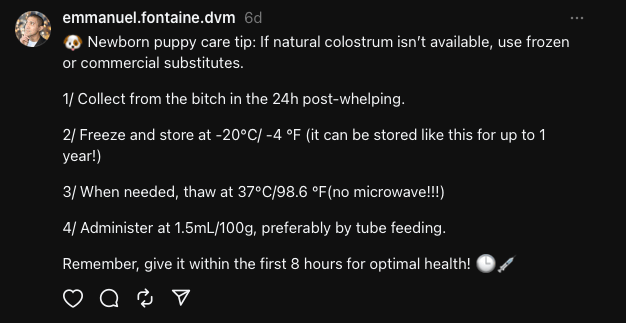
This provides a valuable backup should a female not produce colostrum before giving birth.
Ideally, this colostrum would originate from a female within the same environment or kennel, ensuring that the puppies receive antibodies relevant to the pathogens present in their specific environment.
After the puppies’ initial nursing and during the first 24 hours postpartum, colostrum can be collected and stored in anticipation of future needs.
Notably, the first milk from a female experiencing a pseudo-pregnancy is of equivalent quality to normal colostrum and can also be collected for this purpose.
It is crucial to thaw frozen colostrum in a water bath at 37 degrees Celsius (98.6 degrees Fahrenheit) to preserve the antibodies, as microwaving can destroy these vital components.
The second alternative is a dedicated canine milk replacer, particularly one supplemented with immunoglobulins.
In some countries, specific milk replacers are available that contain antibodies against major threats like E.coli (number 1 infectious cause of neonatal mortality in newborn puppies) and canine parvovirus, which are significant causes of mortality in weaning puppies.
These milk replacers often include maltodextrin, which is beneficial for premature human babies due to its energy-releasing properties, making it equally advantageous for newborn puppies.
This is my preferred option when natural canine colostrum is unavailable.
However, if such a product is not accessible, a standard canine milk replacer still offers a viable solution.
It’s essential to ensure puppies receive sufficient energy to prevent hypoglycemia, which can be more immediately life-threatening than a temporary lack of immunoglobulin transfer.
It’s important to mention that while serum administration has been explored as an alternative, current evidence suggests it is not a suitable replacement for colostrum in puppies.
Similarly, using bovine or equine colostrum is not recommended; although it may provide some benefits to the digestive tract, it lacks the canine-specific antibodies necessary for effective immunity support in puppies.
These alternatives do not adequately address the unique needs of canine neonates and should not be relied upon for ensuring their health and development.
Read my previous blog on this topic: No colostrum… what about serum?
In recent years, our understanding of canine colostrum and its critical role in neonatal health has grown immensely. The strategies and tools that have emerged from this knowledge, such as the weigh-suckle-weigh method discussed in this blog, are not only simple but incredibly effective in my opinion. Implementing these practices in breeding kennels can significantly improve neonatal survival rates, showcasing the practical benefits of veterinary research.
Canine neonatology continues to be a dynamic field within canine reproduction, with new discoveries on the horizon that promise to enhance our practices further. The potential for future advancements is exciting, and I am committed to keeping you informed. As we learn more, I look forward to sharing these developments through my newsletter and on this blog, helping breeders and veterinary professionals enhance the care and outcomes for puppies from their very first moments of life. Stay tuned—there’s much more to come in the world of canine neonatal care for sure!

 DR. EMMANUEL FONTAINE