🇫🇷 Lire en Français | 🇪🇸 Leer en Español | 🇧🇷 Leia em português
Some years ago, I sat in a lecture on kitten diarrhea at a veterinary conference. I expected an hour on parasites and other infectious causes, because that is where these talks usually go. The infectious causes were there, of course, but the speaker added one question I had not expected at all. Are the kittens still nursing from their mother? That question changed the way I look at diarrhea around weaning, and by the end of this article you will see why it is the last one I ask.
Here is the short answer. At weaning, a kitten’s digestion and her immune defenses are immature at the same time, so a feeding mistake, a parasite or a virus can all produce the same stool in the litter box. That is why I ask four questions, always in the same order: how sick is this kitten, how abnormal is her stool, is there an infectious cause, and how is the weaning itself being done. A kitten who is lethargic, vomiting, refusing food or losing weight requires veterinary attention, and the antibiotic, the oldest reflex of all, is rarely the right intervention.
This article is the written version of my video Kitten Diarrhea at Weaning: What to Do First, so you can watch it, read it, or keep both open while you work with your litter. It applies to kittens weaned next to their mother and to orphaned kittens raised on a bottle, and it builds on what I have written over the years on how to stop kitten diarrhea, on weaning diarrhea in kittens and on what I learned at that NAVC lecture.
TL;DR
- First, decide how sick the kitten is. Mild, moderate or severe: the moderate and severe pictures go to your veterinarian.
- Score the stool with a fecal score chart, then score it again two or three days after any change, so you compare numbers and not memories.
- Before six months of age, rule out an infectious cause first, because weaning falls right inside the immunity gap.
- Found does not mean cause. Kittens with diarrhea carry close to three agents on average, and healthy littermates carry most of them too.
- Antibiotics are not indicated in the mild or the moderate picture. They keep their place in the severe picture, and that decision belongs to your veterinarian.
- Check the weaning itself: when it started, how fast the texture changed, how large the meals are, and the milk replacer.
- Last question: is she still drinking milk? Ending the nursing often resolves the diarrhea, while the kittens stay with their mother.
Step One: Identify Which of Three Clinical Pictures You Are Looking At
When a kitten has diarrhea, my first question is not what caused it. My first question is how sick this kitten is, because that answer guides everything that follows. For this, I use a classification from the European ENOVAT guidelines on acute diarrhea. Those guidelines were written for dogs, and nothing equivalent exists yet for kittens, but I think the clinical reasoning applies just as well to them.
In the mild picture, the diarrhea is the only thing that is wrong. The kitten is bright and playful, she eats with appetite, and she keeps gaining weight from one day to the next, and it is by far the most common of the three. In the moderate picture, her general condition is affected: she is less active, she eats less, and she is starting to dehydrate. What defines it is that all of those signs come from the loss of fluids, and they resolve once the fluids are replaced.
The severe picture is a situation of its own. The kitten is so lethargic that she hardly reacts when you handle her, and she shows signs that her whole body is affected, such as a fever, which persist even when her fluids are corrected. It is the rarest of the three, and it is an emergency. Whatever the picture, the three questions that follow are the same: in the mild picture, you have time to work through them with your veterinarian, and in the two others, the kitten is stabilized first and the questions are asked at the clinic.
| Picture | What you see | What it means | What to do |
|---|---|---|---|
| Mild | Diarrhea only; bright, playful, eating, still gaining weight | By far the most common picture | Work through the next three questions with your veterinarian |
| Moderate | Less active, eating less, starting to dehydrate | The signs come from fluid loss and resolve with fluids | Requires veterinary attention |
| Severe | Hardly reacts when handled; fever or other signs of whole-body illness that persist after fluids | The rarest picture | An emergency: the kitten is stabilized first |
Step Two: Score the Stool With a Fecal Score Chart
Why a Slightly Softer Stool Can Be Expected at Weaning
At weaning, this second question is less simple than it sounds. A newborn kitten’s intestine is built for a single food, which is milk. Its main tool is lactase, the enzyme that digests lactose, the sugar found in milk, and lactase activity is high at birth and then falls week after week. Please keep that fact in mind, because it will matter at the end of this article. At the same time, the tools for solid food are still under construction: the pancreas produces amylase, the enzyme that digests starch, and that production rises only gradually with age.
So at weaning, a kitten is asked to digest a new food with equipment that is not finished. Part of what she eats is not fully digested in the small intestine and travels on to the large intestine, where it holds water and the bacteria ferment it. This is why a slightly softer stool can be expected during those weeks, in a bright kitten who is growing well. A liquid stool is something else, and it is never part of a normal weaning.
What the Score Does for You
The difficulty is to tell where one ends and the other begins, because “soft”, “loose” and “runny” do not mean the same thing to two different people. A fecal score chart is a picture scale that goes from a hard, dry stool to a completely liquid one, and you match what you see to one of the pictures. Several charts are in use today, and they do not all count in the same direction. So whenever you give a score to your veterinary team, tell them which chart you used.
At weaning, that number does two practical things for you. First, it tells you whether you have a problem at all, because it separates the softer stool of a normal weaning from real diarrhea. Second, it gives you a starting point: whatever you change afterwards, in the feeding or with a treatment, you score again two or three days later. Without a score, you are comparing today with a memory. What the score cannot tell you is the cause, because color and smell very rarely point to a specific agent.
| Stool at weaning | In a kitten who is | How to read it |
|---|---|---|
| Slightly softer than before | Bright, eating, gaining weight | Can be expected while the digestive equipment matures |
| Liquid | Any kitten | Never part of a normal weaning: real diarrhea |
| Any change in score | After a change of feeding or a treatment | Score again two or three days later: moving back toward normal means it is working |
| Color and smell | Any kitten | Very rarely point to a specific agent |
Step Three: Rule Out an Infectious Cause First
Weaning Falls Inside the Immunity Gap
In a kitten under six months, I always start with infectious diseases. A newborn kitten has almost no antibodies of her own. She receives them from colostrum, the milk her mother produces right after birth, and absorbs them during the first hours of life. Those antibodies were made by her mother, so her body cannot replace them, and their concentration declines week after week while her own immune system is still learning. Between the two, there is a period when the mother’s protection has become too low and her own is not ready yet: we call it the immunity gap, and you will also hear it called the window of susceptibility.
We often say that this gap closes at around twelve weeks, but maternal antibodies can persist until sixteen weeks or longer. This is why the WSAVA vaccination guidelines place the last kitten vaccine dose at sixteen weeks or later. In one study, the antibody level in a kitten’s blood was at its lowest at around three to four weeks of age. Put those two numbers side by side, and weaning falls right inside the period when she is poorly protected, so the intestine is learning a new food at the very moment the immune defenses are at their weakest.
For orphaned kittens, the situation can be even more delicate, because a kitten who lost her mother at birth may never have received colostrum. For her, the gap has been open since the first day. So for both kinds of kittens, the conclusion is the same: before six months of age, an infectious cause has to be ruled out first. The list of candidates is very long, and I have the impression that it gets a little longer every year.
What Is Really Found in the Stools of Kittens With Diarrhea
The first surprise is the agent at the top of the list. It is a virus, the feline enteric coronavirus, found in about seven kittens with diarrhea out of ten. In most kittens, it stays in the intestine, where it can cause a mild and passing diarrhea. Many cat breeders hear the word coronavirus and immediately think of FIP, feline infectious peritonitis, and the two are connected: FIP develops when this intestinal coronavirus mutates inside a cat and starts to spread through the body. But that only happens in a small minority of the kittens who carry it, so a coronavirus in a stool sample tells you the virus is present, not that the kitten has FIP.
The one that worries me most sits lower in the ranking, and it is another virus, feline panleukopenia. I always look for it first because of its gravity: diarrhea is not always present, and in a young kitten, the first sign can be a sudden collapse. It also belongs to the non-enveloped viruses, which have no fragile envelope to lose, so they resist many disinfectants and can survive in a room for months. That is how one sick kitten can contaminate an entire nursery.
After the viruses come the parasites, and among them, the protozoa clearly lead. Protozoa are parasites made of a single cell: Giardia and Cryptosporidium are each found in about one kitten with diarrhea in four, and the coccidia in about one in five. A fourth one, Tritrichomonas blagburni, the former Tritrichomonas foetus, is found less often, but cat breeders should know its name, because it is much more frequent in pedigree cats. Roundworms, hookworms and tapeworms were each found in fewer than one kitten in ten, so at this age, a parasite is far more often a protozoan than a worm.
Found Does Not Mean Cause
This is where the research surprised me the most. In a UK study of cats with diarrhea, a kitten rarely carried a single agent: the average was close to three. Then, when kittens with normal stools were tested the same way, most of these agents were found in them almost as often, and the coronavirus, for example, was present in about half of them. In other words, found does not mean cause, and a positive test is not a diagnosis. A result only makes sense when it is read against the kitten, with her clinical picture and her fecal score, which is exactly why the first two questions come first.
The good news for breeders and shelter teams is that many of these agents can be identified at the clinic, during the visit. Some clinics even have analyzers assisted by artificial intelligence, which read a stool sample in ten to twenty minutes. The diagnosis then decides the treatment, and the kitten’s gut flora, which I describe in my article on gut colonization in kittens, is part of that decision.
| Agent | Found in kittens with diarrhea | What to remember |
|---|---|---|
| Feline enteric coronavirus | About 7 in 10 | Also in about half of kittens with normal stools; present does not mean FIP |
| Feline panleukopenia | Lower in the ranking | The one I look for first: sudden collapse possible, survives for months in a room |
| Giardia, Cryptosporidium | About 1 in 4 each | Protozoa lead the parasites at this age |
| Coccidia | About 1 in 5 | Another single-cell parasite |
| Tritrichomonas blagburni | Less often | Much more frequent in pedigree cats |
| Roundworms, hookworms, tapeworms | Fewer than 1 in 10 each | Far behind the protozoa |
The Antibiotic Reflex I Had for Years
For years, when a kitten had diarrhea, I reached for an antibiotic. Today, we know that in the mild picture, antibiotics are not indicated. This surprises many people, but they are not indicated in the moderate picture either, because what that kitten needs is fluids. They keep their place in the severe picture, where they save lives, and that decision belongs to your veterinarian.
But we are not finished with our kitten. Her tests may come back clean, or they may show agents that her healthy littermates carry too. So what is left to explain the diarrhea? The weaning itself, and that is the fourth question.
| Picture | Antibiotics | What the kitten needs |
|---|---|---|
| Mild | Not indicated | The next questions, worked through with your veterinarian |
| Moderate | Not indicated | Fluids, under veterinary care |
| Severe | Keep their place, they save lives | Emergency care; the decision belongs to your veterinarian |
Step Four: Check How the Nutritional Weaning Is Being Done
When to Start: Age Gives the Window, the Kittens Give the Signal
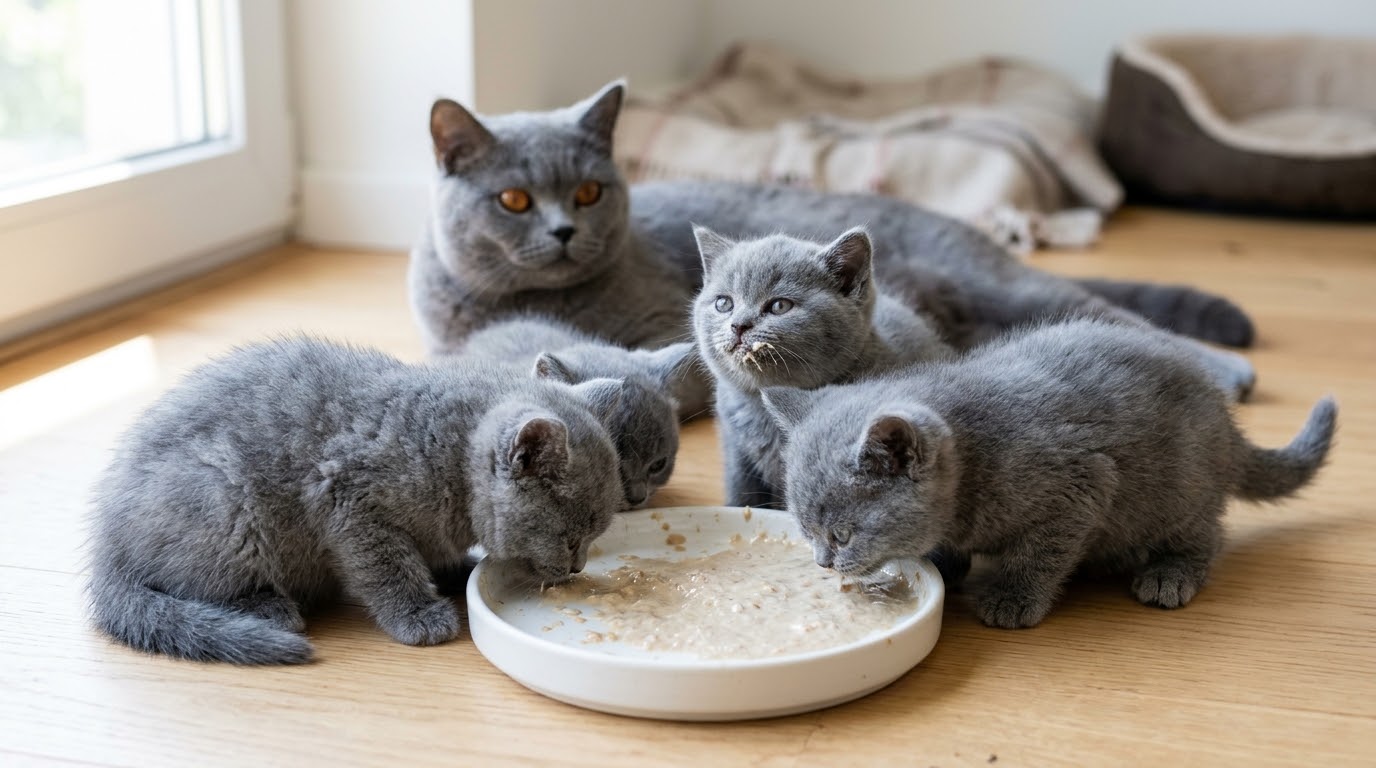
Many cases of diarrhea at weaning start with nutrition, and more precisely with the way nutritional weaning is done, meaning the transition from milk to solid food. The window opens at around four weeks, and I look for three things in the litter. I want to see teeth, because a kitten with no teeth cannot handle soft food. I want to see kittens who walk steadily and can lap from a shallow dish, and I watch their weight, because when the daily gain starts to slow down, their mother’s milk no longer covers their needs.
In orphaned kittens, weaning can start at the end of the third week, but I see that as an exception and not as the rule. Before that, the digestive equipment we talked about earlier is simply not ready. If you raise orphans, my guide on how to feed newborn kittens covers the weeks before weaning.
From Gruel to Solid Food in About Four Weeks
The first meals are a gruel, which is a kitten growth diet softened into a porridge. I soften it with a milk replacer formulated for kittens during the first week, and I have stopped the replacer by the end of the second week. By five weeks, the kittens should be eating that gruel with confidence, and it gets thicker from one week to the next. By six to eight weeks, they eat mostly solid food.
So the whole transition takes about four weeks, and it never goes from milk to dry kibble from one day to the next. I also keep the meals small and frequent, because an overloaded intestine is one of the classic causes of diarrhea at that age.
Why I Recommend Mixed Feeding From Weaning Onwards
Mixed feeding simply means offering both wet food and dry food from weaning onwards, and I have three reasons for it. The first one is water. Cats descend from desert animals and do not have a strong drive to drink, so wet food brings that water with the meal. The second one is the microbiome: wet and dry food do not stimulate the same bacterial populations, so offering both supports a more diverse intestinal flora, at the very moment that flora is being built.
The third reason is the one people know the least, and I call it nutritional education. In cats, food preferences are learned, and most of a kitten’s feeding habits are set between six and eight weeks of age, right at the end of weaning. A kitten who only meets one texture during that window tends to refuse the others later, which we call neophobia, the reluctance to try new foods. One day, that cat may need a specific diet for a medical reason, and it may only exist in the texture she never learned to eat, so a kitten who accepts both textures at weaning keeps that door open for life.
When a Weaning Kitten Has Diarrhea: Go Back One Step
So when a weaning kitten has diarrhea, I ask when the weaning started, how fast the texture changed and how large the meals are. Very often, one of them stands out. The fix is then to go back one step, with a softer texture and smaller meals, and to move forward again more slowly.
I also check the milk replacer, and this applies to every litter, whether the kittens are with their mother or orphaned. It should be formulated for kittens, and it should be prepared exactly as the label says. A replacer that is too concentrated, or a meal that is too large, can cause diarrhea by itself, with no infection involved.
| Age | What the kittens eat | What I check |
|---|---|---|
| Around 4 weeks (end of week 3 in orphans, as an exception) | First gruel: kitten growth diet softened with a kitten milk replacer | Teeth, steady walking, lapping from a shallow dish, slowing weight gain |
| Second week of weaning | Gruel, replacer stopped by the end of this week | Small and frequent meals |
| 5 weeks | Gruel eaten with confidence, thicker each week | Texture changed gradually, never milk to dry kibble overnight |
| 6 to 8 weeks | Mostly solid food, wet and dry | Both textures accepted: habits are being set now |
| Diarrhea at any point | Go back one step: softer texture, smaller meals | Replacer formulated for kittens and prepared exactly as the label says |
The Last Question: Is She Still Drinking Milk?
That brings me to the question from that lecture. Lactase falls week after week, and in one study, by six weeks of age, its activity was already close to the level of an adult cat. The speaker’s reasoning started from there. A kitten who eats solid food and still nurses from her mother is drinking lactose that she digests less and less well, and the lactose that is not digested stays in the intestine, where it draws water in and the bacteria ferment it. In other words, a kitten can develop a form of lactose intolerance in the middle of weaning.
Her suggestion was very simple. When diarrhea appears during weaning, check whether the kittens are still nursing, and if they are, bring that nursing to an end. I use that advice today, and it often resolves the diarrhea. It does not mean taking the kittens away from their mother, because they still need her for their behavioral development: a body suit that covers her mammary glands lets her groom her kittens, play with them and teach them. And if she is still producing a lot of milk, your veterinarian can help you reduce her lactation.
For orphaned kittens, the same question takes another form, which is whether the kitten is still receiving milk replacer. I use it during the first week of weaning, and I have stopped it by the end of the second. None of this replaces the search for an infectious cause, but it is a change you can make the same day.
| Kittens | The question | The change you can make today |
|---|---|---|
| Weaned next to their mother | Are they still nursing? | End the nursing with a body suit over her mammary glands; she stays with them |
| Mother still producing a lot of milk | Is her lactation slowing down? | Ask your veterinarian to help reduce it |
| Orphans | Are they still receiving milk replacer? | Replacer in the gruel the first week only, stopped by the end of the second |
Conclusion
Here is the whole method in one breath. Ask how sick the kitten is, then how abnormal her stool is, and rule out an infectious cause with your veterinarian, reading every test result against the kitten, because found does not mean cause. Then look at the nutritional weaning itself, down to one last question, which is whether she is still drinking milk. We think of weaning as the moment we add solid food, but for the kitten’s intestine, it is just as much the moment the milk has to end.
I went to that lecture to hear about parasites, and I came home with a question about milk. Many years later, it is still the one I never forget to ask. The decision that arrives a few weeks after weaning is the right age to spay, and my video Kitten Spay: What Age Is Right? is the one to watch next.
Want to go further? Inside the Breeder Vault, the library where I add the expanded edition of my newsletter every week, you will find the protocols and the deeper science behind articles like this one, in dogs and in cats.
Tell me in the comments below: at what age do your kittens start their first solid meal? I read every one, and your answers help other breeders compare their weaning with real catteries. And if you want the next article in your inbox, join my free newsletter, every Saturday, in English, French, Spanish and Portuguese.


