🇫🇷 Lire en Français | 🇪🇸Leer en Español | 🇧🇷Leia em português
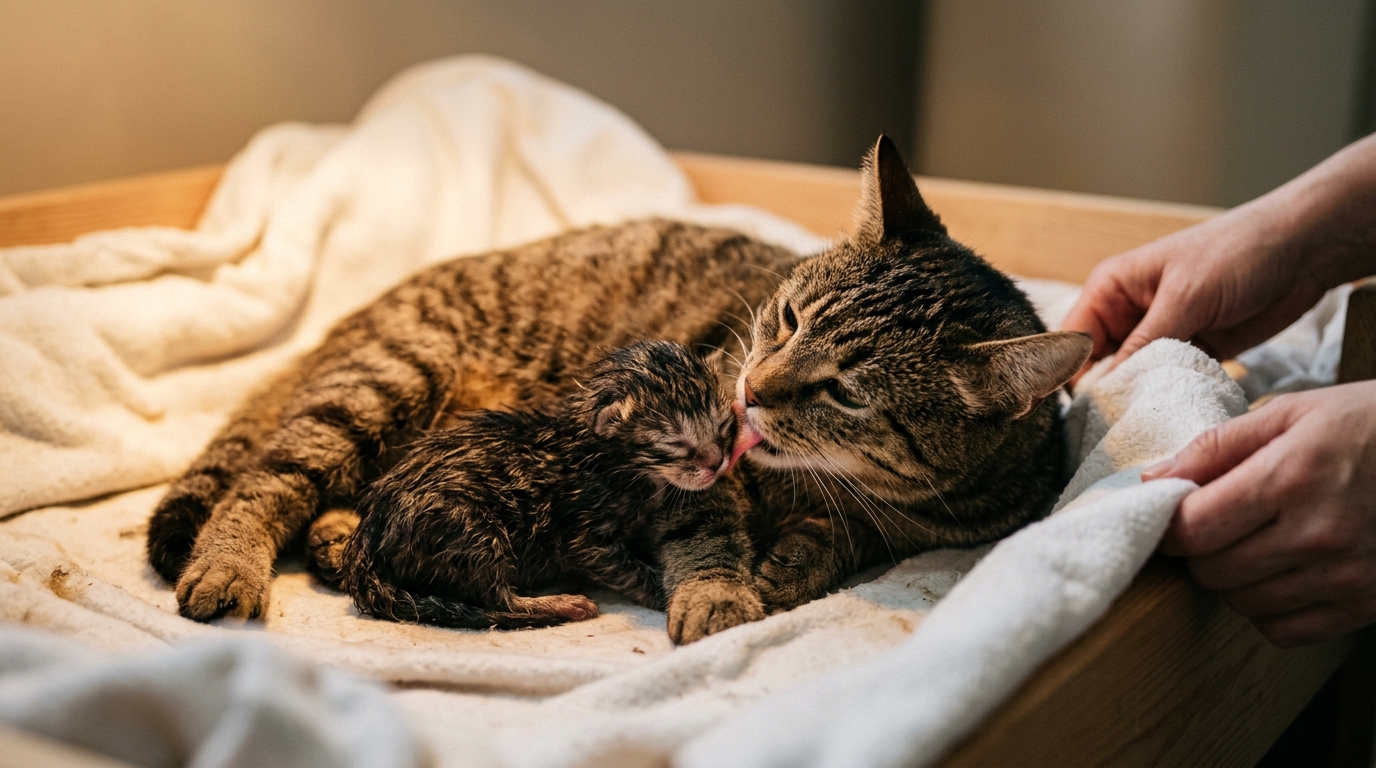
Picture this. A C-section kitten arrives looking perfect, alert, pinking up. By day three, something shifts. The stool is off-color, almost pale. The kitten sleeps more than it should. You watch for hours, wondering what went wrong. The kitten looks healthy. The mother is attentive. Yet something feels different. What changed inside in just 72 hours? The answer lives in the microbiome. The bacterial ecosystem that would normally be seeded during birth canal passage, shaped by mother and environment, and locked in place during the first 48 hours of life. Miss this window, and your kitten travels down a different path, one that can echo through months or years.
Kittens born via caesarean section have fundamentally different microbial seeding than those born through the birth canal. Early maternal separation, unnecessary antibiotics, and the surgical environment all disrupt immune system priming. You cannot change kitten genetics, but you can engineer the microbial landscape during this developmentally critical window.
- TL;DR
- Know Your Kitten’s Microbial Origins
- Do: Activate Protocols for Optimal Colonization
- Have: Monitoring Tools for Microbiome Health
- Watch: Red Flags That Signal Colonization Failure
- Conclusion
TL;DR
- Kitten gut colonization begins during vaginal birth; C-section kittens miss critical bacterial seeding.
- Stool consistency is your daily readout. Brown, formed stool by day 3 signals healthy colonization.
- C-section kittens need extended maternal contact, delayed bathing, and vet discussion about how to optimize their microbiome development.
- Use antibiotics only for confirmed infection; prophylactic antibiotics disrupt immune priming.
Know Your Kitten’s Microbial Origins
Birth canal transit seeds the first bacterial colonists
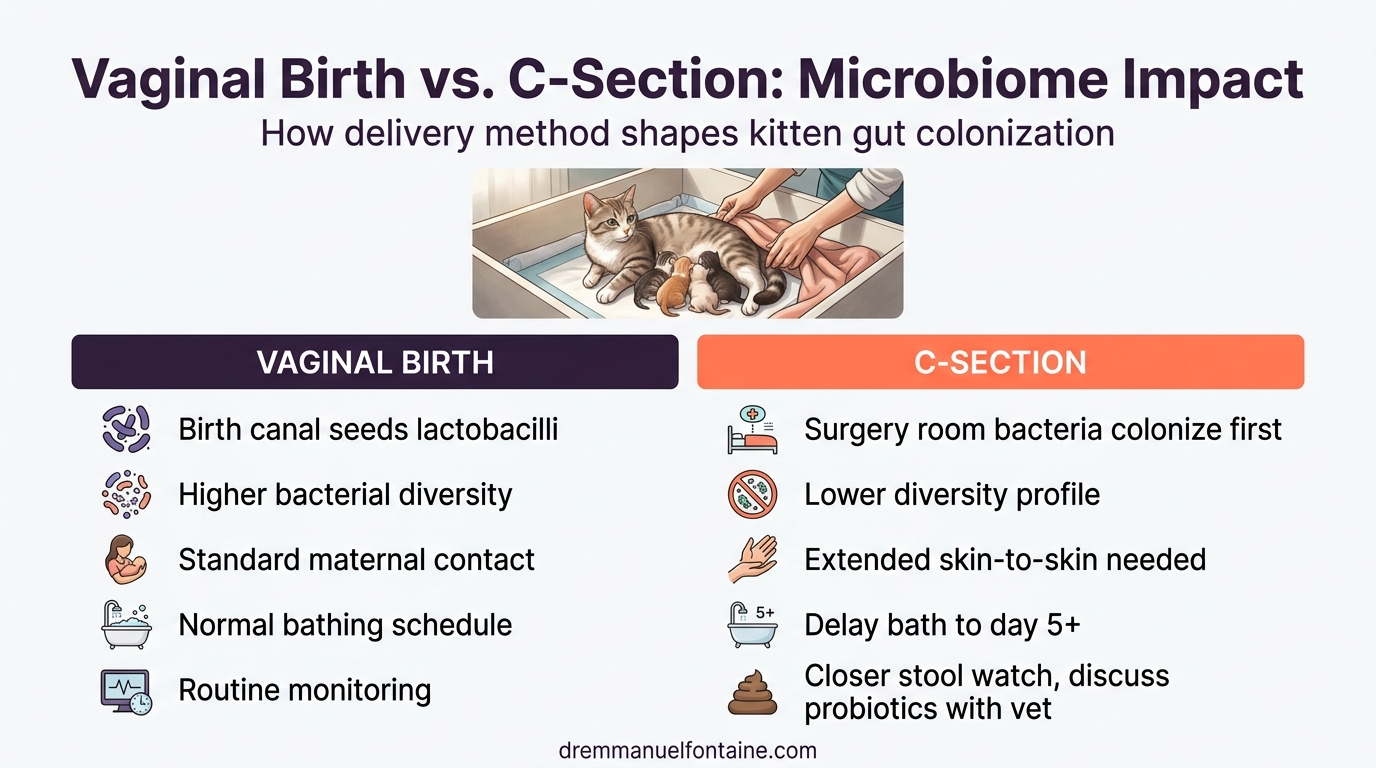
During vaginal birth, kittens receive lactobacilli, bacteroides, and other commensal species directly from the birth canal. Think of the birth canal as a bacterial starter kit, carefully assembled over the dam’s lifetime. These bacteria are not pathogenic. They are the curriculum your kitten’s immune system evolved to expect.
C-section kittens bypass the birth canal and do not receive lactobacilli in the same way. They pick up environmental bacteria from the surgery room, from hands, from air. Research shows newborns born by C-section have lower bacterial diversity compared to vaginally born littermates. The bacterial composition is skewed toward opportunistic species, organisms the immune system has not learned to tolerate.
| Microbiome Feature | Vaginal Birth | Caesarean Birth |
|---|---|---|
| Initial bacteria source | Maternal vaginal flora during birth canal transit | Environmental room bacteria, surgical gloves |
| First 24h bacterial diversity | High (lactobacilli, bacteroides, firmicutes) | Low, skewed toward opportunistic species |
| Immune priming trigger | Mother’s bacteria teach immune system “safe” signals | Delayed; immune system sees unfamiliar organisms |
| Risk of dysbiosis (imbalance) | Low if maternal contact uninterrupted | Higher without targeted intervention |
The 48-hour colonization window is programmable
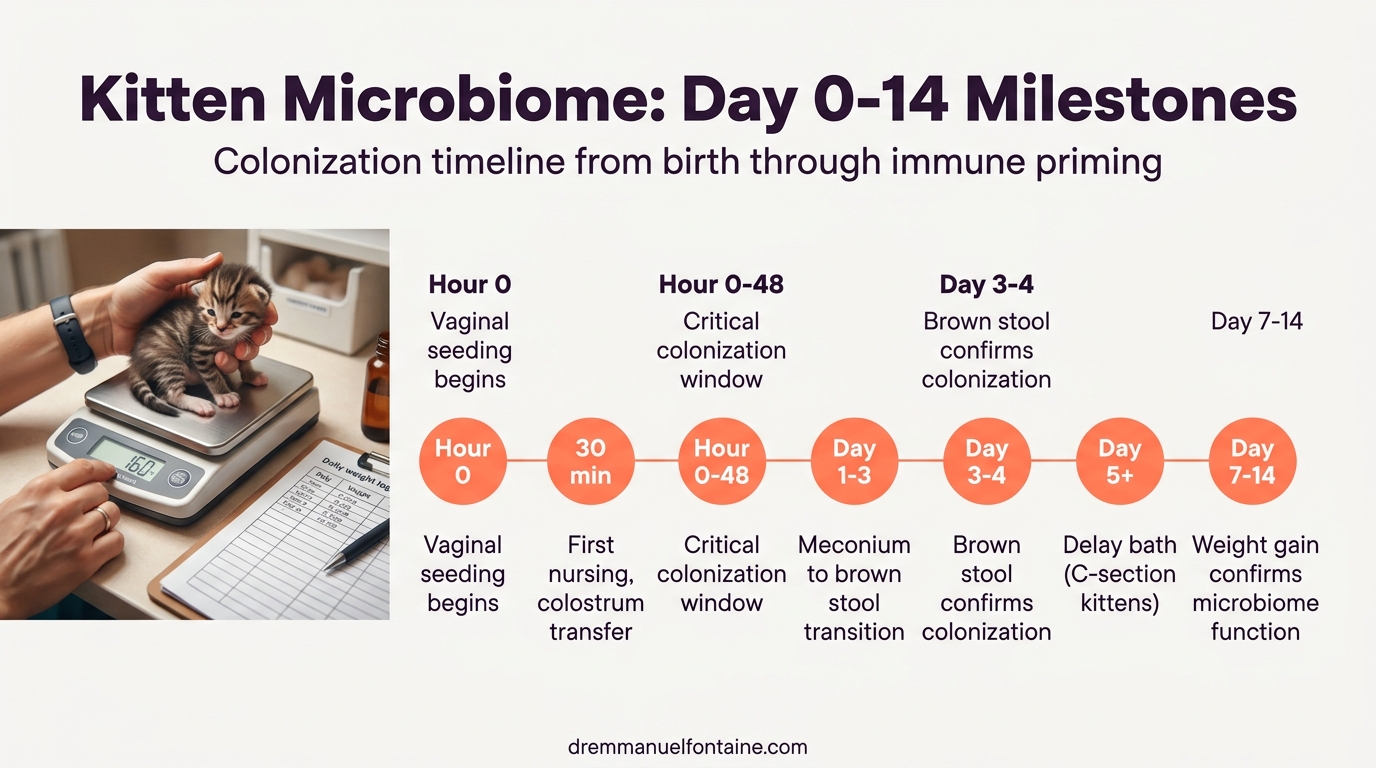
The first 48 hours after birth are critical. Your decisions directly shape which bacteria establish. Skin-to-skin contact maximizes bacterial transfer. Nursing within 30 minutes of birth provides colostrum with prebiotic oligosaccharides that feed commensal bacteria. Bathing and antibiotics disrupt this window. The bacteria that colonize in hours 0 to 48 set the trajectory. Optimize the start if you understand the window.
| Timeline | Colonization Milestone | Breeder Action |
|---|---|---|
| Hour 0-2 (immediate post-birth) | Vaginal bacteria coat skin, mouth, nose; aerobic bacteria dominate | Dry kitten gently; allow immediate maternal contact |
| Hour 2-6 | Kitten nurses colostrum; lactobacilli begin mucosal adhesion | Facilitate first nursing within 30 minutes; monitor latch |
| Hour 6-24 | Anaerobic bacteria establish in gut lumen; microbiota diversity increases | Maintain skin contact; avoid unnecessary handling; delay bathing |
| Hour 24-48 | Microbial populations stabilize; “microbial fecal finger-print” becomes evident in stool | Monitor stool (still dark meconium); assess nursing behavior; record first bowel movement time |
| Day 3-5 | Transition to brown, formed stool; microbiota mature to stable baseline | Stool scoring begins; weight gain trajectory visible |
| Day 5-14 | Microbiota composition sets; immune tolerance to commensal bacteria solidifies | If antibiotics needed, must weigh microbiome disruption cost against infection risk |
Early disruptions leave permanent signatures
When colonization is disrupted, the immune system never receives the bacterial tutorial it evolved to expect. Think of dysbiosis as a garden overtaken by weeds before the flowers had a chance to root. The result is increased allergic responses and inflammatory patterns.
Critical disruptions include maternal separation, unnecessary antibiotics, harsh disinfection, and delayed nursing. Your vet can discuss which interventions were necessary. A confirmed infection needs antibiotics; suspected infection may benefit from observation first.
| Disruption Type | Red Flag (Dysbiosis Risk) | Normal (Colonization On Track) |
|---|---|---|
| Maternal separation timing | Separated >2 hours before first nursing | First nursing within 30 minutes; kitten with mother continuously |
| Stool appearance day 3 | Loose, unformed, or mucoid stool; unusual color (pale, green) | Transitioning from dark meconium to brown; formed consistency |
| Nursing frequency observation | Nursing fewer than 8-10 times per 24h; weak latch | Nursing 10-15 times per 24h; strong suck; alert between feeds |
| Antibiotic exposure (first 48h) | Prophylactic antibiotics given without confirmed infection | No antibiotics; or vet-confirmed infection treated with narrowest spectrum |
| Bathing timing | Bathed in first 24 hours; use of disinfectant on skin | First bath delayed to day 5-7; warm water only, no soap |
Do: Activate Protocols for Optimal Colonization
Skin-to-skin contact and immediate nursing within 30 minutes
Uninterrupted maternal contact is the most important intervention in the first 48 hours. The mother is a microbiota vector. Her skin, milk, and saliva transfer bacteria to the kitten. Nursing within 30 minutes optimizes colostrum transfer and colonization. Skin-to-skin contact means direct contact, not through cloth. The kitten picks up maternal skin microbiota and ingests bacteria from nipples and milk.
| Element | Action | Timing | Why It Matters |
|---|---|---|---|
| Drying kitten | Dry kitten thoroughly after birth with clean towel; remove fetal fluids | Within 2-3 minutes of birth | Removes amniotic fluid but preserves vaginal bacteria on skin; prevents hypothermia |
| Maternal contact | Place kitten on mother’s chest and abdomen, continuous | Immediately after drying; maintained 24/7 if possible | Mother’s skin bacteria transfer passively; maximum bacterial diversity transfer |
| First nursing | Guide kitten to mother’s nipples; support latch if weak | Within 30 minutes of birth | Colostrum transfer; bacterial seeding from mother’s skin bacteria |
| Frequency monitoring | Observe nursing every 1-2 hours; count nursing episodes (target 10-15 per 24h) | First 24 hours onward | Confirms bacterial intake via milk; identifies weak eaters (microbiome risk) |
| Human handling | Limit to essential checks (weight, temperature, latch); wash hands before touch | First 48 hours critical; minimize disruption | Preserves maternal bacterial transfer; reduces environmental contamination |
Managing the nesting environment for microbial seeding
The target is clean, not sterile. A sterile environment deprives the kitten of environmental bacteria. A dirty environment introduces pathogens. A clean nest has fresh blankets, mild disinfection between litters, and no visible feces or urine soaking bedding. It is not treated with antibacterial cleaners or kept in isolation. Launder nest blankets in warm water without antibacterial agents. Change blankets when visibly soiled, but not after every nursing. Confirm heat lamp temperatures do not exceed 30 C (86 F). Discuss with your vet whether your specific situation warrants heightened protocols. Most healthy litters benefit from a simple, clean nest with minimal intervention.
| Environment Factor | Sterile (Harmful) | Clean (Optimal) | Dirty (Harmful) |
|---|---|---|---|
| Nesting material frequency | Changed after every nursing; bleach-treated | Changed when visibly soiled (24-48h intervals); mild soap and water | Changed weekly or less; urine/feces accumulate |
| Bedding type | Disposable paper; antibacterial treated | Soft cloth blankets (cotton or fleece); laundered without antibacterials | Reused bedding with visible stains; mold risk |
| Air circulation | None; sealed isolator | Natural airflow; no drafts directly on nest | Stagnant air; musty smell; mold spores |
| Visitor/handling traffic | No access; maximum isolation | Limited to essential caretakers; hands washed before handling | Open access; heavy traffic; high contamination risk |
Supporting C-section kittens with targeted interventions
C-section kittens have not received vaginal bacterial seeding. They need help. The goal is to maximize maternal bacterial transfer through skin contact, nursing, and environmental exposure. Extend maternal contact beyond what you would do for vaginally born kittens. Delay the first bath to day 5 or later. Monitor stool appearance closely. C-section kittens should transition to brown stool by day 3 to 4. If stool remains pale on day 5 or the kitten seems less vigorous, discuss intervention with your vet.
| Intervention | Threshold (When to Implement) | Action | Timing |
|---|---|---|---|
| Extended maternal contact | All C-section kittens | Maintain continuous contact; minimize separation even for vet checks | Days 0-7 at minimum |
| Delayed bathing | C-section kitten has not picked up environmental bacteria | Bathe if visibly contaminated; otherwise delay first bath to day 5-7 | First bath no earlier than day 5 unless essential |
| Stool monitoring intensity | C-section kitten; any sign of abnormal stool appearance | Score stool appearance daily and record (color, consistency, mucus) | Days 1-14 at minimum |
| Environmental optimization | C-section kitten housed in isolated or sterile space | Transition to clean (not sterile) environment; increase environmental microbial exposure while maintaining cleanliness | After surgery recovery (day 1-2); before day 3 |
Have: Monitoring Tools for Microbiome Health
Stool scoring as your daily microbiome readout
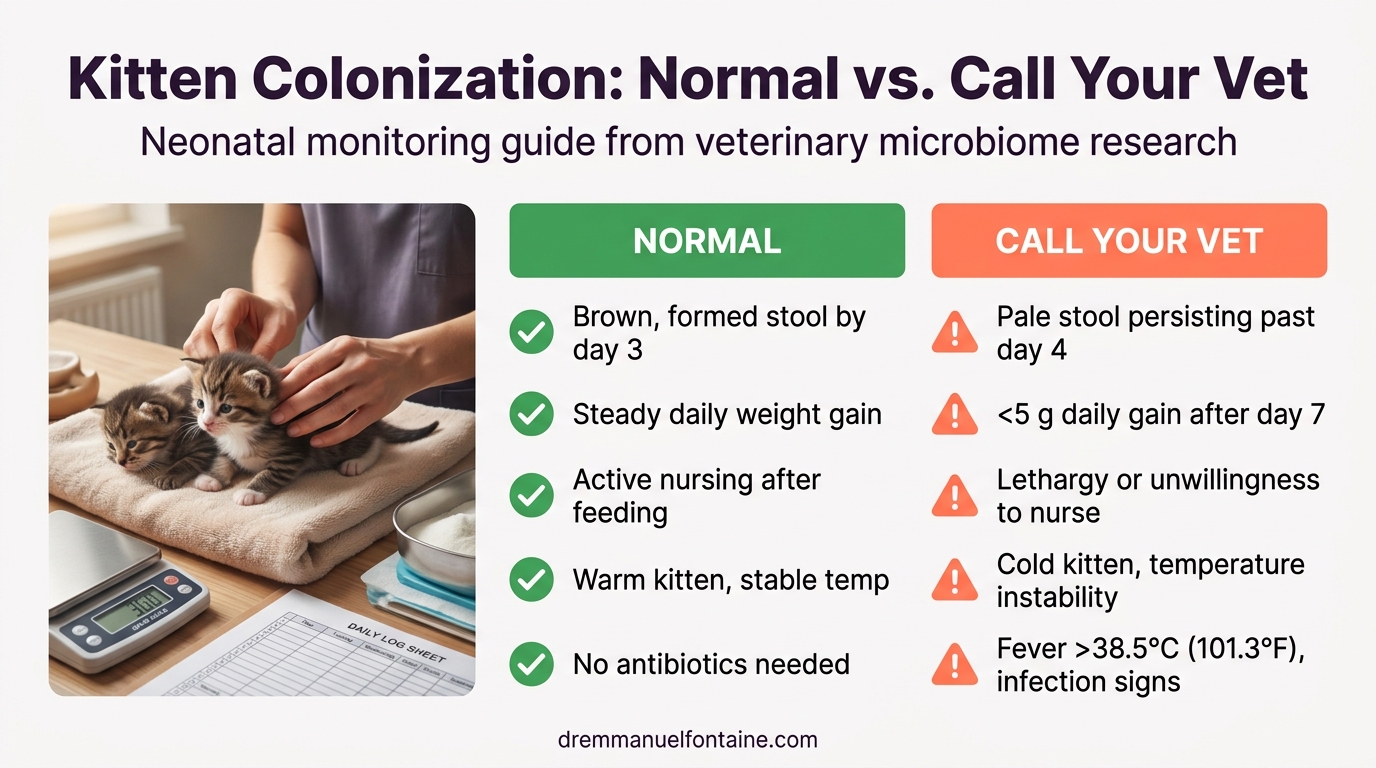
Kitten stool is your daily window into microbiome health. The progression from dark meconium to brown, formed stool reflects successful colonization. You need eyes, a notebook, and a clear Stool consistency scoring system. Day 0 to 1: meconium is dark. Day 1 to 3: stool transitions to brown. By day 3 to 4, stool should be brown and formed. Red flags include pale stool persisting past day 4, blood, or regression to loose consistency. Discuss any abnormal pattern with your vet.
| Stool Characteristic | Red Flag (Dysbiosis Risk) | Normal (Healthy Colonization) |
|---|---|---|
| Color on day 3-4 | Pale, clay-like, or greenish; unchanged from meconium | Brown to dark brown; consistent from day 3 onward |
| Consistency after day 4 | Loose, unformed, or watery; mucus coating >half the stool | Formed, log-like; small amount of mucus is normal |
| Presence of blood | Any visible blood or streaking | None; stool may be slightly tacky but no blood |
| Odor change | Suddenly foul or sour-smelling; sharp change from previous pattern | Mild odor; consistent day to day |
| Frequency change | Sudden diarrhea; kitten defecating every 1-2 hours | Regular pattern; typically 1-3 bowel movements per 24h |
| Mucus appearance | Mucus coating entire stool; slimy, excessive mucus | Thin mucus coating normal; formed stool underneath; no excessive slime |
Weight tracking as a colonization success indicator
Kitten weight gain is proof the microbiome is working. A kitten with successful colonization digests food efficiently and gains weight steadily. Weigh the kitten daily at the same time. Record and calculate daily gain. Assess growth by using neonatal growth charts. Weight stalls precede visible stool changes. Daily weight monitoring is your early warning system. Discuss action triggers with your vet.
Record templates your vet actually wants to see
Your vet is your partner. They can interpret stool findings and advise on antibiotics. But they need data. A simple daily log with weight, stool appearance, and nursing behavior takes 2 to 3 minutes to complete. Include: date, kitten ID, weight (grams), daily gain, stool appearance, stool frequency, nursing frequency, activity level, and concerns. Bring the log to all vet visits. It becomes your permanent record. If a kitten develops issues later, you will have data from the critical first 14 days.
| Field | Purpose | Example Entry |
|---|---|---|
| Date/Time | Establish temporal pattern; correlate with other events | 2026-03-28 08:00 |
| Kitten ID | Track individuals in multi-kitten litter; note dam/sire if relevant | Kitten A (grey female); Kitten B (orange male) |
| Weight (grams) | Daily metric; calculate daily gain in next column | 125g |
| Daily gain | Subtract previous day; flag if below 5g | Today 125g minus Yesterday 120g equals +5g (acceptable) |
| Stool color/texture | Score as per Red Flag/Normal table above | Brown, formed, small mucus coating (normal day 4) |
| Stool frequency per 24h | Typical is 1-3 in healthy kitten; frequent stool may indicate dysbiosis | 2 bowel movements observed |
| Nursing frequency estimate | Healthy kitten nurses 10-15 times per 24h; fewer suggests poor intake | Observed ~12 nursing episodes (normal) |
| Kitten activity level | Active/normal = good; drowsy but responsive = okay; lethargic = concern | Active, exploring nest, vigorous nursing |
Watch: Red Flags That Signal Colonization Failure
Diarrhea patterns that need veterinary attention
Diarrhea in a neonatal kitten is not normal. Healthy stool should be formed by day 4. Any loose or watery stool after day 4 needs attention. Early detection prevents poor nutrient absorption, weight loss, secondary infection, and immune dysfunction.
| Stool Pattern | Working (Normal) | Failing (Dysbiosis/Infection Risk) |
|---|---|---|
| Day 4 onward stool consistency | Formed, log-like, holds shape | Loose, unformed, spreads easily; mucoid; watery |
| Stool color stability | Consistent brown; minor variation between bowel movements | Sudden color change (pale, greenish, streaked); unstable day to day |
| Mucus presence | Thin coating; formed stool underneath | Excessive mucus; slimy; mucus without formed stool |
| Frequency after day 4 | 1-3 bowel movements per 24h; regular intervals | Frequent (every 1-2 hours); urgency; kitten straining |
| Odor | Mild, consistent | Suddenly foul, sour, or abnormal |
| Kitten behavior during defecation | Alert, normal posture, no signs of pain or strain | Hunched posture, vocalization, straining, repeated squatting with little output |
Growth stalls linked to microbiome disruption
A kitten gaining well through day 7 then stalling at day 8 to 10 has experienced a disruption. Common culprits: unnecessary antibiotics given day 5 to 7, early bathing, maternal separation, or temperature fluctuations. If a kitten suddenly gains less than 5 grams per day, review what changed 2 to 3 days prior. If stalled only 1 to 2 days, targeted bacterial seeding support and optimal maternal contact often restore trajectory. If stalled more than 3 days, veterinary assessment is critical. Do not assume stalls resolve on their own. Intervene early.
When antibiotics become necessary despite the risks
Antibiotics are a double-edged tool. They save lives when there is confirmed infection. They also disrupt microbiota at a critical moment. Your vet weighs both sides. Confirmed infection signs: fever over 38.5 C (101.3 F), lethargy, unwillingness to nurse. Suspected infection based on appearance alone may warrant observation first. If prescribed, your vet chooses the narrowest-spectrum antibiotic. Discuss whether probiotics are appropriate once infection is managed. Ask about timeline and when microbiota support can begin. The key is making sure the kitten truly has infection, not just normal variability. As a veterinarian, I see this distinction save kittens.
Get the next issue on Saturday morning
Every Saturday, my free newsletter brings you one piece of science on reproduction and newborn care in dogs and cats, written for breeders and their veterinarians. Read it in English, French, Spanish or Portuguese.
Free. Unsubscribe anytime.
Conclusion
Your kitten’s health trajectory is shaped by microbial seeding in the first 48 hours. You cannot control genetics, but you can optimize the window. Vaginal delivery, immediate maternal contact, nursing within 30 minutes, a clean environment, and thoughtful antibiotic decisions create conditions for successful colonization. C-section births require specific interventions. Extended maternal contact, delayed bathing, and vet discussion about probiotics can compensate for loss of vaginal bacterial transfer. The difference between good and poor outcomes comes down to understanding why the first 48 hours matter and acting deliberately during that window. Your vet is your partner. Bring daily logs, ask questions about C-section protocols, and discuss environmental practices for your breeding program. The bacteria that colonize your kitten’s gut in the first two days are the foundation of lifelong immune health.


