🇫🇷 Lire en Français | 🇪🇸 Leer en Español | 🇧🇷 Leia em português
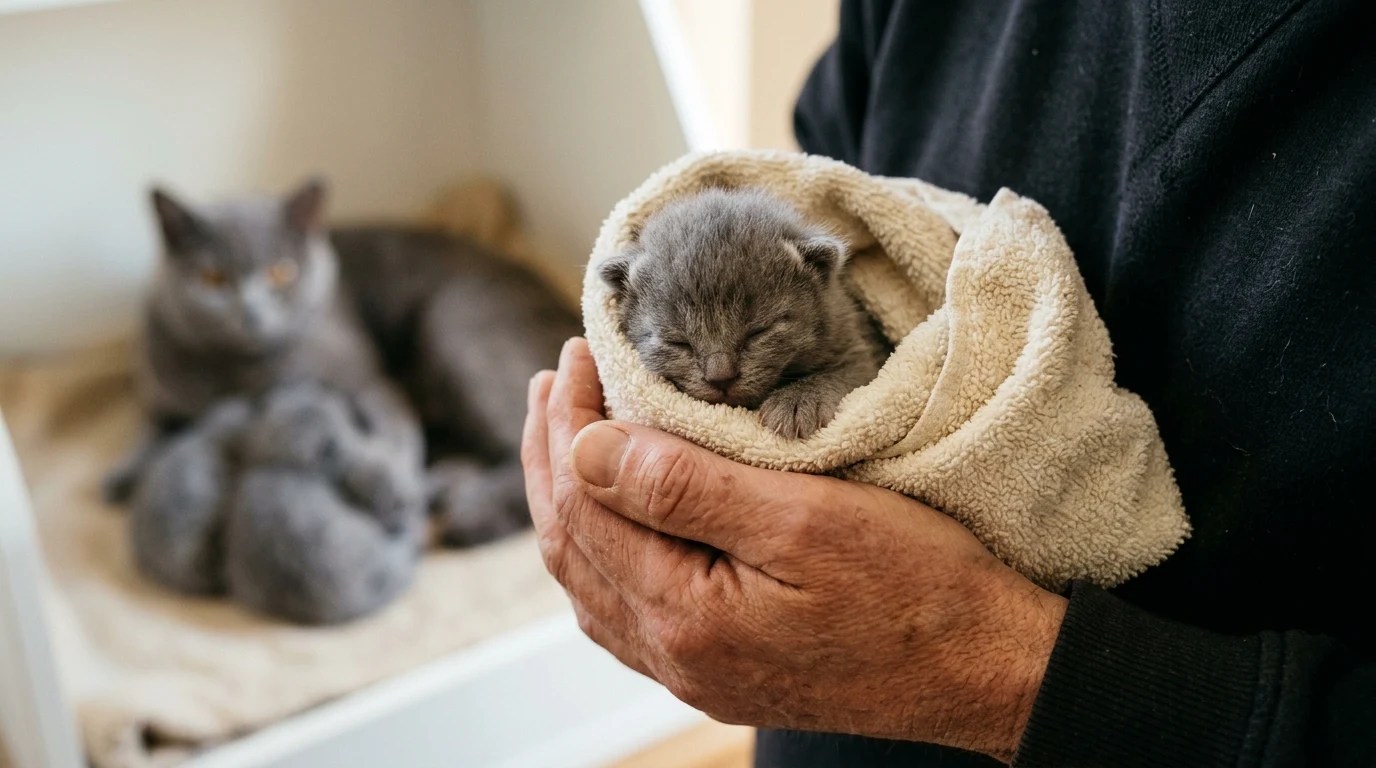
Imagine you check on a litter of newborn kittens early in the morning. They all nursed well during the night, and every one of them looked perfectly fine. When you come back a few hours later, one of them is lying away from his mother. He looks weak, he no longer nurses, and he barely reacts when you pick him up. You post a photo in a group on social media, and within minutes the comments all agree on the same three words: fading kitten syndrome.
Here is where I want to stop you. Fading kitten syndrome is not a disease. It is a box with a label on it, and infections, low birth weight, a lack of colostrum, birth defects and a conflict between blood types all go into that box. The good news is that whatever is inside, a fading kitten almost always falls into the same chain of three problems, which I call the 3H syndrome: hypothermia, hypoglycemia and dehydration. That chain is what you can act on right now, in this order: temperature first, gradual warming, then a kitten milk replacer given the right way, and the scale to tell you whether it is working.
This article is the written version of my video Fading Kitten Syndrome: What to Do in the First Hour, so you can watch it, read it, or keep both open in your nursery. It brings together what I have written on caring for abandoned kittens, feeding newborn kittens and neonatal isoerythrolysis, in four practical steps. Everything here applies to two situations: the kitten whose mother has pushed him aside, and the orphan you are raising by hand.
TL;DR
- Fading kitten syndrome is a box, not a diagnosis. Whatever the cause, act on the 3H chain: hypothermia, hypoglycemia, dehydration.
- Thermometer before bottle. Below about 34 °C (93 °F) his intestine stops, and he can still suck while his gut no longer works.
- Warm him slowly, for at least 1 to 1.5 hours, and give the first meal only once he is back to at least 36 °C (97 °F).
- Nest at kitten level: 30 °C (86 °F) in week one, 28 °C (82 °F) in week two, 25 °C (77 °F) in week three, humidity 55 percent, give or take 10.
- A kitten milk replacer, never cow’s or goat’s milk, mixed exactly, at about 38 °C (100 °F), kitten belly down.
- The scale is your hydration test. A healthy newborn kitten gains every day; no improvement after 24 hours means veterinary attention.
- Know the blood types. Neonatal isoerythrolysis can be prevented before the kittens are born.
Step One: Take His Temperature Before Anything Else
When a kitten is weak and not nursing, the first reflex for most people is to grab a bottle. It makes sense: he has not eaten, so he must be hungry. And yet this is a mistake, and the first thing I reach for is a thermometer, because everything else depends on that number. A newborn kitten cannot regulate his own body temperature during his first three weeks of life. He borrows his heat from his mother, his littermates and the nest.
He also starts life much cooler than you might think. At birth, his body temperature is about 35 to 36 °C (95 to 97 °F), well below the 38 to 39 °C (100 to 102 °F) of an adult cat, and it reaches adult values at about three weeks of age. Please do not rely on your hand to judge it, because most people cannot feel the difference between a kitten at the right temperature and a hypothermic one. A digital rectal thermometer, used gently, or an infrared thermometer gives you the real answer in seconds.
Why the bottle can make things worse
Here is why that number matters before any meal. When his temperature drops below about 34 °C (93 °F), the first thing to shut down is his intestine, which stops moving, a state we call ileus. Below about 32 °C (90 °F), his suckling reflex disappears as well. So the gut stops first and the suckling reflex only follows, which means a kitten can still suck on a bottle while his intestine has already stopped working.
Milk given to a kitten in ileus is not digested. It sits in a stomach that no longer empties, brings him no energy at all and bloats him, and in the worst cases it comes back up and goes down into his lungs, which we call aspiration. For the orphan, this check comes before every single feeding. For any fading kitten, a low reading means the next step is warming him, not feeding him.
| Body temperature | What it means | What you do |
|---|---|---|
| 35 to 36 °C (95 to 97 °F) at birth | Normal for a newborn kitten, rising to adult values by about 3 weeks | Keep the nest warm |
| Below about 34 °C (93 °F) | Ileus: his intestine stops moving | Warm him gradually; no milk yet |
| Below about 32 °C (90 °F) | His suckling reflex disappears too | Warm him gradually; no milk yet |
| At least 36 °C (97 °F) after warming | His gut can work again | First meal with a kitten milk replacer |
Step Two: Warm Him Gradually, Then Fix the Nest
A cold kitten is warmed first, and he is warmed slowly. When a newborn gets cold, his body narrows the blood vessels of his skin and his gut to keep the blood around his heart and brain, so his intestine slows down even more. What we really want from rewarming is to restore that blood flow to the gut, and that takes time. Warm him too fast from the outside, and the vessels of his skin open first, drawing blood toward the surface before his gut has recovered.
In practice, a hypothermic kitten gets at least 1 to 1.5 hours of gradual warming before any feeding. A ten-minute warm-up followed by a bottle is a very common mistake, and it simply does not work. Then I take his temperature again, and he gets his first meal only once he is back to at least 36 °C (97 °F).
Which heat source?
For a kitten who is struggling, the best tool is an incubator, like the ones used in veterinary clinics, because it controls both temperature and humidity. If you do not have one, a heating pad set low and covered with a towel works very well, and so does a hot water bottle wrapped in a towel. Whatever you use, he never lies directly on the heat, and he always has a cooler area to move to if he gets too warm.
There is one more heat source people often forget, which is you. Some breeders hold a cold kitten against their own skin, inside their clothing, and it can work remarkably well. In human medicine this is called kangaroo care, and large reviews found that small and premature babies cared for this way got cold less often, had fewer severe infections and survived better. We do not have studies like these in kittens, and whether skin-to-skin contact could do even more than an incubator is pure speculation on my part, but it is a question I would love to see answered.
The nest: temperature and humidity
Once he is warm, the nest has to keep him warm. Measured at kitten level, I recommend 30 °C (86 °F) in the first week, 28 °C (82 °F) in the second and 25 °C (77 °F) in the third, while the room itself can stay around 21 °C (70 °F) so the mother stays comfortable. Then there is the setting almost everyone forgets, humidity: I aim for 55 percent relative humidity in the nest, give or take 10, measured by a small weather station placed at kitten level.
When the air is too dry, a newborn loses more water, and since his body is about 82 percent water, he dehydrates faster. When the air is too humid, bacteria grow more easily and the risk of infection rises. The air usually gets too dry in winter, when the heating runs all day, or right under a strong heat source, and too humid in a poorly ventilated room, with damp bedding or in a humid summer.
And his mother?
I often hear that the queen knows, and that she sets aside the kitten who is not going to make it. I see it differently. In my experience, mothers usually push aside a kitten who has already become cold. So until he is warm and strong again, think of him as an orphan, and once he is back to temperature, place him against her again and watch whether she accepts him.
| Setting | Target | Why |
|---|---|---|
| Rewarming a cold kitten | At least 1 to 1.5 hours, gradual | Restores blood flow to the gut before the skin |
| First meal | Only at 36 °C (97 °F) or more | A cold gut cannot digest milk |
| Nest, week 1 | 30 °C (86 °F) at kitten level | He cannot make his own heat yet |
| Nest, week 2 | 28 °C (82 °F) | Gradual step down |
| Nest, week 3 | 25 °C (77 °F) | He reaches adult temperature at about 3 weeks |
| Room | About 21 °C (70 °F) | The mother stays comfortable |
| Humidity in the nest | 55 percent, give or take 10 | Too dry dehydrates him; too humid favors bacteria |
| Heat source | Incubator, or a covered heating pad or hot water bottle, or your skin | Never directly on the heat, always a cooler area |
Step Three: Bring Him Energy With a Kitten Milk Replacer
When his temperature is back where it should be, the next step is nutrition. A newborn kitten normally nurses 12 to 20 times in 24 hours, so his energy reserves are tiny, and a kitten who has stopped nursing for a few hours is very likely already in hypoglycemia, which makes him too weak to nurse. That is also why a rewarmed kitten does not always go back to the teat on his own: warming corrects his temperature, but it does not refill his reserves. If his mother is with him, offer him a teat and watch whether he latches and swallows, and even when he does, I would still supplement him with a bottle, because for a fading kitten that bottle is vital energy.
Why not goat’s or cow’s milk?
It must be a milk replacer formulated for kittens: not a homemade recipe found online, not cow’s milk and not goat’s milk, even though goat’s milk is the option people mention most often. A kitten grows much faster than a calf or a goat kid, so the queen’s milk is far richer in energy. Goat’s milk brings much less energy and, for the same amount of energy, about twice as much lactose, which raises the osmolality of the milk, pulls water into the intestine and often ends in diarrhea, the last thing a dehydrated kitten needs. My video Goat Milk for Newborn Puppies & Kittens: Is It Enough? goes through it in detail.
The three mistakes I see most
The first mistake is the preparation. Mix the powder exactly as the label says, with the exact amount of warm, not boiling, water, and whisk until there are no lumps, because a milk replacer made too concentrated or too diluted brings diarrhea or constipation. The second is the temperature of the milk, which I serve at about 38 °C (100 °F): a drop on the inside of your wrist should feel warm, never hot.
The third, which I see very often, is the position. Many people hold a kitten on his back, like a human baby, but in that position milk runs toward his airway, and that is how aspiration happens. A kitten feeds belly down, the way he would lie against his mother, with his head slightly raised, the bottle angled so the nipple stays full of milk, and the milk coming out drop by drop, never in a stream.
Bottle, syringe or tube?
You can check his suckling reflex by slipping a clean fingertip into his mouth. A kitten who sucks firmly is ready for the bottle, and the bottle is always what I prefer first. I am not a big fan of a bare syringe pushing milk straight into his mouth, because the kitten no longer controls the flow, and in his first week he has no reliable gag reflex to protect his airway. If you like working with a syringe, fit a small nipple on its tip, so he sucks at his own pace and you know exactly how many milliliters he has taken. For a kitten who cannot suck at all, the tool is a soft feeding tube, a technique worth learning with your veterinary team.
How often he should eat
In his first week of life, I recommend seven meals in 24 hours, about one every three hours, nights included, then six meals in the second week and five in the third. For a kitten who is weak, small or premature, I add about two extra meals a day, because smaller, more frequent meals are easier for an immature gut. For the orphan, one more gesture follows every meal: his mother would lick him to make him urinate and pass stools, so you replace her with a warm, damp cloth until he is about three weeks old.
During the day, I also like an approach borrowed from human neonatal care, called responsive feeding. Instead of watching only the clock, you watch the kitten: restlessness, searching for a teat and gentle mewing are early signs of hunger, crying is a late one, and when he turns his head away, stops sucking or falls asleep, he has had enough. I use responsive feeding during the day and keep to the schedule at night, so no meal is missed, and I go further in how to feed newborn kittens.
| Feeding | Do | Avoid |
|---|---|---|
| Milk | A milk replacer formulated for kittens | Homemade recipes, cow’s milk, goat’s milk |
| Preparation | Exact powder and water, warm water, no lumps | Measuring by eye; too concentrated or too diluted |
| Milk temperature | About 38 °C (100 °F), warm on your wrist | Hot milk |
| Position | Belly down, head slightly raised, drop by drop | On his back like a human baby |
| Tool | Bottle first; syringe only with a small nipple; tube if he cannot suck | A bare syringe pushing milk into his mouth |
| Meals per 24 hours | 7 in week 1, 6 in week 2, 5 in week 3; about 2 more if weak, small or premature | Skipping night meals |
| Orphans | A warm, damp cloth after every meal until about 3 weeks | Forgetting to stimulate urine and stools |
Step Four: Monitor Him on the Scale, and Give It 24 Hours
Once he is warm and fed, the question is whether all of this is working. Many people check hydration the way we do in adult cats, by lifting the skin at the back of the neck. In a newborn kitten this test does not work, because his skin is very loose and elastic, so it tents easily even when he is perfectly hydrated.
The best way to monitor his hydration, and his progress in general, is the scale. Since his body is about 82 percent water, a sudden drop very often means he is losing fluid. Weigh him at least once a day, at the same time, on a kitchen scale that reads in grams: a healthy newborn kitten gains every single day, so a loss, or even a day without gain, tells you something is not working yet.
The neonatal growth chart
In human medicine, growth charts revolutionized pediatrics, because every child is plotted against reference curves. Neonatal growth charts for kittens work on the same principle, with reference curves breed by breed, and they catch two situations the scale alone can miss: the kitten who gains, but not enough, and the kitten who gains too fast. I use them in every neonatal consultation, and I explain how in how a simple scale can prevent puppy and kitten neonatal loss.
The 24-hour checkpoint
So how do you know whether what you are doing is enough? Put these measures in place and give them 24 hours: gradual warming, a nest at the right temperature and humidity, and a kitten milk replacer given the right way, with the right number of meals. Improvement means he is gaining on the scale, he is more active and he sucks more strongly.
If after 24 hours you see no improvement, it is time to seek veterinary attention. At that point your supportive care has done its job, because it has bought him time, and now the cause needs to be found.
| What you check | How | What it tells you |
|---|---|---|
| Skin tent test | Not useful in newborns | Misleading: his skin tents even when he is hydrated |
| Weight | Once a day or more, same time, scale in grams | A loss or a day without gain means something is not working |
| Growth chart | Weight plotted against breed reference curves | Catches gains that are too small or too fast |
| After 24 hours | Weight gain, more active, stronger suckling | Improving: keep going. No improvement: veterinary attention |
What the Box Can Hide: Neonatal Isoerythrolysis
There is one cause in the box where his own mother’s milk puts him in danger. It is called neonatal isoerythrolysis, a conflict between blood types. Cats have three blood types, A, B and the rare AB, and a type B cat carries strong antibodies against type A blood from birth, with no previous litter or transfusion needed.
Imagine a type B queen bred to a type A tom. Some or all of her kittens will be type A, and they are born healthy, because very few of her antibodies reach them before birth. Then they nurse, and her colostrum is where she concentrates her antibodies, including those against type A blood. During the first 12 to 16 hours of life, a newborn’s intestine lets those large antibodies pass straight into his blood, and in a type A kitten they destroy his own red blood cells over the following days.
This explains a picture that has puzzled many catteries. The kittens who fade first are often the strongest ones, because they drank the most colostrum. They stop nursing and weaken in their first days, their gums can turn pale or yellow, and in milder cases the tip of the tail can darken and die off. Those signs call for veterinary attention without delay, especially in breeds where type B is frequent, such as the British Shorthair, the Devon Rex, the Cornish Rex, the Exotic Shorthair and the Persian.
What makes this cause unique is that it can be prevented before the kittens are even born. Blood typing the queen and the tom tells you whether a pairing is at risk, and it is worth discussing with your veterinarian before breeding. If an at-risk breeding has already happened, the kittens can be blood typed right after birth, before they nurse: type B kittens stay with their mother, while type A or AB kittens are kept away from her milk for their first 24 hours and fed with a kitten milk replacer, then go back to her. Because they miss her colostrum, your veterinarian will plan another source of protection with you. The full protocol is in how do I prevent neonatal isoerythrolysis in kittens?
| Neonatal isoerythrolysis | What to know |
|---|---|
| The risky pairing | Type B queen bred to a type A tom |
| When it happens | Antibodies absorbed from colostrum in the first 12 to 16 hours |
| Who fades first | Often the strongest kittens, who drank the most colostrum |
| Signs | Stops nursing, weakness, pale or yellow gums, darkening tail tip |
| Breeds where type B is frequent | British Shorthair, Devon Rex, Cornish Rex, Exotic Shorthair, Persian |
| Prevention | Blood type the queen and the tom before breeding |
| At-risk litter already born | Type A or AB kittens off her milk for 24 hours, kitten milk replacer, then back to her; your veterinarian plans their protection |
Conclusion
So here is what I would like you to remember. Fading kitten syndrome is a box, not a diagnosis, but the first hours always follow the same order: temperature first, gradual warming, then a kitten milk replacer given the right way. The scale tells you whether it is working, and 24 hours without improvement means it is time to seek veterinary attention. Talk with your veterinarian before the litter is born about blood typing and about who to call at night, because an article is education, not a diagnosis.
Think again of the kitten from the beginning, who looked perfectly fine and then faded away from his mother. A fading kitten never arrives with a diagnosis. He arrives with a temperature, a weight and a few hours, and that is enough to start helping him. For the next fragile period in a kitten’s life, read kitten diarrhea at weaning: what should you check first? or watch my video Kitten Diarrhea at Weaning.
Want to go further? Inside the Breeder Vault, the library where I add the expanded edition of my newsletter every week, you will find the protocols and the deeper science behind articles like this one, in dogs and in cats.
Tell me in the comments below: what heat source do you keep ready in your nursery for a kitten who gets cold? I read every one, and your answers help other breeders. And if you want the next article in your inbox, join my free newsletter, every Saturday, in English, French, Spanish and Portuguese.


