🇫🇷 Lire en Français | 🇪🇸Leer en Español | 🇧🇷Leia em português
A queen delivers a full-term litter. Every kitten looks perfect. Then, within hours, the strongest ones stop nursing, their urine turns dark, and they fade. By morning, half the litter is gone.
This scenario haunts cat breeders who work with breeds like British Shorthairs, Devon Rexes, and Cornish Rexes. The losses feel random, unexplainable, devastating. Many attribute them to infections, congenital defects, or bad luck.
They are none of those things. The killer is neonatal isoerythrolysis, a blood-type mismatch between mother and kittens that turns the queen’s own colostrum into poison. The good news: it is 100% preventable. This post gives you the complete roadmap, from pre-mating blood typing to the 24-hour colostrum management window that saves entire litters.
- TL;DR
- What You Need to Know: The Science Behind the Blood-Type Mismatch
- What You Need to Do: Preventing Neonatal Isoerythrolysis Step by Step
- What You Need to Have: Essential Tools for Your Queening Kit
- What to Watch For: Red Flags in the First 72 Hours
- Conclusion
TL;DR
- Neonatal isoerythrolysis occurs when a Type B queen nurses Type A or AB kittens, and her colostrum antibodies destroy their red blood cells within 24 to 72 hours.
- Type B cats naturally carry powerful anti-A antibodies from birth, no prior exposure needed.
- Blood-typing both the queen and the tom before mating eliminates the risk entirely.
- If an incompatible mating occurs, removing at-risk kittens from the queen for the first 24 hours prevents antibody absorption.
- Dark red or brown urine (pigmenturia) in a newborn kitten is the hallmark warning sign of this condition.
- Kittens denied colostrum need an alternative source of passive immunity. Discuss options with your veterinarian.
- Breeds with high Type B prevalence (34% to 60%) include British Shorthairs, Devon Rexes, Cornish Rexes, Exotic Shorthairs, and Persians.
What You Need to Know: The Science Behind the Blood-Type Mismatch
Cats have a unique blood group system with built-in weapons
Cats carry one of three blood types: A, B, or the rare AB. This matters for breeding because Type B cats are born with highly concentrated antibodies against Type A blood. Unlike the human Rh system, where antibodies only develop after exposure during pregnancy or a transfusion, a Type B queen’s immune system is pre-loaded with anti-A weapons from day one.
Think of it like a lock-and-key mismatch that exists before any breeding ever happens. The queen does not need a previous incompatible litter to develop these antibodies. They are always there, circulating in her bloodstream and concentrated in her colostrum.
Your veterinarian can confirm your cat’s blood type with a simple in-clinic test. This single piece of information tells you whether the blood-type mismatch is even possible in a given pairing.
| Blood Type | Key Fact |
|---|---|
| Type A | Most common in cats overall. Genetically dominant over Type B. |
| Type B | Carries strong, naturally occurring anti-A antibodies from birth. |
| Type AB | Rare. Does not carry anti-A or anti-B antibodies. Lowest risk. |
Blood type inheritance makes incompatible litters predictable
Type A blood is genetically dominant over Type B. A Type B queen must carry two copies of the recessive ‘b’ gene (b/b). When you mate her to a Type A tom, every kitten inherits at least one ‘A’ gene from the father. If the tom carries only ‘A’ genes, 100% of the kittens will be Type A. If he carries one ‘A’ and one ‘b’ gene, roughly half will be Type A.
This means the risky pairing, a Type B queen with a Type A tom, produces a predictable outcome: most or all kittens will inherit the blood type their mother’s antibodies are designed to attack. The mismatch is not random. It follows simple genetics that you can identify before breeding ever takes place.
DNA testing through laboratories like UC Davis VGL can reveal whether a Type A cat carries the hidden ‘b’ allele. Your veterinarian can guide you through submitting a cheek swab for this test.
| Pairing | Kitten Blood Types | Risk Level |
|---|---|---|
| Type B queen x Type A tom (A/A) | 100% Type A kittens | Very high |
| Type B queen x Type A tom (A/b) | ~50% Type A, ~50% Type B | High for Type A kittens |
| Type B queen x Type B tom | 100% Type B kittens | None |
| Type A queen x any tom | Type A or AB kittens | None |
Colostrum absorption shuts down after 24 hours
A newborn kitten’s intestinal lining is uniquely permeable during the first 16 to 24 hours of life. This permeability exists for a critical reason: it allows the kitten to absorb large antibody proteins directly from the mother’s colostrum into the bloodstream. This transfer of passive immunity is what protects vulnerable neonates during their first weeks.
After approximately 24 hours, the kitten’s gut undergoes a process called “gut closure.” The intestinal lining tightens, and large proteins, including antibodies, can no longer pass through. From that point on, any antibodies the kitten swallows are simply digested like ordinary proteins.
This 24-hour window is the entire battlefield for neonatal isoerythrolysis. If you prevent an at-risk kitten from nursing during this window, the threat is over. After gut closure, the kitten can safely return to its mother and nurse normally.
| Time Window | What Happens |
|---|---|
| 0 to 16 hours | Maximum intestinal permeability. Antibodies pass directly into the kitten’s bloodstream. |
| 16 to 24 hours | Permeability decreasing. Gut closure beginning. |
| After 24 hours | Gut closed. Maternal antibodies are digested harmlessly. Safe to nurse. |
What You Need to Do: Preventing Neonatal Isoerythrolysis Step by Step
Blood-type all breeding cats before mating
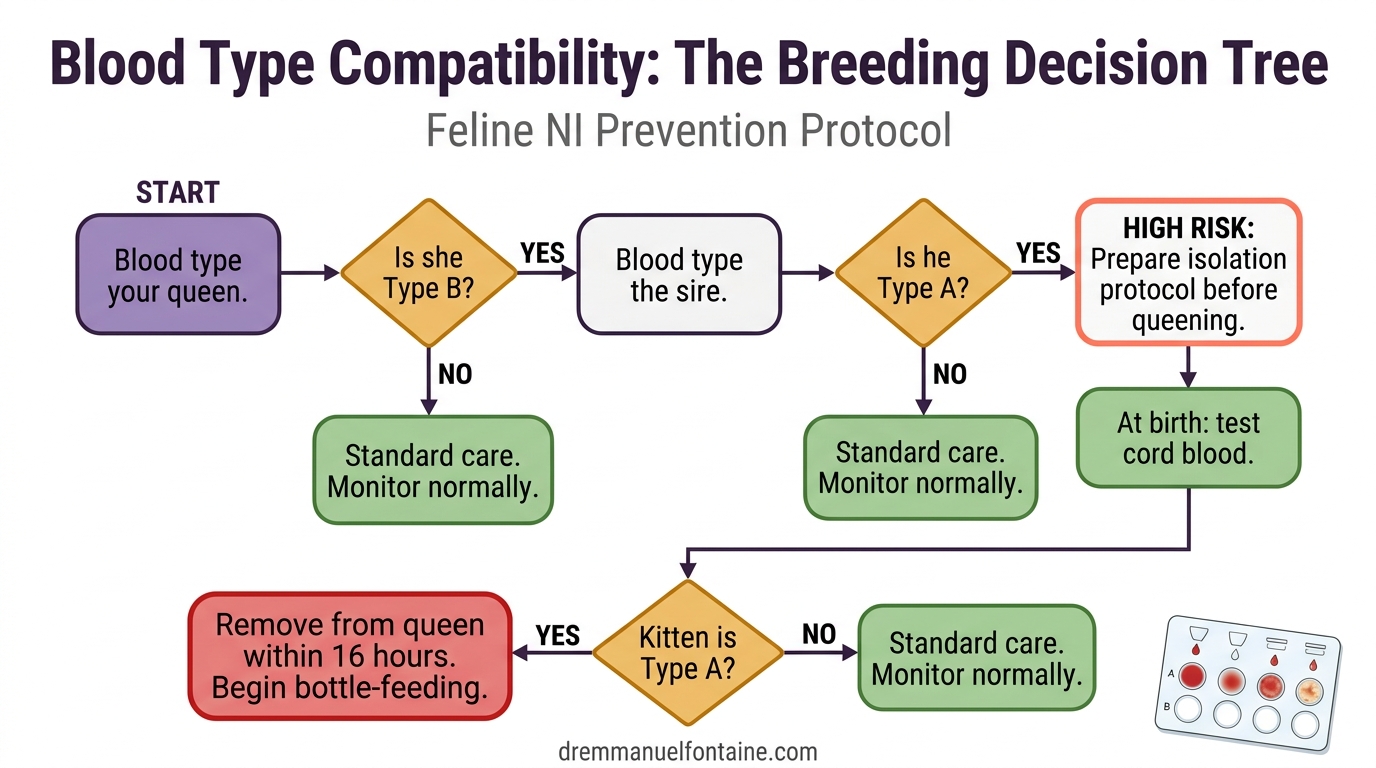
The most effective prevention strategy is the simplest one: know the blood type of every cat in your breeding program. If you never pair a Type B queen with a Type A tom, the condition cannot occur.
Patient-side blood typing cards, such as the RapidVet-H system, give results in minutes at your veterinarian’s clinic. For long-term breeding decisions, DNA testing through a laboratory identifies whether a Type A cat carries the recessive ‘b’ allele (or the ‘b3’ allele seen in breeds like Ragdolls). This deeper information helps you plan future pairings.
Make blood typing part of your standard pre-breeding health screening, alongside infectious disease testing and general health evaluation. Discuss the results with your veterinarian to map out safe breeding combinations.
| Action Step | Details |
|---|---|
| Test the queen’s blood type | Use a patient-side card or send a sample to the lab. Type B queens are the ones at risk. |
| Test the tom’s blood type | A Type B tom paired with a Type B queen produces zero risk. |
| DNA test for hidden ‘b’ allele | A Type A tom carrying one ‘b’ gene produces ~50% Type A kittens with a Type B queen. |
| Record results permanently | Add blood type to each cat’s breeding file. Share with future stud owners. |
Test kittens at birth using umbilical cord blood
Sometimes an incompatible mating has already occurred, or the tom’s blood type is unknown. In these situations, the critical moment arrives at delivery. You need to determine each kitten’s blood type before it has a chance to nurse.
Patient-side blood typing cards can work with a single drop of umbilical cord blood collected immediately at birth. Kittens that test as Type B are safe to stay with their Type B mother right away. Kittens that test as Type A or AB must be removed before they ingest any colostrum.
This requires that you are present for the delivery, which is already standard practice for conscientious cat breeders working with at-risk breeds. Have your typing cards and supplies ready in your queening kit well before the due date.
| Kitten Blood Type | Action at Birth | Return to Queen? |
|---|---|---|
| Type B | Leave with the Type B queen | Yes, immediately |
| Type A | Remove before first nursing | After 24 to 48 hours |
| Type AB | Remove before first nursing | After 24 to 48 hours |
Isolate at-risk kittens for the first 24 to 48 hours
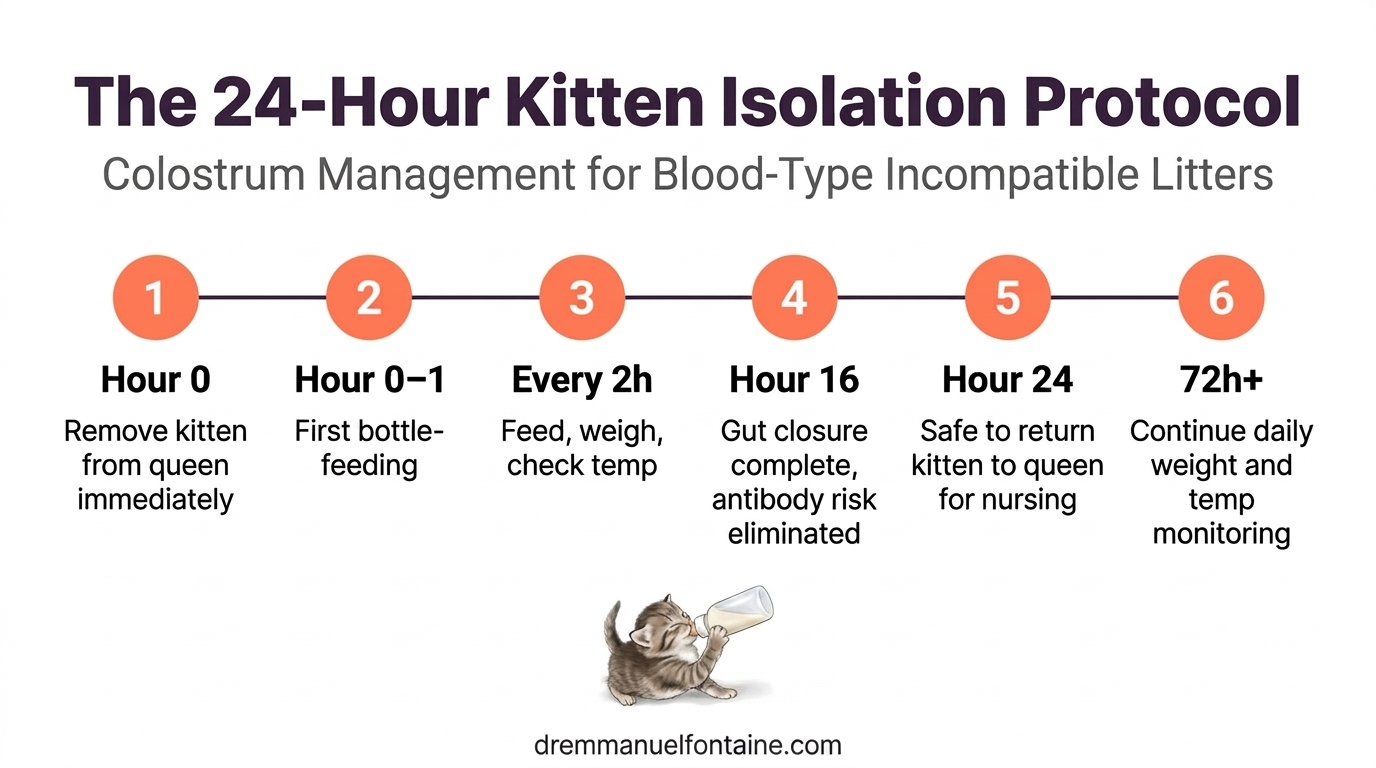
If a Type A or AB kitten is born to a Type B queen, it must not ingest her colostrum during the critical gut-permeability window. Remove the kitten immediately and provide nutrition through one of two routes: bottle-feeding with a commercial kitten milk replacer, or fostering onto a lactating Type A queen if one is available.
As we covered in the What You Need to Know section, gut closure occurs around 24 hours of age. After this window, the queen’s antibodies in her mature milk are simply digested and pose no threat. You can safely reunite the kittens with their biological mother once this period has passed.
Because these isolated kittens are missing the protective antibodies normally delivered through colostrum, discuss alternative passive immunity options with your veterinarian. Administering 1 to 2 mL of serum or plasma from a Type A cat, given subcutaneously, can provide essential immune protection without the lethal anti-A antibodies.
| Isolation Step | What to Do |
|---|---|
| Remove at-risk kittens at birth | Prevent any contact with the queen’s colostrum during the first 24 hours. |
| Feed kitten milk replacer | Use a commercial formula designed for neonatal kittens. Feed every 2 hours. |
| Consider a foster queen | A lactating Type A queen provides the safest natural alternative. |
| Discuss passive immunity with your vet | Serum or plasma from a Type A cat can replace missing colostral protection. |
| Reunite after 24 to 48 hours | Once gut closure is complete, the kittens can nurse from their mother safely. |
What You Need to Have: Essential Tools for Your Queening Kit
Blood typing and genetic testing supplies
Your first line of defense is information. Patient-side blood typing cards like the RapidVet-H system belong in every cattery that breeds at-risk breeds. These cards determine a cat’s blood type (A, B, or AB) in minutes using a small blood sample.
For genetic-level insight, keep cotton swabs on hand for collecting cheek cells. Laboratories such as UC Davis VGL and Langford Vets offer DNA tests that reveal whether a Type A cat carries the hidden recessive ‘b’ allele. This information shapes your long-term breeding strategy, not just the current litter.
Your veterinarian can help you interpret results and plan matings that avoid the dangerous Type B queen to Type A tom combination entirely.
| Supply | Purpose |
|---|---|
| Patient-side blood typing cards | Rapid blood type determination for adults and neonates (using cord blood). |
| Cotton swabs for DNA collection | Submit cheek cells to a lab for genetic ‘b’ allele detection. |
| Gel column agglutination kits | Clinical-grade typing option available through your veterinary clinic. |
The 24-hour colostrum management toolkit
If you are breeding a Type B queen to a tom whose type is uncertain, you need a complete isolation and feeding setup ready before delivery day. The 24-hour window described in the What You Need to Know section leaves no time for last-minute shopping.
Commercial kitten milk replacer is the foundation. Stock a fresh, unexpired supply along with pet nursing bottles, specialized nipples, and syringes. For kittens too weak to suckle, keep 5 FR to 8 FR infant feeding tubes on hand. Your veterinarian can train you in advance on safe tube-feeding technique.
A warm, quiet isolation space near the queen (so she can hear and smell her kittens without nursing them) reduces stress for everyone. Commercially available “snuggle” toys that provide warmth and a simulated heartbeat help soothe kittens separated from their mother.
| Item | Why You Need It |
|---|---|
| Kitten milk replacer (KMR) | Provides nutrition during the 24-hour withholding period. |
| Nursing bottles and nipples | Primary feeding method for kittens strong enough to suckle. |
| 5 FR to 8 FR feeding tubes | For kittens too weak to suckle. Requires veterinary training first. |
| Warm isolation enclosure | Keeps separated kittens at safe body temperature. |
| Snuggle toys with heartbeat | Reduces stress for kittens isolated from the queen. |
Monitoring and record-keeping equipment
Weight is the single most important predictor of neonatal survival. A digital gram scale (a standard kitchen scale works well) lets you weigh each kitten daily at the same time. Healthy kittens typically gain 10 to 15 g per day. Any failure to gain weight, or any weight loss, demands immediate attention.
A pediatric digital rectal thermometer with a soft tip allows you to monitor body temperature. Normal neonatal temperature ranges from 35 to 37.2 °C (95 to 99 °F) during the first week. Building on the gut closure concept from earlier, remember that a hypothermic kitten cannot digest milk properly. Always warm a cold kitten before attempting to feed.
Keep a standardized daily log for each litter: weight, feeding amounts, urine color, stool consistency, and any treatments given. This record becomes invaluable if you need to consult your veterinarian about a kitten that is not thriving.
| Equipment | What to Track | Red Flag Threshold |
|---|---|---|
| Digital gram scale | Daily weight at the same time | Any weight loss or failure to gain |
| Pediatric rectal thermometer | Body temperature | Below 34.4 °C (94 °F) |
| Daily monitoring log | Weight, feeding, urine, stool | Dark urine, diarrhea, no stool |
What to Watch For: Red Flags in the First 72 Hours
Dark urine is the hallmark of neonatal isoerythrolysis
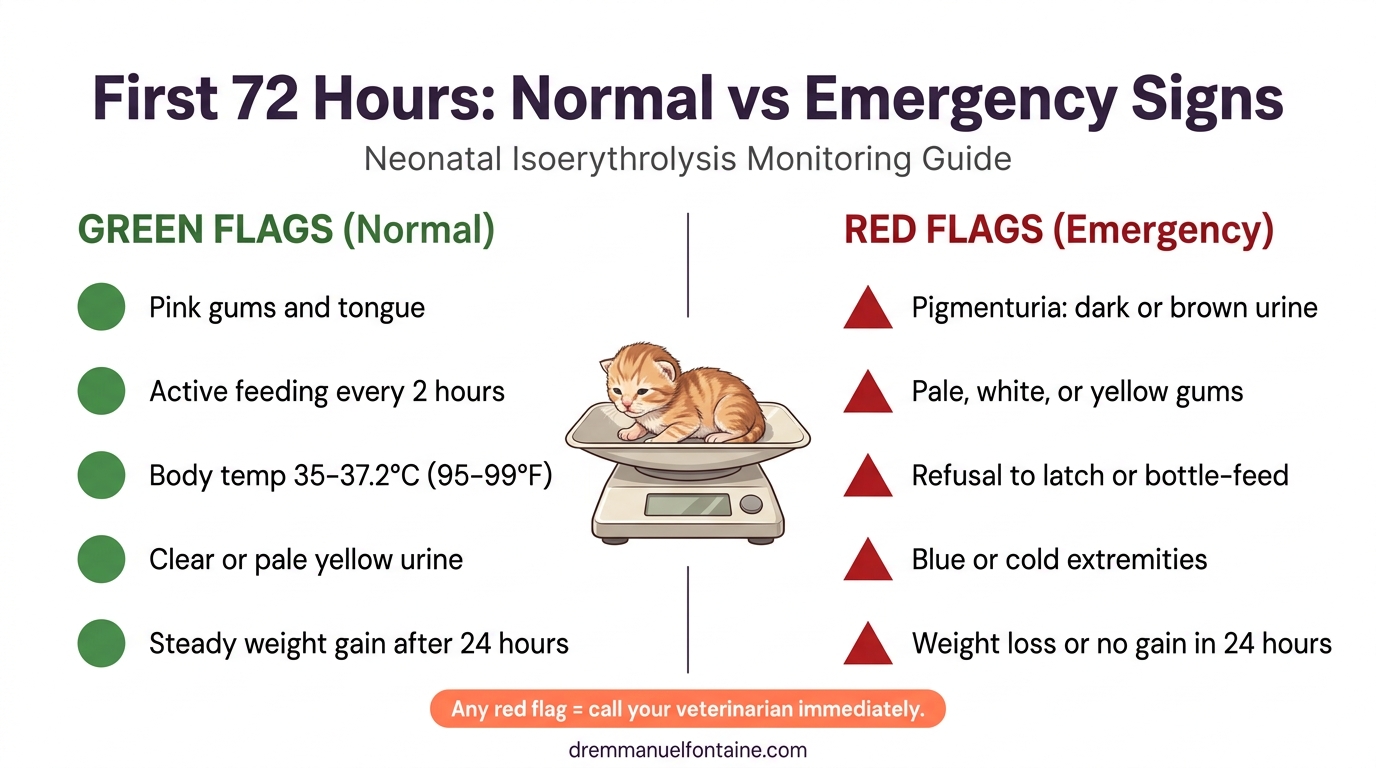
Pigmenturia, urine that is dark red or brown, is the single most diagnostic sign of this condition. This discoloration comes from hemoglobin released when the mother’s antibodies destroy the kitten’s red blood cells. Normal neonatal urine should be clear, colorless, or very pale yellow.
Because neonatal kittens cannot eliminate on their own, you must stimulate them and inspect their urine at every feeding. This puts you in the ideal position to catch pigmenturia early. If you see dark urine in any kitten from a litter born to a Type B queen, contact your veterinarian immediately.
Remember from the What You Need to Know section that the antibody damage happens during the first 24 hours of nursing. Pigmenturia typically appears within 24 to 72 hours of birth, making it an early and reliable signal.
| Urine Color | What It Means |
|---|---|
| Clear or pale yellow | Normal. No intervention needed. |
| Dark yellow or amber | Possible dehydration. Increase feeding frequency and monitor. |
| Dark red or brown | Pigmenturia. Strongly suggests a blood-type reaction. Contact your vet immediately. |
The neonatal triad: hypothermia, hypoglycemia, and dehydration
These three conditions cascade together, and each one makes the others worse. A cold kitten stops digesting milk. Undigested milk means no calories. No calories means blood sugar drops. Low blood sugar means less activity. Less activity means the kitten generates less heat. The spiral accelerates quickly.
Normal neonatal body temperature is 35 to 37.2 °C (95 to 99 °F). A rectal temperature below 34.4 °C (94 °F) causes gut paralysis (ileus) and a dangerously slow heart rate. Never feed a hypothermic kitten. As covered in the What You Need to Have section, warm the kitten gently first, then feed once body temperature has stabilized.
Signs of hypoglycemia include weakness, tremors, and a sudden refusal to nurse. Dehydration in neonates is tricky to assess because skin tenting does not work reliably in kittens under 6 weeks. Instead, watch for dry mucous membranes, dark urine, and absent saliva. If you observe any combination of these signs, your veterinarian needs to see the kitten immediately.
| Condition | What You Will Observe |
|---|---|
| Hypothermia | Cold to the touch. Limp. Slow or absent movement. Below 34.4 °C (94 °F). |
| Hypoglycemia | Weakness. Muscle tremors. Sudden stop in nursing. Lethargy. |
| Dehydration | Dry gums. Dark urine. No visible saliva. Sunken appearance. |
Physical signs that demand immediate veterinary attention
Beyond the neonatal triad, several physical signs in the first 72 hours signal that a kitten is in crisis. Pale, gray, or blue (cyanotic) gums indicate severe anemia or oxygen deprivation. Yellow (jaundiced) gums or skin point to liver stress or the red blood cell destruction caused by the blood-type mismatch.
In milder cases, blood clots from agglutinated red blood cells can lodge in the extremities. Watch for the tip of the tail or toes turning blue and eventually dying off (necrosis). This is a subtle sign that can appear even when the kitten seems otherwise stable.
A kitten that cries for more than 15 minutes, lies away from its littermates, breathes through its mouth, or cannot lift its head needs emergency veterinary care. Neonates deteriorate rapidly, and the window for intervention is measured in hours, not days.
| Warning Sign | What to Do |
|---|---|
| Pale, gray, or blue gums | Contact your vet immediately. Indicates severe anemia or hypoxia. |
| Yellow (jaundiced) skin or gums | Contact your vet immediately. Suggests red blood cell destruction. |
| Blue or necrotic tail tip or toes | Schedule a same-day vet visit. May indicate subclinical damage. |
| Open-mouth breathing or gasping | Emergency. Neonates should only breathe through their noses. |
| Persistent crying (over 15 min) | Investigate: cold, hungry, in pain, or maternal neglect. |
| Seizures or severe tremors | Emergency. Likely severe hypoglycemia or oxygen deprivation. |
Conclusion
Neonatal isoerythrolysis is one of the most lethal threats to newborn kittens in breeds with high Type B prevalence. It is also one of the most preventable. The science is clear, the genetics are predictable, and the management protocol is straightforward.
You now have the knowledge to identify at-risk pairings before they happen, the action steps to protect a litter if an incompatible mating occurs, the tools to monitor every kitten through the critical first 72 hours, and the warning signs that tell you when to call your veterinarian.
Every kitten that survives because a breeder understood this condition is a testament to preparation, knowledge, and partnership with veterinary professionals. Blood typing is a small step that pays for itself in lives saved.