
🇫🇷 Lire en Français | 🇪🇸Leer en Español | 🇧🇷Leia em português
For most of my career as a veterinarian, when a breeder called to say she was confirmed pregnant, my answer fit on a sticky note. Confirm pregnancy on ultrasound around day 28. Talk nutrition. Run a progesterone check if there was any concern about luteal failure. Prepare for whelping. We will see you when she is ready to whelp, unless something comes up.
That was the playbook. It was reasonable. It was also incomplete.
Two studies published in 2025 told me, in clean canine numbers, that the 6 weeks before whelping are doing far more than we thought. The dam’s chronic stress in that window leaves a measurable signal in her puppies: in their birth weights, in how steadily they gain weight, in how they handle a new room at 8 weeks of age. I want to walk you through what those papers actually mean for your kennel, and what I have changed in my own recommendations because of them.
- TL;DR (Quick takeaways)
- 1. The Old Prepartum Playbook, and Why It Stopped Being Enough
- 2. What “Stress” Actually Means in Your Kennel
- 3. The Prepartum Stability Protocol
- 4. Reading Your Dam’s Behaviour, Since Lab Tests Are Not Yet Routine
- 5. After Whelping: Daily Weights Are Your Strongest Puppy Signal
- 6. First-Time Mothers Carry Two Loads at Once
- 7. The Vet Conversations Worth Having
- 8. What Is Coming, and Why You Do Not Have to Wait
- Bringing It Together
TL;DR (Quick takeaways)
The last 6 to 8 weeks before whelping are not waiting time. They are an active programming window for the litter. Here is what to do with that.
- Treat the prepartum period as actively as you treat the whelping box. Stable group, stable schedule, stable handler.
- “Stress” in this window means chronic, not acute. One thunderstorm does not count. Months of unstable group dynamics, repeated transport, or ongoing renovations does.
- If a dam is in late gestation right now: lock the environment. No new dogs in her group, no construction, no rehoming, no transport unless medically required.
- After whelping, weigh every puppy daily, in grams. Plot the curve on a neonatal growth chart, not against last litter’s memory.
- Pay extra attention to first-time mothers. They carry two compounding loads at once: the pregnancy itself and inexperience.
- Bring your dam observation log and your puppy weight chart to your vet. That is what turns “I think she’s stressed” into a clinical conversation.
- Lab tests like hair cortisol are coming, but they are not in your vet’s standard kit yet. The actions above are what you can do today, while the science catches up.
These are not new tools. They are habits you adjust before the litter arrives.
1. The Old Prepartum Playbook, and Why It Stopped Being Enough
How we used to think about it
The prepartum period has been treated as waiting time for almost as long as we have been breeding dogs. Confirm the pregnancy. Adjust the food. Wait. The real work, the thinking went, started at parturition.
I taught it that way. I practiced it that way.
What the 2025 data changed
What changed is data. In 2025, two large canine studies put real numbers on the table for the first time. One followed 90 dams across 12 commercial kennels and tracked their stress hormone load through pregnancy and their puppies’ outcomes through 8 weeks of age. The other followed German Shepherd Dogs across breeding cycles and showed maternal stress hormones passing into offspring in a measurable way.
Here is the headline. The dams in the most-stressed third of that 90-dam study showed the strongest associations with compromised puppy outcomes. That is roughly 1 in 3 dams in a working commercial population. Not an outlier. Not a rare case. A pattern.
That is the signal that flipped the prepartum window, in my mind, from passive monitoring to active management.
Why the placenta is not enough
What we now know is that maternal cortisol, the body’s main stress hormone, does not stay neatly inside the mother. The placenta gives partial protection, but sustained chronic stress appears to overwhelm that buffer. The fetus develops with more cortisol exposure than it should have, and the systems that get tuned during that exposure (especially how the puppy will handle stress later in life) are the systems that show up changed at 8 weeks.
| What I used to recommend | What I now recommend |
|---|---|
| Confirm pregnancy by ultrasound around day 28. | Confirm pregnancy AND audit her environment for the next 6 weeks. |
| Talk nutrition. | Talk nutrition AND lock down social and routine changes. |
| Wait for whelping signs. | Treat the last 6 to 8 weeks as an actively managed window. |
| Monitor puppies postnatally. | Start the puppy story before whelping, with the dam’s stress load. |
That is the shift. Now let’s translate it into kennel practice.
2. What “Stress” Actually Means in Your Kennel
The word stress gets used loosely. In a research paper, it means a sustained elevation of cortisol. In your kennel, it means something more specific that you can actually see.
The three pillars: predictability, social, handler
Stress for a pregnant dam is mostly about three things: predictability, social stability, and handler stability. When those three hold, she is in good shape regardless of how busy your kennel actually is. A bustling, well-run kennel of 30 dogs can be a calmer place for a pregnant dam than a quiet 3-dog home where one of the dogs is constantly being rotated in and out.
Chronic, not acute
The pattern that matters is chronic, not acute. A vet visit, a thunderstorm, a single new sound. None of those are the issue. The issue is months of unsettled group dynamics, ongoing renovations, repeated rehoming of pen-mates, frequent kennel reshuffles, or a recent house move that has not yet settled.
| Kennel setup | Most common chronic stressors |
|---|---|
| Home-based, 1 to 3 dogs | Frequent visitor traffic, schedule swings, relocating the dam between rooms, household conflict. |
| Small kennel, 4 to 10 dogs | Pack reshuffles, intact-male proximity, inconsistent caretaker rotation. |
| Medium to large kennel, more than 10 dogs | New arrivals, group hierarchy disruption, transport for shows or breedings, ongoing renovation. |
| Behavioural sign | Stable | Unstable |
|---|---|---|
| Approach to handler | Confident, routine. | Hesitant, scanning, avoidant. |
| Sleep | Consolidated, deep blocks. | Fragmented, frequent waking. |
| Appetite | Predictable, finishes meals. | Inconsistent, refusing meals she would normally finish. |
| Response to a familiar sound | Brief alert, returns to baseline. | Prolonged alert, sustained vigilance. |
3. The Prepartum Stability Protocol
The week-by-week timeline
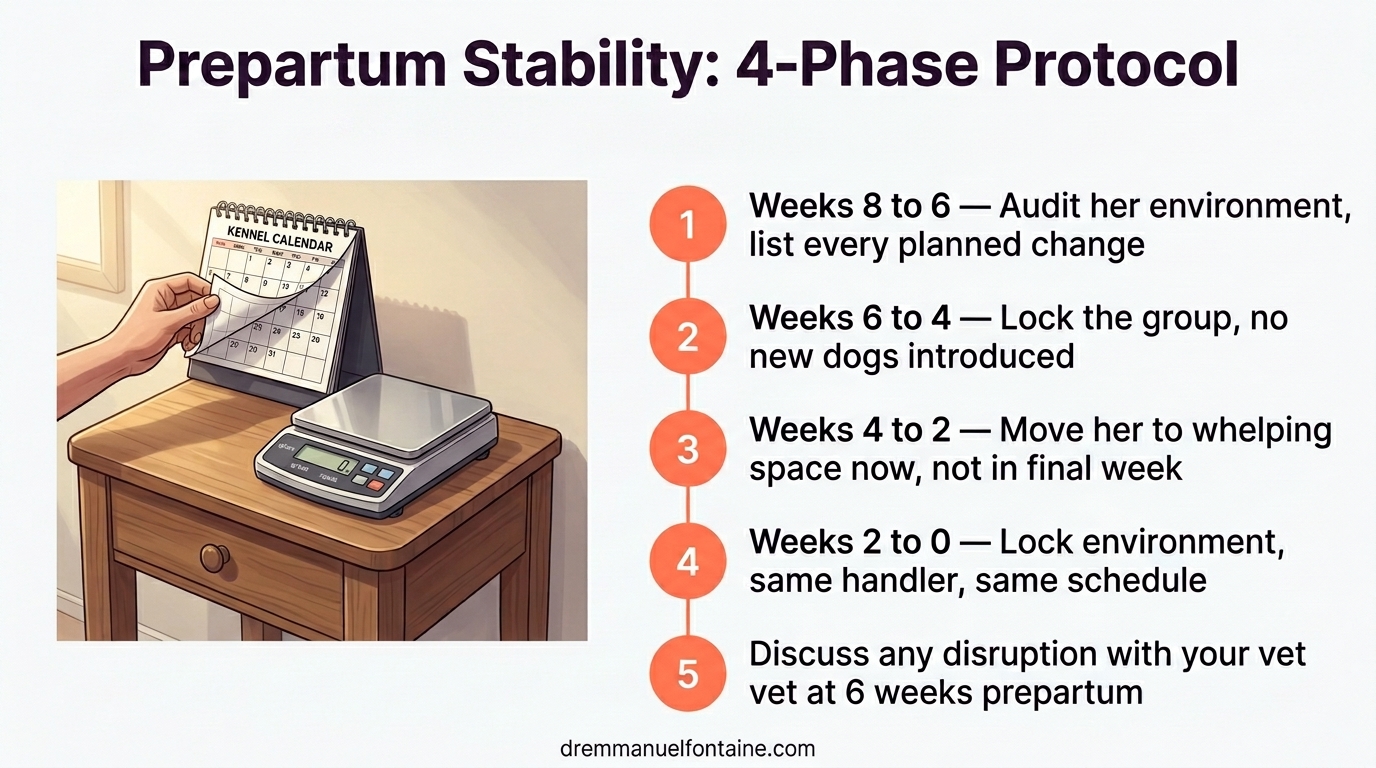
This is the protocol I now ask breeders to run for any planned litter. It is built on the 2025 evidence and on what we already knew about late-gestation welfare. It does not require new equipment. It requires intent.
| Weeks before whelping | What to do |
|---|---|
| 8 to 6 | Audit her current environment. List every planned change in the next 8 weeks (renovations, new dogs arriving, transport). Decide which to defer until after weaning. |
| 6 to 4 | No new dogs introduced to her group. No reorganization of pens. Visitor traffic to her area kept routine. Confirm her caretaker rotation. |
| 4 to 2 | If you plan to move her to her whelping space, do it now, not in the final week. Let her own the room before there is anything happening in it. |
| 2 to 0 | Lock the environment. Same handler. Same schedule. Same room. Same neighbours. No transport unless medically required. |
This is not glamorous. It is mostly what you do not do. That is the point.
Two moves that get missed
Two specific moves that are the most often missed:
Handler stability. If two or three people normally feed and clean, pick the one she is most settled with and have that person handle her late gestation. Cross-cover only when needed. The dam reads the human as much as she reads the room.
Schedule stability. Pregnant dams read time. If she eats at 7 and 5, do not slide that to 8 and 6 because life got busy. Anchor her clock.
| Activity | Rule for the last 4 weeks |
|---|---|
| New dogs in her group | No. |
| Transport | Only for medically necessary appointments. |
| Renovation work | Defer or relocate her, ideally weeks earlier. |
| Show or visitor events | Keep her area off-limits. |
| Pen-mate rehoming | Reschedule to after weaning. |
4. Reading Your Dam’s Behaviour, Since Lab Tests Are Not Yet Routine
Why your eyes still beat the lab
You may have read about hair cortisol testing in pregnant dams. It is real. It is used in research. It is not yet on your veterinarian’s standard panel and there are no validated reference ranges for pregnant bitches across breeds.
That will likely change. Until it does, your best instrument is your eyes. The 2025 study that produced the strongest signals also tested simple behavioural observations, and the dam’s exploration and engagement at 6 weeks before whelping predicted puppy behavioural outcomes at 8 weeks of age, independently of any lab test.
What persistent change looks like
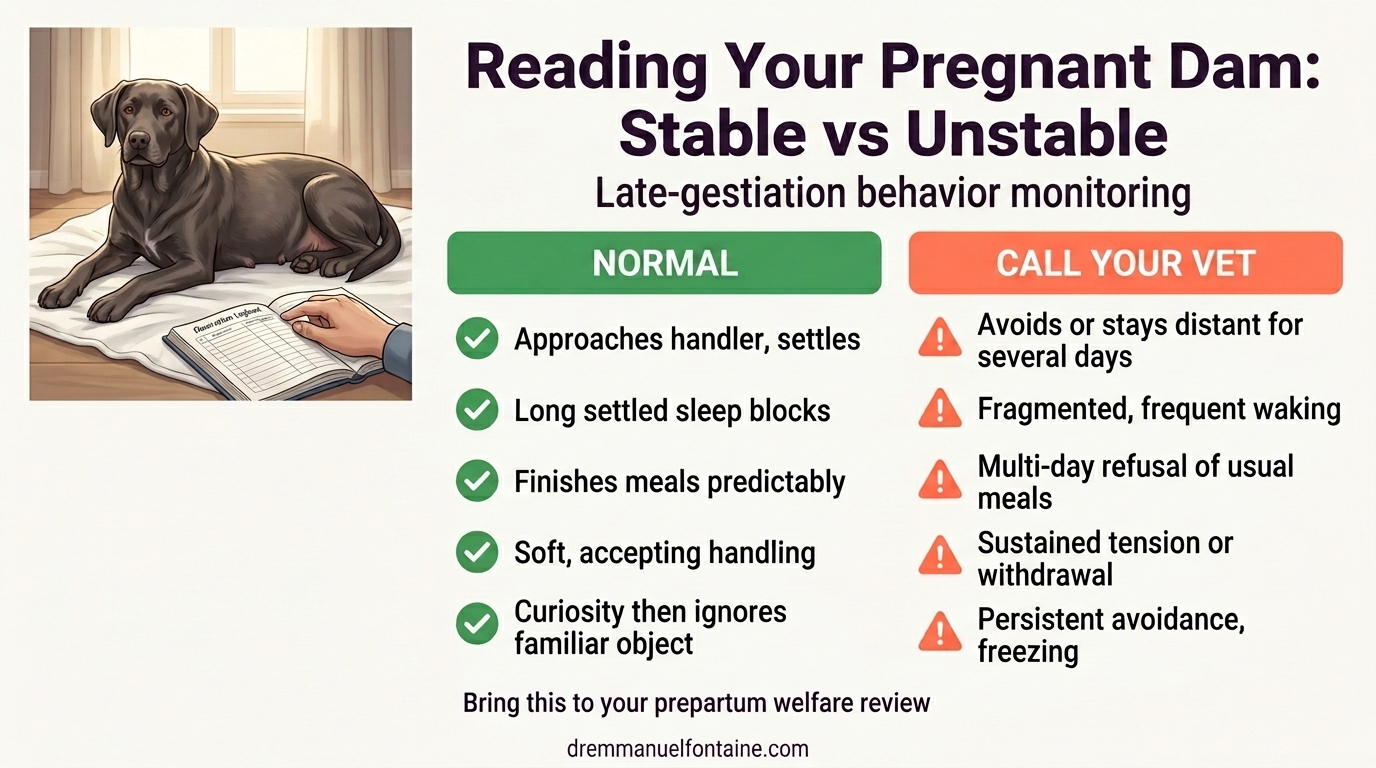
What you are watching for is persistent change from her own baseline. Not absolute scores. Not comparison to other dams. Her own baseline.
| Signal | What is normal for her | What is a flag |
|---|---|---|
| Approach to handler | Greets, settles. | Avoids or stays distant for several days. |
| Response to a familiar object placed in her space | Curiosity, then ignore. | Persistent avoidance or freezing. |
| Sleep pattern | Long settled blocks. | Fragmented, frequent shifts. |
| Appetite | Predictable. | Multi-day refusal of meals she would normally finish. |
| Reaction to handling | Soft, accepting. | Sustained tension or withdrawal. |
| Week (before whelping) | Approach | Sleep | Appetite | Notes |
|---|---|---|---|---|
| 8 | ||||
| 6 | ||||
| 4 | ||||
| 2 |
The weekly observation log
A short paragraph per week is enough. Five minutes on a Sunday. The point is to have a written record so you and your vet can spot drift instead of arguing from memory.
5. After Whelping: Daily Weights Are Your Strongest Puppy Signal
Why daily weighing wins
The 2025 study found that dam stress in late gestation correlated not only with puppy birth weight but with weekly weight gain across the first 8 weeks. That makes daily neonatal weighing the single most useful, lowest-cost monitoring tool you have.
Three rules that matter
A few rules that matter.
Weigh in grams, not ounces. Use a digital scale that reads to the gram. Ounces lose accuracy at the size you care about. A 200 g (7 oz) puppy losing 20 g (0.7 oz) overnight is a meaningful change. The same loss expressed in ounces gets rounded into invisibility.
Forget the old “5 to 10 percent per day” rule. That number was a useful shorthand and we have moved past it. Healthy puppies gain weight every day, but the curve has shape. The right comparison is to a neonatal growth chart for the breed. Veterinary medicine now has these charts available, and your vet can point you to the one that fits your dogs.
Track. Plot. Compare. A single number is not a signal. A line is. Three days of flatlined weight in a puppy that should be climbing is the trigger to call your vet.
| Time point | What to do |
|---|---|
| Within 1 hour of birth | Weigh each puppy in grams. Record on the growth chart with the puppy’s identifier. |
| Every 12 hours, days 1 to 3 | Weigh and record. The first 72 hours are the highest-risk window. |
| Daily, days 3 to 14 | Weigh once at the same time of day. Plot on the growth chart. |
| Every 2 days, days 14 to 28 | Weigh and chart. By now the curve speaks for itself. |
| Tool | Specification |
|---|---|
| Digital gram scale | Reads to 1 g, capacity at least 5 kg (11 lb), flat surface, easy to clean. |
| Neonatal growth chart | Species and ideally breed-appropriate. Ask your vet which chart they recommend. |
| Logbook or app | Anything that lets you plot a curve and share it with your vet. |
| Fine-tip permanent marker | For temporary collar coding when puppies are too small for collars. |
As covered in Section 4, the dam observation log and the puppy weight chart are the two documents you bring to your vet. Together, they convert “I think something is off” into a clinical conversation.
6. First-Time Mothers Carry Two Loads at Once
First-time mothers (primiparous dams) are the most consistently flagged group in the canine literature on prenatal stress. They carry the pregnancy load and the inexperience load at the same time.
What that means in practice:
| Area | First-time dam | Experienced dam |
|---|---|---|
| Environmental stability | Stricter. Every change costs more. | Standard prepartum protocol from Section 3. |
| Handler presence around whelping | Plan to be present and calm. | Standard, with supervision. |
| Postnatal observation frequency | Increase. Watch nursing behaviour, latch, settling. | Standard daily checks. |
| First-litter expectations | Expect more variability in maternal behaviour. | Compare to her own previous litters. |
Be the steady variable
The most useful thing you can do for a first-time mother is be the steady variable in her environment. The biology you do not need to manage is being managed by her body. Your job is to make her body’s job easier by holding everything else constant.
Expect a first-time mother to show more variable maternal behaviour than an experienced dam. Plan for it. Do not over-correct. Quiet observation beats intervention almost every time.
7. The Vet Conversations Worth Having
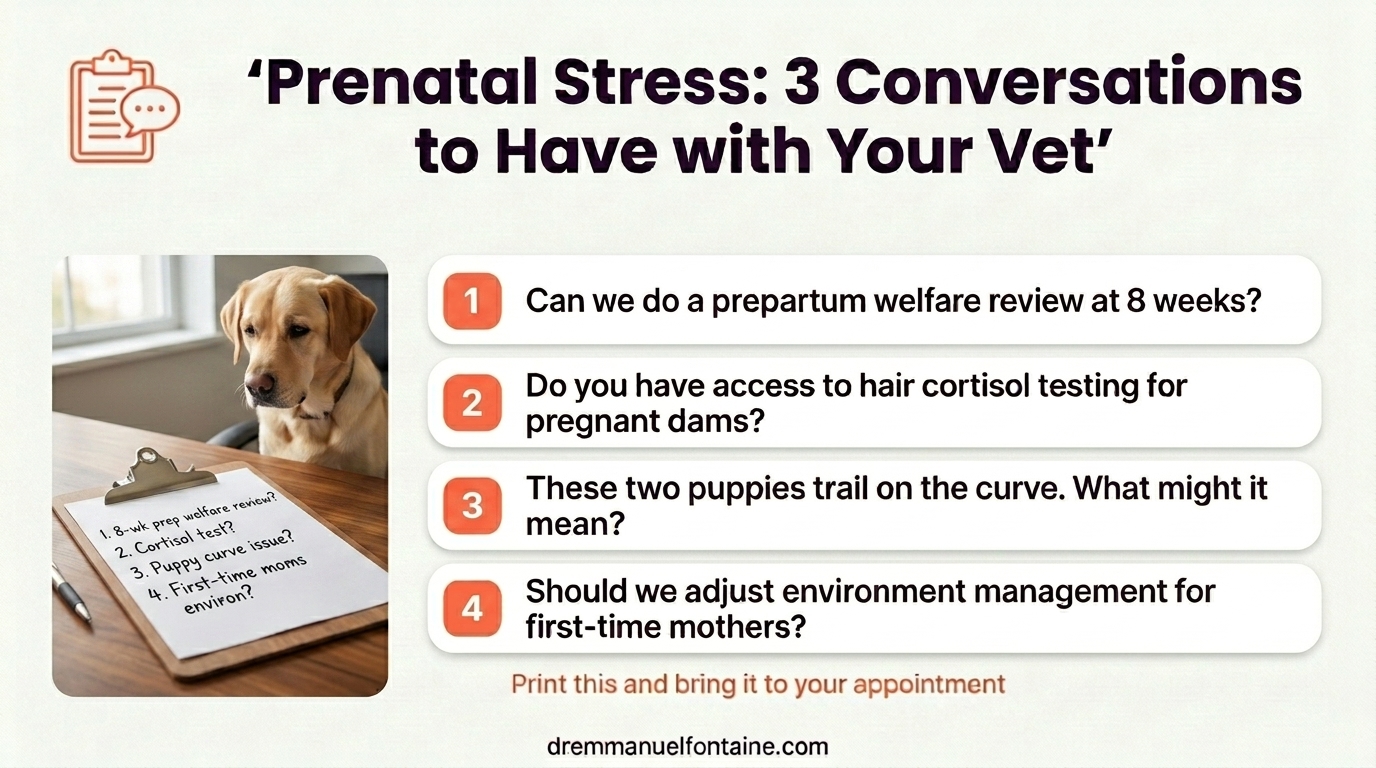
Three conversations are now worth scheduling specifically because of this evidence base. Your vet is the partner who interprets the observations you bring in. Your role is to observe, track, and record. Your vet’s role is to translate that into a clinical decision for your specific dam, your breed, and your program.
The prepartum welfare review
If a dam has experienced significant social disruption, housing changes, or chronic noise in the 6 to 8 weeks before whelping, that is a conversation for your vet, not a question for a Facebook group. Bring your observation log from Section 4.
The cortisol testing question
Ask your vet whether hair cortisol testing is something they have access to or are tracking. The honest answer in most regions today is not routinely. That is fine. The point of asking is to put it on their radar and to signal that you are managing this dam at that level of attention.
The puppy outcomes conversation
If you have one or two puppies in a litter that started behind on the growth chart and stayed behind without an obvious postnatal cause, bring that pattern to your vet. The current evidence does not let us pin any single puppy on prepartum stress. It does tell us the pattern is real at the litter level. That is a conversation worth having before the next breeding plan.
| Conversation | When to book it | What to bring |
|---|---|---|
| Prepartum welfare review | Around 6 weeks before whelping if there has been disruption. | Observation log, environment notes, list of recent changes. |
| Cortisol testing inquiry | Pre-breeding visit or at the first prepartum check. | The question. No documents needed. |
| Puppy growth review | Any litter where one or two puppies trail without a clear postnatal cause. | Daily weight chart, growth-chart comparison, latch and feeding notes. |
8. What Is Coming, and Why You Do Not Have to Wait
Tools on the horizon
Several emerging tools are showing up in the research literature. They are worth knowing about. They are also not yet in your vet’s standard kit, and that is fine.
| Tool | What it measures, in plain language | Why it isn’t routine yet |
|---|---|---|
| Hair cortisol testing in pregnant dams | Average stress hormone load over weeks of growth, from a hair sample. | No validated reference ranges for pregnant bitches across breeds. |
| Puppy stress hormone testing from stool samples | The puppy’s own stress hormone output at 6 to 8 weeks of age. | Used in research; not yet a routine offering at most veterinary labs. |
| Stress-related gene-level markers | Whether stress-response genes have been “tuned” during fetal development. | Research-only; needs specialized genomics infrastructure. |
While we wait, what to do
Treat these as promising tools on the horizon. While we wait for them to enter routine clinical practice, the actions in Sections 3, 4, and 5 are what you can do today, and they are what the evidence supports right now.
That is the right framing for emerging veterinary science in general. Note the trajectory. Use what is established. Do not wait for the perfect test before acting on the better playbook.
Bringing It Together
For most of my career, my prepartum playbook fit on a sticky note. Two papers in 2025 told me it should fit on a clipboard, and that the clipboard should sit by the whelping room weeks before there is anything to whelp.
The dam’s last 6 to 8 weeks before whelping are not waiting time. They are an active programming window. The signal is consistent across the canine studies we now have. The actions that follow from that signal are not exotic and not expensive. Stable environment. Stable handler. Stable schedule. Behavioural log. Daily weighing in grams. A neonatal growth chart. A vet who knows your dam.
If 1 in 3 dams in a 90-dam working kennel was carrying enough chronic load to register in her puppies’ biology, the question is not whether this matters in your kennel. The question is which of the steps above you are not yet doing, and which one you start with this week.
Talk it through with your vet. That is the conversation worth having.
Get the next issue on Saturday morning
Every Saturday, my free newsletter brings you one piece of science on reproduction and newborn care in dogs and cats, written for breeders and their veterinarians. Read it in English, French, Spanish or Portuguese.
Free. Unsubscribe anytime.


