🇫🇷 Lire en Français | 🇪🇸Leer en Español | 🇧🇷Leia em português
A stud comes out of the summer with a flawless pedigree and sperm that barely moves. The bitch ovulated three days ago, nobody tested progesterone, and the only thing anyone is watching is whether the dogs tie.
That is the moment where most natural breeding failures happen. Not in the womb. Not at ovulation. In the seventy-two hours before the mating, in the room where the dogs meet, and in the decisions about when and how often they breed.
The tie matters. It is one important element of a good mating. But semen quality, ovulation timing, environmental temperature, stud dog stress, and mating mechanics carry at least as much weight, and breeders who focus only on whether the dogs tied are missing the other levers that decide whether the cycle produces puppies. A written natural breeding protocol that covers all of these prevents roughly 80 percent of the mishaps I see in practice.
This post is the protocol. I wrote it as a veterinarian, for experienced dog breeders who want the decision framework their vet uses, translated into kennel language.
- The Biology That Breeders Keep Getting Wrong
- The Protocol That Prevents Most Mishaps
- The Tools and the Paperwork
- What to Watch Before, During, and After
- Conclusion
TL;DR
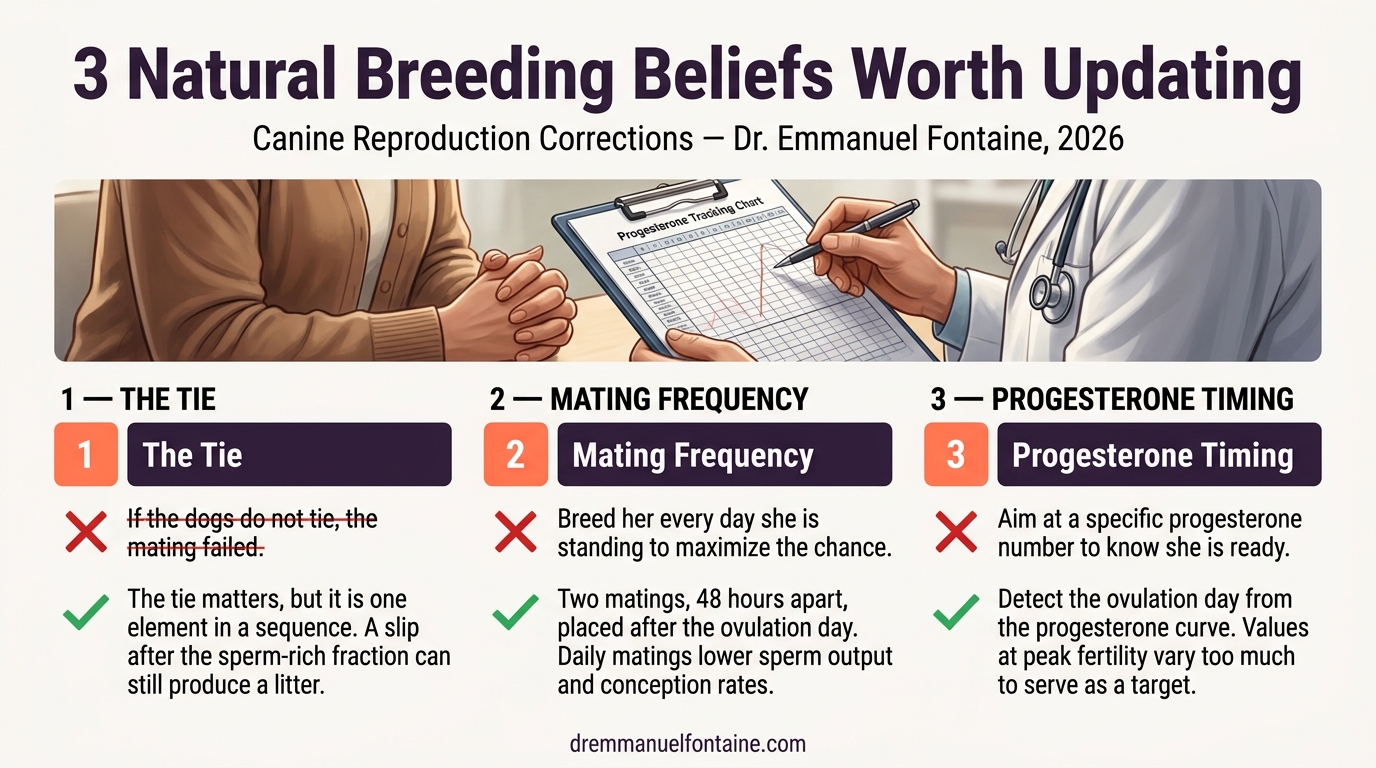
- The copulatory tie matters, but it is one element in a sequence, not the whole mating. A slip mating can still produce puppies if the sperm-rich fraction was released before withdrawal.
- Peak fertility in the bitch sits about two days after ovulation. The goal is to detect the ovulation day with serial progesterone testing, not to aim at a specific progesterone number. Calendar counting misses the window more often than it hits it.
- Daily breeding attempts do not raise conception rates. A 48-hour interval between matings produces more usable sperm than a 24-hour interval.
- Sperm production requires testicular temperature a few degrees below body temperature (the figure most commonly cited is about 2 to 3 °C cooler). A summer heatwave or an afternoon at a dog show can flatten semen quality for weeks.
- The Thermo Hygrometric Index (THI) combines air temperature and humidity into one heat-stress measure. A THI above 72 to 74 is the point where canine heat stress begins. Keep stud dogs below that threshold in the two months before a planned mating.
- The stud’s os penis (a small bone inside his penis) is what lets him penetrate before the erection is complete. It can fracture during a difficult or interrupted mating, and that injury can end a breeding career. Prevention starts with a non-slip floor and a calm handler.
- A written breeding log is the single most useful tool when a mating needs troubleshooting, and it is what lets your veterinarian read a cycle well. Your vet is the decision partner for ovulation timing, semen evaluation, and post-mating complications.
The Biology That Breeders Keep Getting Wrong
The copulatory tie: one element in a sequence
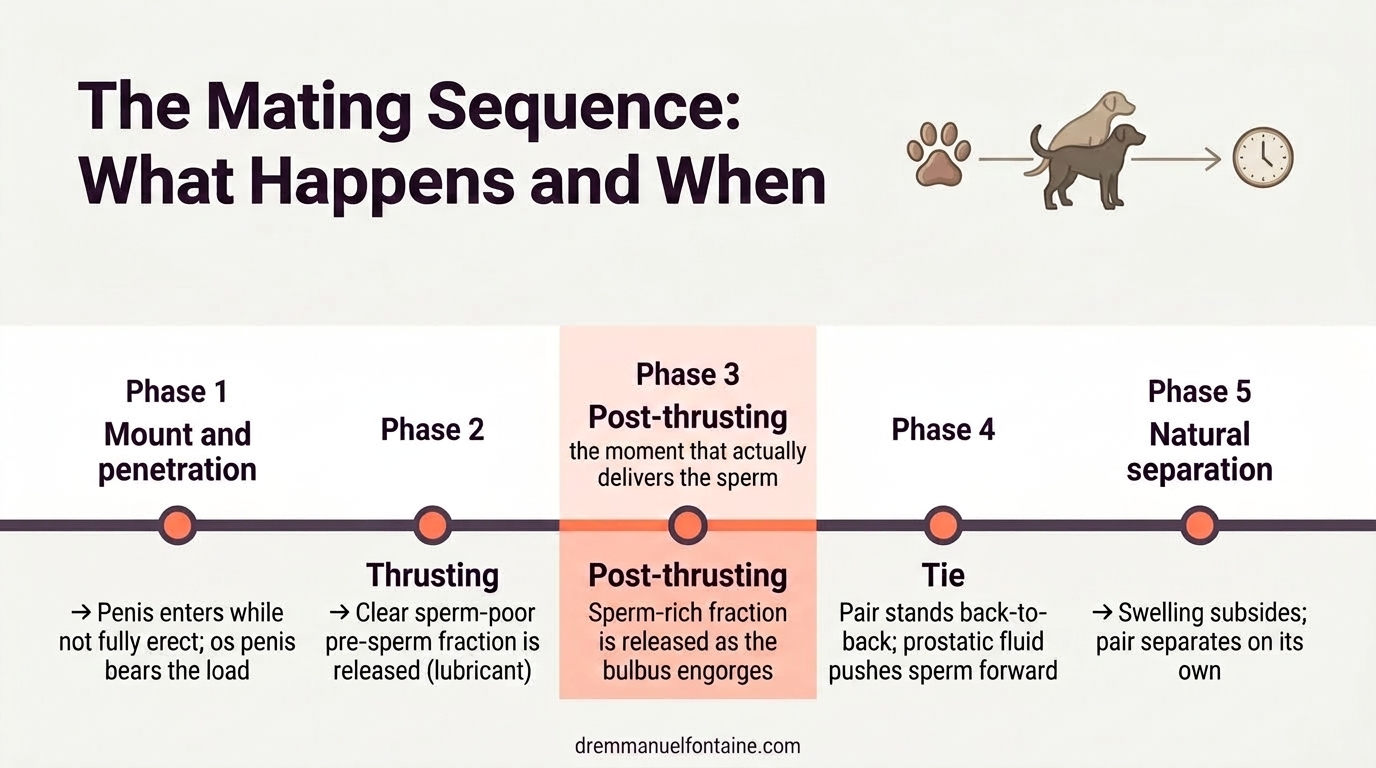
Start with the mechanics, because most breeders do not realize how precisely the sequence unfolds. A dog in full erection cannot penetrate the female. Penetration happens while the penis is still flaccid or only partly turgid, thanks to the os penis (a small bone inside the penis that gives it the rigidity needed to enter). Once the stud is inside, the erection builds, the bulbus glandis (a round swelling at the base of the penis) engorges, and the pair locks together. A stud who is already fully erect before mounting will not penetrate, no matter how many times he tries.
The ejaculate is released in phases. During the thrusting phase, the stud releases a clear, sperm-poor fraction that acts as a lubricant for the genital tract. After thrusting stops and the bulbus engorges, the sperm-rich fraction is released. During the tie that follows, prostatic fluid is released to push that sperm forward into the uterus. The tie can last anywhere from a few minutes to about an hour.
The tie matters. It gives the ejaculate the best chance of reaching the uterus and holds the pair still while that happens. But the tie is one step in a sequence, and a slip mating (where the male withdraws before the tie forms) can still produce a full litter if the sperm-rich fraction was already released. A slip that happens during thrusting, before the sperm-rich fraction, will not produce puppies. The timing of the slip is what decides.
The clinical lesson is direct. Never pull locked dogs apart. Forced separation can tear the genital tract of both partners and can even damage the os penis. Never assume a slip mating automatically means a missed cycle. Call your veterinarian if the stud has repeated outside ties or repeatedly fails to mount. Those patterns point to joint pain, low libido, or a bulbus glandis sized poorly for this bitch, and they are also where os penis injuries tend to happen.
| Outcome metric | Tied mating | Slip mating |
|---|---|---|
| Ejaculate sequence before separation | Thrusting (lubricant) → sperm-rich fraction → tie → prostatic fluid | Thrusting only, OR thrusting + sperm-rich fraction, then early withdrawal |
| Sperm delivered to tract | Full sperm-rich fraction plus prostatic push | Depends on when the withdrawal happened |
| Expected conception rate | Baseline for the pair | Full litter possible if withdrawal was after the sperm-rich fraction; otherwise unlikely |
| What it tells you about the stud | Normal mount sequence, bulbus engorged inside the bitch | Possible joint pain, low libido, or stud already fully erect before penetration |
| Handler action during event | Allow natural separation; stay calm | Note timing of withdrawal; do not force an immediate retry |
The fertile window opens two days after ovulation
Canine ovulation is unusual compared with most mammals. Dogs ovulate when estrogen is already falling and progesterone is rising. That is why calendar counting from the first day of bleeding misses so often. Every bitch writes her own timetable.
Serial progesterone testing is the only reliable way to pinpoint ovulation. Your veterinarian watches the curve over several tests. The first clear rise above baseline marks the LH surge. Ovulation follows roughly two days later. The canine egg is not immediately fertile. It needs another two days to mature, which means peak fertility sits about two days after the ovulation day.
The important point is this. The goal is to detect the ovulation day with your veterinarian, not to hit a specific progesterone number at breeding time. Progesterone values at peak fertility vary too much from bitch to bitch to serve as a target. The decision framework is: identify the ovulation day from the curve, plan the first mating two days later, and repeat the mating 48 hours after that.
A vaginal cytology smear, done by your veterinarian, is a useful adjunct. When 70 percent or more of the cells are superficial (cornified), estrogen has peaked and progesterone testing should begin. Behavior is not reliable on its own. Some bitches stand for the stud days before ovulation. Others never stand until peak fertility has passed. You need the progesterone curve, not the calendar and not the behavior.
| Stage | What your vet is watching the curve for | Action |
|---|---|---|
| Proestrus baseline | Progesterone still at baseline; no rise detected | Continue cytology every 2 to 3 days |
| LH surge | First clear rise in progesterone above baseline | Mark this as the day-zero reference; test more frequently |
| Ovulation day | Curve confirms ovulation has occurred (typically about 2 days after the LH surge) | Plan first mating for 2 days after the ovulation day |
| Peak fertility | About 2 days after the ovulation day | Breed now; repeat the mating in 48 hours |
| Window closing | Vet reads the curve and confirms the fertile window has passed | Second mating should already be placed; further matings will not help |
Summer heat silently degrades sperm
The testis sits outside the body for a reason. Normal sperm production requires testicular temperature a few degrees below body temperature (the figure most commonly cited is about 2 to 3 °C cooler). The dog’s own thermoregulation (the scrotal skin, the pampiniform plexus, the cremaster muscle) handles modest heat. It cannot handle a summer heatwave, an afternoon at an outdoor show, or a long car ride in a stuffy crate.
When testicular temperature rises, the body produces reactive oxygen species (ROS), which damage the fatty membranes of sperm cells. The result is lower motility, more morphological defects, and in severe cases a temporary infertility that lasts weeks.
Because a new sperm cell takes about 60 days to produce and another 14 days to mature, a heat insult today shows up in an ejaculate collected two months from now. That lag is what traps breeders. A July mating, a rough June, and the semen evaluation in September is the first sign something is wrong.
The Thermo Hygrometric Index (THI) is the standard measure of heat stress. It combines air temperature and relative humidity into one number, because humid heat is harder on a dog than dry heat of the same temperature. A THI above 72 to 74 is the threshold where canine heat stress begins. Brachycephalic breeds (Bulldogs, Pugs, French Bulldogs) cross that line earlier than others.
| Exposure | Effect on stud | Recovery window |
|---|---|---|
| THI 72 to 74 for several hours daily | Cortisol rises; early motility drop | Weeks after the heat subsides |
| Prolonged summer heat (days to weeks) | Significant concentration and motility drop | 6 to 10 weeks after cooling |
| Febrile illness (rectal above 39.5 °C / 103 °F) | Transient arrest of spermatogenesis | 60 to 74 days for new sperm cells |
| Obesity (body condition 6 or above) | Chronic low-grade scrotal warming | Improves over months with weight loss |
| Hot air blow-drying on groin or belly | Local scrotal temperature spikes | Removable cause; recovery in weeks |
The Protocol That Prevents Most Mishaps
Prepare the environment before the bitch arrives
The mating room is the most under-respected variable in this whole process. Dogs that will breed on a gravel driveway in June will refuse on a slick tile floor in February. Stress from surroundings can shut down libido in a stud who has been reliable for years.
Three environmental choices carry most of the weight. Surface (non-slip, soft, easy to clean), temperature (cool enough that neither dog is panting), and audience (one calm handler, not a crowd).
A dedicated mating area, used only for breeding, trains both dogs over time. Some studs cue so strongly on the breeding mat, stool, or specific collar that removing any one of them can stall the mating. Plan the space before the bitch arrives. Do not improvise in the moment.
The vet partnership here is the pre-breeding exam. A physical check of the stud’s prepuce, testicles, and joints, along with a baseline semen evaluation, catches the matings that would have failed for reasons that had nothing to do with the room.
| Element | What you want |
|---|---|
| Floor surface | Non-slip, soft, easy to clean; neither dog in a splayed posture |
| Room temperature | Cool enough that neither dog is panting at rest |
| Noise | Calm, low voices, no crowd, no barking neighbors |
| Handlers | One per dog, known to both animals, trained on breeding etiquette |
| Dedicated space | Same room used only for breeding, when possible |
| Pre-breeding exam | Completed by your veterinarian within the previous 30 days |
| Stud cues | Consistent mat, collar, or room the stud associates with breeding |
| Escape routes | A way to safely separate dogs if the mating aborts |
Space the mating attempts 48 hours apart
The myth here is that if the bitch is standing, the stud should breed her as often as possible. The research says the opposite.
Daily collection at 24-hour intervals drops total sperm output, reduces sperm vigor, and raises morphological defects. A 48-hour interval between matings holds all those parameters stable. Collecting or breeding no more often than once every 2 to 3.5 days produces the highest number of usable sperm per attempt.
The practical protocol for natural breeding is two matings, 48 hours apart, placed inside the peak fertile window identified by progesterone. Three matings is rarely better than two. Four is almost always worse.
If your stud has a proven record with fresh cooled or frozen semen, that record does not transfer automatically to live matings. The two methods stress the dog differently. Ask your veterinarian to repeat the breeding soundness exam before the first mating of each season.
| Interval | Sperm quality trend | Conception outlook |
|---|---|---|
| 24 hours (daily) | Total output and motility drop after session 3 | Counter-productive |
| 48 hours | Parameters hold steady across sessions | Highest per-attempt sperm count |
| 72 hours | Parameters fully recovered | Good; slightly wider spacing still effective |
| 96 hours or more | Parameters recovered; fertile window may be exiting | Acceptable if timing still allows |
| Recommended protocol | Two matings, 48 hours apart, in peak fertile window | Standard of care for a live mating cycle |
Protect the os penis during mounting
The stud dog has a small bone inside his penis called the os penis. That bone is what lets him penetrate the female before the erection is complete. As we covered in the biology section, a dog in full erection cannot penetrate. He needs the rigidity of the os penis to enter, and only then does the erection build and the tie form.
This sequence matters because it explains where most mating injuries happen. A slick floor, a sudden movement, a stud repeatedly trying to penetrate a bitch who moves away, or any attempt to force a stud who is already fully erect into a mount. Any one of those can fracture the os penis.
An os penis fracture is hard to repair. The bone is small, the surgery is delicate, and the scar tissue that forms during healing can be painful every time the dog has an erection afterward. A single fracture can end an otherwise promising breeding career.
Prevention is mostly about the room and the handling. Non-slip flooring, a calm handler, and patience while the stud establishes his mount. Do not force a retry if the first mount fails. Do not interrupt a mating in progress. Do not pull locked dogs apart. When a stud shows repeated difficulty mounting, stop the session and call your veterinarian. The os penis is one of those structures where an ounce of prevention is genuinely worth the pound of cure.
| Risk scenario | What can go wrong | How to prevent it |
|---|---|---|
| Slick mating surface | Stud slips during the mount; os penis fractures on impact | Non-slip, soft surface; never polished tile or wet floor |
| Sudden movement during mount | Os penis fracture during intromission | One quiet handler per dog; no audience, no barking neighbors |
| Stud already fully erect before mounting | Penetration fails; repeated failed mounts stress the os penis | Allow the mount sequence to begin without over-stimulation; do not present the bitch with the stud already erect |
| Forced separation during the tie | Vaginal tear in bitch; preputial and penile trauma in stud | Never pull locked dogs apart; let the tie resolve naturally |
| Interrupted or hurried tie | Sperm delivery incomplete; stud may try to re-mount and injure himself | Do not interrupt; if something looks wrong during the tie, call your vet rather than intervene |
| Repeated outside ties or failed mounts | Frustration, injury risk, possible underlying joint pain | Stop the session; your vet can run a musculoskeletal exam before the next attempt |
The Tools and the Paperwork
Climate control for summer matings
Once you accept that testicular temperature controls sperm quality (the point we made in the biology section), the tool list becomes concrete. You need a way to keep the stud below his heat-stress threshold in the two months leading up to a planned mating. Sperm produced during that window is what breeds the bitch.
A room thermometer or weather station in the main kennel, and a second reading on any transport crate, is the minimum. A portable data logger (any modern humidity-and-temperature recorder) is better, especially if the stud travels. Plot the THI over the week. If it rises above 72 to 74 for several hours a day, the heat-stress clock has started.
Practical controls include air conditioning during summer months, shaded runs, a cool water source during exercise, avoiding midday exercise, and no hot air blow-drying on the groin or belly. Obesity quietly raises scrotal temperature too. A stud at a body condition of 4 out of 9 produces better sperm than one at 6 or 7.
Your veterinarian is the partner on nutritional support. Ask about evidence-based options like omega-3 fatty acids and antioxidant support for stud dogs. Do not layer trendy supplements onto an already complete diet without talking to your vet first. An already-balanced working diet is easier to keep balanced than one that is being adjusted by guess.
| THI or condition | Effect on stud | What to do |
|---|---|---|
| THI below 72 | Baseline; normal sperm production | Maintain ventilation; record readings |
| THI 72 to 74 | Onset of heat stress in most breeds | Cool the room; restrict midday exercise |
| THI 74 to 78 | Cortisol rises; early ROS in sperm | Add air conditioning; move exercise to dawn or dusk |
| THI above 78 | Clinically significant sperm damage | Suspend breeding; plan a semen evaluation in 8 weeks |
| Transport crate above 29 °C (84 °F) | Local testicular warming; ROS produced | Cool the crate; avoid mid-day transport |
A way to read stud dog stress
A stud who is not eating, not sleeping, or who shows lip licking, tucked tail, and flattened ears is not going to produce a good mating even if the bitch is at peak fertility. Stress shuts down libido. It also lowers semen quality when it runs for more than a few days.
Most breeders read stress by feel. A written checklist makes it visible. You want to know the dog’s baseline (how he eats, how he sleeps, how he carries his tail in the kennel) before the bitch arrives, then compare to the breeding week.
Bitches in heat change the stud’s environment. Even if he is not being bred, the hormonal signal from a bitch next door can raise his cortisol for days. If you are running multiple bitches on overlapping cycles, physical separation between the bitches’ quarters and the stud’s resting area helps.
The vet partnership here is the semen evaluation you run before the first mating. A drop in total sperm count or motility, compared with his last evaluation six months earlier, is the objective signal that something has changed. Bring the breeding log with you so the results can be read in context.
| Domain | Normal | Red flag |
|---|---|---|
| Appetite | Eats the usual ration within 10 to 15 minutes | Skipping meals or leaving food |
| Sleep | Settles in crate or bed; full rest periods | Restless, pacing, or excessive sleeping |
| Body language | Soft eyes, loose posture, relaxed tail | Lip licking, tucked tail, flattened ears |
| Libido | Interest in the teaser or the breeding cue | No interest or refusal to mount |
| Weight | Stable month over month | Loss of 5 percent or more across a breeding season |
| Recovery | Returns to baseline within 24 hours of a mating | Multi-day appetite or sleep disruption |
The breeding log that protects every decision
Every mating cycle should be recorded the same way. A written log is the single most useful tool when a mating needs troubleshooting, when a future generation’s infertility needs tracing, or when your veterinarian asks “what happened last time?”
At minimum, log the bitch’s first-signs date, every progesterone and cytology result (with methodology and laboratory), every mating attempt (date, time, environment, observed behavior, whether a tie occurred, tie duration), and any post-mating observations. Also record the stud’s baseline (most recent semen evaluation, current body condition, any medications or supplements in the last 60 days).
Keep the log on paper or in a dedicated breeding app. Spreadsheets work if you back them up. Do not rely on memory. Details vanish in 10 days, and the third time you say “I think she stood on Tuesday” is the moment a decision goes wrong.
When you sit down with your veterinarian after a cycle that did not produce a litter, the log is what lets you and them figure out whether it was timing, a stud issue, a bitch issue, or an environment issue. None of that investigation is possible without the record.
| Field | Example entry |
|---|---|
| Bitch name / cycle number | Mira, cycle 3 |
| First day of bleeding | 2026-06-12 |
| Cytology (percent superficial cells, date) | 75% superficial, 2026-06-20 |
| Progesterone values and methodology | 6.4 nmol/L (2 ng/mL), chemiluminescence, reference lab, 2026-06-21 |
| Day zero (initial rise identified) | 2026-06-22 |
| Mating attempt: date, time, tie duration | 2026-06-25 at 10:15, tie 22 minutes |
| Behavior and environment notes | Calm room, stud cue mat in place, no interruptions |
| Stud baseline: last eval, BCS, medications, supplements | Last eval 2026-02 (normal), BCS 4/9, no meds |
| Post-mating observations (days 1 to 7) | No discharge, normal appetite, normal mobility |
| Pregnancy confirmation date | Ultrasound 2026-07-20, confirmed |
What to Watch Before, During, and After
Normal and abnormal copulatory behavior
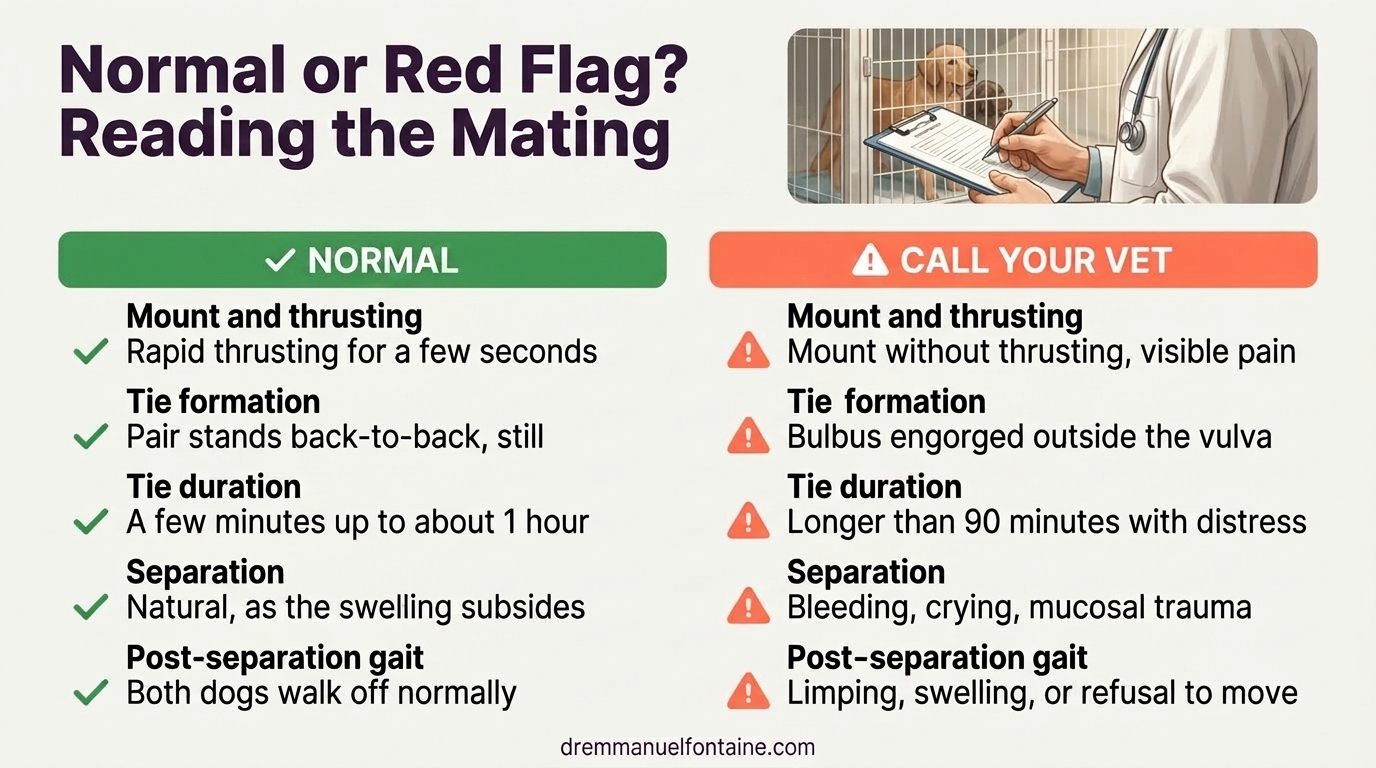
When the pair comes together, a rhythm is visible. Pre-mount sniffing and the bitch flagging her tail. A rapid mount with vigorous thrusting for a few seconds. The stud turning so the pair stands back-to-back. A tie lasting anywhere from a few minutes to about an hour. A natural separation when the swelling subsides.
What you should not see is the stud repeatedly dismounting, obvious pain at mount, the bitch biting or spinning aggressively, a mount without any thrusting, a tie longer than 90 minutes, or visible blood from either animal.
Forced separation is the most dangerous intervention in the room. Trying to pull tied dogs apart can tear the vaginal wall of the bitch or the preputial mucosa of the stud. Let them separate naturally. If one of them is visibly distressed during a long tie, call your veterinarian for guidance rather than acting on your own.
A bitch who refuses the stud is not being difficult. She may be uncomfortable, anxious, or wary of this particular stud. Try again the next day, and if the refusal pattern continues across attempts, check in with your veterinarian. Never force. Force is how you produce defensive aggression and bite wounds on everyone in the room.
| Phase | Normal | Red flag |
|---|---|---|
| Pre-mount | Sniffing, bitch flags tail, stud shows interest | Stud dismounts repeatedly, bitch spins or bites |
| Mount and intromission | Rapid thrusting for a few seconds | Mount without thrusting, visible pain, no intromission |
| Tie | Pair stands back-to-back, still | Bulbus engorged outside the vulva (no tie) |
| Tie duration | A few minutes up to about 1 hour | Longer than 90 minutes with visible distress |
| Separation | Natural, as the swelling subsides | Bleeding from either partner, crying, mucosal trauma |
| Post-separation gait | Both dogs walk off normally | Limping, crying, or visible swelling |
The first week after the mating
The mating is not the end of the protocol. The first week after is when most preventable problems surface. Your job is observation, not intervention.
In the bitch, watch for abnormal vaginal discharge (foul-smelling, purulent, bright red), persistent straining or restlessness, appetite loss lasting more than 24 hours, or lethargy. Any one of those signals a vet call.
In the stud, watch the prepuce for swelling or discharge, and check his mobility and appetite. A stud who stops eating or sleeps more than usual for several days after a mating may have a preputial injury that is not visible from the outside.
Record everything in the breeding log discussed in the paperwork section. Date and time of each observation. Then, at day 25 to 30 after the last mating, your veterinarian can confirm pregnancy by ultrasound. That same visit also rules out early complications that can masquerade as a normal post-breeding period.
| Observation | When and how often |
|---|---|
| Vaginal discharge color and odor in the bitch | Daily for the first 7 days |
| Appetite and water intake (both dogs) | Daily for the first 7 days |
| Prepuce and penis of the stud | Inspect on day 1 and day 3 |
| Mobility and posture (both dogs) | Observe during walks and rest |
| Bitch rectal temperature | Check if appetite drops or lethargy appears |
| Pregnancy ultrasound | Day 25 to 30 after the last mating |
| Radiograph for puppy count | Day 55, only if ultrasound confirmed pregnancy |
| Breeding log update | After every observation |
The red flags that need a vet call
Some signals cannot wait until the next scheduled visit. A purulent or green-black vaginal discharge in the first week. Vulvar swelling that does not subside within 10 days. Fever (rectal temperature above 39.5 °C (103 °F)). Repeated natural breeding failures across two consecutive cycles. Any stud who has a visible injury to the prepuce or penis.
The Brucella canis screen is the check breeders defer most often, and it is the one that catches silent infections capable of destroying a reproductive program. Ask your veterinarian to include it in any pre-breeding evaluation, especially when you introduce a new stud or import semen.
Routine medications can also quietly suppress fertility. Steroids, certain anti-fungals, some behavior medications, and some antacids all have effects on semen quality. Review the stud’s medication list with your veterinarian before each breeding season starts.
A final note on cycles that fail. A single missed cycle does not mean a retirement decision. Two consecutive failed cycles, with good timing and a proven stud, is the moment to sit down with your veterinarian and plan a full infertility workup. Pattern matters. One miss, rarely. Two, always.
| Observation | Response |
|---|---|
| Foul-smelling or green-black vaginal discharge | Same-day veterinary visit |
| Bright red hemorrhage from either partner | Emergency veterinary visit |
| Fever above 39.5 °C (103 °F) in the bitch | Same-day veterinary visit |
| Tie longer than 90 minutes with visible distress | Call your veterinarian for guidance; do not force separation |
| Swollen or discharging prepuce in the stud | Veterinary visit within 24 hours |
| Appetite loss lasting more than 24 hours | Veterinary consult within 24 hours |
| Two consecutive failed cycles with good timing | Full infertility workup with your veterinarian |
| Any visible injury after a mating | Immediate veterinary visit |
Conclusion
Natural breeding done right is not about force, or luck, or how many times you put the pair together. It is about reading four levers and writing down what happens.
Progesterone tells you when. Temperature and stress tell you whether the stud’s sperm is healthy enough for the mating to matter. Spacing (two attempts, 48 hours apart) tells you how. The breeding log tells you what to do differently next time.
The tie is a beautiful thing to watch. It is not the thing you should be measuring. The numbers worth measuring are progesterone values, testicular temperature history, body condition, and the stud’s own baselines.
Your veterinarian runs the tests, does the exams, and interprets the results. You run the protocol, keep the log, and watch for the signals the tests cannot see. The partnership is the work. The protocol is how you show up for it.
Get the next issue on Saturday morning
Every Saturday, my free newsletter brings you one piece of science on reproduction and newborn care in dogs and cats, written for breeders and their veterinarians. Read it in English, French, Spanish or Portuguese.
Free. Unsubscribe anytime.


