🇫🇷 Lire en Français | 🇪🇸Leer en Español | 🇧🇷Leia em português
You weigh your pregnant dog every week. On week three, she gained almost nothing. By week seven, she’s gained 5 kg (11 lbs). Then panic sets in: is that normal? Too much? Will she have trouble giving birth.
Gestational weight in dogs follows a predictable pattern, and understanding it means the difference between a healthy pregnancy and one headed toward dystocia. This guide walks you through the science of canine pregnancy weight, the week-by-week protocol for tracking it, and the red flags that signal your veterinarian needs to step in.
- TL;DR
- The Science of Canine Gestational Weight Change
- Your Week-by-Week Weight Monitoring Protocol
- Tools for Precise Gestational Weight Management
- Warning Signs in Gestational Weight Patterns
- Conclusion
TL;DR
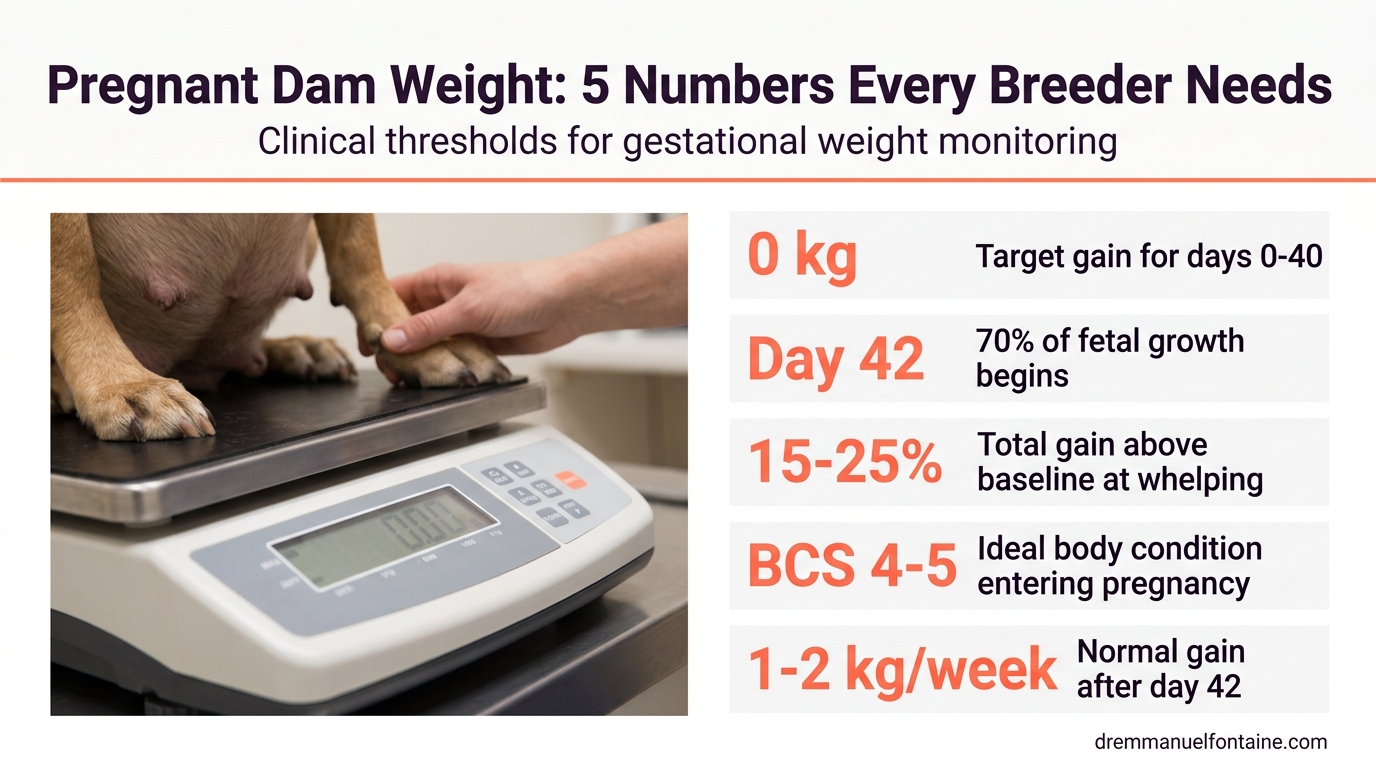
- First 40 days of pregnancy should show almost zero weight gain; this protects the myometrium from fat infiltration.
- After day 42, pregnant dog weight monitoring shows rapid fetal growth: 70 percent of puppy birth weight develops in the final three weeks.
- At whelping, expect a total weight increase of 15 to 25 percent above baseline, but all of this gain is normal if it occurred after day 42.
- Overfeeding during early pregnancy causes fat to infiltrate the myometrium, weakening uterine contractions and triggering dystocia.
- Use body condition scoring alongside weight tracking: a dog at BCS 6 or higher entering pregnancy runs higher risk of delivery complications.
- Weekly weigh-ins must use the same scale at the same time to account for hydration and meal timing.
- Work with your veterinarian to set target weight ranges based on your individual dam’s baseline and breed standard.
The Science of Canine Gestational Weight Change
Why the First 40 Days Should Show Zero Weight Gain
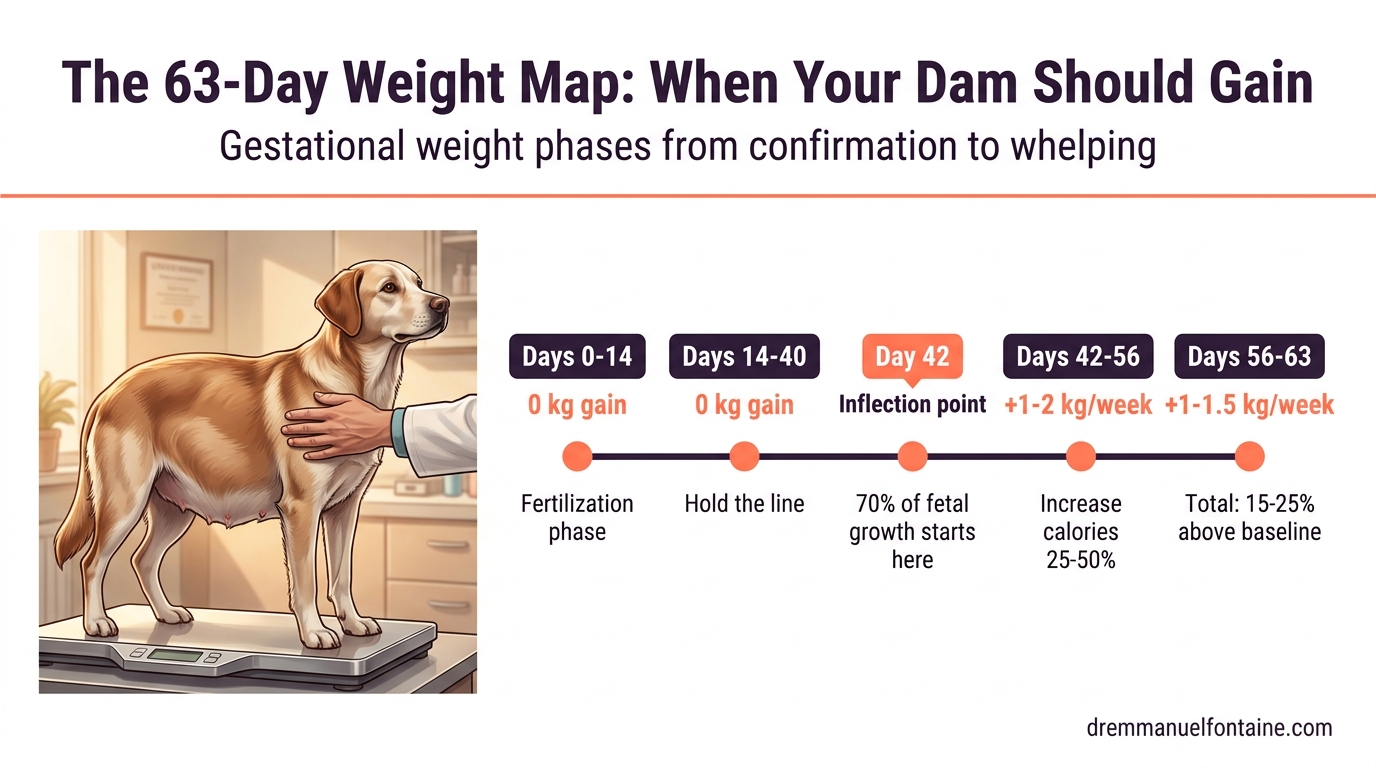
The first 40 days of pregnancy are not about feeding the puppies. Fertilized eggs take several days to reach the uterus. Implantation happens around day 14. Until day 40, the puppies are tiny, and the mother is doing no metabolic work to sustain them.
Weight gain early in pregnancy is your dog gaining fat. That fat deposits where it can: around the organs, in the body cavity, and critically, in the myometrium (the muscle that contracts during labor). A myometrium infiltrated with fat cannot contract effectively. This is the direct cause of dystocia.
Monitoring your pregnant dog weight during the first 40 days means keeping it flat. Your veterinarian should confirm pregnancy between days 21 and 30. This is the moment to establish baseline weight and start tracking.
| Gestational Days | Expected Weight Change | What’s Happening | Feeding Approach |
|---|---|---|---|
| 0–14 | 0 kg (0 lbs) | Fertilization and early embryo development | Maintenance calories only |
| 14–28 | 0 kg (0 lbs) | Implantation and early placental development | Maintenance calories only |
| 28–40 | 0 kg (0 lbs) | Embryos still <5% of final puppy size | Maintenance calories only |
| 35–42 | 0–0.5 kg (0–1 lb) | Transition phase; growth begins | Slight increase acceptable |
| 42+ | 1–2 kg per week (2–4 lbs/week) | Rapid fetal growth acceleration | Increase by 25–50% |
The Day 42 Inflection Point: When 70% of Puppy Growth Begins
Day 42 marks the moment fetal development shifts from slow to explosive. In a 63-day gestation, the puppies gain the majority of their birth weight in the final three weeks. Specifically, 70 percent of a puppy’s birth weight develops between day 42 and day 63.
This is why your pregnant dog weight monitoring shows almost nothing until week six, then jumps 1 to 2 kg (2 to 4 lbs) per week. This is not excess. This is normal. The entire weight gain you see from week six onward is justified by fetal development.
Your role is to ensure she has enough calories to support this growth without overfeeding. Too many calories pushed too early (days 0–40) creates fat in the wrong places. Calories withheld too late (days 42–63) starve the puppies. The protocol is to keep weight flat early, then increase feeding after day 40.
| Stage | Gestational Days | Fetal Weight % of Birth | Weekly Gain Target |
|---|---|---|---|
| Implantation | 14–28 | 1–5% | 0 kg |
| Early Growth | 28–42 | 5–25% | 0–0.1 kg/week |
| Mid Growth | 42–49 | 25–50% | 1–1.5 kg/week |
| Late Growth | 49–56 | 50–80% | 1.5–2 kg/week |
| Final Sprint | 56–63 | 80–100% | 1–1.5 kg/week |
How Overfeeding Infiltrates the Myometrium and Causes Dystocia
The myometrium is muscle. Muscle contracts. When fat deposits between muscle fibers, the fibers cannot shorten and pull with full force. During labor, weak myometrial contractions cannot expel puppies effectively. The uterus tires. Puppies become stuck. Dystocia occurs.
This mechanism is why veterinary literature consistently links pre-pregnancy body condition and early-pregnancy weight gain to delivery complications. A dog that enters pregnancy overweight and gains weight during days 0–40 is almost certain to have a difficult birth.
The solution is prevention. By keeping your pregnant dog weight stable for the first 40 days, you protect the myometrium from fat infiltration. Your veterinarian can assess body condition at each checkup and guide feeding adjustments to hit the target range.
| Condition at Whelping | Myometrial Fat Infiltration | Contraction Force | Dystocia Risk |
|---|---|---|---|
| Optimal (BCS 4–5) | Minimal | Strong | Low |
| Overweight (BCS 6) | Moderate | Weakened | Moderate |
| Obese (BCS 7+) | Severe | Greatly Weakened | High |
Your Week-by-Week Weight Monitoring Protocol
Establishing Baseline Weight at Confirmation of Pregnancy
Your veterinarian confirms pregnancy between days 21 and 30 using ultrasound. This is the moment to record baseline weight. This single number is the anchor for all future tracking.
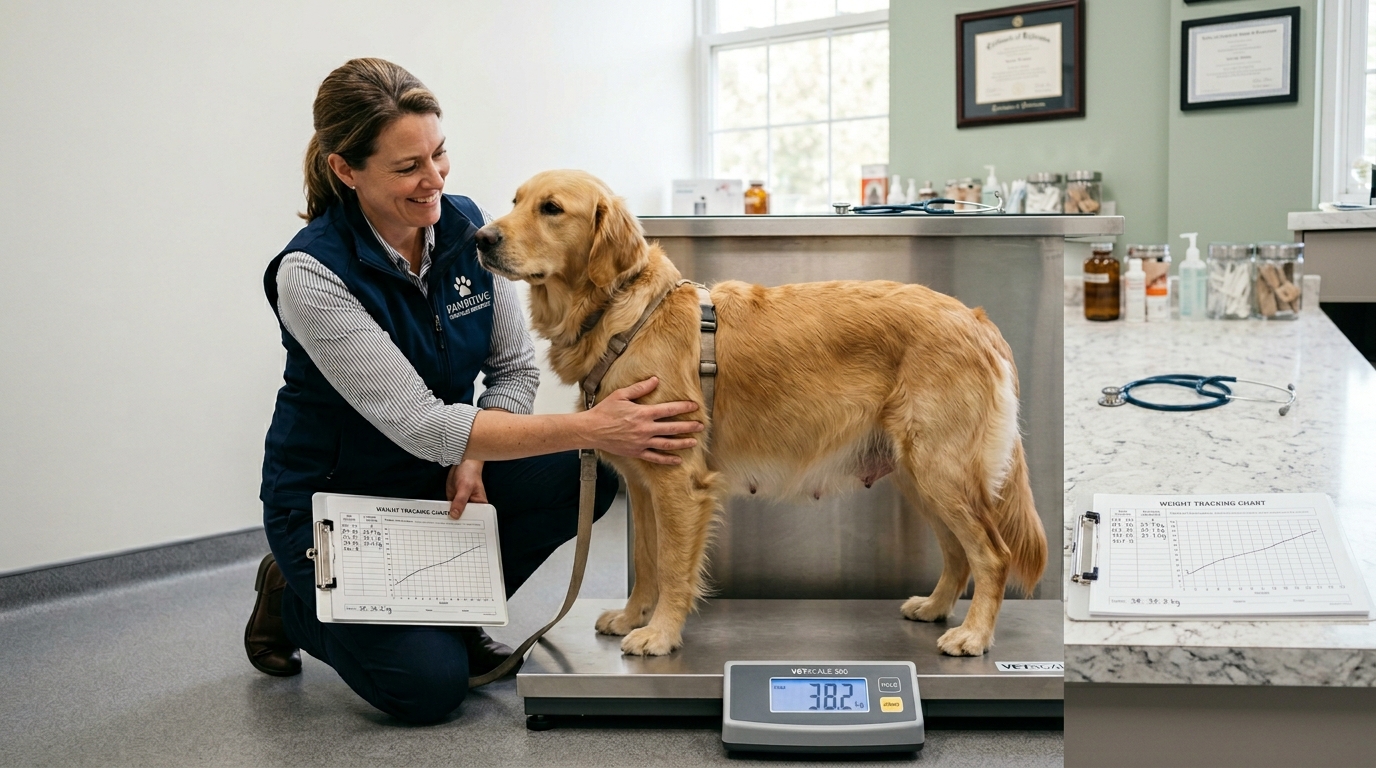
Baseline weight should be taken in the morning after your dog has urinated but before eating. Use the same scale throughout pregnancy; electronic scales vary by 0.5 kg (1 lb) or more. Document the date, time, scale location, and baseline weight in writing or in a spreadsheet you will update weekly.
Calculate your target whelping weight (see section 2.3). Share both baseline and target with your veterinarian. This sets expectations and creates a shared framework for intervention if weight deviates from the protocol.
| Step | Timing | What to Do | Why It Matters |
|---|---|---|---|
| 1. Confirm pregnancy | Days 21–35 | Ultrasound or palpation by veterinarian | Establishes gestation timeline |
| 2. Weigh the dam | Immediately after confirmation | Use the same scale every time | Eliminates scale variation |
| 3. Record baseline | Same day | Morning, after urination, before food | Ensures consistency |
| 4. Calculate target range | Same day | 15–25% of baseline = target at whelping | Sets monitoring range |
| 5. Brief your veterinarian | At confirmation visit | Share baseline and target | Aligns expectations |
Weekly Weigh-in Technique for Accurate Tracking
Weekly weigh-ins only work if they are standardized. Water intake, meal timing, and time of day all affect what the scale reads. Pick one day each week, one time of day, and one scale. Stick to it.
The best practice is to weigh your pregnant dog on the same day and time every week. Morning is preferred because hydration status is most stable after an overnight fast. Weigh her after she urinates but before breakfast.
Record the weight, date, and day of gestation. If weight jumps or drops unexpectedly, reweigh the next day on the same schedule to confirm before alerting your veterinarian. A single outlier reading can trigger unnecessary concern.
| Variable | Standard Protocol | Why Important | Common Mistake |
|---|---|---|---|
| Day of week | Same day every week (e.g., Monday) | Enables comparison across full pregnancy | Varying day by 1–2 days creates false variance |
| Time of day | Morning, 7–8 AM | Hydration stable; post-void; pre-meal | Weighing after meals adds 0.5–1 kg (1–2 lbs) |
| Scale location | Same scale every time | Eliminates equipment variance | Clinic scale vs. home scale can differ by 1+ kg |
| Before meals | Yes, always before breakfast | Food in GI tract adds 0.5–2 kg (1–4 lbs) | Weighing after eating gives false high |
| After urination | Yes, always after voiding | Eliminates bladder weight (0.2–0.5 kg) | Full bladder skews results upward |
The 15–25% Rule: Calculating Your Bitch’s Target Whelping Weight
Not all dogs should gain the same amount. A 30 kg (66 lb) dog and a 20 kg (44 lb) dog have different baseline energy needs and carry different litter sizes. The 15–25% rule gives you a personalized target.
Take your dam’s baseline weight at pregnancy confirmation and multiply by 1.15 (15% gain) and 1.25 (25% gain). This range is her target weight at the moment of whelping. Everything she gains between day 42 and day 63 should push her toward this range.
Example: A 25 kg (55 lb) baseline dog should weigh between 28.75 kg (63 lbs) and 31.25 kg (69 lbs) at whelping. If she weighs 27 kg (59 lbs) at day 56, she is behind target and needs more calories. If she weighs 33 kg (73 lbs) at day 50, she is ahead of target and may need a feeding cut.
| Baseline Weight | 15% Target (Lower) | 25% Target (Upper) | Expected Total Gain | Litter Size Estimate |
|---|---|---|---|---|
| 20 kg (44 lbs) | 23 kg (50 lbs) | 25 kg (55 lbs) | 3–5 kg (7–11 lbs) | 4–6 puppies |
| 25 kg (55 lbs) | 28.75 kg (63 lbs) | 31.25 kg (69 lbs) | 3.75–6.25 kg (8–14 lbs) | 5–7 puppies |
| 30 kg (66 lbs) | 34.5 kg (76 lbs) | 37.5 kg (83 lbs) | 4.5–7.5 kg (10–17 lbs) | 6–8 puppies |
| 35 kg (77 lbs) | 40.25 kg (89 lbs) | 43.75 kg (96 lbs) | 5.25–8.75 kg (11–19 lbs) | 6–9 puppies |
| 40 kg (88 lbs) | 46 kg (101 lbs) | 50 kg (110 lbs) | 6–10 kg (13–22 lbs) | 7–10 puppies |
Tools for Precise Gestational Weight Management
Body Condition Scoring During Pregnancy
Weight alone does not tell the full story. A dog can be at her target weight and still be overweight for pregnancy if she started pregnancy overweight. Body condition scoring (BCS) fills in the gaps.
BCS is scored on a 1–9 scale (1 = severely underweight, 9 = severely obese). For a breeding dam entering pregnancy, ideal BCS is 4 to 5. This means ribs are easily felt but not visible, and there is a visible waist from above.
Your veterinarian should assess BCS at every pregnancy checkup. If your dam’s BCS is 6 or higher at pregnancy confirmation, that is a red flag. She is carrying excess fat that will infiltrate the myometrium. Feeding during pregnancy must be conservative: you are not trying to gain weight; you are trying to support fetal development while keeping her from gaining.
| Body Condition Score | Appearance | Pregnancy Risk | Management Goal | Feeding Tactic |
|---|---|---|---|---|
| 4 | Ribs easily felt, slight waist | Low | Maintain through day 40; increase calories after | Maintenance + 25–50% after day 42 |
| 5 | Ribs palpable, defined waist | Low | Maintain through day 40; increase calories after | Maintenance + 25–50% after day 42 |
| 6 | Ribs palpable but not easily felt, waist not visible | Moderate | Do not allow further gain; increase calories minimally | Maintenance + 10–20% after day 42 |
| 7+ | Ribs not palpable, no waist, sagging abdomen | High | Restrict calories; consider dietary adjustment | Maintenance only; discuss with veterinarian |
Feeding Adjustments by Gestational Stage
Feeding a pregnant dog is a two-phase protocol. Phase one (days 0–40) is about holding the line. Phase two (days 42–63) is about strategic calorie increases to fuel fetal growth without excess.
In phase one, your dam eats her normal maintenance diet or a diet meant for this specific stage of gestation. Do not add extra calories. Do not feed premium puppy food yet. The goal is almost zero weight gain, which requires feeding only what she needs to maintain her body condition.
In phase two, starting after day 40, increase her calorie intake. Gradually increase by 25 to 50 percent of her baseline calories spread across more frequent meals. Split her daily ration into three meals instead of one or two. This supports fetal growth, aids digestion during the cramped third trimester, and keeps her comfortable.
| Gestational Days | Feeding Phase | Calorie Level | Meal Frequency | Food Type |
|---|---|---|---|---|
| 0–40 | Maintenance | 100% of baseline | 1–2 meals/day | Standard adult maintenance |
| 40–42 | Transition | 110% of baseline | 2 meals/day | Standard adult maintenance |
| 42–56 | Growth | 120% of baseline | 3 meals/day | High-quality adult or puppy formula |
| 56–63 | Late Growth | 130% of baseline | 3 meals/day | High-quality adult or puppy formula, balanced minerals |
Building a Weight Tracking Chart with Your Veterinarian
A weight tracking chart is a simple spreadsheet or paper log that records your dam’s weight each week and marks whether it falls within the expected range. Sharing this with your veterinarian gives both of you a visual picture of the pregnancy arc.
Columns should include: date, gestational day, weight in kg or lb, expected range (from your baseline calculation), variance from target, and notes (appetite, activity, any concerns). Your veterinarian can add notes about body condition, exam findings, and recommendations.
Review the chart together at each visit. If weight is tracking below target (e.g., at day 50 she has only gained 2 kg when she should have gained 3 to 4), increase feeding. If she is tracking above target (e.g., at day 45 she has already gained 3 kg), hold feeding steady until she catches down to expected range.
| Date | Gestational Day | Weight (kg) | Expected Range (kg) | Variance | Notes |
|---|---|---|---|---|---|
| Jan 15 | 35 | 25.0 | 25.0–25.0 | Within | Pregnancy confirmed; baseline set |
| Jan 22 | 42 | 25.1 | 25.0–25.2 | Within | No gain yet; normal for early phase |
| Jan 29 | 49 | 26.2 | 26.0–27.0 | Within | 1.1 kg gain; increase feeding begun |
| Feb 05 | 56 | 27.8 | 27.5–28.5 | Below | 1.6 kg gain this week; increase to 160% calories |
| Feb 12 | 63 | 29.5 | 28.75–31.25 | Within | 1.7 kg gain; whelping imminent; ready for delivery |
Warning Signs in Gestational Weight Patterns
Excessive Early Weight Gain: The Dystocia Risk Signal
If your dam gains more than 0.5 kg (1 lb) per week during days 0–40, something is wrong. This is not fetal growth (puppies are too small). This is fat deposition.
Excessive early gain happens when feeding is too generous. You may have switched to a richer food, increased portions because the dam seems hungry, or simply did not realize that feeding should stay flat. The consequence is myometrial fat infiltration.
The moment you notice early-phase weight gain, alert your veterinarian. Do not wait for the next scheduled checkup. Early intervention (reducing calories immediately) can prevent dystocia. Late intervention (realizing at whelping that the myometrium is weak) leaves you with an emergency and possibly dead puppies.
Work with your veterinarian to adjust feeding. Return to maintenance calories. Recheck weight in one week. If the gain has stopped, you are back on track. If gain continues, your veterinarian may recommend a dietary change or bloodwork to rule out metabolic issues.
| Week of Pregnancy | Normal Weight Gain | Red Flag: Excessive Gain | Likely Cause | Action |
|---|---|---|---|---|
| Week 2–4 | 0 kg | 0.3+ kg (0.66+ lbs) | Overfeeding or rich diet | Reduce calories to maintenance immediately |
| Week 4–6 | 0–0.5 kg | 1+ kg (2+ lbs) | Significant overfeeding | Reduce calories; consult veterinarian |
| Week 6–8 | 1–2 kg/week | 3+ kg per week (6+ lbs) | Possible metabolic issue or advanced litter size | Immediate veterinary evaluation needed |
| Week 8–9 | 1–1.5 kg/week | 2.5+ kg per week (5+ lbs) | Possible metabolic issue or fluid retention | Immediate veterinary evaluation needed |
Insufficient Weight Gain in Late Pregnancy
After day 42, your pregnant dog weight should increase consistently: about 1 to 2 kg (2 to 4 lbs) per week. If she is not gaining at this rate during days 42–63, the puppies are not growing normally.
Insufficient late-pregnancy weight gain can signal small litter size, fetal resorption, metabolic stress, or inadequate nutrition. It is not an emergency, but it is a sign that your veterinarian needs to investigate.
Measure weight at days 42 and 49. If the dam has gained less than 0.5 kg (1 lb) across that entire week, increase feeding by 25 percent. Recheck weight at day 56. If she is still not gaining, your veterinarian should perform an ultrasound to assess fetal viability and litter size.
| Gestational Week | Normal Gain for Week | Red Flag: Insufficient Gain | Most Likely Cause | Next Step |
|---|---|---|---|---|
| 6–7 (days 42–49) | 1–1.5 kg | <0.3 kg | Underfeeding or small litter | Increase calories to 150%; recheck in 1 week |
| 7–8 (days 49–56) | 1.5–2 kg | <0.5 kg | Metabolic stress or resorption | Ultrasound to assess viability |
| 8–9 (days 56–63) | 1–1.5 kg | <0.3 kg | Possible late-term resorption or impending whelping | Veterinary exam; prepare for early labor if near term |
When Weight Patterns Suggest Complications
Weight tracking is a simple tool with surprising power to predict complications. A dam whose weight pattern deviates from normal is showing you that her pregnancy is not tracking as expected. Trust that signal.
The most dangerous pattern is early-pregnancy weight gain combined with late-pregnancy leveling off. This suggests a dam that is overweight and at risk of dystocia, and puppies that may not be growing well because the myometrium is fat-compromised.
A second red flag is rapid weight loss in the final week. A 1–2 kg (2–4 lb) drop in the week before whelping is normal (related to hormonal shifts). A drop of 3+ kg (6+ lbs) is not. This suggests a metabolic crisis, possible infection, or ketosis. Your veterinarian needs to evaluate immediately.
Don’t hesitate to share your weight tracking chart with your veterinarian at least once a week during the final two weeks of pregnancy. Ask her to interpret the pattern and flag any concerns. This is not excessive monitoring. This is preventive care.
| Weight Pattern | Interpretation | Dystocia Risk | Fetal Risk | Veterinary Action |
|---|---|---|---|---|
| Flat days 0–40, then steady gain days 42–63 | Ideal progression | Low | Low | Monitor; routine care |
| Rapid gain days 0–40, then moderate gain days 42–63 | Myometrial fat infiltration likely | High | Moderate | Pre-whelping ultrasound; discuss assisted delivery risk |
| Flat throughout; minimal gain even after day 42 | Underfeeding or small litter or resorption | Moderate | High | Increase calories; ultrasound to assess viability |
| Rapid gain days 0–40, then plateau or loss days 42–63 | Myometrial compromise + fetal stress | Very High | Very High | Immediate ultrasound; may need early induction |
| Steady gain days 0–56, then loss >2 kg in final week | Possible metabolic crisis, infection, or ketosis | Very High | Very High | Emergency veterinary evaluation required |
Conclusion
Monitoring your pregnant dog weight is not guesswork. It is a protocol: zero gain for 40 days, then consistent gain until whelping. It is an anchor: baseline weight, target range, expected gain per week. It is a conversation: between you, your scale, and your veterinarian.
A dam that enters pregnancy at optimal body condition and maintains that condition through day 40 protects her myometrium. A dam that gains weight steadily but within range from day 42 onward supports healthy fetal development. A dam that reaches whelping within her 15–25 percent gain range is set up for a normal, productive labor.
When weight tracking shows deviation, act. When gain is too fast too early, cut feeding. When gain is too slow too late, increase feeding. When the pattern breaks the expected curve, call your veterinarian before the emergency happens. The goal of pregnant dog weight monitoring is not just data. It is a healthy mother, viable puppies, and a birth without crisis.
Want to put all of this into action during your next pregnancy? Inside the Breeder Vault, you’ll find the Pregnant Bitch Weight Management Field Protocol: a printable week-by-week monitoring checklist with decision trees, weight thresholds, and veterinary request scripts designed for real-time use. It’s the operational companion to everything you just learned.


