🇫🇷 Lire en Français | 🇪🇸Leer en Español | 🇧🇷Leia em português
A puppy or kitten is born almost agammaglobulinemic: her bloodstream carries a tiny fraction of the antibodies she will need to survive the first weeks of life. The rest has to arrive in the first hours, through the dam’s first milk, inside a window that closes faster than it looks.
That first milk is colostrum, and what we now know about it has shifted in important ways. New work on the gut microbiome, on what really happens in the first 12 to 16 hours after birth, and on what helps the dam build better colostrum in the last third of pregnancy has changed how I talk to breeders about this.
This update keeps what is still true, drops what has not held up, and gives you the practical levers you can actually pull in your kennel. Your veterinarian is the partner who plans this with you in late gestation, well before any of it has to be improvised at the whelping box.
- TL;DR
- The (Almost) Agammaglobulinemic Neonate
- The Window Is Short, and It Closes Faster Than It Looks
- Colostrum Is Much More Than Antibodies
- Colostrum or Pre-Milk? When Lactation Starts Too Early
- What You Can Actually Do at the Whelping Box
- What Shapes Colostrum Quality Before the Litter Arrives
- The Warning Signs You Cannot Afford to Miss
- When a Neonate Cannot Suckle: A Realistic Action Ladder
- Building a Frozen Colostrum Bank
- When Canine or Feline Colostrum Is Not Available
- Plan With Your Vet Before Whelping, Not During
- Conclusion
TL;DR
Seven practical takeaways for your kennel:
- Puppies and kittens are born almost without antibodies. The placenta passes only a small fraction of the dam’s IgG. Colostrum has to do the rest.
- The absorption window is short. Peak uptake happens in the first 4 hours. By 16 hours, the gut is already mostly closed. By 24 hours, the door is shut for good.
- Colostrum from a dam in your own kennel is the best match for your environment, because she carries the antibodies against the pathogens her newborns will actually meet.
- Colostrum is more than antibodies. It seeds the gut microbiome, drives intestinal maturation, and feeds the neonate fast energy.
- Boost colostrum quality before breeding, not during it. Vaccinations should be up to date before breeding. Use a complete gestation/lactation diet, and consider Saccharomyces boulardii CNCM I-1079 from day 28 of gestation when available.
- Watch for the warning signs: a neonate who does not latch in the first 2 hours, who is pushed off the teat, or who fails to gain weight in the first 24 hours. These are the signals that need action.
- Plan with your veterinarian before whelping, not at 3 a.m. with a fading neonate. The conversation about backup colostrum, donors, and supplementation belongs in late gestation.
The (Almost) Agammaglobulinemic Neonate
Dogs and cats both have an endotheliochorial placenta, a thicker barrier between the dam’s bloodstream and her developing young than the human placenta. In humans, antibodies cross freely in the third trimester. In dogs and cats, only a small fraction makes it through.
That fraction is about 10 percent of what the puppy or kitten will carry once colostrum is on board. Ninety percent has to come postnatally, through the dam’s first milk, inside the absorption window.
So the neonate is not strictly agammaglobulinemic at birth, but she is almost there. The math at the whelping box is the same: without colostrum in the first hours, she runs out of immune cover fast.
This is not a flaw in the system. It is a strategy: instead of trickling antibodies across pregnancy, the dam concentrates them into a single, powerful first milk. Colostrum becomes the handoff. Miss it, and you cannot reopen it. The antibodies your vet helped the dam build before breeding are sitting in that first milk; if it does not transfer, those titers go nowhere useful.
Table 1. Where puppy and kitten antibodies actually come from
| Source of antibodies | Approximate share | What it means for you |
|---|---|---|
| Through the placenta during gestation | ~10% | Real but small. Not enough on its own. |
| Through colostrum after birth | ~90% | The decisive source. Has to land in the first hours. |
| From the neonate’s own immune system | Builds slowly from 4 to 6 weeks | Too late to bridge the first weeks. Colostrum has to cover the gap. |
The Window Is Short, and It Closes Faster Than It Looks
The reason colostrum has to arrive now is that the neonate’s gut is built to absorb whole antibody molecules for a very limited time. The cells lining her intestine can swallow large proteins intact and pass them into her bloodstream.
After a few hours, those same cells start to mature and lose this ability. Once they mature, they treat antibodies like any other protein: they digest them. The antibodies are still there in the milk; the door for absorbing them has just closed.
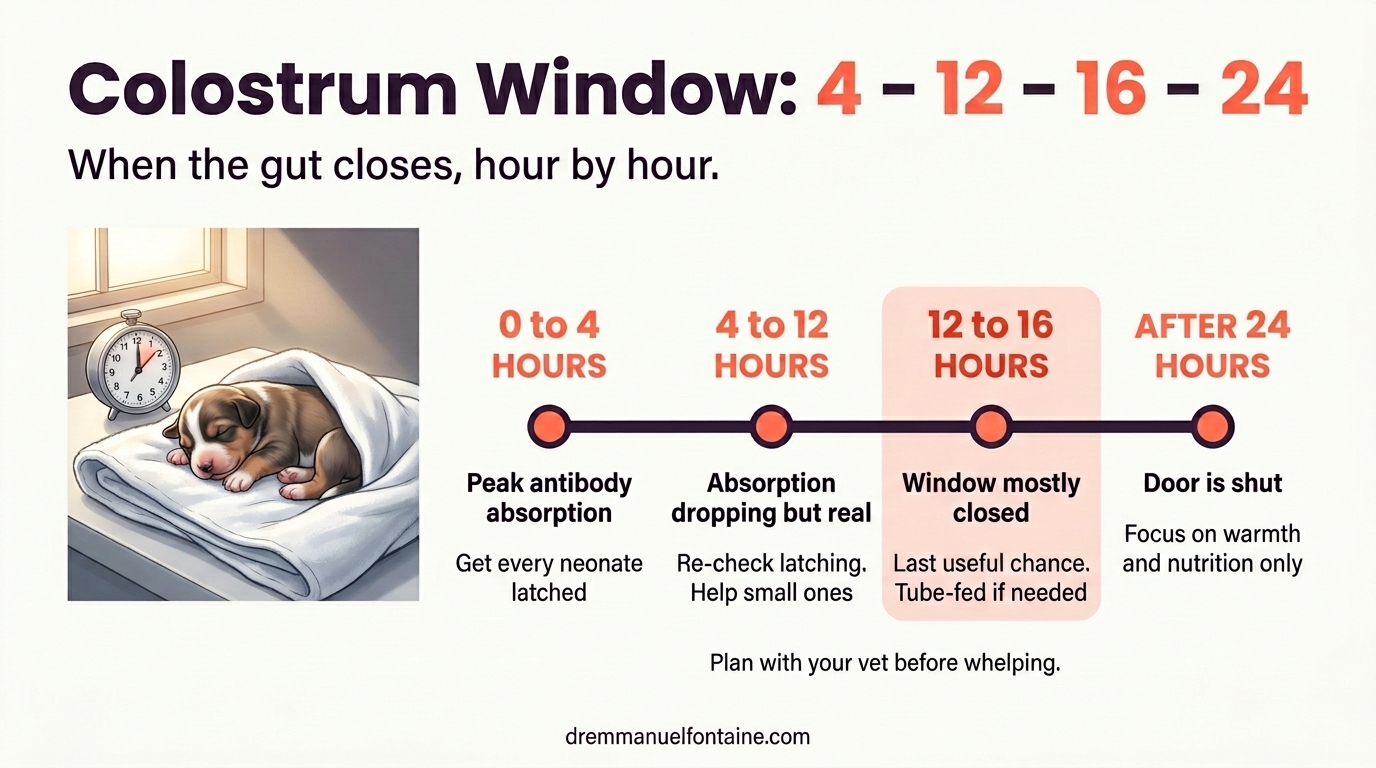
Peak absorption happens in the first 4 hours after birth. By 12 to 16 hours, the gut is already mostly closed to antibody uptake. By 24 hours, the door is shut for good.
A puppy or kitten who feeds well at hour 18 will be nourished, but most of the antibodies in that meal will not cross into her blood. This is a hard biological clock. It is the reason your vet emphasizes weighing and watching in those first 24 hours: the window for catching a feeding problem is the same window for absorbing the colostrum that prevents it.
Your job at the whelping box is to make sure every neonate is latched and feeding within the first 2 hours. Everything else flows from that.
Table 2. Hour-by-hour absorption window: what is happening, what to do
| Time after birth | What the gut is doing | What you do |
|---|---|---|
| 0 to 4 hours | Peak antibody absorption | Get every neonate latched. Watch each one feed. |
| 4 to 12 hours | Absorption is dropping but still real | Re-check latching. Help small or pushed-off ones. |
| 12 to 16 hours | Window mostly closed | Last useful chance. Tube-fed colostrum if a neonate has not fed. |
| After 24 hours | Door is shut | No more antibody uptake. Focus shifts to nutrition and warmth. |
Colostrum Is Much More Than Antibodies
It is tempting to think of colostrum as antibodies in liquid form. That is a small piece of the picture. Modern work on canine and feline colostrum has shown that the first milk is doing several jobs at once, and only a few of them get talked about in older breeder content.
Antibodies, yes, but tuned to your kennel
The antibodies in colostrum are a snapshot of the dam’s immune history: the diseases she was vaccinated against (which is why your vet will want her vaccinations sorted before breeding, more on that below), the pathogens she has met in the daily life of your kennel, the bugs that live on your floors and in your air.
This is why colostrum from a dam who lives in your kennel is the best possible match for the newborns who will live in that same kennel. She carries antibodies against the exact organisms her litter is about to encounter. No outside source can match that.
A starter kit for the gut microbiome
This is the part that has changed in recent years. Colostrum is also a bacterial booster. The dam’s first milk delivers live bacteria that help build the newborn’s gut microbiome from day one. That microbiome is now understood to drive immune maturation, gut wall integrity, and resistance to common neonatal infections.
In practical terms: a neonate who receives a good first feeding is not just getting protection against the world outside. She is also getting the right gut residents to keep her healthy from the inside. This is one of the reasons artificial replacers, however good, are not the same thing as the real first milk.
Energy and growth signals
Colostrum is dense in fast energy and in growth factors that drive the maturation of the intestinal lining itself. In the first 24 hours, colostrum is helping build the very gut that will absorb everything coming after it. Newborns who miss it carry that handicap into the first weeks of life.
Table 3. What colostrum delivers compared with mature milk
| Component | Why it matters | Best in colostrum, fades fast in milk |
|---|---|---|
| Antibodies (mostly IgG) | Protection against pathogens in the kennel and the dam’s vaccines | Yes. 10 to 15 times higher in colostrum. |
| Live bacteria (microbiome seed) | Builds the newborn’s gut flora | Yes. The first feedings carry the strongest seed. |
| Growth factors (IGF-1, EGF) | Drive the maturation of the gut lining | Yes. Drop quickly into mature milk. |
| Concentrated energy and protein | Keep blood glucose and warmth stable | Yes. Mature milk is more dilute. |
Table 4. Why a dam in your own kennel is the best colostrum source
| Source of colostrum | Antibody match to your kennel | Practical position |
|---|---|---|
| Same dam, your kennel | Best match. Antibodies tuned to local pathogens. | First choice. Always preferred when available. |
| Another dam, your kennel | Strong match. Same environment. | Excellent backup. Bank her excess colostrum if you can. |
| Outside dam, similar environment | Variable match. Different pathogens possible. | Acceptable bridge if no in-kennel option exists. |
| Frozen colostrum from a previous litter in your kennel | Good match if the kennel has not changed | A reserve worth building. |
Colostrum or Pre-Milk? When Lactation Starts Too Early
Colostrum is, technically, the first milk that comes out of the mammary glands once lactation has begun. The catch is that some dams start producing milk a few days, or even up to two weeks, before they whelp. So a real question shows up at the whelping box: is what she is producing on day 60 still colostrum on the day the puppies arrive?
Honest answer: we do not yet know whether early lactation impacts colostrum quality at whelping. The science is not settled. What we do know is that colostrum tends to accumulate in the mammary glands as long as nothing is taken out. So if a dam starts dripping milk a week before her due date, the safest position is to leave it where it is.
In practice that means: do not try to extract milk if she starts lactating early. Do not let curious children, well-meaning helpers, or the dam herself groom the colostrum out of the glands. Keep her calm, keep the area clean, and let the colostrum sit. The first feeding the newborns get should be the first time those glands are emptied.
If lactation starts more than 2 weeks before the expected due date, that is worth flagging in your pre-whelping conversation with your vet. It does not mean disaster, but it is one more reason to have a backup colostrum plan ready.
Table 5. Lactation onset: what to do, what to avoid
| Situation | What it means | What you do |
|---|---|---|
| Lactation starts in the last 24 to 48 hours pre-whelp | Normal range | No action. Keep environment quiet and clean. |
| Lactation starts 1 to 2 weeks pre-whelp | Possible early onset | Do not extract milk. Keep glands undisturbed. Let it accumulate. |
| Lactation starts more than 2 weeks pre-whelp | Worth a planned vet conversation | Discuss in late gestation. Have a backup colostrum source identified. |
| Active loss of milk pre-whelp (dripping, leaking) | Some colostrum has been lost | Do not panic. Plan for closer monitoring at first feeding. |
What You Can Actually Do at the Whelping Box
There is no whelping-box test that tells you in 30 seconds whether the dam’s colostrum is good enough. The kind of refractometer reading that gets quoted in some sources has not held up in dogs, and your vet cannot run a same-day antibody test in clinic either. So we work with what we can actually see and measure: behavior, latching, and weight.
The first 2 hours: get every neonate latched
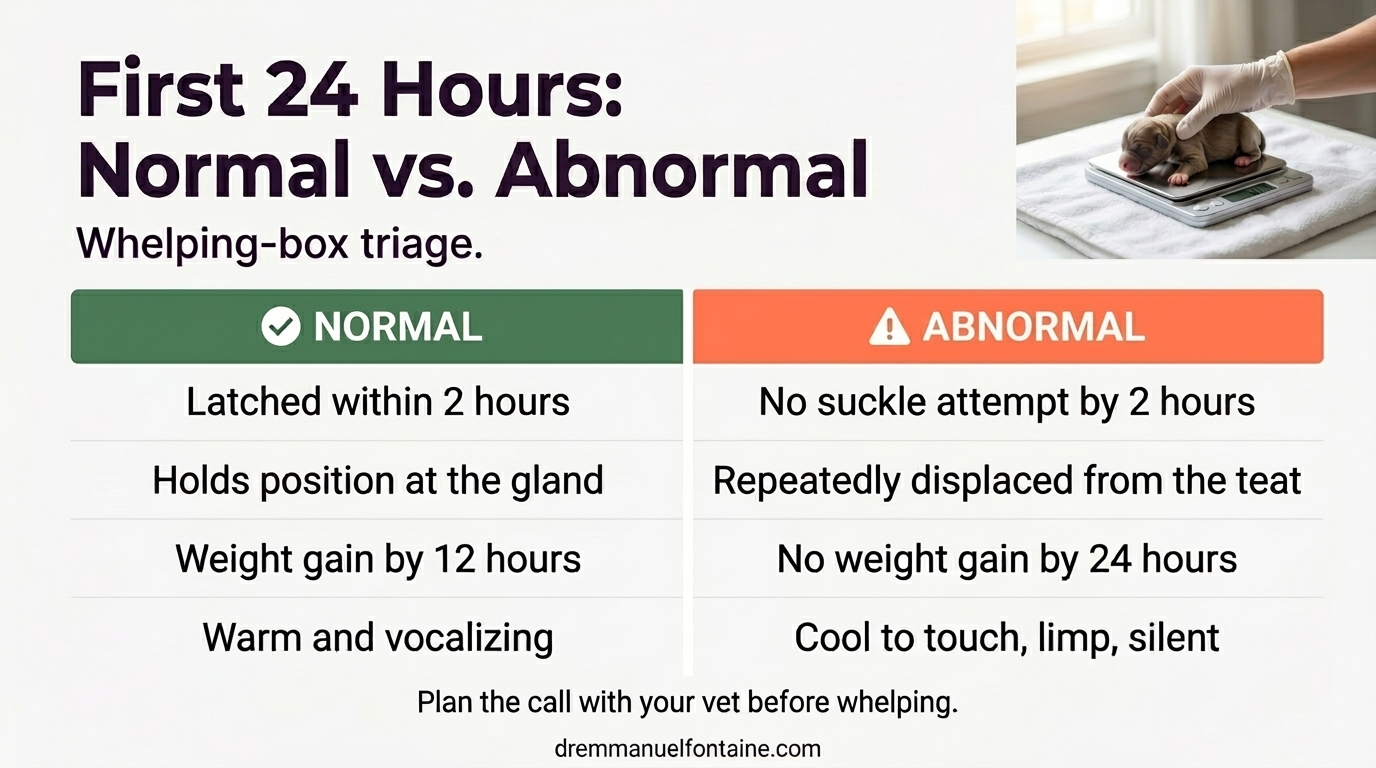
Watch the first feeding in person. Every newborn should be at a teat and actively suckling within the first 2 hours of birth. A puppy or kitten who falls asleep at the gland without swallowing, who is repeatedly displaced by larger littermates, or who simply does not seek the mammary glands is not feeding effectively, even if it looks like she is.
If you can, place the smallest neonate first, and on a back gland (the back glands tend to produce more milk in dogs and cats). Do not assume the litter sorts itself out. The first 4 hours decide more than any other intervention you can make later.
The 12 and 24 hour weight check
This is the most important measurement you have. Weigh every neonate at birth, then again at 12 and 24 hours. A newborn who has not gained any weight in the first 24 hours is the clearest signal you have that something is going wrong with feeding or absorption.
Use a kitchen-style digital scale that reads to 1 gram. Record every value in grams (not ounces) so the trend is readable. Patterns over the next 3 days will tell you whether you are catching up or falling behind.
Use breed-appropriate neonatal growth charts, not a one-size-fits-all percentage. Your vet can supply a chart matched to your breed. Daily gain is what matters; the exact target depends on size and species.
Table 6. The first 24 hours: what to watch and when to act
| Window | What to check | Trigger to act |
|---|---|---|
| At birth | Birth weight, vigor, latching attempt | No suckle attempt by 2 hours = act. |
| At 4 hours | All neonates feeding | Any neonate not feeding = assist latch or tube-feed. |
| At 12 hours | Weight check | No weight gain or weight loss = act. |
| At 24 hours | Weight check, behavior, warmth | Still no weight gain or fading vigor = act and call your vet. |
What Shapes Colostrum Quality Before the Litter Arrives
By the time the first puppy or kitten is on the floor, the quality of the colostrum is already set. This is where the most powerful levers in the whole pipeline sit, and they all sit weeks before the whelping. Pull them, and you give the entire litter a better start. Wait until labor begins, and you are working with what you have.
As we covered earlier, the antibodies in the dam’s colostrum are a snapshot of her immune history. Late gestation is when that snapshot becomes the colostrum the litter will actually drink. Below are the four levers that move it.
Get vaccinations sorted before breeding
My position on this is firm: vaccinations should be up to date before breeding, not during gestation. If a dam needs a booster, that should be done at least 30 days before she is bred so her antibody titers have time to peak. Then those titers transfer cleanly into colostrum.
I prefer not to vaccinate during gestation. Vaccination stimulates the immune system, and that stimulation can come with side effects, including hyperthermia. Hyperthermia during gestation can interfere with embryo and fetal development. The risk is small but real, and it is one I avoid by anticipating rather than reacting. The exception is the canine herpesvirus vaccine, which is specifically designed to be used in late gestation; that one is timed differently and is a separate conversation with your vet.
Feed the dam for the colostrum she will produce
In the last third of pregnancy, the dam is building the colostrum on the same metabolic pool that is feeding the rapidly growing puppies or kittens. Use a complete diet formulated for gestation and lactation. A pre-fortified diet does the work that piecemeal supplementation tries to do, only more reliably and without the risks of getting the balance wrong.
Bring the dam’s full diet history to your pre-whelping vet visit. That is the moment to identify gaps. Trying to retrofit a poor diet at day 55 of gestation does not work.
Consider a yeast probiotic for the dam
The most interesting nutritional lever to come out of recent research is Saccharomyces boulardii CNCM I-1079, a yeast probiotic that has been studied specifically in pregnant bitches. Supplementation has been associated with higher energy content in the colostrum, higher protein content in the milk, and fewer low-birth-weight puppies.
The protocol used in the studies is straightforward: 1.3 billion CFUs daily, started at day 28 of gestation, mixed into the dam’s food, and continued through the rest of pregnancy and the entire lactation. Because it is a yeast and not a bacterium, it survives stomach acid and is not destroyed if the dam needs antibiotics during whelping or postpartum. Discuss availability and a sourcing plan with your vet before breeding so it is in the bowl on day 28, not week 8.
Manage stress and the whelping environment
Stress hormones change colostrum composition and interfere with milk letdown. Move the dam into her whelping space at least 1 to 2 weeks before her due date, in a quiet, low-traffic part of the home or kennel. A pheromone diffuser in the maternity area in the last 1 to 2 weeks of gestation has good evidence for improving maternal calmness and nursing time. The cost of these levers is low; the upside on first-feeding success is real.
Table 7. Pre-whelping levers that improve colostrum quality
| Lever | When | Why it matters |
|---|---|---|
| Vaccinations up to date | Before breeding (at least 30 days before) | Antibody titers peak before gestation, transfer cleanly into colostrum. |
| Complete gestation/lactation diet | Last third of pregnancy | Provides substrate for dense, well-composed colostrum. |
| Saccharomyces boulardii CNCM I-1079 | Daily from day 28 of gestation through lactation | Higher colostrum energy, fewer low-birth-weight neonates. |
| Quiet whelping space + pheromone diffuser | Set up 1 to 2 weeks before due date | Lower stress, better letdown, better first feeding. |
The Warning Signs You Cannot Afford to Miss
A neonate in trouble does not announce it. The early signs are quiet, easy to dismiss, and easy to confuse with normal newborn behavior. If you wait until she is fading, you have already lost most of your options. The point of watching closely in the first 24 to 48 hours is to catch the warning early, while there is still something to do.
Here is what I want you to watch for, in order of how early they show up:
She does not try to suckle
A healthy newborn seeks the mammary glands within minutes of being dry. She crawls toward warmth, she roots, she finds a teat.
A neonate who lies still, who attempts a latch and gives up, or who falls asleep at the gland without swallowing is in trouble even if she looks pink and warm. Help her latch. If she will not, this is the moment to act.
She is being pushed off the teat
Litter dynamics are real. The biggest, strongest neonates monopolize the best glands. The smallest get displaced. If you watch one neonate consistently end up at the back of the line, she is the one most at risk of failure of passive transfer, even if she is anatomically fine.
She is not gaining weight in the first 24 hours
This is the single most useful number you have. A puppy or kitten who weighs the same at 24 hours as she did at birth is not feeding enough. A puppy or kitten who has lost weight is in active trouble. Either is a clear trigger to act.
She feels cool, weak, or limp
Hypothermia and weakness travel together in the newborn. A neonate who feels noticeably cooler than her littermates, who is limp when handled, or who has stopped vocalizing is not on a normal trajectory. Warm her gently before doing anything else, because cold gut does not absorb. Then handle the feeding problem.
Table 8. Red flags in the first 24 to 48 hours
| Sign | What it means | Trigger to act |
|---|---|---|
| No suckle attempt by 2 hours | Failure to latch | Assist latching now. |
| Repeatedly displaced from teat | Effective feeding compromised | Schedule dedicated feeding time. Weigh at 12 hours. |
| No weight gain at 12 to 24 hours | Inadequate intake or absorption | Tube-fed colostrum. Plan to call vet if no improvement. |
| Cool to the touch, weak, limp | Likely hypothermia, possibly hypoglycemia | Warm gently, feed warmed colostrum, contact vet. |
When a Neonate Cannot Suckle: A Realistic Action Ladder
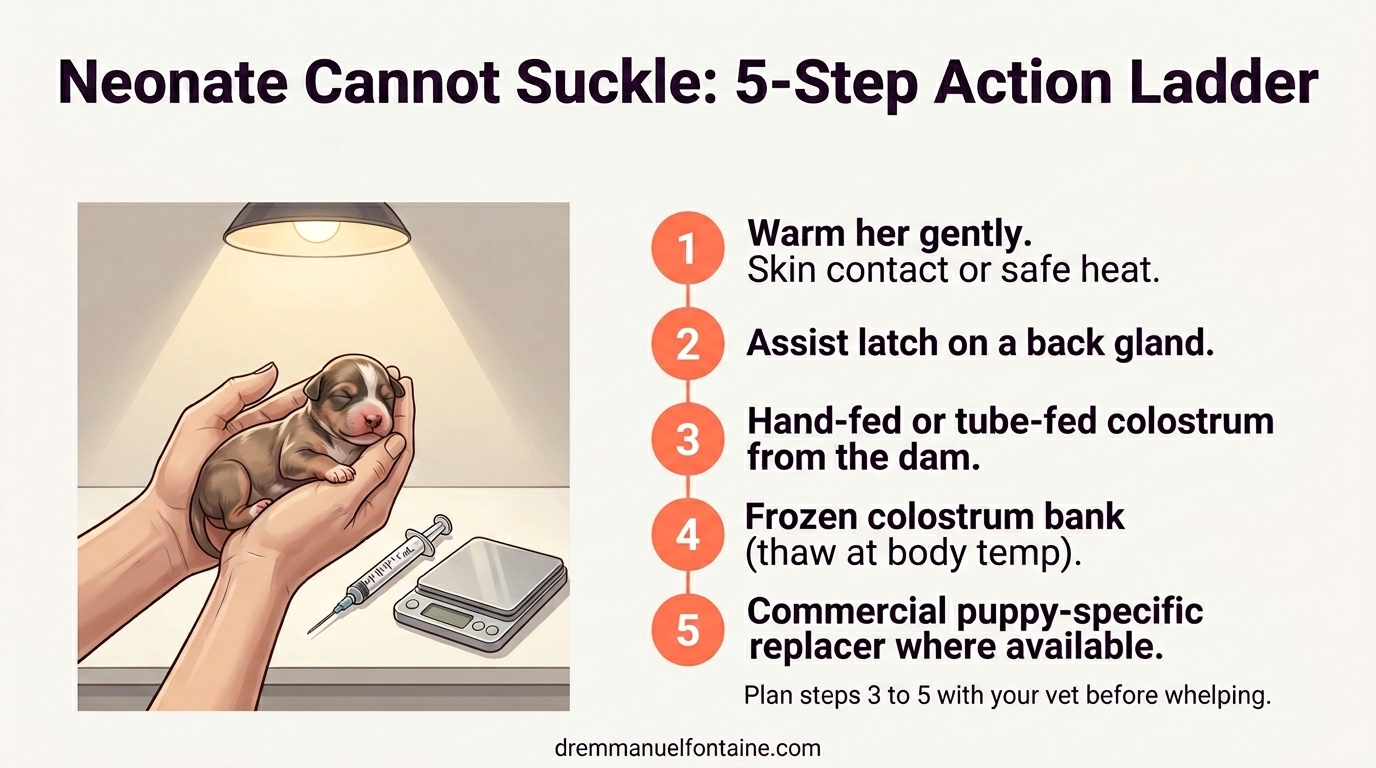
This is the part of the blog I most want you to take with you. A neonate who cannot suckle is where every minute counts, and where it is easy to freeze. Here is a clear ladder of what to do, in order.
The point is not to make you a vet. Remember the absorption window we covered earlier (peak at 4 hours, mostly closed by 12 to 16)? The point of this ladder is to make sure colostrum gets into that newborn while the window is still open. Steps 1 to 3 are things you and your vet have planned for in late gestation. Steps 4 and 5 are your insurance.
Step 1: Warm her
A cold newborn cannot absorb. Warm her gently and gradually against your skin or with a heat source set up safely so she can move away from it.
Never force-feed a cold neonate: you risk inhalation, ileus, and worse. The first thing the body has to do is hold a stable temperature. Then you feed.
Step 2: Try assisted latching
Place her on a back gland of the dam. Hold her in position. Express a drop of colostrum onto her lips so she tastes it. Many newborns who looked unable to feed will latch once they have the taste and the milk is already flowing. Try this for 5 minutes before moving on.
Step 3: Hand-fed or tube-fed colostrum from the dam
If she still will not feed, the next step is to get colostrum from the dam into the newborn another way. You can carefully express a small amount of colostrum from the dam and feed it by syringe drop by drop, or by tube if you have been trained by your vet.
This procedure is not a DIY project to invent at 3 a.m.: discuss it with your vet during late gestation, ideally with a hands-on training session, so you have the technique and the equipment ready before you need them.
Step 4: Pull from your frozen colostrum bank
If the dam cannot supply enough, frozen colostrum from a previous litter or from another dam in your kennel is the next-best option. Thaw it gently in a warm water bath at body temperature. Never microwave it: microwave heating destroys antibodies even when the average temperature looks fine.
Step 5: Use a commercial puppy-specific colostrum replacer if available
There is now a commercial colostrum replacer formulated specifically for puppies on the veterinary market. It is not available everywhere, and there is currently only one product designed for this purpose that I am aware of, but where you can source it through your vet, it is a real option to consider, particularly for puppies born by elective C-section, premature puppies, or low-birth-weight puppies. It is not a perfect substitute for the dam’s own colostrum, but it is a serious step up from anything generic.
Plan that sourcing in late gestation. The product is harder to find than a tin of milk replacer, and that is not a search you want to start on the night of the whelping.
Table 9. Action ladder for a neonate who cannot or will not feed
| Step | What you do | Why this order |
|---|---|---|
| 1. Warm gently | Skin contact or safe heat source | Cold gut does not absorb. Warmth comes first. |
| 2. Assisted latch on a back gland | Hold in place, express a drop on her lips | Many will latch once they taste it. |
| 3. Hand-fed or tube-fed colostrum from the dam | Drop by drop or by tube (with prior vet training) | Same-kennel colostrum is the best match. |
| 4. Frozen colostrum bank | Thaw at body temperature in a warm water bath | A backup that is only useful if you built it before whelping. |
| 5. Commercial puppy-specific colostrum replacer | Used where available, sourced through your vet | A real option for the gap, planned for in late gestation. |
Building a Frozen Colostrum Bank
A frozen colostrum reserve is not a theoretical idea. It is a kennel-management tool that pays for itself the first time you use it. Canine and feline colostrum frozen at -18 C (0 F) or colder retains most of its activity for up to a year. The key is to collect from the right dam at the right moment, store it correctly, and thaw it gently when you need it.
If a dam in your kennel has a small litter and produces more colostrum than her newborns are using, that is the moment to bank a small reserve. Collect within the first few hours postpartum, in small clean containers (5 mL aliquots are easiest to thaw), label each one with the dam’s identifier and the date, and freeze immediately. Discuss the collection technique with your vet so you do not deplete the source for the litter that is feeding right now.
Thawing matters. Use a warm water bath at body temperature, never a microwave. Microwaved colostrum is expensive warm protein, not immune protection.
Table 10. Frozen colostrum bank: the simple protocol
| Step | What you do |
|---|---|
| When to collect | First few hours postpartum, when output is highest. |
| How much to take | Small amounts only. Never compete with the live litter. |
| Container | Sealed sterile 5 mL containers, labeled with dam ID and date. |
| Storage | -18 C (0 F) or colder, in a dedicated freezer, up to 12 months. |
| Thaw method | Warm water bath at body temperature, 15 to 20 minutes. |
| Never | Microwave heating destroys the antibodies, even when the liquid feels warm. |
When Canine or Feline Colostrum Is Not Available
Sometimes there is no colostrum to be had: the dam is gone, she will not let down, the bank is empty, or the litter is large and the per-puppy volume is just not enough. The honest answer in this situation is that nothing fully replaces species-specific colostrum from the dam. The available alternatives all have meaningful caveats. Here is how I think about each of them.
Bovine and goat colostrum: not the alternative they look like
Cow and goat colostrum are easy to find and look like they should work. In practice, I do not recommend them for puppies or kittens. The pathogens a cow encounters in a barn are not the pathogens a puppy meets in a kennel.
Remember the kennel-match advantage from earlier (the dam’s antibodies are tuned to your specific environment)? Bovine and caprine colostrum are the opposite of that. The antibodies are tuned to the wrong threats, and the species-specific cross-protection is limited. Calling these products an alternative overstates what they actually do.
Oral canine or feline serum: a real debate, not a default
Oral serum from a healthy adult dog or cat as a way to provide passive immunity in the first 24 hours has been discussed for years. In puppies, my own position is that I do not recommend it as a routine intervention: the data are mixed, and there are better options to plan for. That said, some experienced veterinarians do recommend it based on their own clinical experience, and this is an active debate within the profession. So if your vet brings it up as a possibility for your kennel, take the conversation seriously, ask about donor screening and dosing, and make the decision together.
Commercial puppy-specific colostrum replacer
As mentioned earlier, there is currently a commercial colostrum replacer designed specifically for puppies on the veterinary market. Where available, it is the strongest off-the-shelf option for filling the colostrum gap, particularly for elective C-section litters, premature pups, or low-birth-weight pups. Source it through your vet during late gestation. It is not the same as the dam’s own colostrum, but it is the best engineered alternative we currently have.
What I am not going to recommend
To keep this practical: I am not going to point breeders at generic immunoglobulin supplements, goat-milk-based colostrum substitutes, or homemade serum mixes. The evidence does not support them, and most of them are marketed harder than they are tested. The list of alternatives that I think is realistic is short, and the table below sums it up.
Table 11. Realistic alternatives when species-specific colostrum is missing
| Option | Practical position |
|---|---|
| Frozen colostrum from your kennel bank | Best alternative. Plan and collect ahead of whelping. |
| Frozen colostrum from another trusted breeder | Good alternative if environments are similar. |
| Commercial puppy-specific colostrum replacer | Real option where available. Source through your vet in late gestation. |
| Oral canine or feline serum | Debated. I do not recommend routinely. Discuss with your vet if they raise it. |
| Bovine or goat colostrum | Not recommended. Wrong pathogen profile. |
| Generic immunoglobulin supplements | Not recommended. Evidence does not support them. |
| Puppy or kitten milk replacer alone | Nutritional support only. Zero antibody benefit. |
Plan With Your Vet Before Whelping, Not During
Almost every section of this blog has pointed back to the same idea: the work that makes a colostrum problem manageable is done before the litter arrives.
The vaccinations done before breeding. The diet sorted in late gestation. The yeast probiotic in the food from day 28. The frozen bank labeled. The hand-feeding technique trained. The replacer sourced.
None of that is improvised at hour 6 of a difficult whelping. The conversation worth having is the planning one: in the last weeks of gestation, you sit down with your vet and agree on what happens if a few common scenarios show up.
Be realistic about what your vet can and cannot do. There is no in-clinic test that tells you right now whether colostrum was good enough.
A neonate who cannot suckle in the middle of the night is a situation many vets are not set up to manage in real time. That is exactly why the planning happens earlier, when there is time to discuss tubing technique, source a colostrum replacer, identify a willing donor, and make sure the supplements you want to use are actually in the cupboard.
Three questions to bring to that pre-whelping appointment:
First: what does this dam need before breeding next time? Vaccinations, supplementation, diet, environment, breeding interval. The plan you build now also shapes the next litter.
Second: what is the plan if a neonate cannot feed? Walk through the action ladder together. Confirm the technique for hand-fed or tube-fed colostrum. Confirm what to do if the dam has not let down in the first hours.
Third: what backup colostrum is sourced and where is it? Frozen bank from this kennel. Source for the commercial replacer. A trusted breeder you can call if you need shared frozen colostrum. The names and the freezer locations should be written down.
Table 12. Pre-whelping checklist with your vet
| Item | When | Goal |
|---|---|---|
| Vaccinations boosted before breeding | At least 30 days before breeding | High antibody titers transferring into colostrum. |
| Gestation/lactation diet in place | From day 42 of gestation | Substrate for dense, balanced colostrum. |
| Saccharomyces boulardii CNCM I-1079 sourced | Before day 28 of gestation | Daily supplementation from day 28 through lactation. |
| Hand-fed or tube-fed colostrum technique trained | In the last 2 weeks of gestation | You can act in the first hours if a neonate cannot suckle. |
| Frozen colostrum bank inventory checked | 1 week before due date | Reserve labeled and ready to thaw. |
| Commercial puppy-specific colostrum replacer | 1 to 2 weeks before due date (where available) | On hand for elective C-section, premature, or low-birth-weight pups. |
| Quiet whelping space + pheromone diffuser | 1 to 2 weeks before due date | Lower stress, better letdown, better first feeding. |
Conclusion
The biology of passive immunity in the newborn puppy or kitten is short, beautiful, and unforgiving. Almost everything that will protect her in the first weeks of life has to arrive in the first 24 hours, through colostrum, or it does not arrive at all.
The good news is that most of the levers that decide how that handoff goes are in your hands, and most of them sit before the litter is born.
The dam’s vaccinations are sorted before breeding. The diet is right by the third trimester. The yeast probiotic is in the bowl from day 28. The whelping space is quiet by week 8.
The technique to hand-feed colostrum has been practiced. The commercial replacer is in the cupboard. The frozen bank is labeled in the freezer. By the time labor starts, the work is mostly done.
Your role at the whelping box is then narrow and focused: get every neonate latched in the first 2 hours, weigh them at 12 and 24 hours, and act on the warning signs the moment they show up. Your vet’s role is to plan with you in advance, train you on the techniques you might need, and back you up on the calls that need a clinician. Neither role is optional. Together, this is what a well-protected litter looks like.
Get the next issue on Saturday morning
Every Saturday, my free newsletter brings you one piece of science on reproduction and newborn care in dogs and cats, written for breeders and their veterinarians. Read it in English, French, Spanish or Portuguese.
Free. Unsubscribe anytime.


Excellent information!!I shared with our national club. Many positive thoughts!! Donna Hills MSN RN CNSHigh Risk IntrapartumBravo! Miniature Schnauzers … since 1988AMSC Breeder EducationWww.Bravo1988.com770-365-6695“Be a yardstick of quality. Some peop
LikeLike