🇫🇷 Lire en Français | 🇪🇸Leer en Español | 🇧🇷Leia em português
The first 21 days decide more about a puppy’s gut than the next 21 months. That is not folklore. It is what 14 new canine microbiome papers between 2023 and 2026 keep showing, in different breeds, different kennels, and different study designs.
I rebuilt this article from the ground up. The first version we published years ago held up reasonably well, but the science has moved. We now have longitudinal cohorts, large clinical trials, and maternal-seeding studies that change how I talk to breeders about probiotics, weaning, and what to expect after a cesarean. This is your updated map.
You will see the word dysbiosis a few times. It just means a microbial community that is out of balance. The opposite is a stable, age-appropriate community, which is what we are trying to build during those first weeks.
- TL;DR
- What the New Evidence Says About Puppy Gut Colonization
- The Birth Weight Connection You Can Track at Home
- Probiotics in the First Months: What the Trials Actually Show
- Weaning, Diet, and the Maturation Curve
- Conclusion
TL;DR
Five practical takeaways for your kennel:
- The dam seeds the litter before, during, and after birth. A healthy dam in a healthy whelping environment, with normal nursing, does most of the work.
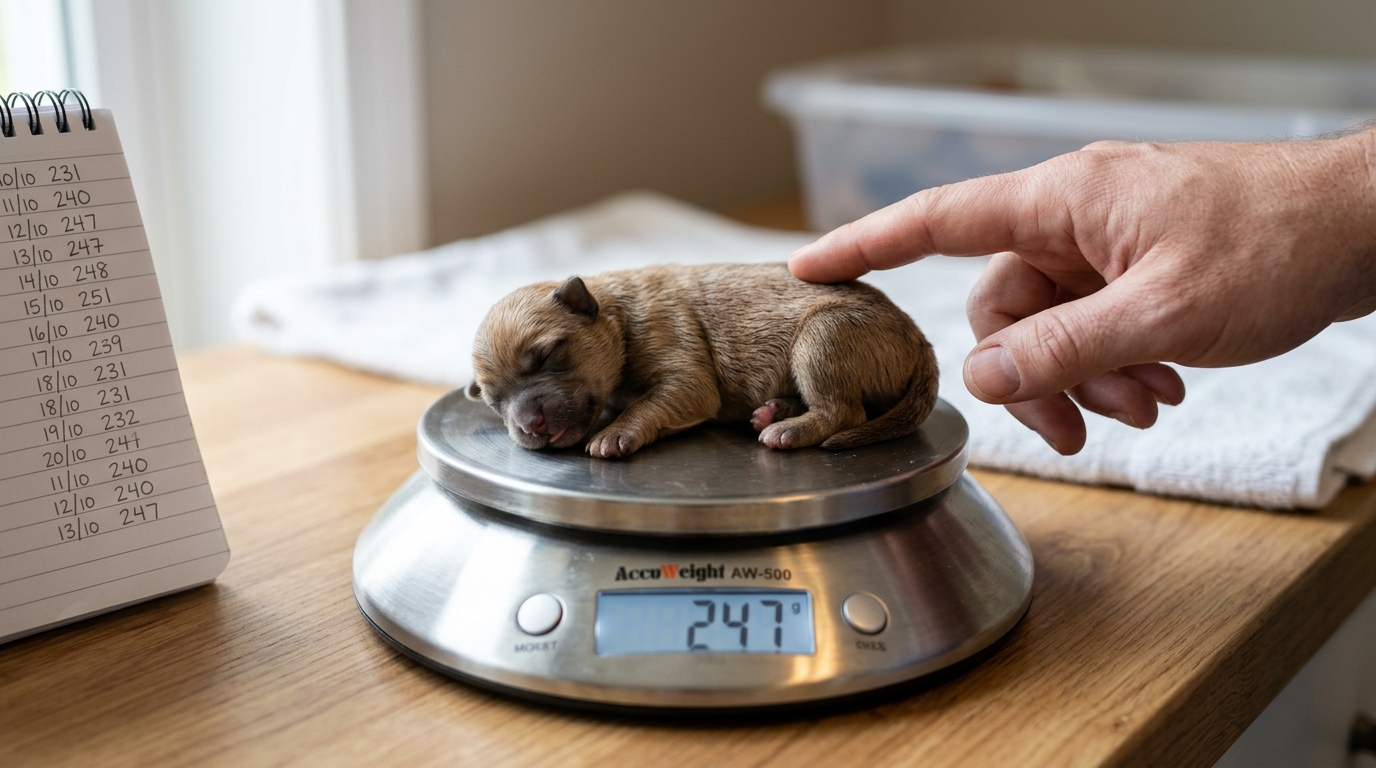
- Birth weight is your earliest gut-health signal. Weigh every puppy at birth and twice a day for the first 14 days. Trends matter more than single numbers.
- Not all probiotics are equal. The strain on the label is the variable that decides whether the product works. Read labels carefully and look for the specific strain name, dose, and supporting research.
- Weaning is the single biggest gut shift in the first year. The diet you introduce at weaning shapes the gut more than birth mode does.
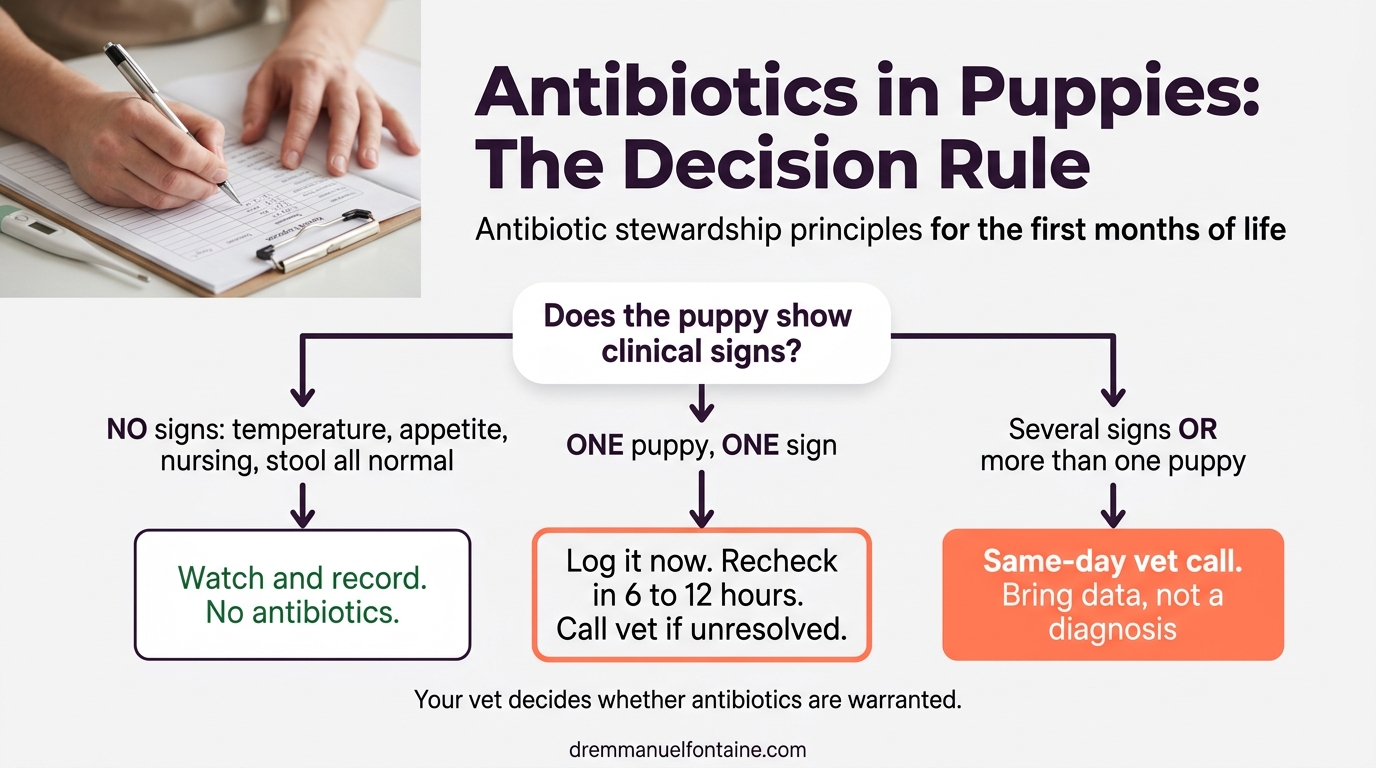
- Antibiotic stewardship protects the gut you just built. No clinical signs, no antibiotics. When your vet does prescribe, follow the dose schedule exactly.
What the New Evidence Says About Puppy Gut Colonization
The old picture was simple. Puppies were thought to be born sterile, then colonized at delivery and through the dam’s milk. The picture now is more nuanced. Bacterial DNA shows up in places we did not expect, and the dam’s role is broader than just the birth canal.
The pre-birth question and what meconium is telling us
Meconium is the first stool a puppy passes. A study that swabbed meconium from 60 vaginally delivered puppies across two breeds found that 93.3% of samples already contained bacteria, and the bacterial profile matched the dam’s birth canal and rectum more than the kennel environment.
That does not prove placental colonization is real or important in dogs, which is still debated. What it does say is that the dam’s microbial fingerprint is already on the litter at birth. The whelping box is not a sterile starting line.
| Day window | What is happening practically |
|---|---|
| Day 0 (birth) | The dam seeds the puppy. Bacterial DNA is already present in the first stool. |
| Days 1 to 7 | An early, simple bacterial community sets up. The puppy is most vulnerable to imbalance during this stretch. |
| Days 7 to 21 | More mature gut bacteria begin to establish. Nursing, warmth, and the dam’s contact drive most of the progress. |
| Days 21 to 28 | First diet signals start as solid food is introduced. The next 4 weeks of weaning will reshape the community. |
How the dam shapes the first 21 days
A 2025 study followed 36 dams and their 284 newborns. Researchers sampled the dam’s stool, birth canal, and colostrum the day after birth. Only the dam’s birth-canal bacteria predicted neonatal outcomes. Three patterns emerged across the dams.
The pattern with the lowest stillbirth and neonatal mortality was a balanced, diverse bacterial community. The pattern with the highest mortality was an imbalanced one, dominated by a single bacterial group and with lower overall diversity.
This is research, not a clinical test you can request. There is no routine birth-canal microbiome panel in canine practice today. What the finding tells you is that the dam’s general reproductive health and history matter more than we used to credit. If your kennel sees recurring neonatal losses, the conversation with your vet is about the full reproductive picture, not a single test that does not yet exist.
| What researchers observed in the dams | How it played out in the litter |
|---|---|
| Balanced, diverse bacterial community in the birth canal | Lowest stillbirth and neonatal mortality. |
| Mixed pattern | Intermediate outcomes. |
| Imbalanced community dominated by one bacterial group, low diversity | Highest stillbirth and neonatal mortality. |
When delivery mode changes the trajectory
Cesarean section bypasses the dam’s birth canal, which has led to concern about long-term gut effects. Two new studies clarify this.
A 2025 study tracked the mouth bacteria of 15 cesarean-born puppies from 4 French Bulldog dams. By day 15 the puppies’ oral bacteria had converged toward the maternal profile. The driver appeared to be everyday maternal contact, not colostrum specifically.
A separate longitudinal study reported that certain bacterial groups were elevated in cesarean-born puppies during the 8 to 10 week window compared with vaginally delivered littermates. The signal was real, but it was a window, not a permanent imbalance.
This matters most in breeds where puppies effectively grow in an incubator during their first weeks. In the past we used to think those litters only needed food and warmth. The new evidence reframes that. There is hope, because the gut catches up.
There is also a clear instruction. During this restoration window the puppies are fragile, and they need to spend as much time as possible with their mother. Skin-to-fur contact, normal nursing, and shared maternal environment do most of the heavy lifting after a cesarean.
There is no microbiome-restoring spray to use on the puppies. That is not on the evidence map yet.
| What you might worry about | What to actually do |
|---|---|
| Are cesarean puppies at a permanent disadvantage? | No. The gut catches up. Most of the maternal pattern is back by around 2 weeks. |
| There is a window where they look different at 8 to 10 weeks. | Be especially careful with handling, hygiene, and stress during that window. No new vaccines or diet changes you do not need. |
| Should I try ‘vaginal seeding’? | No. It is not validated in dogs. Talk to your vet before trying anything you read online. |
| What helps most after a cesarean? | Maternal contact, normal nursing, calm whelping box, stable warmth. Time with the mother is the intervention. |
The Birth Weight Connection You Can Track at Home
If you weigh puppies at birth and across the first 28 days, you are already collecting data that maps onto the gut microbiome. A 2023 study followed 57 puppies grouped by birth weight, with rectal swabs at 5 time points. Birth weight predicted the gut bacteria found at every early time point.
What low birth weight does to the early gut
Low birth weight puppies showed an immature, stress-pattern gut community in the first three weeks, with bacterial groups that often dominate when the gut is starting on a slimmer reserve. High birth weight puppies showed earlier maturation, with more of the bacterial groups associated with a healthy, established gut. Normal birth weight puppies sat in the middle.
| Birth weight group | Early gut signature |
|---|---|
| Low birth weight | Immature, stress-pattern community in the first 3 weeks. The puppy is running on a slimmer reserve. |
| Normal birth weight | Intermediate, age-appropriate progression. |
| High birth weight | Earlier maturation. The bacterial groups associated with a healthy, established gut appear sooner. |
Why it matters past day 28
By the end of the first month, low birth weight puppies in that study were starting to look like their normal birth weight littermates on the bacterial fingerprint. Whether the early imprint leaves a downstream mark on growth, immunity, or adult disease risk is the open question. The longitudinal cohorts published in 2025 and 2026 are the studies that will eventually answer it.
A low birth weight puppy is not a microbially doomed puppy. It is a puppy whose first three weeks are being run on a slimmer reserve. That is exactly the period where weight tracking, warmth, and milk access make the biggest difference.
What you can record in a notebook (and bring to your vet)
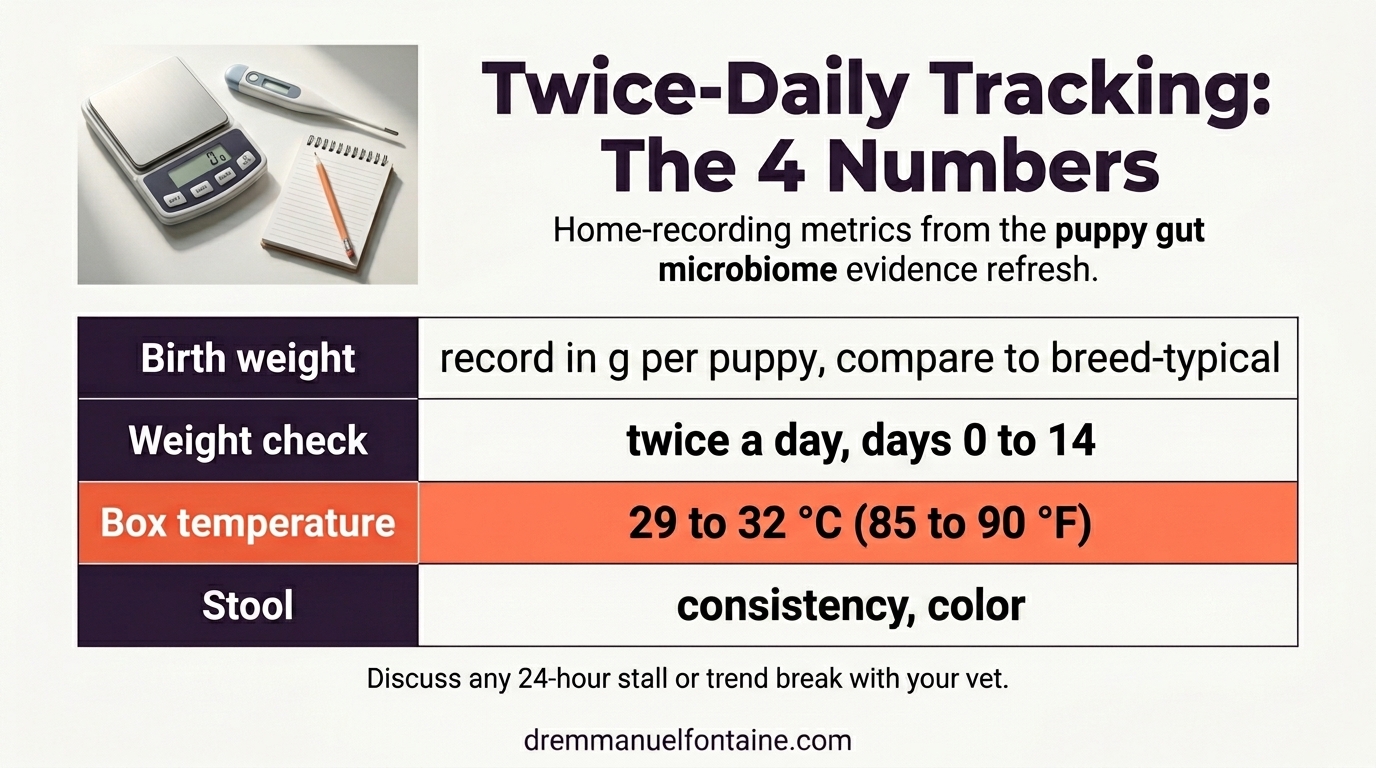
You cannot run a gut bacteria sequencer in a whelping box. You can, however, gather the same variables the studies above are using. Record birth weight, twice-daily weights for at least the first 14 days, body temperature, and stool consistency. When something shifts, your vet will read those notes faster than any test we can order.
| What you record at home | Why it matters to the gut story |
|---|---|
| Birth weight in grams (oz) for each puppy | Predicts early gut trajectory and the risk window. |
| Twice-daily weights, days 0 to 14 | Daily weight gain trends are the most sensitive whole-puppy signal you have. |
| Stool consistency, color, and timing | Loose or watery stool flags overgrowth or infection. Bring it up the same day. |
| Whelping box temperature | Cold stress slows nursing and shifts gut maturation. Target 29 to 32 °C (85 to 90 °F) inside the box. |
None of those rows ask you to interpret. They ask you to record. Interpretation belongs to your veterinarian.
Probiotics in the First Months: What the Trials Actually Show
Probiotics are the most common question I get from breeders about puppy gut health. Building on what the dam already seeds in those first weeks, can a probiotic fix what nature did not seed perfectly? The honest answer: the evidence is uneven, and it depends on what you are using them for. Three recent trials illustrate the spread.
When probiotics help: targeted clinical scenarios
A 2023 trial enrolled 120 puppies aged 1 to 4 months who were already showing gastroenteritis. Both groups received standard care. The treatment group also received a multi-strain probiotic for 7 days.
After a week, 70% of treated puppies had an excellent recovery, versus about 33% in the control group. Stool consistency normalized faster in the treated group. The trial does not say probiotics replaced standard care. It says they accelerated recovery in puppies who were already symptomatic.
When they do not: routine prophylaxis in healthy puppies
A 2026 trial enrolled 419 healthy assistance-dog puppies on a synbiotic combination from 5 to 10 weeks of age, against 412 placebo puppies and 116 non-operative controls. A synbiotic is a probiotic combined with a prebiotic, which is a fiber that feeds the bacteria once they are inside the gut. The product was not given because the puppies were sick. It was given preventively.
The results were a flat line. No significant difference in diarrhea, gastrointestinal disease, or atopy between groups. This is one of the largest preventive trials we have in puppies, and the answer it gave is the answer it gave. Routine, just-in-case use of this synbiotic in healthy puppies did not move the outcomes that matter.
| Scenario | What the trial showed |
|---|---|
| Active gastroenteritis, with supportive care alongside | Faster recovery: 70% vs 33% excellent recovery at day 7. |
| Healthy puppies, preventive synbiotic from 5 to 10 weeks | No effect on diarrhea, gastrointestinal disease, or atopy. |
| Maternal yeast supplementation in late gestation and lactation | Lower odds of low birth weight. Improved puppy growth rate from day 21 to day 56. |
The pattern is clear. Probiotics show value when they are matched to a clinical question, given to the right animal, at the right time. The flat results in healthy puppies are not a verdict against probiotics. They are a verdict against using them as a default.
Why the strain on the label is the variable that matters
Marketing pages rarely make this clear. Not all probiotics are equal. Different bacterial strains have different jobs.
Some target acute diarrhea. Some support the dam during late gestation. Some have been studied as routine prevention and showed no benefit.
The variable that decides whether the product works is the specific strain, the dose, and whether that exact strain has been tested in puppies for the question you are trying to answer. A product that worked in a clinical trial worked because of one strain at one dose. A different strain in the same family is a different product.
This means you do not need to wait for someone else to tell you which probiotic is worth using. You can read the label yourself. The information is on the package, in the manufacturer’s data sheet, and in published research. Once you have looked, you can have a real conversation with your vet about whether the product fits the situation in your kennel.
| What to look for on the label | What it tells you |
|---|---|
| The full strain name, not just the genus | A specific identifier (something like Lactobacillus rhamnosus GG) means the manufacturer knows which strain is in the bottle. “Lactobacillus” alone tells you nothing. |
| The daily dose in colony-forming units (CFU) | The dose used in published trials is the one to match. A dose that is much lower will not reproduce the trial result. |
| A reference to peer-reviewed studies in dogs or puppies | Clinical evidence in the right species beats lab-dish evidence. If the only data is in vitro, the product has not been proven where it counts. |
| Storage requirements and expiry date | Live bacteria are fragile. Many strains lose potency at room temperature, so refrigeration and a fresh expiry date matter. |
Once you have done that homework, bring it to your vet for a second opinion. The choice is better when both of you have looked at the label.
Weaning, Diet, and the Maturation Curve
Weaning is the single largest gut event between birth and one year. A 2026 longitudinal study followed 60 puppies from birth to 81 weeks. The variety of bacteria in the gut rose sharply during weaning and stabilized by about 6 months of age. Most of the variation after the first weeks of life was explained by diet and the individual puppy, not by birth mode.
The maturation timeline
A second 2025 cohort study sampled 76 Labrador puppies at 3 to 4, 7, and 12 months. The variety of bacteria declined between 3 and 12 months in that cohort. That sounds like a contradiction with the rise during weaning, but it is not.
Bacterial variety rises during weaning, then refines as the community specializes. The healthy adult gut is not the most diverse gut. It is the right community for that life stage.
| Phase | What is happening in the gut |
|---|---|
| Pre-weaning (Day 0 to Day 21) | Low variety, dam-imprinted. The puppy is still living off milk. |
| Weaning transition (Day 21 to Day 56) | Sharp rise in bacterial variety. The bacterial groups that produce healthy gut energy expand. |
| Post-weaning (2 to 6 months) | Community structure approaches adult-like. Diet drives most of the variation. |
| Juvenile to adult (6 to 12 months) | Variety refines and specializes. Each individual puppy starts to look like itself. |
The diet transition you actually feed
Diet is the lever you control. Recall from the birth weight section that even normal-weight puppies catch up by week four. Once weaning starts, your diet choices begin to dominate the picture. Both longitudinal cohorts above identified diet as a major driver of community composition once weaning was underway.
The right diet to introduce at weaning is one formulated for growth and reproduction, with stable nutrient quality, introduced gradually as a porridge from about 3 weeks of age and titrated up alongside continued nursing through 6 to 8 weeks.
| Week | What you offer |
|---|---|
| Week 3 | First exposure to a soft porridge, 1 to 2 times a day. Nursing continues normally. |
| Weeks 4 to 5 | Porridge gradually thickens. Frequency rises to 3 or 4 times a day. Nursing still primary. |
| Weeks 6 to 7 | Solid food becomes the larger share. Nursing tapers as the dam steps away more often. |
| Week 8 | Fully on the growth-and-reproduction diet you selected. Nursing fully stopped or close to it. |
The best signal that the diet is doing its job is simple. A steady weight curve, formed stool, and a calm puppy. Your vet can help you choose the specific product based on your breed, kennel, and litter.
Antibiotics: stewardship is part of gut care
The Labrador cohort above also specifically tracked antibiotic use. Recent oral or injected antibiotics were associated with reduced bacterial variety and shifts across several major bacterial groups. Most of the change happened within the first week of treatment and was largely transient. The community recovered, but it was clearly disturbed in the meantime.
| Time relative to a course | What the cohort showed |
|---|---|
| Within 1 week of an antibiotic course | Largest drop in bacterial variety. |
| Composition shifts | Across several major bacterial groups. |
| Recovery | Largely transient. The community returns over the following weeks. |
This is where antibiotic stewardship becomes part of gut care, not a separate topic. The principle is the simplest one. No clinical signs, no antibiotics. A puppy with a normal temperature, a normal appetite, normal nursing, and a formed stool is not a candidate for antibiotics, no matter how anxious the litter is making you.
“Just in case” prescribing is the part of antibiotic use that costs the gut the most and gains the puppy the least. When your vet does prescribe, they are weighing a real bacterial threat against the disturbance the drug will create. Your role is to give an accurate history and to follow the dose schedule exactly.
Skipped doses, half-doses, and stopped-early courses do more damage to the gut than the original infection in many cases. Stewardship is also why your vet may say no when you ask for antibiotics. That “no” is a clinical decision, not a refusal.
| Stewardship rule | What it looks like in your kennel |
|---|---|
| No clinical signs, no antibiotics. | Normal temperature, normal nursing, formed stool, no lethargy. You watch and you record. You do not request a script. |
| Bring data, not a diagnosis. | Weights, stool log, temperature trend, behavior changes. Your vet decides whether antibiotics are warranted. |
| Finish what was prescribed, on time. | Same dose, same intervals, same number of days. No stopping when the puppy looks better. |
| Probiotics are not a substitute for antibiotics, and antibiotics are not a substitute for clean husbandry. | Each one is the right answer to a specific question. Your vet helps you match them. |
When to call your vet without waiting
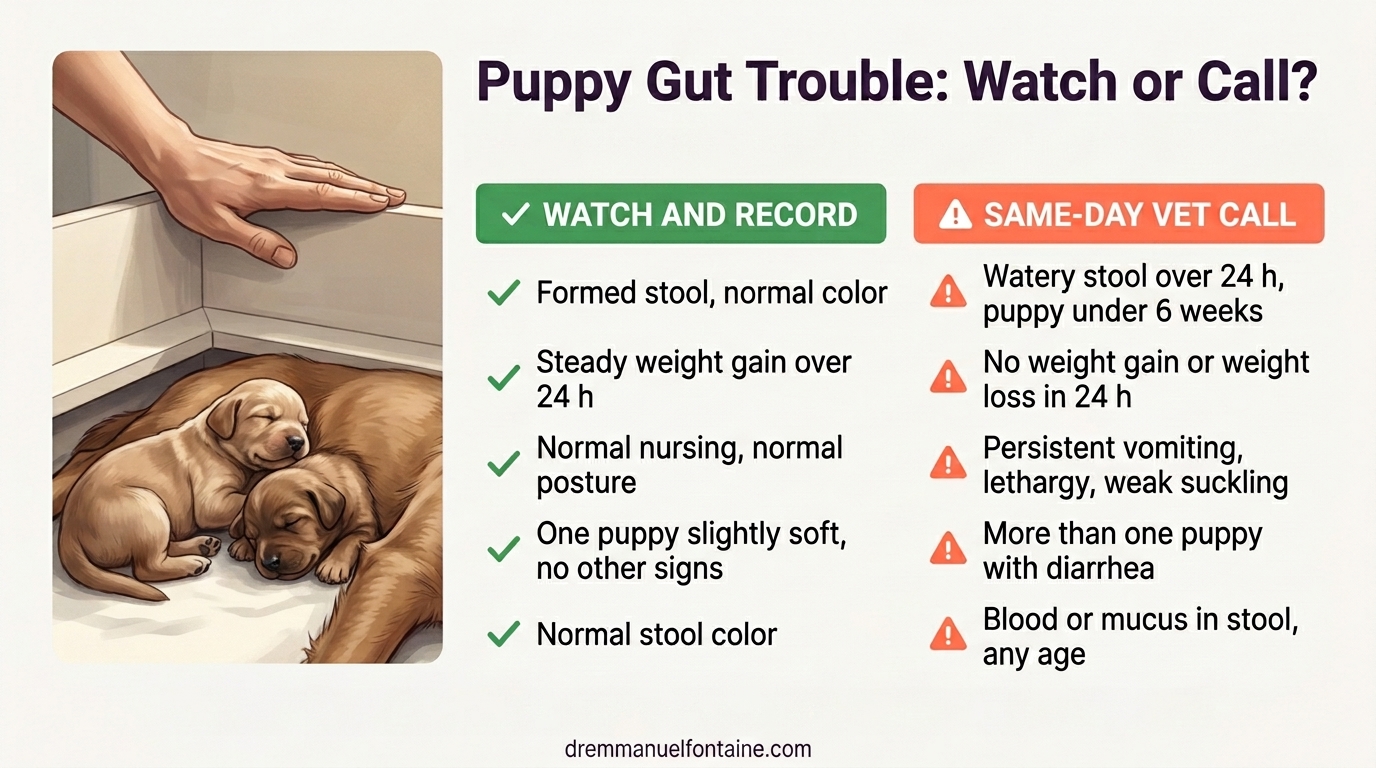
The body of this article is about steady, observational care across the first months. There are also moments when you do not wait. These signs need a same-day phone call, not a watch-and-see weekend.
| Sign | Why it matters |
|---|---|
| Watery stool lasting more than 24 hours in a puppy under 6 weeks | Risk of dehydration. Bacterial overgrowth or viral cause likely. |
| Blood or mucus in stool at any age | Possible parasitic, bacterial, or inflammatory cause. Needs vet attention. |
| Failure to gain weight or weight loss across 24 hours | Not gaining means not thriving. The gut is rarely the only problem. |
| Litter-wide diarrhea (more than one puppy) | Suggests an environmental or maternal source. Cluster signal. |
| Persistent vomiting, lethargy, or a drop in suckling reflex | Systemic illness. Bring the puppy in immediately. |
Conclusion
The first 21 days are still the frame, the way they were when we first published this article. What has changed is that we now have longitudinal cohorts, large clinical trials, and maternal-seeding data that turn that frame into specific decisions.
The dam matters more than we used to credit. Birth weight gives you a real-time, in-the-whelping-box signal. Probiotics work when they are matched to a question and a strain, and not when they are not.
Weaning and diet are where you spend most of your influence. Antibiotic stewardship is what protects the work you did before.
None of this replaces your veterinarian. It gives you better data to bring to the conversation. Track weights, watch stools, write things down, and ask. We do that part together.
Get the next issue on Saturday morning
Every Saturday, my free newsletter brings you one piece of science on reproduction and newborn care in dogs and cats, written for breeders and their veterinarians. Read it in English, French, Spanish or Portuguese.
Free. Unsubscribe anytime.


