🇫🇷 Lire en Français | 🇪🇸Leer en Español | 🇧🇷Leia em português
A cat DNA test arrives in your inbox as a neat list of results. It can feel like a final verdict. It is not. It is a set of clues, and some clues are far stronger than others.
Here is the one idea that changes how you read every report you will ever get. Some tests work like a switch, predicting a trait or a disease with near-certainty. Others work like a dial, only shifting the odds. Read a dial like a switch, and you will make the wrong call.
This is about the vocabulary to read your own reports and hold a sharper conversation with your vet. You already know your lines better than anyone. What follows adds one tool: the ability to tell a certainty from a probability, a breed-specific result from a universal one, and a real risk from a false alarm.
- TL;DR
- What DNA testing actually measures in your cats
- How to use genetic results to plan safer matings
- The tools and records every genetic-testing program needs
- The warning signs and misreads to watch for
- Bringing it together
TL;DR
- Penetrance is everything. A test is only as strong as the share of cats with that gene result who actually develop the trait. A high-penetrance recessive predicts; a low-penetrance risk variant only nudges the odds.
- A negative test is not a clean bill of health. It only tells you the cat lacks the one mutation it checked, and nothing about the variants it never looked at.
- Most feline disease mutations are breed-specific. A variant proven in one breed usually means nothing in another, even when a lab will happily sell you the test.
- Coat colour follows simple, predictable rules, so DNA reads it well. Body type, temperament, and many diseases are polygenic, and no single test can predict them.
- A carrier is not a cat to remove. Bred well, a carrier keeps its qualities in your line without passing on the disease. Removing every carrier at once hurts the breed.
- Blood type can be deadly in the nursery. The wrong pairing can cost you kittens, and how likely that is depends heavily on your breed.
- DNA finds risk; your vet confirms health. You need both, not one or the other.
What DNA testing actually measures in your cats
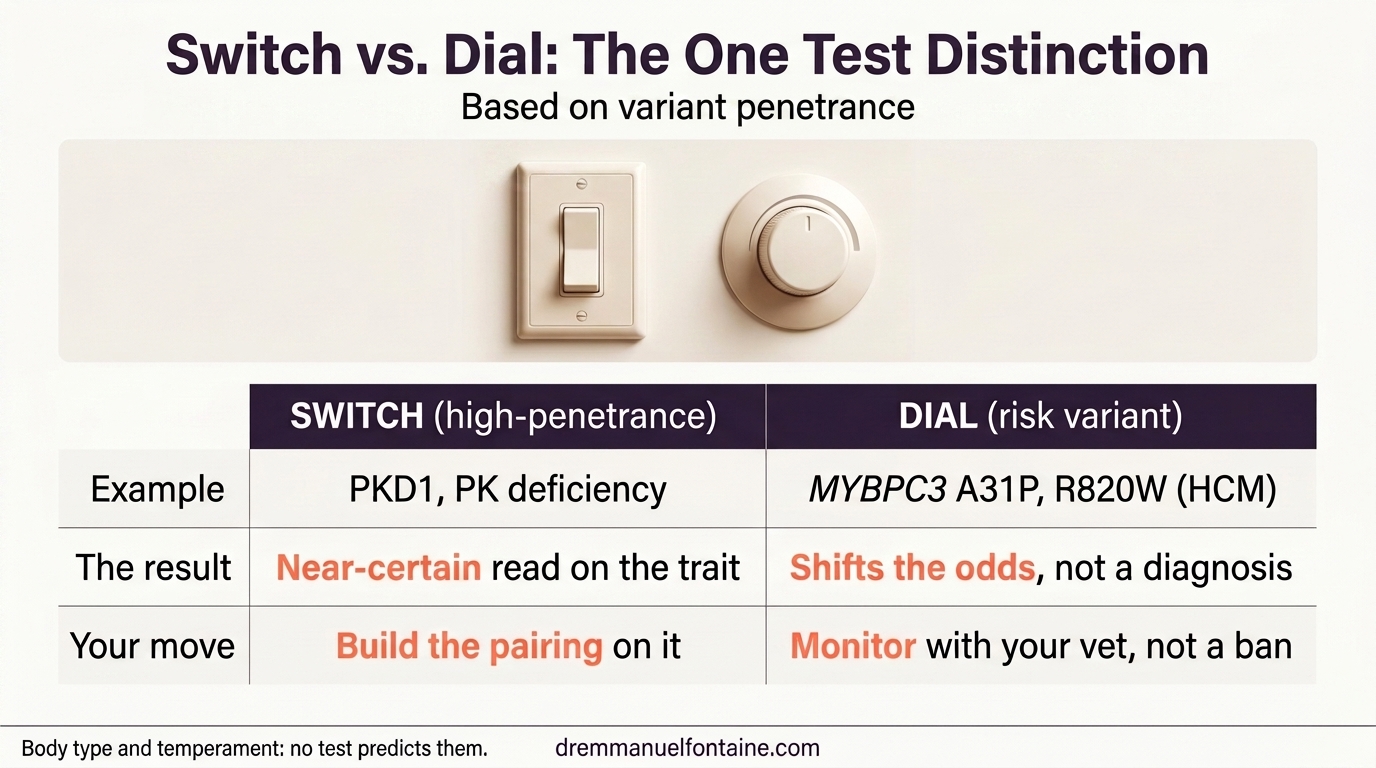
The difference between a test that predicts and a test that only shifts the odds
Every result rests on one idea: penetrance. Penetrance is the share of cats with a given gene result who actually go on to develop the trait. That single idea sorts every test you will ever run into two kinds.
Some variants have high penetrance and behave like a switch. Pyruvate kinase deficiency is the classic example. It is a recessive disease seen most in Abyssinians and Somalis, and in breeds built partly from them, such as the Bengal. It leaves the red blood cells short of energy, so they break down early and the cat becomes anaemic, tired, and pale. When a cat inherits two copies, the defect is there. That is a result you can plan around with real confidence.
Other variants have low penetrance and behave like a dial. The MYBPC3 heart variants are the classic case here. They are linked to hypertrophic cardiomyopathy, the most common heart disease in cats, in which the heart muscle thickens and pumps poorly. The A31P version raises risk in the Maine Coon, and R820W does the same in the Ragdoll. Carrying one raises the odds, but age, other genes, and plain chance decide whether disease ever appears. A positive result is a reason to watch the heart, not a diagnosis.
So the first question a report should raise is not “positive or negative?” but “is this a switch or a dial?” The table below is the whole framework in one view.
| Type of test | Example | What the result really means | How to hold it |
|---|---|---|---|
| Switch (high-penetrance) | PKD1, PK deficiency | A near-certain read on the trait | A firm fact you can build a pairing around |
| Dial (risk variant) | MYBPC3 A31P, R820W (HCM) | A shift in the odds, not a diagnosis | A reason to watch, not a breeding ban on its own |
| No test at all | Body type, temperament | Nothing, because the trait is polygenic | Judge the cat and your vet’s exam, not DNA |
Why a breed-specific result only counts for that breed
Feline mutations are usually tied to the breed they were first found in. The A31P variant predicts risk in the Maine Coon. R820W does the same in the Ragdoll. Neither one tells you anything about heart disease in a British Shorthair or a Sphynx. A test that was never proven in your breed is not a weak signal. It is no signal at all, even when a lab is happy to sell it.
So why do cats end up tested for variants that do not apply to them? It happens more than you would think. Many labs sell large, one-size-fits-all panels that run every variant they offer, whatever breed you send in, and a breeder chasing peace of mind ticks the whole list. It also happens with cats of mixed or unknown background, and with newer breeds that share ancestors with a tested breed. The trap is always the same: an off-breed positive looks alarming and means nothing. The habit worth building is to match the panel to your breed before you order, and to treat any off-breed result as a question for your vet rather than a reason to act.
How blood type is inherited and why it matters in the nursery
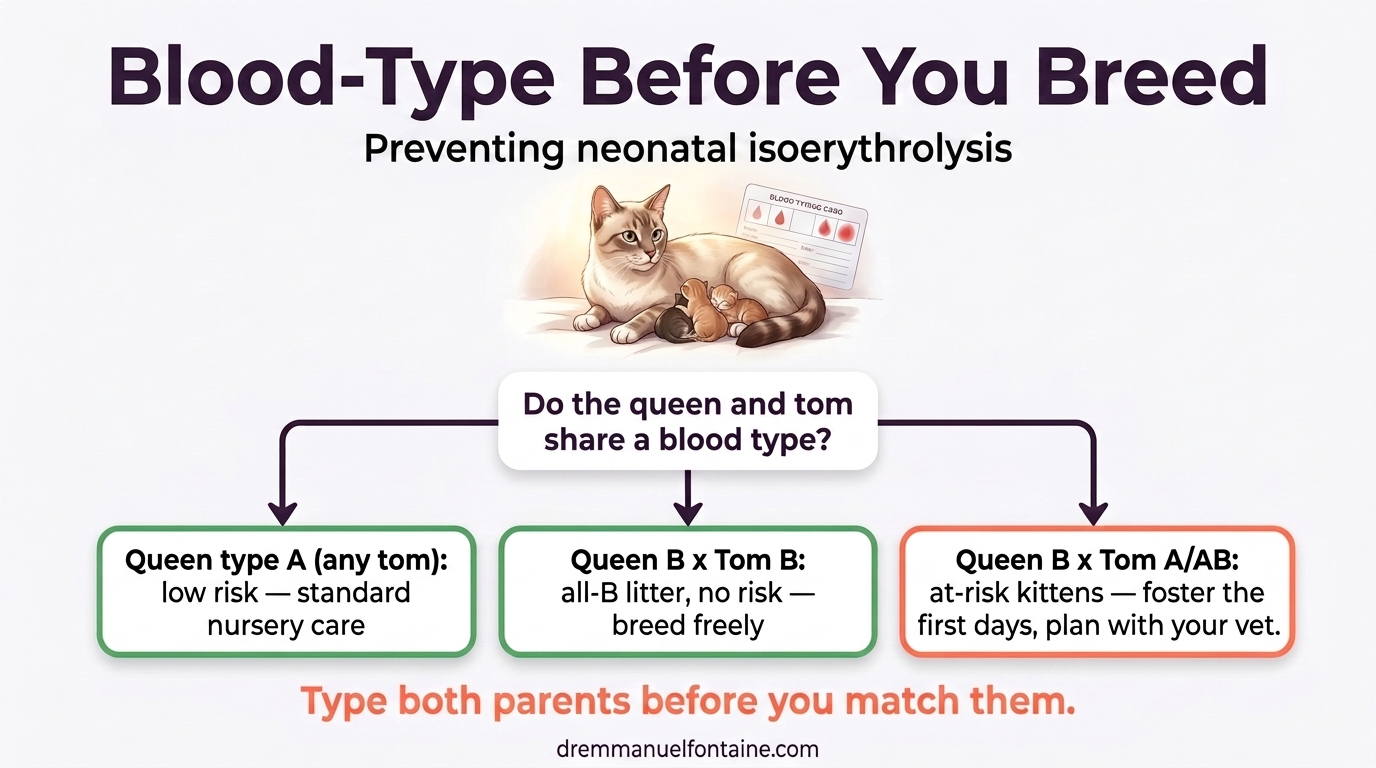
Blood type is a simple genetic trait with a hard consequence. It is set by the CMAH gene, and a type B cat carries two copies of the recessive b allele. Type B cats make strong antibodies against type A blood. That is harmless until a type B queen nurses a kitten of a different type, and passes those antibodies into her first milk. The antibodies then attack the kitten’s own red blood cells. That reaction is neonatal isoerythrolysis, and it can kill a kitten in its first days.
The real question is how likely this is in your cats, and the honest answer is that it depends almost entirely on the breed. Type B is common in some breeds, such as the British Shorthair, the Devon and Cornish Rex, the Exotic Shorthair, and the Birman, and it is most common of all in the Turkish Van and Turkish Angora. In those breeds a random pairing carries a real chance of putting an at-risk kitten under a type B queen, so typing before mating is not optional. In breeds that are almost entirely type A, such as the Siamese and Burmese, the direct nursery risk is low. Knowing where your breed sits is what tells you how hard to worry. Your vet confirms the actual type with a blood test before any high-risk mating or transfusion.
How to use genetic results to plan safer matings
Manage a recessive disease without losing the line
A positive carrier result is not a reason to remove a good cat from your program. For a recessive disease, a carrier bred to a tested-clear mate never produces an affected kitten, and every quality that cat carries stays in your line. That much is settled genetics.
What is not automatic is the strategy. The right move depends on two things: how common the disease already is in your breed, and the approach geneticists recommend for that specific condition. You are really chasing two goals at once. You want less of the disease in the breed, and you want to protect the gene pool while you do it. When a mutation is rare and only a few cats carry it, the simplest safe path can be to leave those carriers out of breeding. When a mutation is common, pulling every carrier at once would strip too many cats from the breed and choke the gene pool into a bottleneck, which tends to push other hidden problems up. In that far more common case, the smarter path is to keep breeding carriers, always to tested-clear mates, and to bring the carrier rate down slowly across generations.
So the question to sit with is not “is this cat a carrier?” but “what does this disease, in this breed, actually call for?” For a serious late-onset disease, that is a conversation to have with your vet before you plan the pairing, not after.
Plan around blood type before you plan the mating
Blood type is one of the few genetic facts you can act on before a single kitten exists. If your queen is type B, pairing her with a type B tom gives a litter that all shares her type and carries no nursery risk at all. The trouble only appears when a type B queen must go to a type A or AB tom, and some of the litter inherits the tom’s type.
You do not need a stopwatch to manage that. You need a plan, made in advance with your vet, for keeping the at-risk kittens off the queen’s first milk during the short early window when the newborn gut can still absorb her antibodies, and returning them once it cannot. The decision that matters happens before the mating, not in the delivery box. The single question to settle first is simple: do the queen and tom share a type, and if they do not, is the fostering plan already in place?
Test before you breed, not after
A genetic test is worth the most before a mating is planned, not after a problem shows up in a litter. Run the tests validated for your breed, confirm both parents, and only then design the pairing around what you learned. Testing is a planning tool, not a post-mortem. A result that arrives after the kittens are on the ground can only explain a loss. The same result, ordered earlier, could have prevented it.
The tools and records every genetic-testing program needs
The right test for the right breed
A good program starts with knowing which validated tests actually apply to your breed. A Persian program leans on the PKD1 test; a Maine Coon program watches A31P as a dial and treats a switch like SMA as a firm result; Abyssinian, Somali, and Bengal lines carry the recessive switches such as PK deficiency and PRA. Ordering the whole menu instead wastes money and can mislead you with results that were never meant for your cats. Match the panel to the breed, and treat any variant of unknown significance as something to discuss, not a trigger to act.
Diversity and inbreeding tools, and what they cannot do
Beyond single diseases, diversity tools help you manage the whole gene pool. A pedigree coefficient of inbreeding is only as good as the pedigree behind it. A genomic panel reads the DNA directly. Both estimate inbreeding by association rather than perfectly, and neither can predict body type or promise freedom from a disease no one has mapped yet.
This is the piece most breeders underweight, and it matters more than it looks. Managing diversity is not only about dodging disease. It is one of the best ways to protect fertility in a breed, and it is the part we most often forget. As inbreeding climbs, litters shrink, more matings fail to take, and fewer kittens survive. Watching your diversity trend across generations is, quietly, one of the most important things you can do for your line. No single number should override breed type or a validated health test, but do not let this one drift off your radar.
Clean samples and complete records
Good decisions rest on good data, and that starts at the swab. Here is a small step that is easy to get wrong, and it is one of the most common mistakes breeders make. Keep the cat away from its mother and littermates before you take a cheek swab. Cats groom each other constantly, so another cat’s cells sit in the mouth and ride out on the swab. When that happens, the lab can read a mix of two cats’ DNA and hand you a wrong or muddy result on the very cat you cared about. Separate the cat for a short while first, follow the lab’s collection instructions, and the problem never arises. Then keep records you can actually use: genotypes, blood types, and the pairings you chose, tracked across generations instead of trusted to memory.
The warning signs and misreads to watch for
False reassurance from a negative test
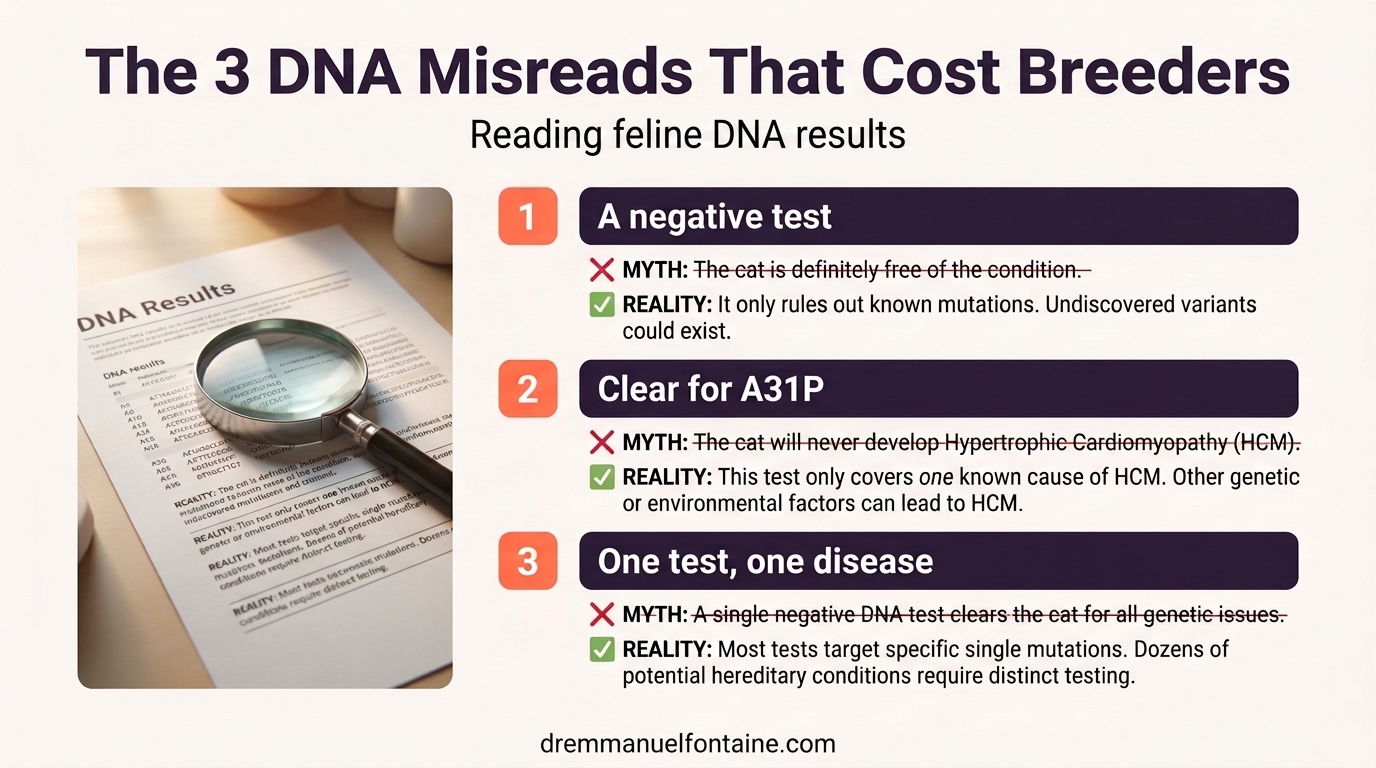
The most common misread is treating a negative result as proof of health. A negative test only rules out the one mutation it checked. A Maine Coon that is clear for A31P can still develop hypertrophic cardiomyopathy from other variants no test yet maps. That is exactly why regular heart scans by your veterinary cardiologist stay the gold standard, whatever the DNA says. The table below lines up the three misreads that catch careful breeders most often.
| The misread | What is actually true |
|---|---|
| A negative test means the cat is healthy | It only rules out the one mutation it checked |
| Clear for A31P means no heart disease | Other heart variants exist that no test yet maps |
| One test covers the whole disease | Many diseases are driven by more than one variant |
When removing carriers costs more than it saves
The opposite mistake is just as costly: removing every carrier of a recessive condition from your program on reflex. Carriers of harmless traits, such as Factor XII deficiency, need no action at all. Even carriers of serious recessive diseases can be bred safely to tested-clear mates. Pulling every carrier out of the gene pool at once shrinks it fast and can raise the frequency of other hidden diseases. The goal is to reduce a problem on purpose and across generations, not to sweep it out in one move that quietly costs you more than it saves.
| Situation | The reflex to avoid | The better approach |
|---|---|---|
| Carrier of a serious recessive | Removing the cat from your program | Breed it to a tested-clear mate |
| Carrier of a benign trait (Factor XII) | Removing the cat from your program | Breed normally; no action needed |
| Chasing a perfect diversity score | Ignoring breed type and health tests | Balance diversity with type and validated tests |
Nursery red flags in an at-risk blood-type litter
When you have knowingly bred an at-risk pairing, the first days of life are the window that matters. Watch every newborn for dark brown urine, for jaundice in the gums or skin, for sudden weakness or a kitten that stops nursing, and for a tail tip that begins to darken. These are the signs that a queen’s antibodies are destroying her kittens’ red blood cells. They are not wait-and-see signs. They are a reason to call your veterinarian immediately, because in this situation hours matter.
Bringing it together
Genetic testing has moved cat breeding from guesswork to something far more precise. But precision only helps when you read the results correctly. A switch and a dial are not the same result. A breed-specific variant is not a universal one. A negative test is a narrow fact, not a promise. Hold those distinctions, and the reports stop feeling like verdicts and start working like tools.
You bring the knowledge of your lines and the discipline to test, record, and plan. Your vet, and when it helps a veterinary geneticist, brings the clinical confirmation that DNA alone cannot give. Together, that partnership is what keeps a breed both healthy and genetically rich, one well-planned pairing at a time.