🇫🇷 Lire en Français | 🇪🇸Leer en Español | 🇧🇷Leia em português
If you have ever wondered why I keep dragging pig research into conversations about whelping boxes and queening pens, this blog is the answer. The largest, cleanest, most decision-relevant studies on maternal probiotic supplementation sit in the swine literature, not the canine or feline one. As a vet who works mostly with dog and cat breeders, I read those pig papers because they sharpen what I look for at the dam’s pre-breeding visit, what I watch on day 1 of a litter of puppies or kittens, and what I tell breeders we are still learning together.
This is not a literature review. This is what I take from these papers and how it has changed the way I think about your dam, your colostrum, and your first 48 hours. You already do most of this work. My job here is to give you a sharper lens, a few more things worth tracking, and a small set of conversation openers for your next vet visit.
- TL;DR
- Why I Look at Sow Research When I Think About Bitches and Queens
- What the Sow Findings Mean at the Whelping or Queening Box
- Translating What Sows Teach Us Into Bitch and Queen Reality
- Bringing This Into the Vet Conversation
- What This Changes in How You Watch a Litter
- Conclusion
TL;DR
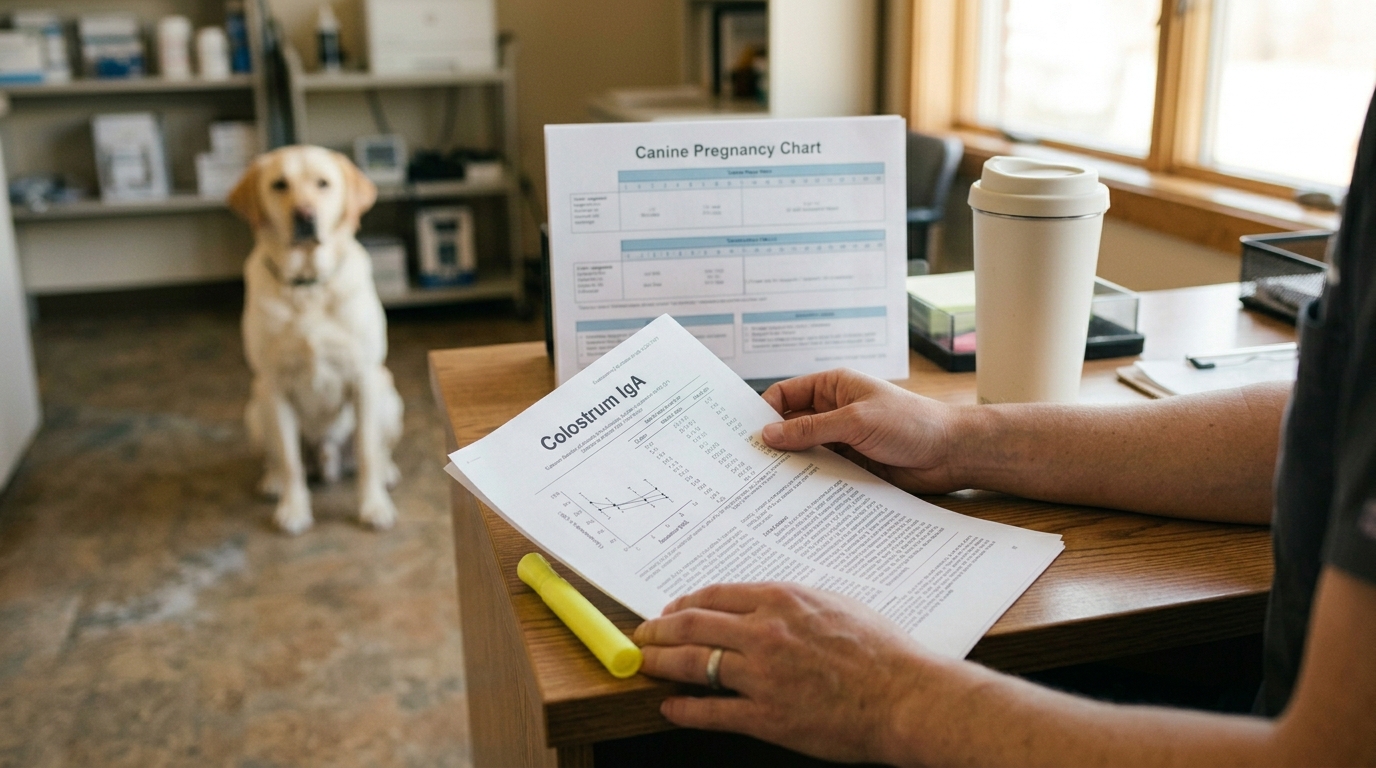
- Watch the first 24 hours after the puppies or kittens are born with the same care you give the heat cycle. That is the colostrum-absorption window where passive immunity is built, and the sow data has only made me more convinced that what your dam eats in the last weeks of pregnancy lands in that exact window.
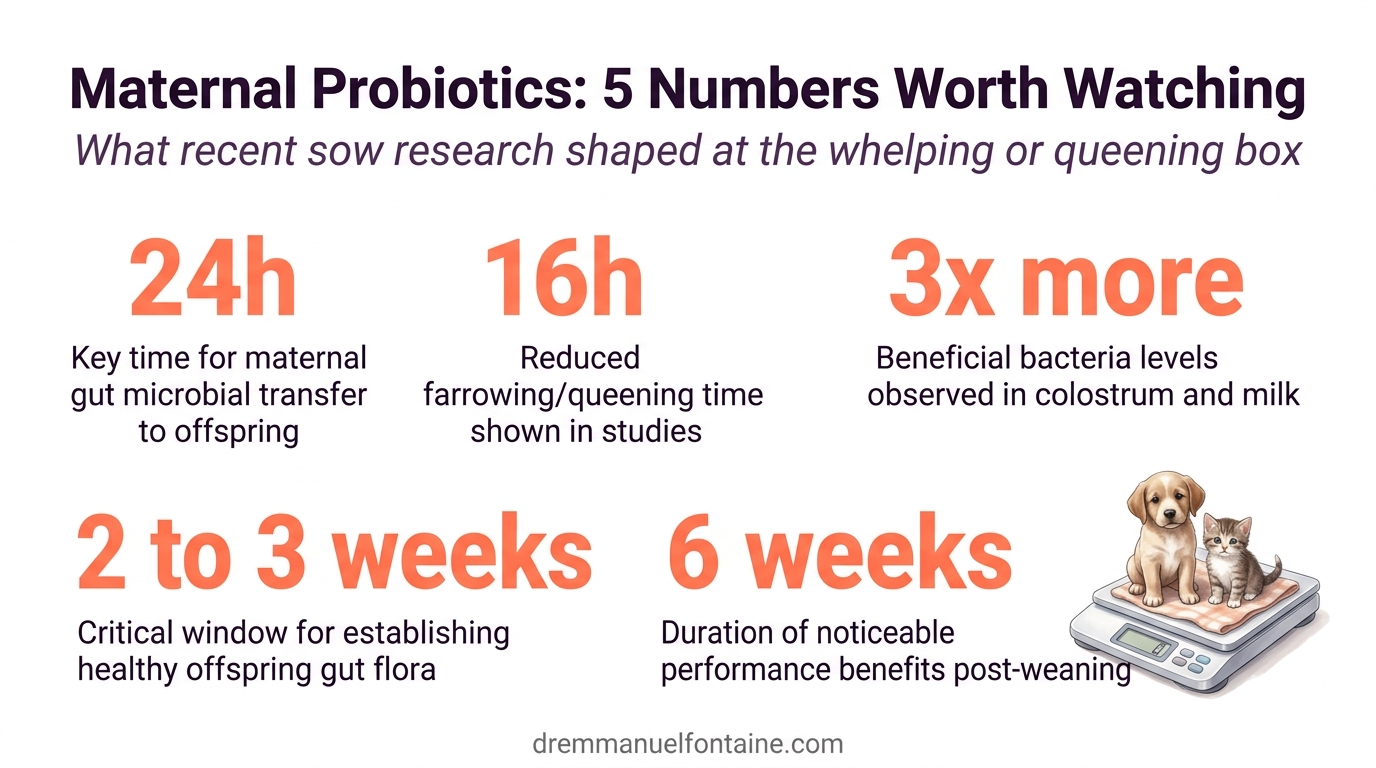
- In sows, maternal probiotic supplementation produced roughly three times more IgA in the colostrum at 24 hours after birth. IgA is the antibody class that coats and protects the gut and airway lining of the newborn. More IgA in the milk during that early window means more protection at the surfaces where infection actually starts.
- In a second sow trial, supplemented mothers produced piglets with healthier guts in the first two weeks: fewer cases of soft stools, stronger gut lining, larger immune-tissue patches in the gut wall. Translated to your kennel or cattery: fewer dehydration episodes, easier first weeks, sturdier neonates entering the next phase.
- A third trial mapped how the effect travels: maternal gut microbes shape the milk, the milk shapes the offspring gut, and the shift sticks past weaning. There is no shortcut around the dam.
- Bring this to your veterinarian as a conversation opener, not a request for a verdict. Most general practitioners have not seen this body of work yet, and the dog and cat side is still very young. We are figuring this out together.
Why I Look at Sow Research When I Think About Bitches and Queens
Maternal nutrition research in dogs and cats has historically been thin. Litters are small, breeding programs are scattered, and properly controlled trials are slow and expensive to run. Sow research is the opposite. The pig industry has decades of well-funded, controlled, longitudinal data on what the mother eats and how it lands on the litter. When I want to think carefully about that question, that is where the cleanest evidence lives. So I read it, and I translate it back to my world of bitches and queens.
The One Thing Pigs, Dogs, and Cats Share at Birth
Here is the bridge that earns the cross-species conversation, and it is not the placenta. The placenta is actually quite different across our three species. Pigs have an epitheliochorial placenta with six layers between the sow’s blood and the piglet’s blood, and that barrier blocks antibody transfer entirely. Dogs and cats have an endotheliochorial placenta with four layers, and a small amount of antibody crosses, but nowhere near enough to give the newborn what it actually needs.
The practical result is the same in all three species. Piglets, puppies, and kittens arrive functionally immunologically naive and depend on colostrum to load up on passive immunity in the first hours of life. The window closes faster in kittens than in puppies , gut closure happens around 16 hours after birth in kittens and around 24 hours in puppies , so the urgency at the queening box is even higher than at the whelping box. That shared dependence on colostrum is the bridge that makes sow data worth reading when I think about your dam, dog or cat. The placentas themselves are different, and they always will be.
| What I Watch in the Kennel or Cattery | What the Sow Data Has Shaped in How I Read It |
|---|---|
| Colostrum intake in the first 12 hours (puppies and kittens) | Sow research keeps reinforcing that this window does not just feed the newborn, it programs early gut and immune tone. Your hands-on monitoring of latching and intake is one of the highest-yield things you do , and even more so for kittens, whose absorption window closes earlier. |
| Dam appetite and gut comfort in late gestation (bitches and queens) | If she is off her feed or her stools change in the last 2 to 3 weeks, the sow literature suggests that maternal gut state is reaching the milk. Flag it earlier than you used to. |
| Stool consistency in the litter at week 2 | Soft-stool episodes are not just a passing nuisance. The sow studies link maternal feeding to litter gut quality at this exact age. Track patterns across litters from the same dam. |
| Weaning weight and neonatal growth curve | I treat these as a downstream report card on the late-gestation and lactation period, not just a snapshot. The sow data has made that view sharper. |
What I Took From Reading This Body of Work
Three recent sow trials reshaped the way I think about maternal supplementation. I want to share the part that changed something in how I practice.
The first one made me sit up because of the colostrum signal. Sows that received a maternal probiotic in late pregnancy and lactation produced colostrum with about three times more IgA at 24 hours after birth. IgA is the antibody class that protects mucosal surfaces , gut, airway, and beyond , in the newborn. That is the exact window where the puppy or kitten loads up on passive immunity. The number itself does not transfer to dogs or cats, but the principle does: what the mother eats in the last weeks reaches the colostrum, and the colostrum reaches the litter at the moment that matters most.
The second one mattered to me because of the piglet gut itself. Maternal supplementation tracked with healthier digestion in the first two weeks, larger immune-tissue patches in the gut wall, and stronger weaning weights. In kennel or cattery terms, that is fewer soft-stool episodes, fewer dehydration close calls, and sturdier neonates moving into weaning. The maternal effect did not stay in the colostrum; it kept paying off later.
The third one closed the loop on how any of this works at all. The maternal gut shifts. The milk shifts. The offspring gut shifts in turn, and the change persists past weaning. There is no shortcut around the dam, and that has changed how I think about the pre-breeding visit. The dam is the lever. The litter is the readout.
| The Sow Finding | What That Looks Like at the Whelping or Queening Box | What I Would Do With It |
|---|---|---|
| Maternal supplementation produced about 3x more colostrum IgA at 24 hours after birth | More mucosal-protection antibody (IgA coats the gut and airway lining of the newborn) in the milk during the exact window the puppy or kitten can absorb it. Stronger first-day immune coating. | Treat the last 2 to 3 weeks of gestation as the lever, not an afterthought. Make sure your dam is on a diet built for gestation/lactation. Anything beyond that is a vet conversation. |
| Maternal supplementation tracked with healthier piglet digestion and gut-wall structure in the first 2 weeks | Fewer soft-stool flares. Stronger gut lining doing the absorption work. Larger immune-tissue patches that handle infectious pressure better. | Watch stool quality in the litter at week 2 with the same care as birth weight. Patterns across litters from the same dam are worth flagging. |
| Maternal gut microbes shaped milk metabolites, which then shaped offspring gut microbes past weaning | The sow data confirms there is no way around the dam. Whatever benefit you want at the litter level travels through the mother. | Center your maternal-care attention on the last 3 weeks of pregnancy and the first 4 weeks of lactation. That is where the lever is. |
What the Sow Findings Mean at the Whelping or Queening Box
Now I want to take you through each finding the way I read it, with the practical translation alongside it. What I read, what I learned, and what I think about it for your dam.
When Maternal Supplementation Reaches the Colostrum
The sow trial that opened my eyes was run in a Thai farrowing facility under heavy infectious pressure (a porcine epidemic diarrhea outbreak). The control group was losing more than half its piglets before weaning, which is a brutal baseline and one I would never use as the dog or cat reference. The intervention group received a multi-strain maternal probiotic from week 12 of pregnancy through weaning. The colostrum and milk were sampled across the absorption window, and the team measured IgA , the antibody class that coats and protects the gut and airway lining of the newborn , at multiple time points. The numbers below are the part that matters; the survival headline is noise from the outbreak setting, not a clean signal.
| Outcome | Probiotic Group vs Control | What That Means in Practical Terms |
|---|---|---|
| Colostrum IgA at 6 hours after birth | 26.22 ± 7.09 mg/mL (treatment, peak signal of the window) | Peak signal at 6 hours = the window when absorption is highest. The newborn’s gut is still ‘open’ to taking these antibodies in. |
| Colostrum IgA at 24 hours after birth | 11.87 vs 3.41 mg/mL | Roughly 3x more mucosal-protection antibody available at the close of the absorption window. More protection at the exact tissues where infection starts. |
| Milk IgA at 48 hours after birth | 4.51 vs 3.41 mg/mL | The maternal effect did not stop with colostrum. The milk continued carrying more protection into the second day. |
| Pre-weaning piglet mortality | 24.9% vs 53.6% | Striking, but driven by the disease outbreak. The principle (more protection = more survival under pressure) translates; the absolute numbers do not. |
| Weaning weight | 5.9 vs 3.9 kg | Stronger neonates entering the next phase. In a healthy kennel or cattery, the size of the gap would be much smaller, but the direction is consistent. |
| Piglets weaned per litter | 8.1 vs 5.1 | Outbreak-driven again. Track this only as supportive context, not as a target. |
Here is what I take from this. The colostrum window is not a passive event. What the dam ate in the last weeks of pregnancy travels into the milk that arrives in the first day of life. I already think of late gestation as a clinical window for both bitches and queens. This trial reinforced the priority and changed the urgency I bring to it , particularly for queens, whose kittens have an even shorter colostrum-absorption window.
When Maternal Supplementation Reaches the Piglet Gut Itself
A second sow trial, run in calmer commercial conditions, used spores of two Bacillus species across pregnancy and lactation in 96 sows. The team measured the obvious things (weights, stool quality, antibodies) and one thing I would not have predicted: actual gut-wall architecture in the offspring. Larger immune-tissue patches. Longer absorptive structures. Thicker intestinal lining. The supplemented bacteria were even recovered downstream in the piglet’s gut tissue, which means they actually got there.
| Outcome | Probiotic Group Effect | What That Means in Practical Terms |
|---|---|---|
| Sow blood antibodies at farrowing | Higher in supplemented group | The dam’s own immune system was running at a slightly higher tone, which is part of what gets passed along through colostrum. |
| Piglet weaning antibodies | Higher in supplemented group | The offspring’s own immune profile was stronger at the end of the maternal phase. |
| Piglet weaning weight | Higher | Stronger neonates moving into the next stage of growth. |
| Litter gain | Higher | More uniform growth across the litter, not just a few standout piglets pulling the average. |
| Creep feed consumption | Higher | The piglets transitioned to solid food more readily. Translation to puppies and kittens: easier weaning. |
| Stool quality at week 2 of life | Improved | Fewer soft-stool episodes when the litter is most vulnerable to dehydration. |
| Gut-wall thickness, longer absorptive lining, larger immune-tissue patches | Greater in supplemented piglets | Real structural changes, not just a transient microbiome shift. The gut was built differently. |
Here is what I take from this. Maternal feeding is not just an early-window event. It can shape the structure of the offspring gut for the first weeks of life. I will not pretend the dog or cat numbers will look the same, and the cat side has not even been studied this way under a comparable maternal trial. The principle, though, is the part I keep , for both species.
How the Effect Travels From Sow Gut to Litter Gut
A third trial asked the bridge question: how does maternal supplementation actually reach the piglet gut? They used a defined maternal probiotic blend in sows and tracked three layers across time: maternal gut microbiota, milk metabolite profile, and piglet fecal microbiota.
| What They Measured | What Maternal Supplementation Did | What That Means in Practical Terms |
|---|---|---|
| Sow gut microbiota structure | Reconstituted; community shifted toward the supplemented blend’s signature | The maternal gut is the upstream lever. Change it, and you have changed the source of every downstream signal. |
| Milk metabolite profile | Shifted toward small molecules linked to gut development and immune signaling | The milk is not a passive food; it is a continuously updated message from the dam’s gut to the litter’s gut. |
| Piglet fecal microbiota at day 10 | More beneficial bacteria, fewer of the typical pathogenic-leaning ones | The litter’s gut started its life with a friendlier community. |
| Piglet fecal microbiota at day 28 | The shift was still visible after weaning | The maternal influence outlasted the colostrum window. The early lever kept paying off later. |
Here is what I take from this. There is no shortcut around the dam. You can supplement a puppy or kitten directly after birth (which is a different conversation), but the most efficient lever is upstream: a healthy maternal gut, a milk that carries a good signal, and an offspring gut that is set up to receive it well. That has changed where I focus my attention at the pre-breeding visit, whether the dam is a bitch or a queen.
Translating What Sows Teach Us Into Bitch and Queen Reality
Sow data does not transfer whole. The honest path is to identify what travels across, name what does not, and let the gap be a gap. Here is how I read it for both bitches and queens , and where queens specifically are reading this through one extra layer of caution, because the feline maternal-probiotic literature does not yet exist at all.
What I Carry Across to Dogs and Cats
Three principles travel reasonably well from sow to bitch and from sow to queen. The first: colostrum is a high-value, short-window event for passive immunity in all three species, and the queen’s window closes earlier than the bitch’s. The second: maternal gut state shapes the milk, and the milk shapes the offspring. The third: the maternal lever can register in offspring tissue, not just in offspring blood. Each of these is what I carry across, for puppies and kittens alike.
What I do not carry across: specific strains, specific doses, and any specific commercial product. The strain blend used in any pig trial is calibrated for the pig gut, not the dog gut or cat gut. A sow weighs 200+ kg (440+ lbs); a bitch weighs 5 to 50 kg (11 to 110 lbs); a queen weighs 3 to 6 kg (6.5 to 13 lbs). Doses do not scale linearly. And the dramatic survival numbers from a disease-outbreak herd are not a baseline I would import into a healthy kennel or cattery. Bring the question, not the protocol.
| The Principle I Carry Across | What I Do With It in Dogs and Cats |
|---|---|
| Colostrum drives passive immunity in the first day of life. The window closes earlier in kittens (around 16 hours) than in puppies (around 24 hours). | I treat the first 12 to 24 hours as a clinical window, not a quiet one. In kittens the urgency is even higher because the door closes earlier. |
| Maternal gut state shapes the milk; the milk shapes the offspring gut. | I push the late-gestation conversation upstream for both bitches and queens. Diet, gut comfort, and stool quality in the dam in the last 3 weeks of pregnancy are now part of the pre-breeding plan, not a separate concern. |
| Maternal supplementation can reduce the share of the smallest neonates in a litter. | An emerging dog trial points the same direction. The cat side has not been studied this way yet. I treat litter-weight uniformity as a marker of how the maternal phase actually went, in either species. |
| Maternal supplementation may dampen the first-vaccination inflammatory response in offspring. | Useful as a longer-horizon outcome to flag with your vet at the puppy or kitten visits, while we wait for more data on the canine and feline side. |
Bringing This Into the Vet Conversation
Sow data should never be applied directly. It should be brought into the consultation room as a question. And here I want to set the right expectation for both you and your vet: this body of work is young on the dog and cat side, and most general practitioners have not seen it yet. The point is to start the conversation, not to expect a verdict.
Going In With Questions, Not Demands
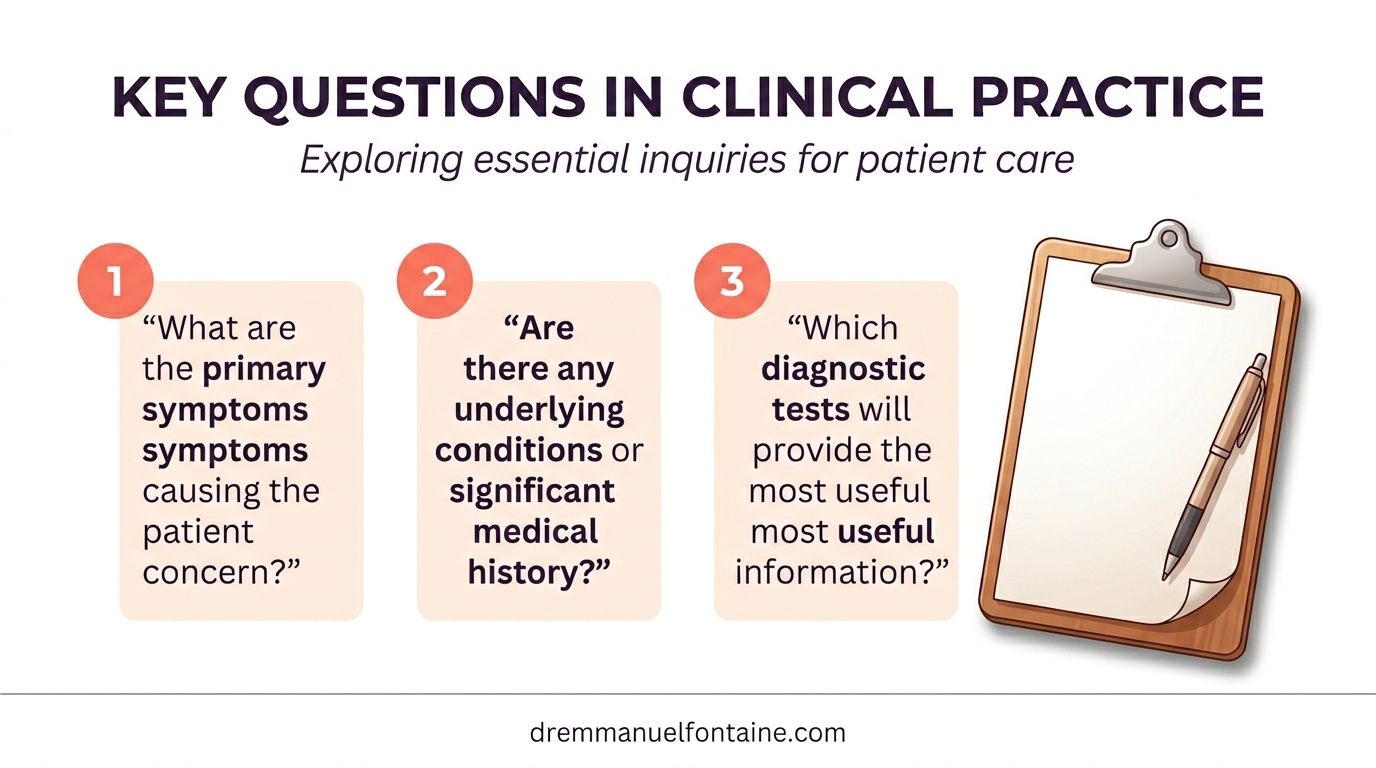
If you walk in with a printed pig paper and a request for a specific product, the conversation gets narrow fast. If you walk in with a genuine question, the conversation opens. The right question is not “should I give my bitch or my queen this probiotic?”. The right question is closer to “the sow research suggests maternal nutrition shapes colostrum quality. Is there anything you would change about how we approach my dam this gestation, given what you currently know?” The first version forces a yes/no. The second invites your vet to think with you, even if the honest answer is “we are still figuring this out together”.
Three Conversation Openers for Your Next Visit
These are not interrogation prompts. They are conversation openers that fit naturally into a pre-breeding or mid-gestation visit, with both you and your vet acknowledging that the dog and cat science is still early.
| Your Conversation Opener | What This Lets You Both Explore | What You Take Away |
|---|---|---|
| “What do you currently make of the maternal-probiotic question for my dam?” | An honest read on whether your vet has been tracking this literature, and what they think of it for your specific dam, breed, and program. | Even “I have not read it yet” is useful; it tells you where the conversation is starting from. You can offer to share what you have read. |
| “If we wanted to change anything about her late gestation this time, where would you start?” | A practical anchor. Diet quality? Stool quality? Body condition? This question keeps the conversation in things you can both act on now. | A small, specific change to track this litter. Do not push for a strain or a dose; push for a tracking variable. |
| “Are there observations from this litter you would want me to send back so we can build a baseline?” | Pulls your vet into the loop as a partner in the next decision, not just this one. Most are happy to be asked. | A short list of things to log: weights, stool patterns, dam appetite, neonatal vigour. You and your vet build the baseline together for next time. |
When Your Vet Says “We Don’t Know Yet”
Sometimes the answer will be we do not know yet, or not now. That is the most accurate answer the field can currently give for many specific dams in many specific situations, and it is not a brush-off. Maybe your dam is in a healthy program with no flagged colostrum or growth issues, in which case the marginal benefit of any new strategy is small. Maybe she has a co-existing condition that makes any change to gut microbial pressure unwise this cycle. “We do not know yet” is a real clinical answer. The right response is to use the cycle to build the dataset that will sharpen the next conversation: weight curves, stool patterns, dam appetite, neonatal vigour scores. That is a permanent gain regardless of which way the supplementation question lands.
What This Changes in How You Watch a Litter
Even without supplementing anything, the sow translation work changes how I watch a litter, and it has changed how I would coach you to watch yours. Recall the colostrum window: short, decisive, and the moment when most of the passive-immunity work happens. The first 48 hours after birth become a measurement window, not a quiet observation period. Here is how I would re-shape your monitoring without changing your feeding plan, until your vet says otherwise.
The Window That Matters Most
If a maternal supplementation conversation does open, the window is the variable that matters most. The pig literature targets late gestation through lactation because both the colostrum signal and the milk-microbiome signal need time to register. In dogs and cats, the same window has to be redrawn at the species’s gestation length: late canine gestation begins around day 45, late feline gestation begins around day 45, and the colostrum-priority window is the last two weeks of pregnancy in both.
| Window | Dam Action | Breeder Observation |
|---|---|---|
| Late gestation (last 2 weeks) | Diet already formulated for gestation/lactation; any vet-directed maternal supplementation initiated during this window | Track dam appetite daily, body condition score (BCS) weekly, water intake, and stool quality (using the chart your vet uses) |
| Whelping or queening day 0 to 24 hours after birth | First colostrum feeds; ensure each puppy or kitten latches and nurses | Weigh every neonate at birth and again at 12 and 24 hours; record vigour score |
| Days 1 to 14 (peak passive immunity dependence) | Maintain dam nutrition; address mastitis or appetite drops with vet immediately | Track weight gain in grams daily; use breed-appropriate neonatal growth charts from your vet |
| Days 14 to 35 (microbiome maturation) | Sustain lactation feeding; no abrupt diet changes | Monitor stool patterns in the litter; flag any weight stalls |
| Weaning transition (around 6 weeks onward in both dogs and cats; queens may continue limited nursing through 8 weeks) | Smooth transition; document anything you tracked this litter for the next-cycle conversation | Document weights, growth curves, dam recovery for the next-cycle conversation |
The Tools You Already Have
You do not need a research lab to apply the spirit of the sow data. You need disciplined tracking of the variables your vet can interpret. The same tools the pig studies relied on, in cruder form, are already in your kennel or cattery. The job is to use them with intent.
| Tool | What It Measures | Where to Use It |
|---|---|---|
| Neonatal weight curve (in grams) | Birth weight, 12-h check, 24-h check, daily weights through day 14 | Use breed-appropriate neonatal growth charts available from your vet |
| Neonatal vigour scoring (heart rate, respiration, reflex response, mucous-membrane color, motility) | An at-birth score of how each puppy or kitten is doing, similar in spirit to a human APGAR | First 10 minutes of life and again at 1 hour |
| Dam appetite and water intake log | Daily intake during the last 2 weeks of gestation and through peak lactation | Track in grams of feed consumed and mL of water |
| Dam stool consistency | Stool quality scored against the same fecal-score chart consistently. Several charts are in circulation, so ask your vet which one their clinic uses and use that one | Daily during late gestation and the first 2 weeks of lactation |
| Litter stool observation | Stool quality and frequency in neonates from day 7 onward | Document any deviations and bring photos to the vet visit |
How I Think Through the Question
This is not a recipe. This is how I work through the question myself when a breeder asks whether maternal probiotics make sense for the next litter, based on what we currently know from the broader scientific literature. I think of it as a sequence of gates. At every gate the answer is decide with your vet, not decide alone.
The first gate is your dam’s history. If she has shown colostrum or growth issues in prior litters, the case for a maternal nutrition review is strong. The second gate is your facility. If the kennel or cattery has any active disease pressure, sanitation and biosecurity outrank any feeding strategy , full stop. The third gate is your dam’s overall health. If your vet has flagged anything, address that first; supplementation does not solve underlying medical issues. The fourth gate is the diet itself. A diet already formulated for gestation and lactation is simpler, more reliable, and supported by stronger data than any single-strain supplement. If you are not on one, fix that before anything else. Only when all of those gates are clear does the conversation about a vet-directed supplementation trial , window, strain category, tracking , become useful.
| Variable | What the Sow Studies Tell Us |
|---|---|
| Strain category | Defined yeasts, defined Bacillus species, and defined lactobacilli have all shown maternal-supplementation effects in sows. The category that fits a dog or cat best is a vet conversation. |
| Dose | Specific doses do not transfer across species; a vet-directed dose is the only safe path. |
| Window | Late gestation through lactation is the window that consistently shows colostrum and milk effects in sows. |
| Reachability | Maternal supplementation can shift the offspring gut microbiome through milk, not only at the colostrum window. |
| Persistence | Effects on offspring microbiome can persist past weaning. |
Conclusion
Sow research has done something for the maternal-microbiome conversation that canine and feline research has not yet been able to do at the same scale. It has shown, in a controlled and repeatable way, that what the dam eats lands on the litter. The mechanism is the maternal gut shaping the milk, and the milk shaping the offspring. The currency is colostrum. The downstream signal is offspring growth, gut quality, and immune tone , for puppies and for kittens.
That story is real, and the dog data is starting to confirm a directional echo. The cat data is not there yet, and queens are reading this through one extra layer of caution. But the sow data is not a recipe in either species. It is a translation model. Bring the questions to your vet, not the answers. Track your litters with discipline so the next conversation is sharper than this one. We are figuring this out together , for both bitches and queens.
Get the next issue on Saturday morning
Every Saturday, my free newsletter brings you one piece of science on reproduction and newborn care in dogs and cats, written for breeders and their veterinarians. Read it in English, French, Spanish or Portuguese.
Free. Unsubscribe anytime.


