🇫🇷 Lire en Français | 🇪🇸Leer en Español | 🇧🇷Leia em português
When a litter looks unsettled in the third week, most breeders ask the same question first. Does she have enough milk? It is a fair question, but it is hard to answer by looking at the litter. By the time milk supply is obvious enough to worry about, the situation has usually been building for a while.
There is an easier place to look. The mother herself. Her weight, her body condition and her muscle change in ways you can measure, and those changes often show up before anything about the litter looks wrong. Not always, but often enough that watching her is the better use of your attention.
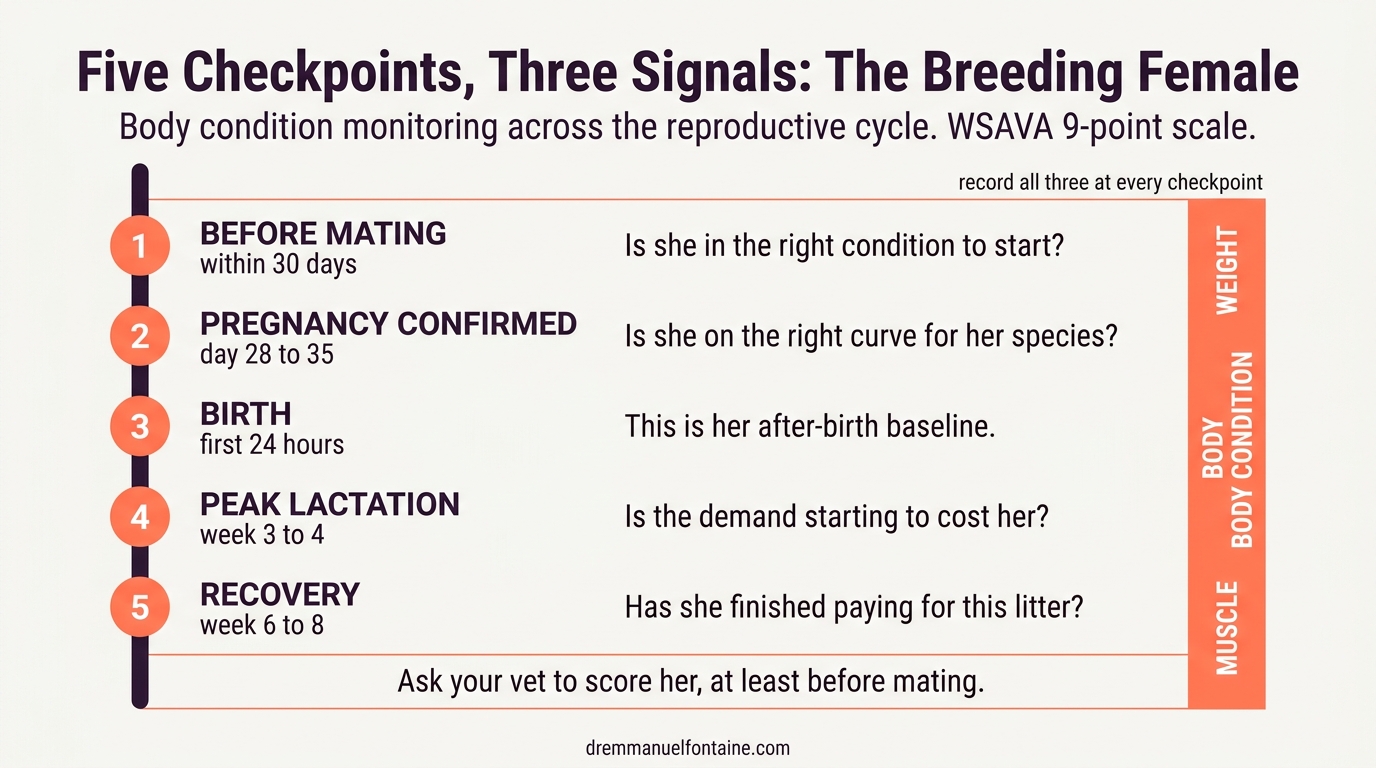
So this article gives you one system. Five checkpoints across the cycle. Three signals at each one: weight, body condition and muscle. If you remember nothing else, remember those two lines.
The short version
- Watch her at five checkpoints: before mating, at pregnancy confirmation, at birth, at peak lactation in weeks 3 to 4, and during recovery in weeks 6 to 8.
- At each one, record three things: her weight, her body condition score, and whether her muscle still feels full.
- Body condition score, or BCS, is a simple way of judging how much fat she is carrying. This article uses the 9-point scale for both species, and the target at mating is 4 to 5 out of 9 in the female dog and 5 out of 9 in the queen.
- While she nurses, my aim is a stable weight in the dam and only a small, gradual loss in the queen. Weigh her at least once a week, so you are reading a line and not a single number.
- A female can hold her weight and still lose muscle. That is the best reason to put your hands on her rather than trusting the scale alone.
- The two triggers I use for calling the veterinarian, which are my own monitoring thresholds rather than published cutoffs: a loss of 2 body condition points within 14 days, or a loss of more than 10 percent of her after-birth weight in one week.
The system: five checkpoints, three signals
Weight, body condition and muscle each answer a different question. Each also covers a blind spot the other two leave open, which is why they are recorded together rather than one at a time.
- Weight tells you which way she is going, and how fast. It is the only one of the three that shows a trend within days.
- Body condition tells you how much fat she is carrying now. It is a hands-on judgement, so it moves more slowly and depends on who is scoring.
- Muscle tells you what she is spending. Weight and body condition can both look steady while lean tissue is going.
You take the weight on a scale. You take the body condition score with your hands on her ribs, waist and spine, and the muscle with your hands over her skull, shoulder blades, loin and hips. All three together take about two minutes. Recording only one of them, which is what most kennels and catteries do, leaves a gap you will not notice until it matters.
The five checkpoints are not arbitrary. Each one sits where the answer changes what you do next, and each falls when you are already paying close attention to her. Photographs and appetite are not a fourth and fifth signal: photographs are how you record the three, and appetite is the separate same-day alarm described further down.
| Checkpoint | When | The question you are answering |
|---|---|---|
| 1. Before mating | Within 30 days of the planned mating | Is she in the right condition to start? |
| 2. Pregnancy confirmed | Day 28 to 35 | Is she on the right curve for her species? |
| 3. Birth | First 24 hours | What is her after-birth baseline? |
| 4. Peak lactation | Week 3 to 4 | Is the demand starting to cost her? |
| 5. Recovery | Week 6 to 8 | Has she finished paying for this litter? |
Read a line, not a snapshot
One weight on one day tells you almost nothing. The same weight, taken the same way, four weeks running, tells you whether she is holding, drifting or falling. Every decision in this article is made on the shape of that line rather than on a single reading. That matters because your eye is the least reliable instrument you own for slow change. You see these animals every day, so your sense of normal quietly resets to whatever you saw yesterday.
Why the mother is worth watching this closely
Peak lactation, in weeks 3 to 4, is the heaviest sustained demand of the whole reproductive cycle. A nursing female dog may need three to four times the energy she needs when she is not breeding, and a queen commonly needs two to two and a half times hers. Athletes are prepared before the race, not during it. Peak lactation can ask for more than food alone easily covers at the time. That is why two things matter so much: reaching mating in the right body condition, and then following the feeding curve that fits her species through the pregnancy.
Same milk, different puppies
Most of us assume that if maternal weight affects the litter, it does so through the milk. Recent work in dogs makes that assumption harder to hold. Researchers compared female dogs in ideal body condition, at 4 to 5 out of 9, with overweight ones, at 6 to 7 out of 9. They weighed every puppy daily for three weeks. The nutrients they measured showed no significant difference between the two groups, in a study too small to rule out smaller differences or components nobody measured. The puppies were a different story. Those born to the overweight mothers gained faster in the first days. A mild form of swimmer puppy syndrome, where the chest flattens and the legs splay out to the side, appeared in the overweight group and not in the ideal-condition group.
What the study cannot do is explain why. It was not designed to test any mechanism, and the nutrients they measured did not account for the difference. In women, being overweight before pregnancy is associated with a slower start to milk production, which is worth knowing but is not evidence in our species. The dog work does sit alongside older work on nutrition in the pregnant female, in which heavier females had more difficult labours, although why that happens is not settled. Two separate lines of evidence favour arriving at mating in ideal body condition rather than overweight, and that is enough for me to act on.
The queen who held her weight and still lost muscle
Researchers working with lactating queens measured what the cats actually ate, week by week, and what their bodies did with the protein in it. The diets met the protein recommendation in force at the time. By the second week of nursing the queens were using more protein than they were taking in, and body scans showed that some of them were losing lean tissue, not only fat.
That is the part that matters day to day. A change like that does not have to announce itself on a scale, and it does not have to look dramatic from across the room. The scale alone will not show it to you. Your hands will.
Checkpoint by checkpoint
1. Before mating
Body fat is not dead weight waiting to be burned. It is active tissue that tells the brain how much is in reserve, and that signal is part of what allows a normal cycle to start. Females carrying too little condition are more likely to show missed or silent heats and early pregnancy loss. Females carrying too much face the opposite set of problems, including less efficient labour.
So this checkpoint has one job: bring her to the start line in the right shape. Target 4 to 5 out of 9 in the female dog and 5 out of 9 in the queen, confirmed by hand rather than by eye. Ask your veterinarian to score her too, so the number in your record is not only your own. If she is at 6 out of 9, work out together whether there is enough time for a slow, steady correction before the planned mating. If there is not, wait for the next cycle rather than crash-dieting her to meet a date in the diary.
2. Pregnancy confirmed
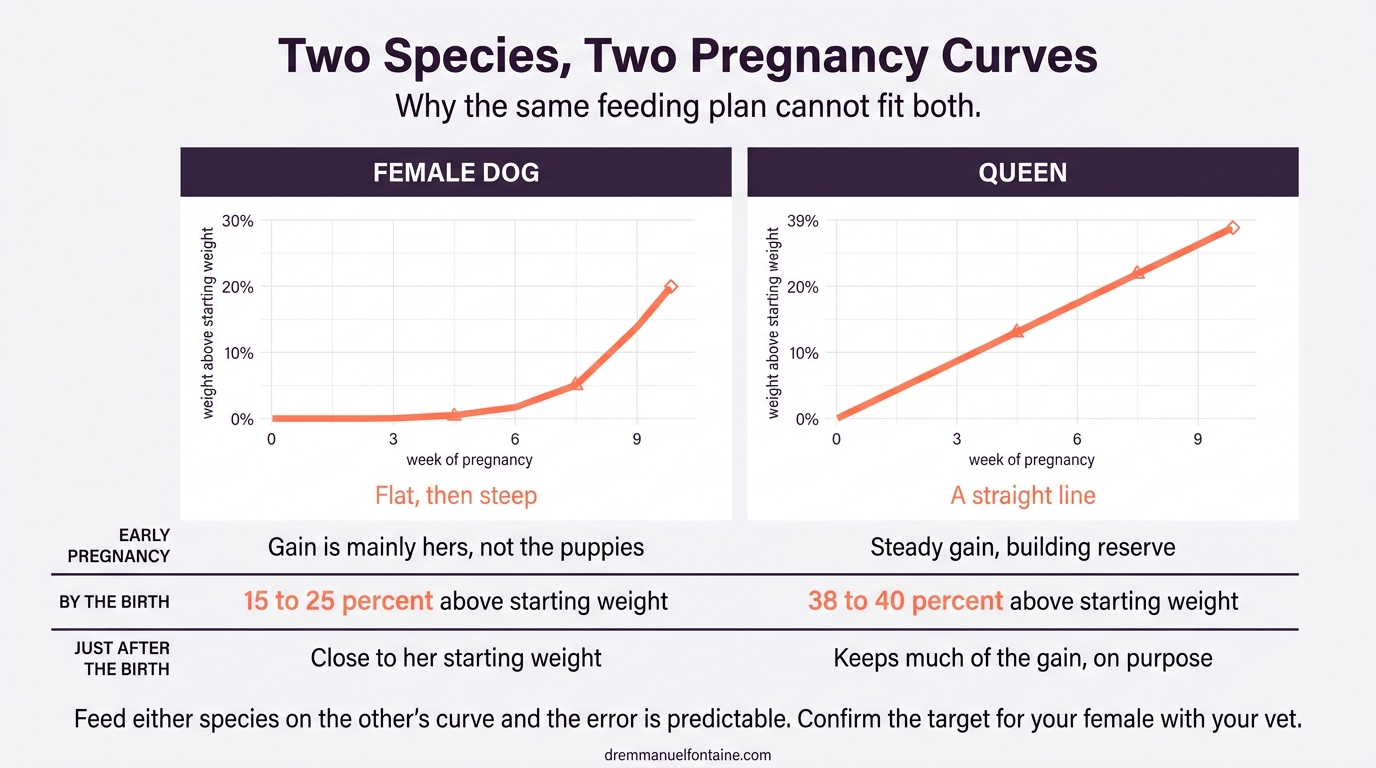
This is where dogs and cats stop being comparable, and the simplest way to hold it in your head is as two shapes. The dog is flat, then steep. Most of the puppies’ body mass is laid down in the last three to four weeks. Weight gained in early pregnancy is therefore mainly maternal rather than fetal, and overfeeding in that first stretch mostly adds to her own stores. The cat is a straight line. The queen gains steadily from the first week, and most of that gain is not kitten. It is the reserve she will spend on feeding them, which is why she still looks substantial the week after queening. She is meant to keep it.
Feed either species on the other’s curve and you get it wrong in a predictable direction. The dog arrives at whelping carrying fat she never needed. The queen arrives at the hardest month of her life underfunded.
| Female dog | Queen | |
|---|---|---|
| Early pregnancy | Little change; gain here is mainly hers, not the puppies | Steady gain from week 1, building reserve |
| Late pregnancy | Most of the fetal mass goes on in the last 3 to 4 weeks | The same steady climb continues |
| By the birth | About 15 to 25 percent above her starting weight | About 38 to 40 percent above her starting weight |
| Just after the birth | Close to her starting weight | Keeps much of the gain, on purpose |
3. Birth and the first days
Take the three measurements within the first 24 hours, once she has settled with the litter. This gives you her after-birth weight, which is the number one of the practical triggers below is measured against. You are also checking appetite here, because a female who is not eating well in the first days will not keep up with what is coming.
4. Peak lactation, weeks 3 to 4
This is the checkpoint that matters most, and it is where I want to correct something that has become common sense without ever being correct. Nursing is not supposed to melt her. In the female dog, my aim through the whole nursing period is a stable weight. She is on a diet built for this and eating several times her usual ration, so a flat line is a realistic target. Some texts accept a dam sitting slightly below her pre-breeding weight at peak. I do not treat that as a target, because a falling line is the earliest information you are going to get.
In the queen, a small loss is expected. She is spending the reserve she built in pregnancy, and the aim is to keep that loss small and gradual. Fast loss, or a queen well below her starting weight while the kittens are still nursing hard, is a different picture and needs looking at. This is the reason for the weekly weight. Between one Monday and the next you will not see the change by eye. Four weekly numbers in a column show you the shape of the line early enough to look into what is behind it.
5. Recovery, weeks 6 to 8
By six to eight weeks she should be moving back toward the weight, condition and muscle she started with. A female who has not recovered has not finished paying for this litter, and breeding her again on that schedule means the next pregnancy starts from a deficit. This is also the checkpoint breeders skip most often, because by then the litter is taking all the attention. It is worth protecting. The recovery curve is the most useful thing you can have in front of you when you are deciding whether to breed her on her next cycle or the one after.
How to take the three measurements
The weight
You do not need laboratory equipment. These are adult dogs and cats, so a scale that reads to about 100 g (roughly a quarter of a pound) and gives the same answer twice in a row is enough. Consistency beats precision here: the same scale, the same day of the week, the same time relative to a meal, written on the litter record next to the other two signals.
The body condition score
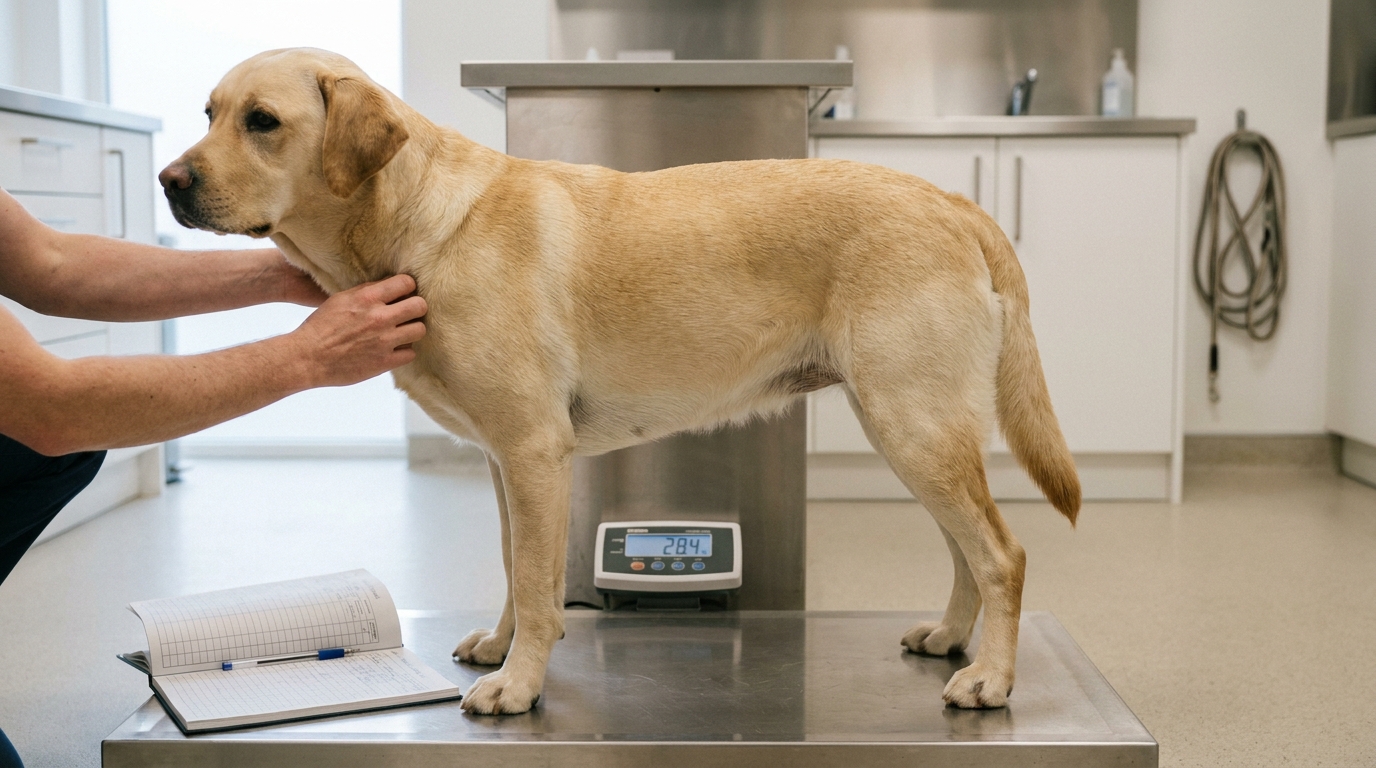
Body condition score is a structured way of judging body fat by hand. This article uses the 9-point scale, where 4 to 5 out of 9 is ideal, which is the scale the WSAVA charts use for both dogs and cats. Use the same scale every time so the scores in your record can be compared with each other. The check has four points and takes under a minute. Look down at her from above for a waist behind the ribs. Look from the side for a belly rising toward the back legs. Then run flat hands along her ribs, which should feel like the knuckles of a flat hand resting on a table. Last, feel the spine and hips, which should be findable under a thin cover rather than either buried or standing out.
Be aware of your own bias here. In studies comparing owners and handlers against trained assessors, a large share of owners underestimated how heavy their own dog was. The same pattern appears in cats, and the misreadings cluster around the boundary between ideal and slightly heavy. That is the boundary that matters most before mating. So I like a veterinary score whenever she is seen, and especially before mating, rather than relying only on the score you take at home.
The muscle
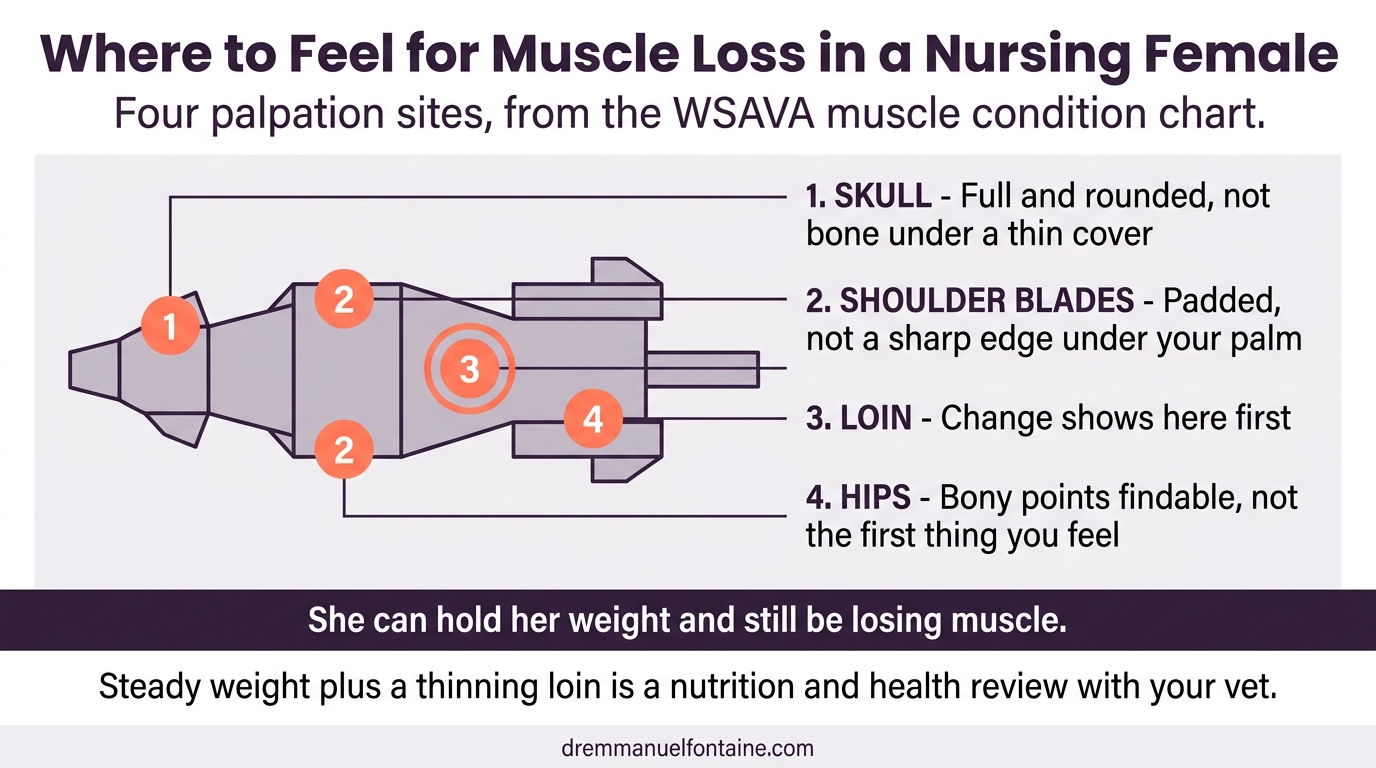
Muscle is assessed by feel, in four places, and the question in each is the same: does this feel full and rounded, or can I feel bone under a thin cover? Check over the skull, above and behind the eyes. Check over the shoulder blades. Check along the loin, on both sides of the spine between the last rib and the hips. Then check over the hips themselves. In a nursing female, change usually shows first along the loin.
Muscle loss and fat loss do not always happen together, so she can hold her weight, hold her body condition score, and still be thinning over the loin. Compare her against her own last checkpoint rather than against another animal, because breed and build vary enormously. When you find it, resist the urge to reach straight for a higher protein food. Muscle loss makes protein worth reviewing, but total intake, energy density, illness and how well she is absorbing what she eats can all produce the same finding. It is a nutrition and health review with your veterinarian.
The photographs
Take two photos at every checkpoint, one from directly above and one from the side at her own height, in the same light each time. It costs ten seconds and it answers a real problem: familiarity hides gradual change, and a photograph does not. Two of them a fortnight apart, side by side on your phone, will settle in a second an argument you could otherwise have with yourself for a week. They are also simple to send to your veterinarian when you are not sure whether what you are seeing is real.
When to bring in your veterinarian
I use two triggers to decide when watching a trend becomes making a phone call. Be clear about what they are. They are not validated cutoffs from a clinical trial. They are the points I use in practice so that a breeder does not keep watching while a trend is clearly heading the wrong way. The first is a loss of 2 body condition points within 14 days while she is nursing. The second is a loss of more than 10 percent of her after-birth weight in a single week.
The first catches a slide that is deep. The second catches one that is fast, in a female whose condition score has not moved much yet. Either on its own is enough, and neither asks you for anything you are not already writing down. There is also a third trigger that has nothing to do with numbers. Poor appetite, unusual flatness, or any sudden change in how she is behaving with the litter deserves a same-day call. A trend is something you follow. A sudden change is something you call about.
What you bring changes the conversation. Weekly weights, condition scores, a note on muscle, what she has actually eaten, and comparable photographs. Together they let your veterinarian see the timeline, the direction and the speed in a few seconds. That is a very different starting point from she seems thinner than she was. The record will not diagnose anything by itself, and it is not meant to. Your job is to notice and to write it down. Working out the cause and deciding what to do about it is your veterinarian’s.
| What your record shows | What to do |
|---|---|
| Weight holding, muscle full, behaviour normal | On track. Keep the weekly checks going. |
| 1 condition point lost over 14 days | Check what she is actually eating, and look again in 7 days |
| 2 or more condition points lost in 14 days | Call your veterinarian this week |
| More than 10 percent of after-birth weight lost in 1 week | Call your veterinarian this week |
| Weight steady, but muscle thinning over the loin | Call your veterinarian; nutrition and health review |
| Off her food, very flat, or a sudden change with the litter | Call the same day |
Start with the next female you plan to breed
Not the one nursing right now. The next one. Weigh her, score her, put your hands on her muscle, take the two photographs, and write those four things on one line with today’s date. Then repeat it at the five checkpoints: same three signals, same order, every time.
The system is deliberately small, because a small one is what still gets done in the middle of a whelping season. The payoff is seeing the change early, while there is still time to work out what is driving it and put it right. The alternative is reconstructing the story afterwards from memory, when the only honest answer to when did this start is that nobody wrote it down.
Get the next issue on Saturday morning
Every Saturday, my free newsletter brings you one piece of science on reproduction and newborn care in dogs and cats, written for breeders and their veterinarians. Read it in English, French, Spanish or Portuguese.
Free. Unsubscribe anytime.


