🇫🇷 Lire en Français | 🇪🇸Leer en Español | 🇧🇷Leia em português
The first 48 hours of a puppy’s life decide more than most breeders realize. Birth weight, body temperature, the first colostrum feed, the first weigh-in at 12 hours: these tiny numbers carry the whole litter. The good news is that you have real levers before any of those numbers are recorded, and they live in the bitch’s bowl during gestation.
Maternal supplementation in dogs is not new. Folic acid, omega-3 fatty acids, and antioxidants already form the prenatal stack most repro vets recommend. What is new is one specific live yeast strain, Saccharomyces cerevisiae var. boulardii CNCM I-1079, and a 2024 dog-specific study that put it on the table as a serious addition to that stack.
This blog walks you through why maternal supplementation matters in the first 48 hours, what S. boulardii CNCM I-1079 actually adds, and how to use it in your kennel without overcomplicating your prenatal plan. The aim is simple: give you a practical reason to consider strengthening your supplementation protocol.
- TL;DR
- What Maternal Supplementation Already Does for Your Litter
- What Live Yeast Adds to the Stack
- How to Use Live Yeast in Your Kennel
- What This Does Not Replace
- Conclusion
TL;DR
- Maternal supplementation already works. Folic acid, omega-3s, and antioxidants are well-established. Live yeast is the newest addition.
- The 2024 evidence is canine-specific. A 2024 study followed pregnant bitches supplemented with S. boulardii CNCM I-1079 from day 28 of gestation through weaning.
- Better colostrum, better early milk. Supplemented bitches produced richer first feeds and stronger early-lactation milk.
- Fewer underweight puppies. More puppies were born closer to the litter average; fewer arrived in the small/at-risk range.
- Softer first vaccine response. Puppies from supplemented bitches showed less of the sluggish 24- to 48-hour reaction some puppies have after their first shot.
- It is not a mortality fix. Overall litter mortality was the same in both groups. Live yeast supports the live puppies; it does not save the ones in critical trouble.
- Where to start: at your pre-breeding consult. The strain identity (CNCM I-1079) and the timing (day 28 of gestation through weaning) are the variables that matter.
What Maternal Supplementation Already Does for Your Litter
Before we talk about live yeast, it helps to remember that maternal supplementation in dogs is not a frontier topic. There is already a working stack of supplements that most repro vets weave into a prenatal plan. Knowing what that stack looks like is the right starting point. Live yeast is not replacing any of it. It is being added to it.
The Existing Prenatal Stack: Folic Acid, Omega-3, Antioxidants
Three families of supplements have been part of the canine prenatal conversation for years. Folic acid supports neural tube formation and palate closure, and matters most in lines that have a history of palate or midline issues. Omega-3 fatty acids (DHA in particular) feed fetal neural development and shift the fat profile of the milk in a direction puppies use well. Antioxidants (vitamin E, selenium, and others) support oocyte quality and help manage the oxidative stress that gestation puts on the dam.
Each one has a clear role. None is a panacea. The point is that by the time you reach the live yeast question, you are already standing on a stack that works. The full case for these three is in our piece on the established prenatal supplement plan; here, we are layering live yeast on top.
| Supplement | What It Supports in the Litter |
|---|---|
| Folic acid | Neural tube formation, palate closure |
| Omega-3 (DHA) | Fetal neural development, milk fat profile |
| Antioxidants (vitamin E, selenium) | Oocyte quality, gestational oxidative stress |
Why the Maternal Microbiome Is the New Lever
The newer thread in maternal supplementation is the bitch’s gut microbiome. The bacteria living in her intestine shift through pregnancy in response to hormones, food intake, and stress. They feed off what she eats, and what they produce in return ends up in her colostrum, her milk, and the environment her puppies are born into.
A puppy is born with a digestive microbiome that is evolving at a fast pace: progressively populated by the dam, the whelping environment, and the air. The microbes that arrive in those first hours are the ones that take hold. By 24 hours, the puppy’s gut is closed: colostrum is no longer absorbed across the gut wall, in any puppy. Anything the bitch can do during gestation and lactation to deliver a stable, well-stocked microbial environment shows up in the litter before the breeder weight check ever flags it.
| What Happens in the Bitch | What Reaches the Puppies |
|---|---|
| Gut bacteria shift through pregnancy | First microbes the puppies encounter at birth |
| Diet and supplements feed those bacteria | Colostrum and early-milk composition |
| Stable gut means stable milk supply | Steadier weight gain in the first week |
| Less inflammation in the dam | Calmer immune environment for the litter |
Where S. boulardii CNCM I-1079 Fits In
Live yeast is not a probiotic in the bacterial sense. Saccharomyces cerevisiae var. boulardii is a defined eukaryote (a yeast, not a bacterium) that does not colonize the canine gut. It passes through. The hypothesis behind supplementing with it is that its transient presence in the gut interacts with the local immune tissue and the resident bacteria during a vulnerable window: gestation and lactation.
The strain matters. The 2024 study that anchors this blog used one specific strain at one specific dose: S. boulardii CNCM I-1079. Other yeast strains, even other S. boulardii strains, are not interchangeable. If you bring this up with your vet, ask for the strain by name.
| Tool | Status in 2026 | Practical Note |
|---|---|---|
| Folic acid, omega-3, antioxidants | Established | Already in most prenatal stacks |
| S. boulardii CNCM I-1079 | New (anchored by one canine study) | Strain identity matters; ask for it by name |
| Other yeast or probiotic strains | Mostly extrapolated from other species | Not interchangeable with the trial strain |
What Live Yeast Adds to the Stack
This is where the 2024 study earns its keep. Researchers compared two groups of bitches: one group received S. boulardii CNCM I-1079 from day 28 of gestation through weaning, the other did not. The puppies were tracked from the first breath to about 8 weeks of age. Three findings are worth pulling out for the whelping box.
Better Colostrum, Stronger First Feed
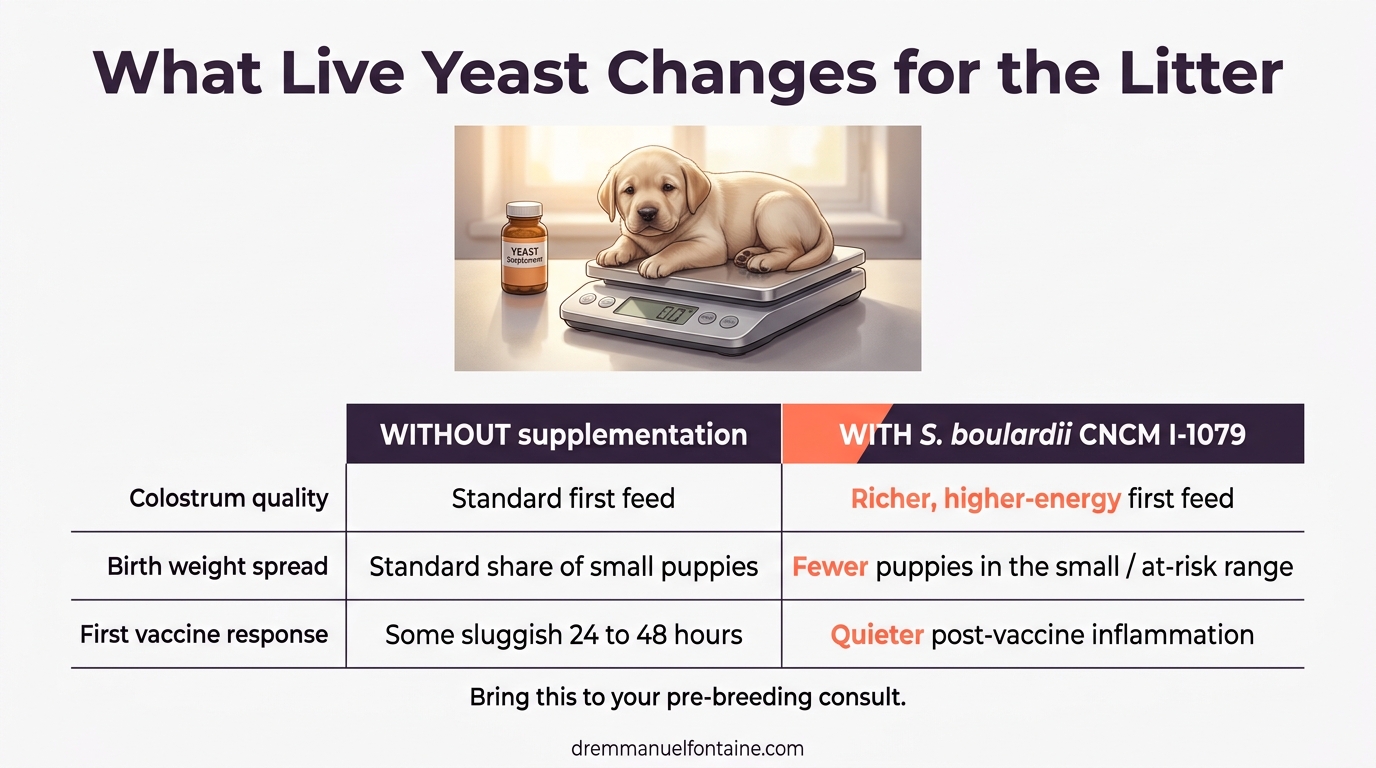
Colostrum is the first feed and the most important one. It carries the antibodies the puppies cannot make yet, and the energy they need to keep their body temperature up while they figure out the teat. The supplemented bitches produced richer colostrum: more energy per gram, and a milk profile at day 7 that was higher in protein than the control group. Translation for the whelping box: stronger first feeds, fuller bellies through the first week.
This is the most important practical finding. The breeder cannot test colostrum quality at the kitchen counter, but the breeder can see the downstream: puppies that latch faster, suck more confidently, and recover from birth without needing extra warmth or hand support.
| Window | What the Puppies Got | What You See at Home |
|---|---|---|
| First 24 hours (colostrum) | Higher-energy first feed | Stronger latch, faster recovery from birth |
| Day 7 (early milk) | Higher-protein milk | Steadier weight gain, fuller bellies |
| Through lactation | Stable milk supply | Easier first three weeks for the dam |
Fewer Underweight Puppies at Birth
In every litter, some puppies are born noticeably smaller than their littermates. Those small puppies carry most of the mortality risk in the first 48 hours. They lose body heat faster, latch later, and run out of glucose sooner.
In the supplemented group, fewer puppies were born in that small/at-risk range. More were born closer to the litter average. The trial does not say maternal yeast prevents small puppies. It says the maternal nutritional environment is a real lever on early birth weight, beyond what genetics and breeding choices already deliver. For the breeder, the practical effect is fewer puppies needing extra warmth, fewer hand-feeding decisions in the first 24 hours, and a smoother whelping recovery for the dam.
| Without supplementation | With S. boulardii CNCM I-1079 |
|---|---|
| Standard share of small puppies in the litter | Fewer puppies in the small/at-risk range |
| Standard number of puppies needing extra warmth | Fewer puppies needing extra warmth in the first hours |
| Standard hand-feeding decisions | Fewer hand-feeding decisions in the first 24 hours |
| Same overall mortality | Same overall mortality |
A Softer First Vaccine Response
All puppies make protective antibody after their first vaccine. That part did not change between the two groups. What changed was the inflammatory side of the response: puppies from supplemented bitches had a quieter immune flare in the day or two after their shot.
In practical terms: less of the sluggish, off-feed 24 to 48 hours that some puppies show after a first injection. Same protection, easier recovery. This is a softer first vaccine, not a stronger one. It matters for the breeder because those first 48 hours after vaccination overlap with the moment buyers are starting to bond with their puppies, and a calmer puppy at that handoff is a real practical win.
| Without supplementation | With S. boulardii CNCM I-1079 |
|---|---|
| Normal post-vaccine inflammatory bump | Quieter post-vaccine inflammatory bump |
| Some puppies sluggish or off-feed 24-48h | Less of that 24-48h slump |
| Protective antibody made | Protective antibody made (same) |
How to Use Live Yeast in Your Kennel
If the findings above ring true for the way you breed, the next questions are practical: when to start, how long to continue, and what to watch for. The 2024 study built its window deliberately, and the design holds up as a working roadmap. Here is how to translate it into your prenatal plan.
When to Start: Day 28 of Gestation
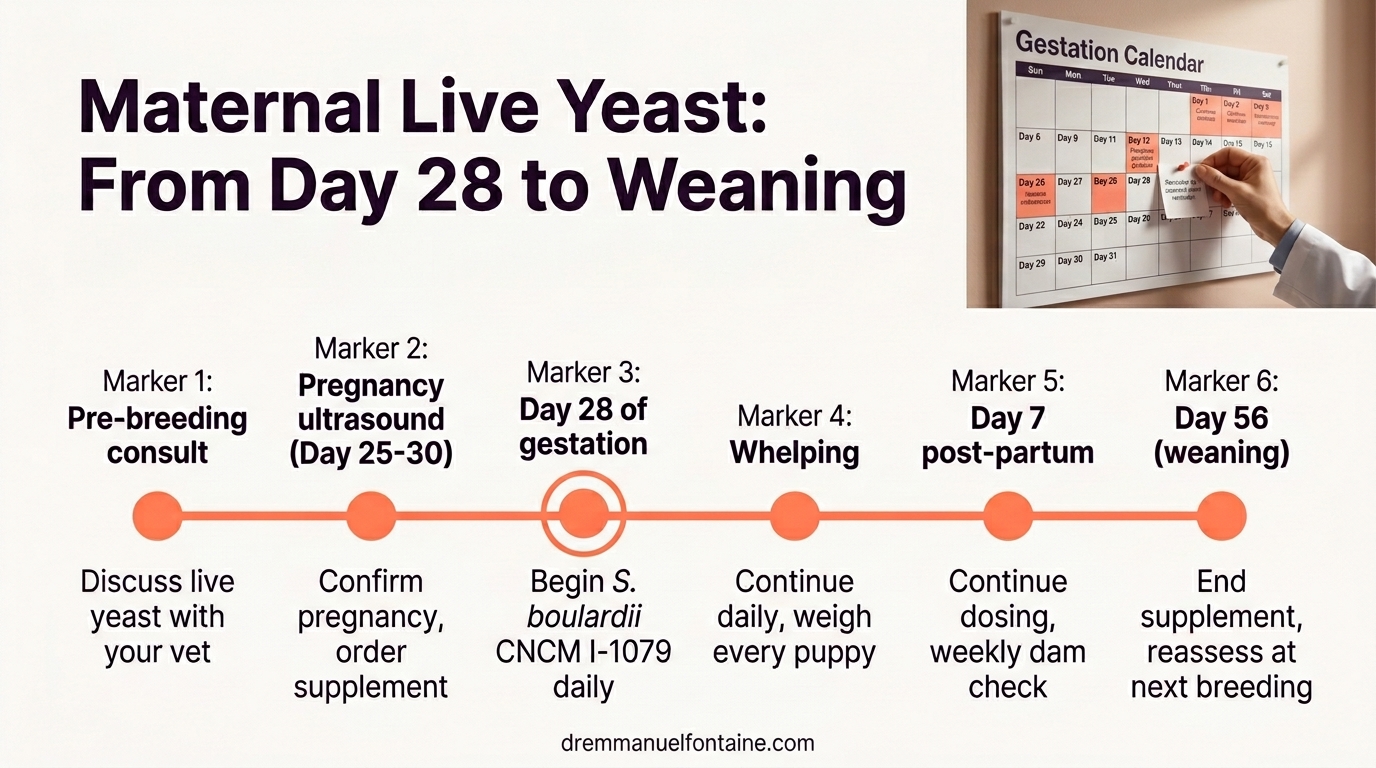
Supplementation in the trial began at day 28 of gestation: after embryonic implantation, after pregnancy is confirmed by ultrasound, and before the major fetal growth push of the last trimester. That is the practical anchor.
On the kennel calendar, pencil S. boulardii CNCM I-1079 in at the same appointment as your pregnancy ultrasound. One conversation, one decision, one date. If pregnancy is not confirmed, you have not committed to anything. If it is, the start date lines up with the rest of your prenatal plan.
| Stage | What to Do |
|---|---|
| Pre-breeding consult | Discuss adding live yeast to the supplement plan |
| Confirmed pregnancy (Day 25-30 ultrasound) | Begin S. boulardii CNCM I-1079 around Day 28 |
| First trimester | Hold off on yeast until pregnancy is confirmed |
How Long to Continue: Through Weaning
Supplementation in the trial ran from day 28 of gestation through weaning at about day 56 post-partum. That is roughly 12 to 13 weeks of consistent daily supplementation. The window is long on purpose: the gut-stability and milk-quality effects show up across late gestation, whelping, and lactation, and stopping early throws away part of what you are paying for.
The most common mistake to avoid is stopping at whelping. The colostrum bonus is delivered in the first 24 hours, but the milk-quality effect runs through the entire lactation. Continue daily until the puppies are weaned and you reassess at the next breeding.
| Window | What’s Happening | Why Continue |
|---|---|---|
| Day 28 to whelping | Late gestation, fetal growth | Stabilizes the dam’s gut through whelping |
| Whelping to Day 7 | Colostrum and transition to milk | Lifts colostrum and early-milk quality |
| Day 7 to weaning (~56 days) | Established lactation | Maintains milk supply, supports the litter |
| Post-weaning | End of supplementation window | Reassess at the next breeding |
What to Watch in the First 48 Hours
Maternal supplementation is upstream. The breeder’s job in the whelping box is downstream: weigh every puppy, write it down, and watch the curve. The published canine standard for concerning weight loss is more than 4% of birth weight by 48 hours. The cleanest way to think about it is even simpler: newborns should not lose weight, period. If they do, you need to know the percentage and the trend.
That puts the work where it belongs. Use a kitchen scale that reads to the gram. Weigh at birth, at 12 hours, at 24 hours, and at 48 hours. Most puppies will be back at birth weight by 48 to 72 hours. If a puppy is below 4% of birth weight at the 48-hour mark, or losing weight at 24 hours instead of holding steady, that is your flag.
On the vet conversation: if you have been weighing puppies for years and your bitch’s last few litters have been textbook, you already know what normal looks like. If this is your first complicated whelping, or your bitch has a history of weak puppies, your vet is the right partner to bring in early. Use the partnership when you need it. You don’t need to call for every weight curve, but you should not hesitate when something feels off.
| Time | Action | Flag |
|---|---|---|
| At birth | Weigh, record to the gram, label by toe ribbon | Birth weight noticeably below breed average |
| 12 hours | Re-weigh | Any weight loss without recovery in the next reading |
| 24 hours | Re-weigh | Newborn losing weight, not just holding steady |
| 48 hours | Re-weigh | More than 4% loss from birth weight |
What This Does Not Replace
Live yeast is one tool added to a stack. It is not a replacement for any of the work you already do before, during, and after a breeding. Knowing what it does not do is part of using it well.
It Does Not Lower Mortality
Overall puppy mortality from birth to weaning was the same in both groups in the 2024 study. The puppies that were going to be in critical trouble were still in critical trouble. Live yeast supports the live, viable puppies. It does not rescue the ones that needed surgical intervention, intensive thermoregulation, or specialist care from the first hour.
Take the framing seriously: this is a quality-of-litter intervention, not a survival intervention. The work that drives mortality down stays where it has always been: pre-breeding workup, ovulation timing, vaccination history, environmental hygiene, and the hands-on whelping protocol you already run.
| Claim | Status |
|---|---|
| Lifts colostrum and early-milk quality | Supported |
| Lowers the share of small/at-risk puppies | Supported |
| Quiets the post-vaccine inflammatory bump | Supported |
| Lowers overall litter mortality | Not supported |
| Replaces basic neonatal care | No |
| Works for any yeast strain | No (strain identity matters) |
It Does Not Replace Your Pre-Breeding Workup
Live yeast is a maternal nutrition lever. It does not substitute for Brucella canis screening, ovulation timing, progesterone work, or the conformation and health checks you already do. Those are decisions about whether and when to breed. Supplementation is a decision about how to support a confirmed pregnancy.
In other words, the prenatal stack lives downstream of the breeding decision, not upstream of it. If a bitch is not a good candidate to breed, no supplement closes that gap. If she is, then the question becomes which supplements to add and how to time them.
| Established practice | Where Live Yeast Fits |
|---|---|
| Brucella canis screening | Separate decision; do both |
| Progesterone-timed breeding | Separate decision; do both |
| Folic acid, omega-3, antioxidants | Adds to the stack, does not replace |
| Pre-breeding BCS work | Separate decision; do both |
| Vaccination and parasite control | Separate decision; do both |
How to Bring This Up With Your Vet
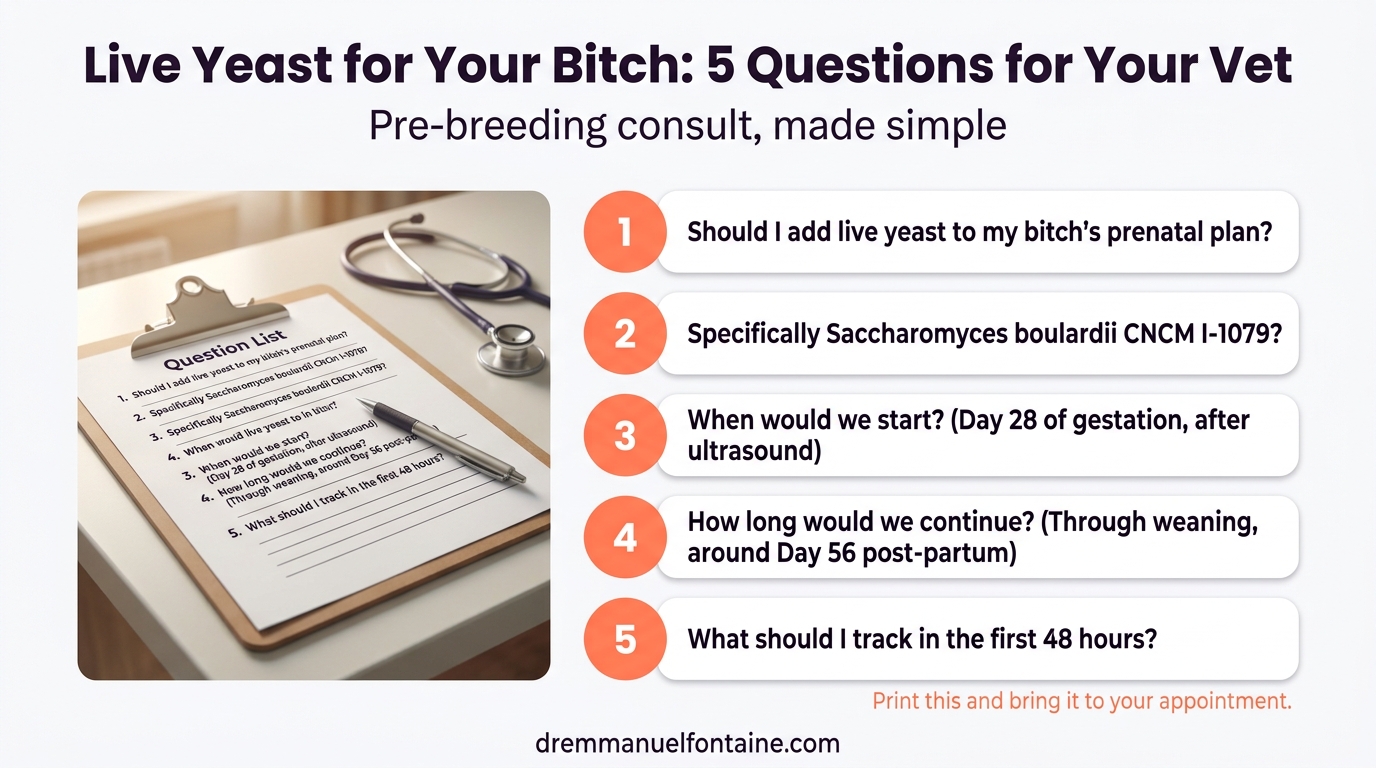
This is a conversation worth having at your pre-breeding consult, not in a panic on whelping day. Bring three things: the bitch’s history (parity, last litter outcomes, any prenatal issues), the strain identity (S. boulardii CNCM I-1079), and the timing (day 28 of gestation through weaning).
Your vet may have additional considerations specific to your bitch, your line, or your kennel setup. The goal of this conversation is not permission. It is partnership: bringing a tool you have decided is worth considering, and aligning on whether and how to use it for this breeding.
| Question for Your Vet | Why It Matters |
|---|---|
| Should I add live yeast to my bitch’s prenatal plan? | Tailors the decision to her history and parity |
| Specifically S. boulardii CNCM I-1079? | Strain identity is the variable that drives the evidence |
| When would we start? | Day 28 of gestation, after pregnancy is confirmed |
| How long would we continue? | Through weaning, around day 56 post-partum |
| What should I watch in the first 48 hours? | Builds the home-monitoring plan |
Conclusion
Maternal supplementation in pregnant dogs is not a question of whether. It is a question of which tools, at what dose, for how long. Folic acid, omega-3 fatty acids, and antioxidants have been doing their part in the prenatal stack for years. Live yeast is the newest addition, anchored by a 2024 dog-specific study using S. boulardii CNCM I-1079 from day 28 of gestation through weaning.
What it offers is concrete: richer colostrum, fewer underweight puppies, and a softer first vaccine response. What it does not offer is a mortality fix. Used well, in the window the trial defined, with the strain it tested, it is a real reason to strengthen your prenatal plan rather than leave it where it is. Bring it up at your next pre-breeding consult, and decide with your vet how to fold it in.
Get the next issue on Saturday morning
Every Saturday, my free newsletter brings you one piece of science on reproduction and newborn care in dogs and cats, written for breeders and their veterinarians. Read it in English, French, Spanish or Portuguese.
Free. Unsubscribe anytime.


