🇫🇷 Lire en Français | 🇪🇸Leer en Español | 🇧🇷Leia em português
The litter is on the ground. The mother is panting, exhausted, and licking. Most breeders breathe out at this moment. I tell mine the opposite: the next three weeks are where the work shifts from rescue to vigilance. Whelping is the sprint. The first 21 days that follow are the recovery window where metritis, mastitis, and postpartum hypocalcemia announce themselves with small signals before they become emergencies.
This article is about what matters during those three weeks, and how to think about what you are seeing. Your experience and your eyes are the first line of defense. You know this female better than any vet ever will after one exam. Your vet is your partner for the moments where a decision needs medical hands. The two of you give her a clean recovery, and her litter the mother they need.
TL;DR
- The first three weeks after whelping are when metritis, mastitis, and eclampsia almost always show up. Your daily eyes catch them before they break the litter.
- Trends matter more than single observations. A number on a thermometer is a marker. The pattern across days is the signal.
- Light spotting can be normal for weeks. Heavy persistent bright red flow or a foul smell is the call.
- Eclampsia risk peaks deeper into the watch window. Small breeds with large litters and females fed an unbalanced homemade diet carry the most risk.
What Recovery Actually Looks Like in the First Three Weeks
Uterine involution: the slow shrink behind every check
Uterine involution is the mother’s body shrinking the uterus back toward a non-pregnant size. After whelping, the uterus is still large, soft, and shedding the inner lining where the placentas were attached. The process unfolds across roughly a month, but the first three weeks are the loud half. The visible signal is the lochia: the vulvar discharge you see at the start of her recovery.
Early lochia is red-brown. It shifts to brown-green as uteroverdin, a placental pigment, takes over, then fades to light spotting that drifts off. Spotting on and off for a few weeks is not automatically abnormal. What changes the conversation is the character of the discharge, not the simple fact that it is there. Heavy persistent bright red bleeding, a foul odor at any point, or a sudden return of heavy flow after things had calmed are the moments to pick up the phone.
Mammary glands: the lactation workload starts loud
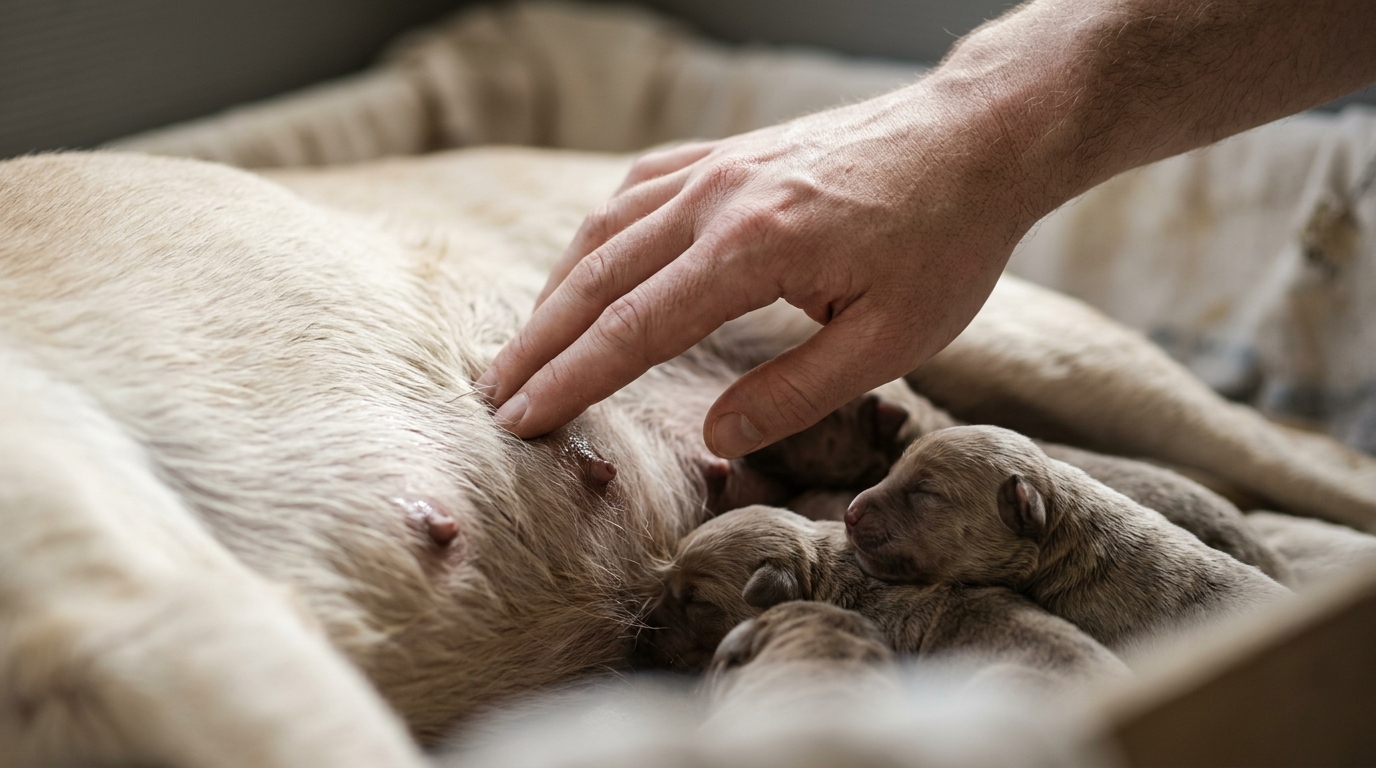
By the time the last puppy is delivered, the mother’s mammary glands are full, warm, and slightly firm. Puppies latch and the chains fluctuate by feeding cycle. Asymmetry is normal in nursing: one chain may be more used than another. What is not normal is asymmetry combined with heat, pain, or color change. That combination is the early signal of mastitis, and it is the kind of change a daily eye catches and a weekly eye misses.
The question to hold in your hand is simple: does today look like yesterday? The earliest mastitis I see in clinic is the gland the dam herself starts to avoid. You are tracking change against her own baseline, not against a textbook.
Why the first three weeks are the active risk window
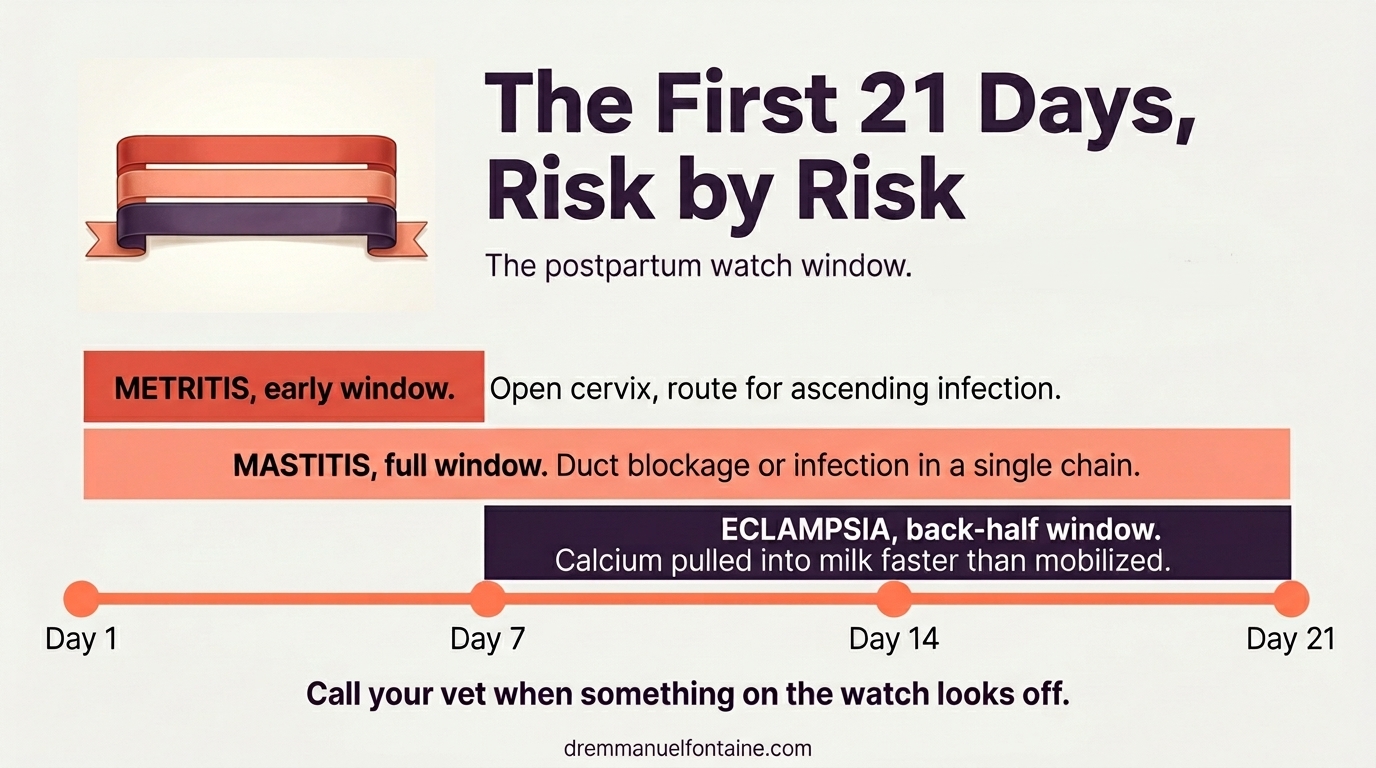
Three things are happening in parallel. The uterus is shedding tissue, which means an open cervix and a temporary route for ascending infection. The mammary system is in peak demand, which means any blocked or infected duct shows up fast. And the dam’s calcium reserves are being pulled hard into milk, which means ionized calcium can drop enough to trigger eclampsia.
The risks do not arrive at the same time. Metritis and early mastitis tend to appear in the first week, when the cervix is still permissive and milk supply is establishing. Eclampsia and peak-lactation mastitis appear later, when milk demand is climbing toward its highest point. The watch window holds at three weeks because the risks do.
| The three big risks | What is going on underneath | When in the window |
|---|---|---|
| Metritis | Open cervix and a route for ascending infection while the uterus is still shedding tissue | Tends to appear early |
| Mastitis | A duct can block or get infected as the mammary system meets a fast-rising milk demand | Can appear at any point in the window |
| Eclampsia | Calcium pulled into milk faster than the dam’s body can mobilize it back | Tends to appear deeper into the window, around peak lactation |
The Logic of Daily Observation
Why a single number lies, and the curve does not
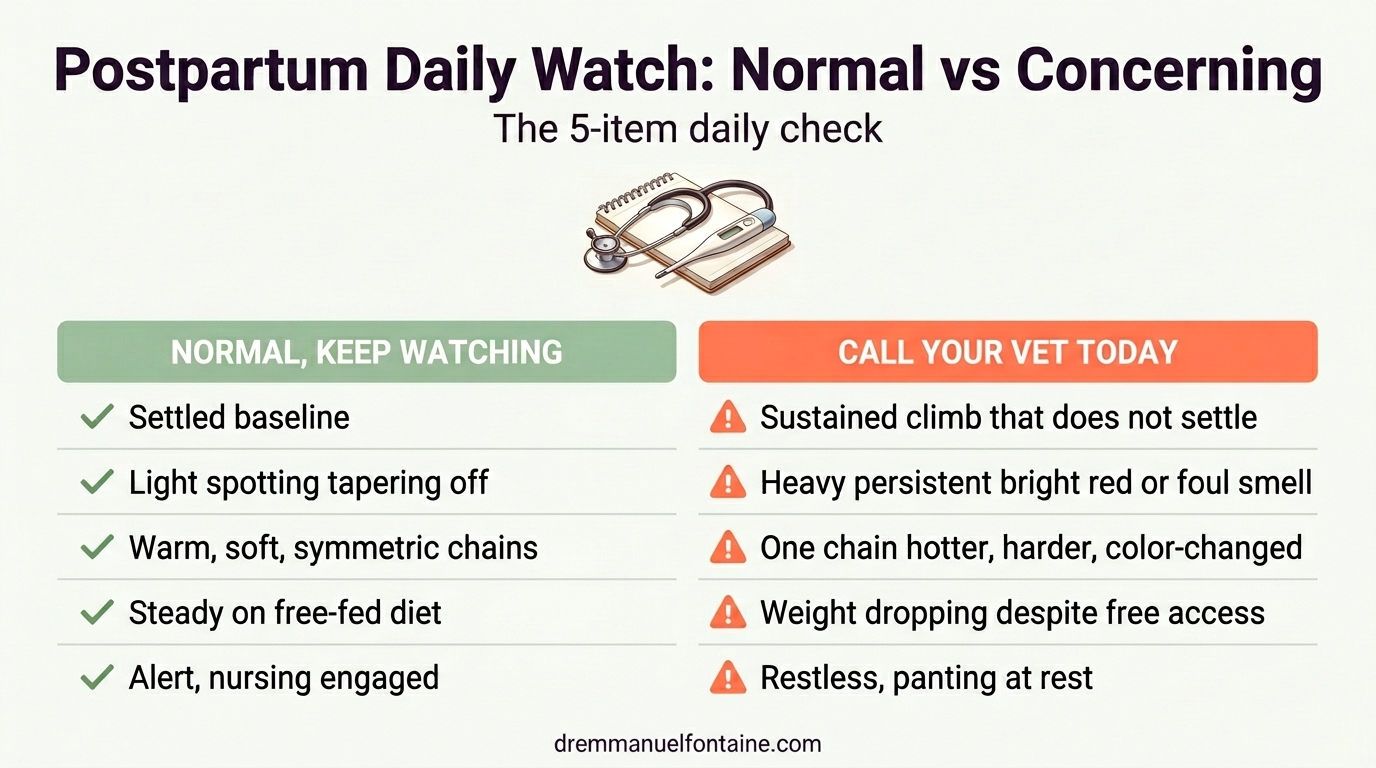
Rectal temperature in a postpartum dam settles within about a day. What you are looking for is not a single reading. You are looking for the shape of the curve: her own settled baseline, the gentle ripple from milk letdown and uterine work, and the moment something climbs above where it usually sits and stays there.
A sustained climb that does not settle is a vet call. A drop below her baseline paired with a flat, unresponsive dam is an emergency, whatever the hour. The number on the thermometer is a marker. The pattern is the diagnosis.
This is where the morning-by-morning thresholds matter, and where the field protocol carries the exact numbers. This blog teaches the principle. The protocol turns it into a daily workflow.
Weight, appetite, and the simple feeding rule
A nursing dam is doing the metabolic work of two athletes. Her energy demand climbs sharply through peak lactation. The simple principle I share with my breeders is one sentence: free-feed her a high-quality growth or gestation-lactation diet from whelping into weaning. Food in the bowl, at all times, fresh, accessible.
The goal is for her to hold her body weight, not lose it during lactation. A nursing dam dropping condition is not a normal feature of motherhood. It is a flag. The first questions to ask are practical: does she have free access, is the food fresh, is the litter blocking her from the bowl. If those answers are yes and she still drops, that is a call.
Lochia, mammary chains, and the look-and-feel pass
Once a day, run a quiet observation pass. Look at the bedding under the dam. Move her chains gently and ask whether any chain feels hot, hard, lumpy, or asymmetric against its mirror gland. Then scan her attitude. A recovering dam is alert when puppies cry, settles to nurse, and grooms them. A dam who lies flat and ignores cries, or who paces and pants at rest, is telling you something is off.
Compare today to yesterday, not to a textbook. Today’s small change against yesterday’s normal is the most reliable signal you have. Behavior is part of the dashboard, not separate from it.
The Red Flags That Tell You to Call
When a fever is the call, and when a temperature drop is the emergency
A sustained fever that pushes past her baseline and stays there is the most reliable early signal of metritis: inflammation or infection of the uterus. Foul-smelling lochia and a fading appetite usually arrive with it. That combination is a same-day vet call, not a wait-and-see.
On the other end, a drop below her baseline with a flat, unresponsive dam is a sign of systemic collapse, often septic. That is an emergency contact, whatever the hour. Wrap her warm, support hydration if your vet directs you, and move.
Mastitis caught early and mastitis caught late
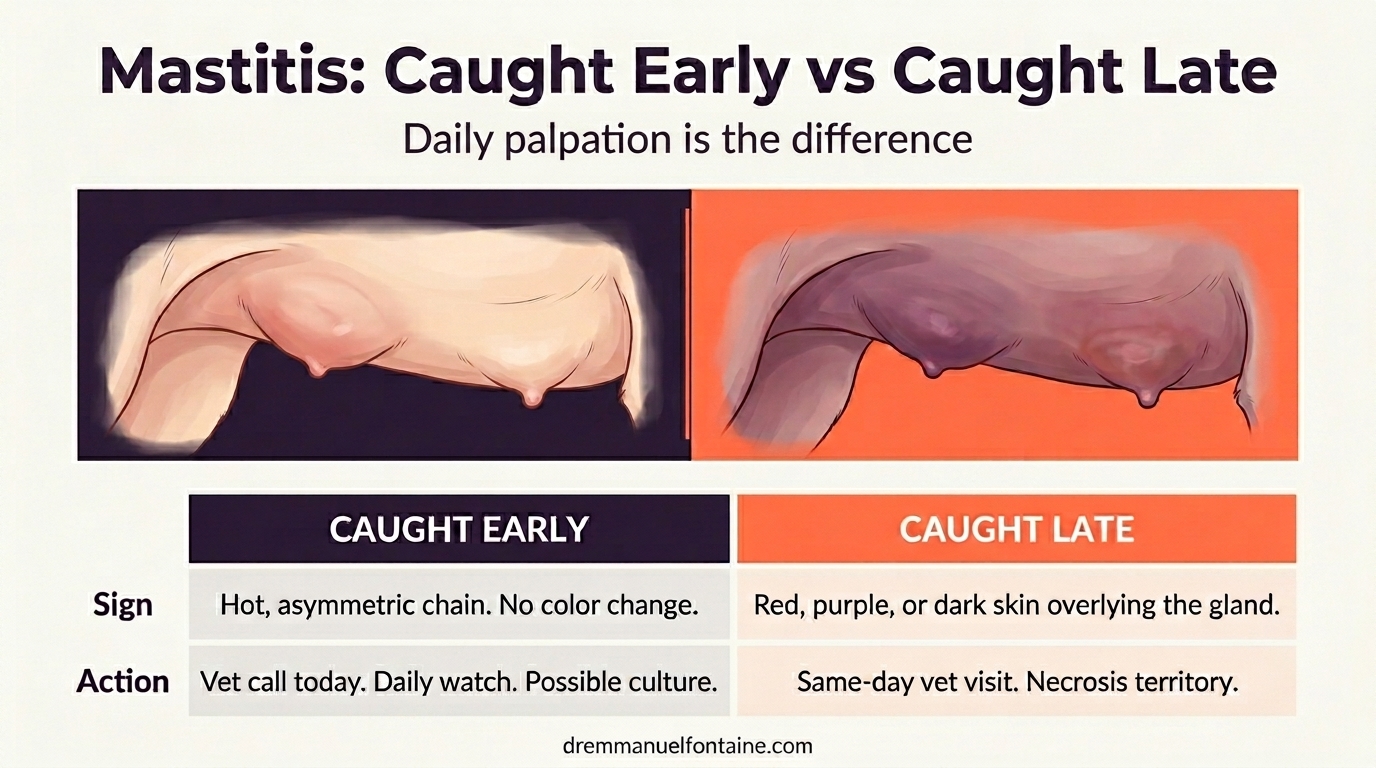
Mastitis announces itself in a single mammary chain: warmer than its mirror gland, firm or lumpy where you expect soft and pliable. The dam often pulls the chain away from puppies. In severe cases the gland can become abscessed or gangrenous, which is a surgical emergency.
Catch it at heat-and-hardness without color change and the conversation with your vet is straightforward: assess, decide, continue the daily watch. Catch it later, when the skin has turned, and you are managing necrosis. Daily palpation is the difference between the easy version of this conversation and the hard one.
Eclampsia: the signal sequence you do not want to misread
Eclampsia, also called puerperal hypocalcemia, happens when calcium leaving the dam in milk outpaces what her body can mobilize. The signal sequence is consistent: restlessness and panting at rest first, then muscle twitching, then stiff limbs, then collapse and seizure. Small breeds with large litters carry the highest risk, and the danger sits deeper in the watch window. I also see eclampsia frequently in females fed a homemade diet, because home-prepared rations are commonly deficient in minerals, especially calcium.
Catch it at restlessness and panting at rest, and you have time to call your vet, transport her in, and let the team correct the calcium with measured care. Catch it at seizure, and you are racing. Do not start oral calcium on your own: this is a conversation to have with your vet, who decides whether it makes sense and how to dose it. Never attempt intravenous calcium yourself. IV calcium is a vet-administered protocol every time, because the heart can react badly to the rate of infusion.
Working With Your Vet Through the First Three Weeks
There is no routine recheck. There is the call when something looks off.
Most of the breeders I work with do not book a routine recheck during these three weeks, and that is fine. A routine wellness recheck is not mandatory at this stage. You go to your vet when something on your daily watch looks off. The advantage of paying attention every day is that it tells you when off is real, not just nerves.
If you do call, have the whelping summary ready: how many puppies, time of last delivery, any retained placentas suspected, the dam’s behavior in the last hour of labor, and a quick read on her temperature, lochia, and appetite. That information shapes whether the call ends with reassurance, a same-day in-clinic exam, or a uterine ultrasound on the table.
Nutrition during lactation is not something to relitigate
During lactation, the answer to most nutrition questions is one sentence. Free-feed a high-quality growth or gestation-lactation diet through whelping, lactation, and into weaning. That is the plan. Where your vet adds value in these weeks is not on diet design. It is on clinical decisions when a signal appears: a fever that does not settle, a hot chain, restlessness at rest, a dam who stops eating. Those are the calls.
Notes are ideal, not mandatory
If you can hold a few honest notes across the watch window, that is ideal. The point is not paperwork. The point is the curve, not the snapshot. A vet who can hear the shape of the recovery sees what one in-clinic exam cannot, and the conversation shifts from generic advice to specific decision. This is where a structured monitoring sheet becomes useful, and where the field protocol carries one.
That said, I am realistic. Most breeders will not write down every observation every day, and that is honest. If a full daily log is not going to happen, do the minimum: hold mental notes on temperature, appetite, and behavior, and a quick written note on the days something looks different. Frame the call as observation plus question, not ‘is this normal’ but ‘her temperature has been creeping up for two days with appetite holding, what would you want me to watch for tomorrow‘. Specific input, specific output.
| Risk | The sign you are most likely to notice first | Why the early version matters |
|---|---|---|
| Metritis | A fever that does not settle, paired with a change in the lochia or a fading appetite | Caught early, this is a conversation. Caught late, the dam is septic. |
| Mastitis | One chain that feels different from its mirror, or one chain the dam herself starts to avoid | Caught at heat-and-hardness, you have options. Caught at color change, you are managing necrosis. |
| Eclampsia | Restlessness and panting at rest, before any tremor | Caught at restlessness, your vet has time. Caught at seizure, you are racing. |
Conclusion
The first three weeks after the litter is on the ground are not the easy part. They are the part where most preventable losses still happen: metritis caught late, mastitis caught at color change rather than at heat, eclampsia caught at seizure rather than at restlessness. The fix is not heroics. The fix is paying attention every day, repeated through the watch window.
Your role is observe, record, communicate. Your vet’s role is diagnose, decide, treat. You bring the daily eyes that no exam can replicate. Your vet brings the medical hands and the clinical decision. The blog gives you the principle. The field protocol turns it into a daily workflow, and together they hold the line for the dam and her litter through the three weeks that matter most.
Get the next issue on Saturday morning
Every Saturday, my free newsletter brings you one piece of science on reproduction and newborn care in dogs and cats, written for breeders and their veterinarians. Read it in English, French, Spanish or Portuguese.
Free. Unsubscribe anytime.


