🇫🇷 Lire en Français | 🇪🇸Leer en Español | 🇧🇷Leia em português
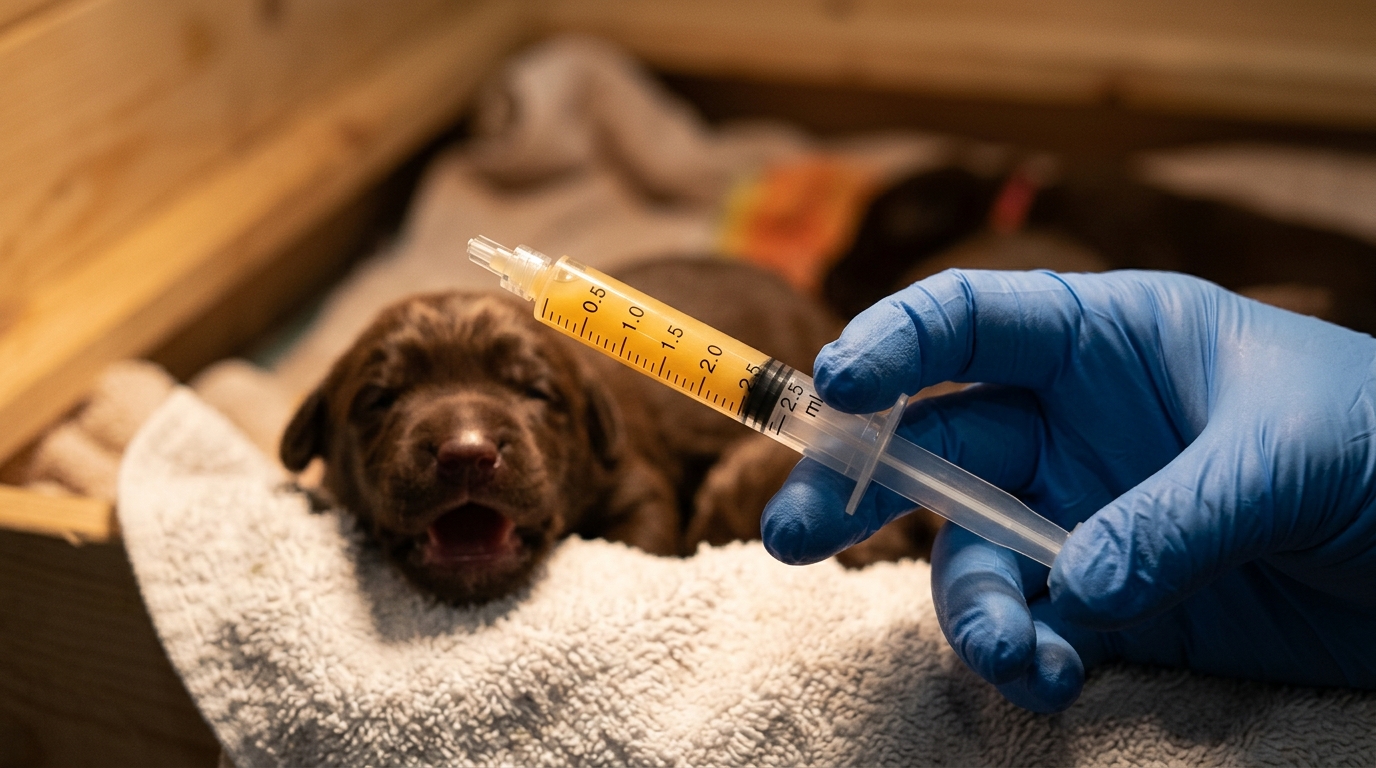
A litter of vaccinated puppies still gets parvo. The first reflex is to blame timing, and the canine nomograph promises to fix timing with a single blood test from the dam. I want to tell you why that promise does not survive contact with the whelping box. The nomograph is elegant on paper. It reads the dam’s serum titer, applies a half-life curve, and predicts the age at which maternal antibodies should fall below the interference threshold in her litter. The problem is the assumption buried in the model. It assumes that every puppy in the box receives the same antibody load from the dam. Biology does not work that way. In this post, I will walk through why the model fails, what the data on colostrum intake and mammary gland variability actually shows, and where your real leverage lies. The answer is not better prediction. It is better colostrum. Although the nomograph itself is a canine tool, the same biology applies to kitten breeders, because queens and puppies share the same passive transfer mechanics.
- TL;DR
- What Actually Happens When a Vaccinated Puppy Gets Sick
- Why the Nomograph Looks Convincing
- The Two Biological Realities That Break the Model
- Upstream Versus Downstream: Where Your Real Leverage Lies
- Upstream Lever 1: Optimize the Dam’s Colostrum Before Whelping
- Upstream Lever 2: Maximize Colostrum Intake in the First 24 Hours
- What This Means for the Vaccine Schedule
- Verify Immunization After the Final Dose
- Biosecurity Remains the Real Safety Net
- Precision We Can Actually Deliver
TL;DR
- The canine nomograph predicts when maternal antibodies should fade by reading the dam’s serum titer and applying a half-life calculation. It sounds precise. It is not.
- The model assumes every puppy inherits the same antibody load from the dam. Two well-documented biological realities break that assumption.
- First, up to 20 percent of puppies experience partial or complete failure of passive transfer because they do not ingest enough colostrum in the first 24 hours.
- Second, antibody concentration varies significantly from one mammary gland to another within the same dam, so which gland a puppy nurses on matters more than the average serum titer.
- Your real leverage is upstream. Optimize the dam’s colostrum quality before whelping, then maximize colostrum intake by every neonate in the first 24 hours.
- For vaccination, follow your veterinarian’s core schedule, accept that the interference window cannot be predicted per puppy, and verify immunization with a post-vaccine titer check.
What Actually Happens When a Vaccinated Puppy Gets Sick
Vaccination Is Not the Same as Immunization
This is the distinction that reframes everything. Vaccination is the act of injecting a vaccine product into a puppy or a kitten. Immunization is the biological outcome, where the neonate’s own immune system mounts an active, protective response. You can vaccinate perfectly and fail to immunize. The puppy received the injection. The puppy’s immune system never saw the antigen, because maternal antibodies neutralized the vaccine virus before it could replicate. The only way to confirm that immunization has actually occurred is a post-vaccine titer test, and that is a conversation to have with your veterinarian.
Table 1. Vaccination versus immunization
| Concept | What it means |
|---|---|
| Vaccination | A vaccine product was injected into the neonate. |
| Immunization | The neonate produced its own protective antibodies. |
| Vaccine failure | Vaccine given, but no active immunity developed. |
| Verification | Post-vaccine titer test confirms active immunity. |
Why Maternal Antibodies Block the Vaccine
Puppies and kittens are born immunologically naive. In the first hours after birth they absorb maternally derived antibodies, usually abbreviated MDA, from the first milk of their mother, the colostrum. Passive transfer happens across a specialized neonatal gut that is temporarily open to the immunoglobulins in colostrum. The neonatal intestine closes functionally to whole immunoglobulin absorption at roughly 24 hours of age. After that, the gate is shut. Whatever antibodies the neonate has absorbed during that window are the passive shield it carries into the next several weeks of life.
MDA protects against wild disease. It also neutralizes modified-live vaccines if present in sufficient concentration. The maternal antibody sees the vaccine virus as a threat and inactivates it before the puppy’s immune system can respond. This is the interference phenomenon, and it is the single biggest reason young puppies fail to immunize on schedule.
Table 2. Passive transfer timeline
| Phase | What happens |
|---|---|
| Birth to 24 hours | Neonatal gut absorbs intact MDA from colostrum. |
| After 24 hours | Gut closes. No further MDA absorption. |
| Weeks 1 to variable | Absorbed MDA circulates and protects against disease. |
| MDA decline | Antibodies degrade over time, rate varies by individual. |
Why the Nomograph Looks Convincing
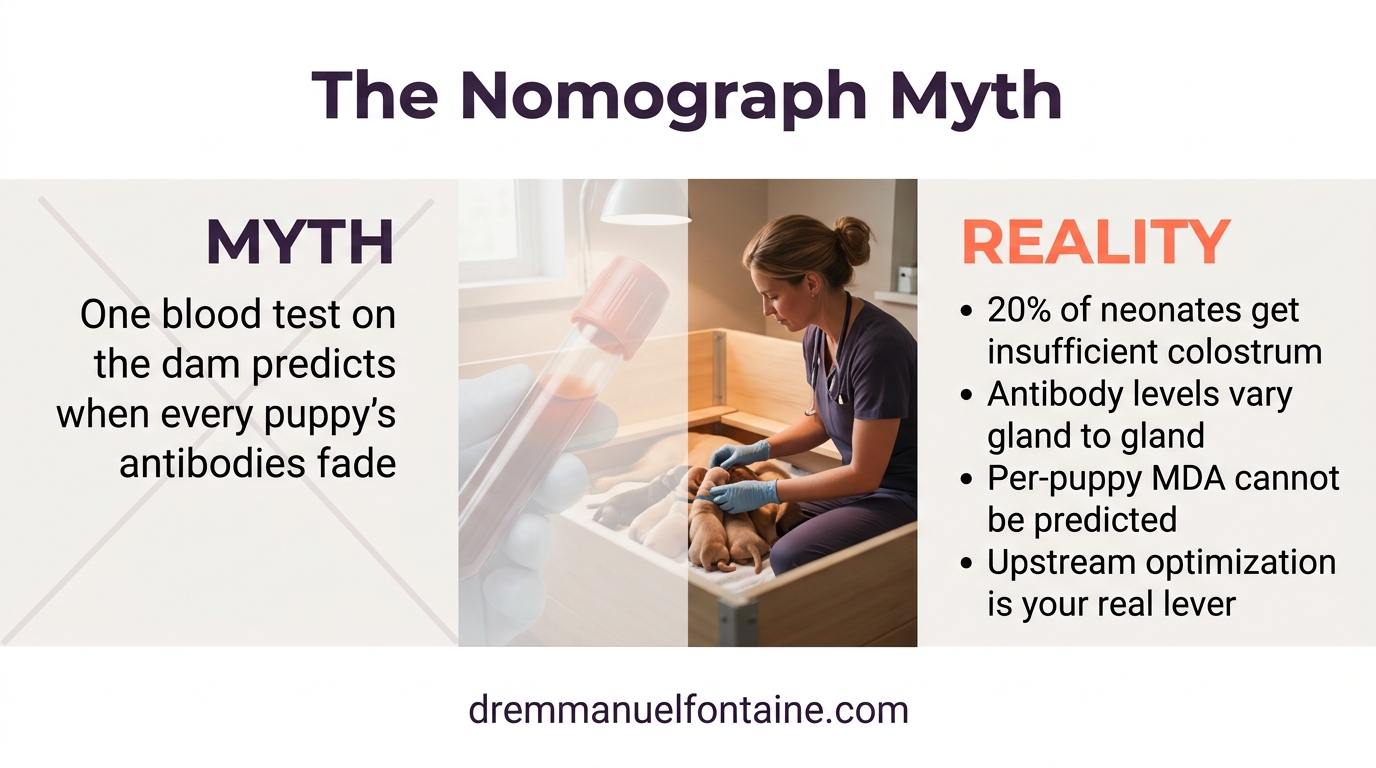
The canine nomograph is a laboratory tool. You send a serum sample from the dam, taken either two weeks before her expected whelping date or two weeks after birth, and the laboratory measures her antibody titers to canine distemper virus and canine parvovirus. The laboratory then applies a half-life assumption, usually around 12 days, and generates a timeline predicting the age at which the dam’s puppies should fall below the interference threshold. On paper, this replaces routine with precision.
I understand the appeal. Every breeder has lost puppies or watched a litter struggle despite doing everything the standard protocol asked of them. A personalized timeline feels like the scientific upgrade the field has been waiting for. Unfortunately, when you audit the assumptions the nomograph rests on, the precision starts to come apart.
Table 3. What the nomograph measures and what it claims
| Measurement | Claim |
|---|---|
| Dam’s serum IgG titer | Captures the antibody pool available to the litter. |
| 12-day half-life curve | Predicts the rate of MDA decline in the puppies. |
| Fade-threshold age | Estimates when the first vaccine can be effective. |
| Applies to the whole litter | Every puppy is assumed to share the same fade curve. |
The Two Biological Realities That Break the Model
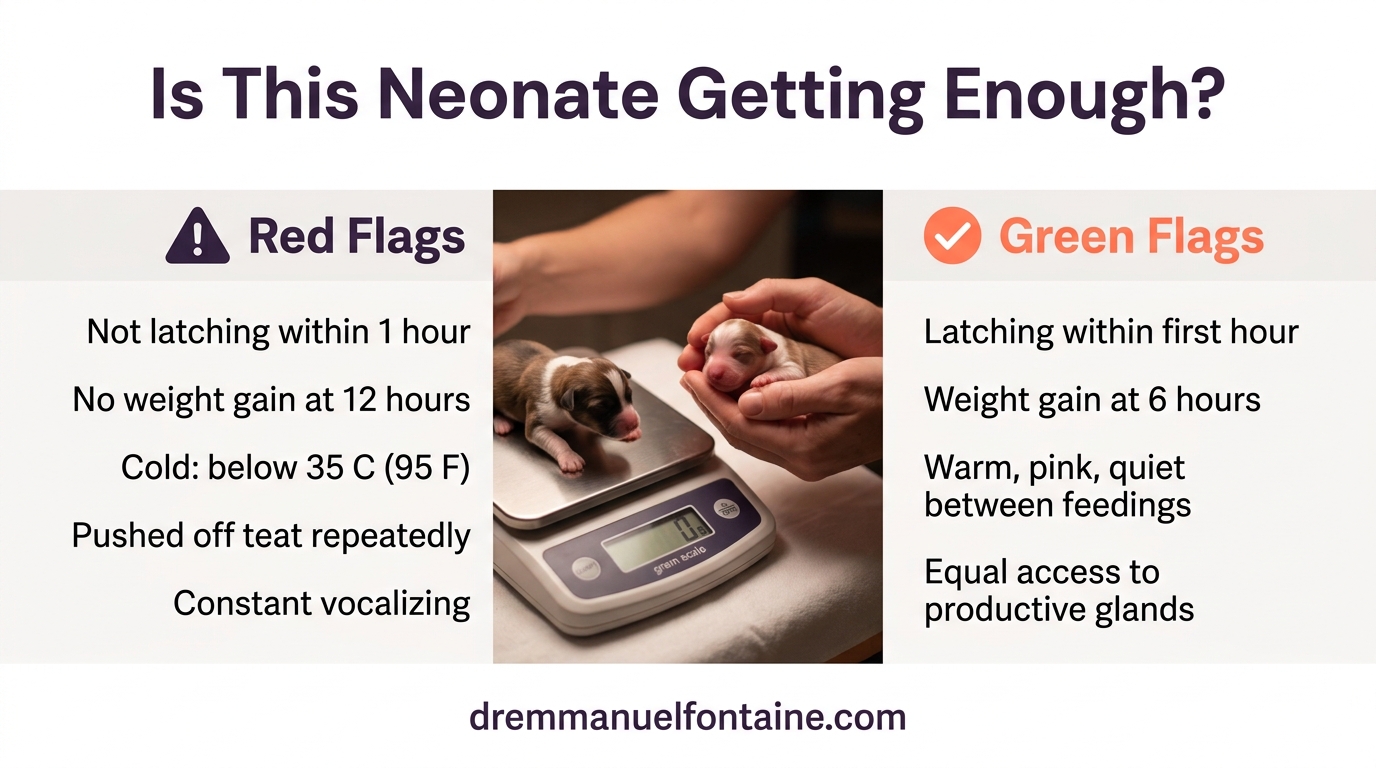
Two findings, both well documented in the neonatal literature, dismantle the assumption that the dam’s serum titer predicts what each puppy actually receives. I see them in the field, and I see them in the clinical data. A nomograph cannot correct for either of them.
Reality 1: Colostrum Intake Is Not Uniform Across the Litter
Up to 20 percent of puppies experience partial or complete failure of passive transfer. They did not get enough colostrum in the first 24 hours, or they got it late, or the gut had already started to close. Large litters compete for teats. Weak puppies get pushed off. Primiparous mothers are sometimes slow to let down. Some puppies nurse briefly and fall asleep. A cleft palate prevents effective suckling. Each of these realities produces a neonate whose circulating MDA is dramatically lower than the model would predict from the dam’s serum alone. The same phenomenon happens in kittens. Large feline litters, weak kittens, and queens with fewer functional glands produce the same uneven intake pattern, and the same interference shows up when a breeder plans feline panleukopenia vaccination.
Table 4. Why some neonates absorb less colostrum
| Situation | Effect on passive transfer |
|---|---|
| Large litter, teat competition | Smaller puppies or kittens get displaced. |
| Weak or hypothermic neonate | Weak suckling reflex, low intake. |
| Cleft palate or poor latch | Milk flows in, but not enough is swallowed. |
| Late nursing, after 12 hours | Gut absorption efficiency is already dropping. |
| Primiparous mother, slow letdown | First hours of milk flow are limited. |
Reality 2: Antibody Concentration Varies Between Mammary Glands
This is the part most nomograph discussions skip. The dam’s serum is not a perfect proxy for her colostrum, and her colostrum is not a single uniform fluid. Antibody concentration varies significantly from one mammary gland to another within the same dam. Two glands on the same bitch can deliver different amounts of IgG in the same hour. Which gland a given puppy happens to latch onto during the critical first-24-hour window has a real effect on the antibody load it inherits. This is stochastic. The nomograph cannot see it. It issues one number for the whole litter, but the litter does not actually behave as one unit. It behaves as a group of individuals who each drew a different hand from the same mother.
Table 5. Sources of MDA variability within a single litter
| Source | Why it matters |
|---|---|
| Gland-to-gland IgG variation | Two teats can deliver different concentrations. |
| Teat preference and rotation | Puppies do not sample glands evenly. |
| Total intake per puppy | Small, weak, or late puppies take less volume. |
| Timing of first nursing | Earlier nursing maximizes gut absorption. |
| Dam condition and stress | Cortisol and nutrition alter colostrum quality. |
Upstream Versus Downstream: Where Your Real Leverage Lies
Once you accept that per-puppy MDA cannot be predicted from the dam’s serum, the question changes. It stops being, how do I predict the interference window, and starts being, how do I make sure every puppy in the box receives the best possible colostrum dose. That is a question you can actually answer. It splits into two upstream levers: colostrum quality, which depends on the dam before whelping, and colostrum intake, which depends on what happens in the first 24 hours of life.
Table 6. Upstream levers versus downstream unknowns
| Can be controlled (upstream) | Cannot be predicted (downstream) |
|---|---|
| Dam’s colostrum quality pre-whelping | Exact MDA fade age per puppy |
| Time to first nursing for each neonate | Gland-to-gland IgG variation |
| Identification of weak neonates | Which teat each puppy chooses |
| Supplemental colostrum protocol | Individual interference windows |
Upstream Lever 1: Optimize the Dam’s Colostrum Before Whelping
The colostrum the dam produces is not made at the last minute. It is built during the final weeks of gestation from her existing antibody pool, her nutritional status, and the condition of her mammary tissue. You influence this by planning ahead. Check her vaccination status at least 30 days before breeding. If her titers are low, work with your veterinarian to boost her before conception so she has time to mount a response and concentrate it into her colostrum. Do not boost in the last two weeks of gestation, because the immune response comes too late and the stress is not welcome. Feed her through late gestation in a way that supports mammary development and does not force rapid weight shifts. Reduce her environmental stress as whelping approaches. Everything you do in this phase raises the ceiling on what her litter can absorb.
Table 7. Pre-whelping checklist for colostrum quality
| Action | When |
|---|---|
| Check dam’s CDV and CPV titers | At least 30 days before breeding |
| Discuss booster with veterinarian | Before conception, if titers low |
| Balanced late-gestation nutrition | Last third of pregnancy |
| Parasite and deworming plan | Pre-breeding and pre-whelping |
| Low-stress whelping environment | Final 10 days before due date |
Upstream Lever 2: Maximize Colostrum Intake in the First 24 Hours
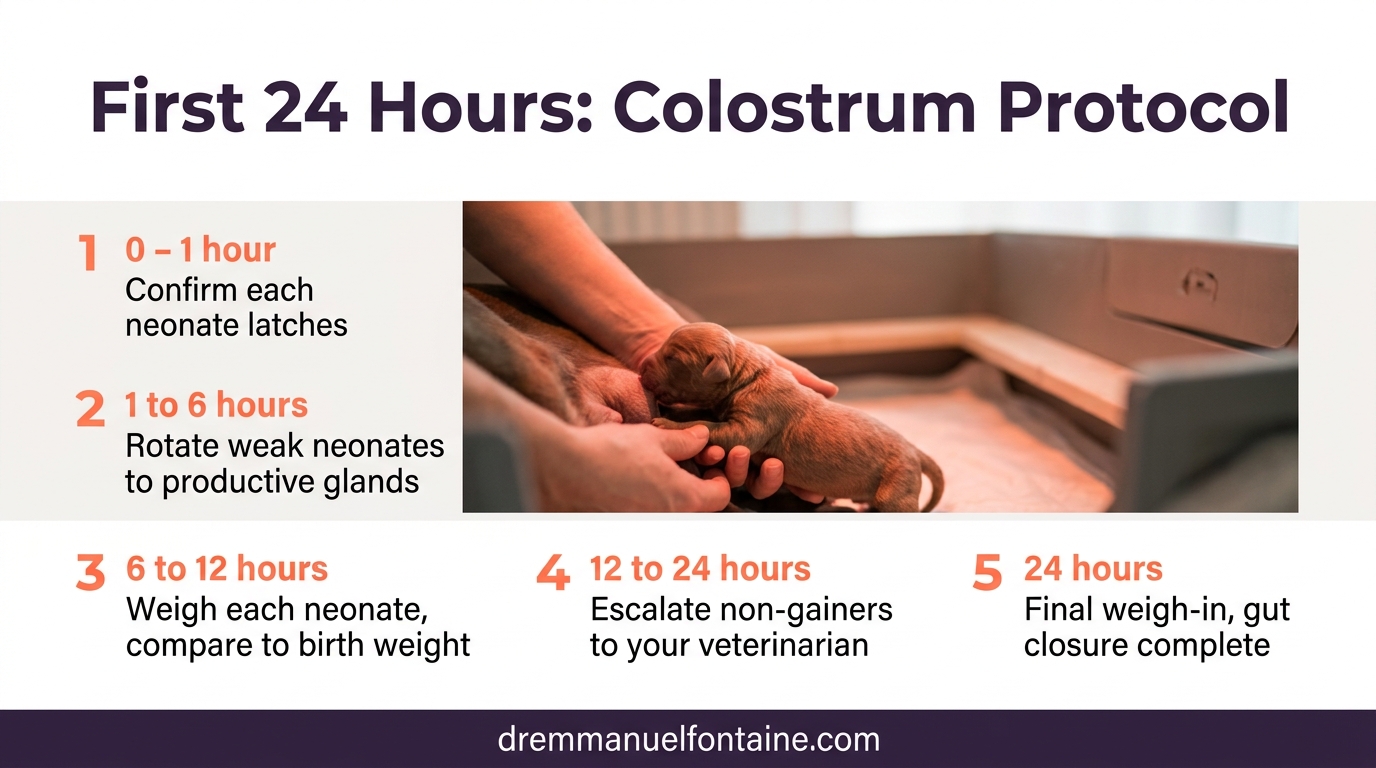
This is where the real work happens. The 24-hour window is short and the gate is closing the entire time. Your job is to make sure every neonate in the box is actively nursing as early and as often as possible. Observe the first nursing in person if you can. Watch for puppies or kittens who latch briefly and fall asleep, puppies who get pushed off, and puppies who cry but do not settle on a teat. Weigh every neonate at birth and again at 12 and 24 hours. A newborn who has not gained any weight in the first 24 hours is a red flag, as we noted earlier in the section on failure of passive transfer. Work with your veterinarian on a plan for supplemental colostrum. A puppy who cannot nurse effectively can sometimes be helped with hand-fed colostrum from the dam or a frozen colostrum reserve. Your veterinarian can train you on this procedure if it fits your program. The goal is simple. Do not let any neonate leave the first 24 hours under-supplied.
Table 8. First-24-hour colostrum intake protocol
| Time after birth | Action |
|---|---|
| 0 to 1 hour | Confirm each neonate latches and suckles. |
| 1 to 6 hours | Rotate weak neonates onto productive glands. |
| 6 to 12 hours | Weigh each neonate, compare to birth weight. |
| 12 to 24 hours | Escalate any non-gainers to your veterinarian. |
| At 24 hours | Final weigh-in. Passive transfer window closes. |
Table 9. Red flags in the first 24 hours
| Observation | What it signals |
|---|---|
| Not latching within the first hour | Possible weakness or poor reflex. |
| Pushed off the teat repeatedly | Displacement, likely under-fed. |
| No weight gain at 12 hours | Inadequate intake, rising risk of FPT. |
| Cold neonate under 35 C (95 F) | Hypothermia blocks effective suckling. |
| Constant vocalising, restless | Often a hunger signal, assess intake. |
What This Means for the Vaccine Schedule
Once you accept that per-puppy MDA cannot be predicted, the rational response is the one your veterinarian already follows. The standard WSAVA and AAHA core vaccination schedule exists because no single prediction covers every neonate. The multi-dose approach is not clumsy. It is the honest answer to biological variability. Each dose is an attempt to catch the individual puppy’s interference window as it opens, knowing the window does not open on the same day for every puppy in the litter. This framing matters, because breeders sometimes feel that the standard schedule is a failure of science. It is not. It is science doing the best it can with a problem that prediction cannot solve.
Table 10. Why the standard multi-dose schedule exists
| Principle | Implication |
|---|---|
| MDA decline varies by individual | No single dose fits every puppy. |
| Gland-to-gland IgG variation | Littermates start at different MDA levels. |
| Unknown failure of passive transfer | Some puppies need an early working dose. |
| Interference risk shrinks with age | Later doses have the highest success rate. |
Verify Immunization After the Final Dose
Because vaccination and immunization are not the same event, as I noted in the opening, the only way to confirm protection is to test for it. Two to three weeks after the final scheduled vaccine dose, ask your veterinarian about a titer check. In-clinic point-of-care tests provide reliable results for parvovirus within minutes. Distemper and adenovirus detection on some point-of-care devices is less specific, so your veterinarian may send a sample to the laboratory for quantitative titers, using hemagglutination inhibition or virus neutralization methods, if a definitive answer is needed. Protective thresholds commonly cited are 1:32 or higher for canine distemper virus and 1:160 or higher for canine parvovirus. A puppy whose titer does not reach these levels is a non-responder, and your veterinarian will discuss revaccination options with you.
Table 11. Post-vaccine verification plan
| Step | Detail |
|---|---|
| Timing | 2 to 3 weeks after final core vaccine dose. |
| First-line test | In-clinic point-of-care antibody test. |
| Confirmation test | Laboratory HI or VN quantitative titer, if needed. |
| CDV protective threshold | 1:32 or higher (quantitative). |
| CPV protective threshold | 1:160 or higher (quantitative). |
Biosecurity Remains the Real Safety Net
Every neonate in your program lives through a window where immunization is not yet proven. Biosecurity is what keeps that window safe. This is not the focus of today’s post, but it belongs on the list because the colostrum optimization work we just discussed is wasted if parvovirus walks into the whelping room on a visitor’s boot. Use accelerated hydrogen peroxide or correctly diluted sodium hypochlorite bleach. Remove organic material with detergent first, then apply the disinfectant. Avoid quaternary ammonium products, which field evidence shows are not reliable against parvovirus. Maintain solid physical separation between litters. Treat every boot, every pair of hands, and every visitor as a potential vector until proven otherwise.
Table 12. Non-negotiable biosecurity basics
| Area | Standard |
|---|---|
| Disinfectant choice | Accelerated hydrogen peroxide or diluted bleach. |
| Pre-disinfection | Detergent wash to remove organic matter. |
| Footwear policy | Dedicated kennel boots or disposable booties. |
| Litter separation | Solid physical barriers between litters. |
| Visitor policy | No direct contact with neonates under 8 weeks. |
Precision We Can Actually Deliver
The canine nomograph asked a reasonable question. When will maternal antibodies fade in this specific litter. The honest answer from the biology is that we cannot tell you per puppy, because we cannot see what each puppy absorbed during those first 24 hours, and we cannot see which gland fed which puppy how much IgG. Precision at that level of resolution is not available to us. What is available is something more practical and more powerful. We can optimize the dam’s colostrum before whelping. We can make sure every neonate in the box nurses early, often, and with support. We can weigh, observe, and escalate to the veterinarian when a newborn is not thriving. We can follow the standard vaccine schedule without guilt, because the schedule is designed for exactly the variability we just described. And we can verify that immunization actually happened with a post-vaccine titer test, replacing hope with proof. That is the precision we can actually deliver. It lives in the first 24 hours of life, not in a laboratory calculator, and it is the place your experience as a breeder matters most.
Get the next issue on Saturday morning
Every Saturday, my free newsletter brings you one piece of science on reproduction and newborn care in dogs and cats, written for breeders and their veterinarians. Read it in English, French, Spanish or Portuguese.
Free. Unsubscribe anytime.


I’ve been kicked out (twice!) from the Puppy Culture group for saying that all that nomographs do is putting puppies at risk, as many will have lower antibodies/will be able to mount an immune response way sooner than what the nomograph says. So thanks for covering this issue, hope this post gets the attention it deserves.
LikeLike