🇫🇷 Lire en Français | 🇪🇸Leer en Español | 🇧🇷Leia em português
You have heard it works in livestock: increase calories around breeding and litter sizes jump. So you try it with your breeding queen. More food, bigger litters. Except your veterinarian keeps warning against it. The reason is species-specific biology. Feline progesterone responds to metabolic disruption in ways that livestock progesterone does not.
This does not mean queens should stay on maintenance calories throughout gestation. Queens need a gradual, controlled energy increase starting from the beginning of pregnancy. The real danger is sudden caloric excess, the kind that comes from aggressive flushing protocols borrowed from livestock. This post walks you through the science, the correct feeding protocol, and the monitoring that makes the difference between a litter of eight kittens and a litter of three.
- TL;DR
- Why Flushing Works in Livestock But Backfires in Queens
- The Gradual-Increase Protocol for Breeding Queens
- Monitoring Tools for Queen Nutrition and Pregnancy
- Warning Signs That Nutrition Is Affecting Fertility
- Conclusion
TL;DR
- Flushing works in livestock because their bodies compensate for increased progesterone clearance by suppressing liver enzymes. Queens lack this safeguard. Caloric excess drives progesterone clearance with no brake.
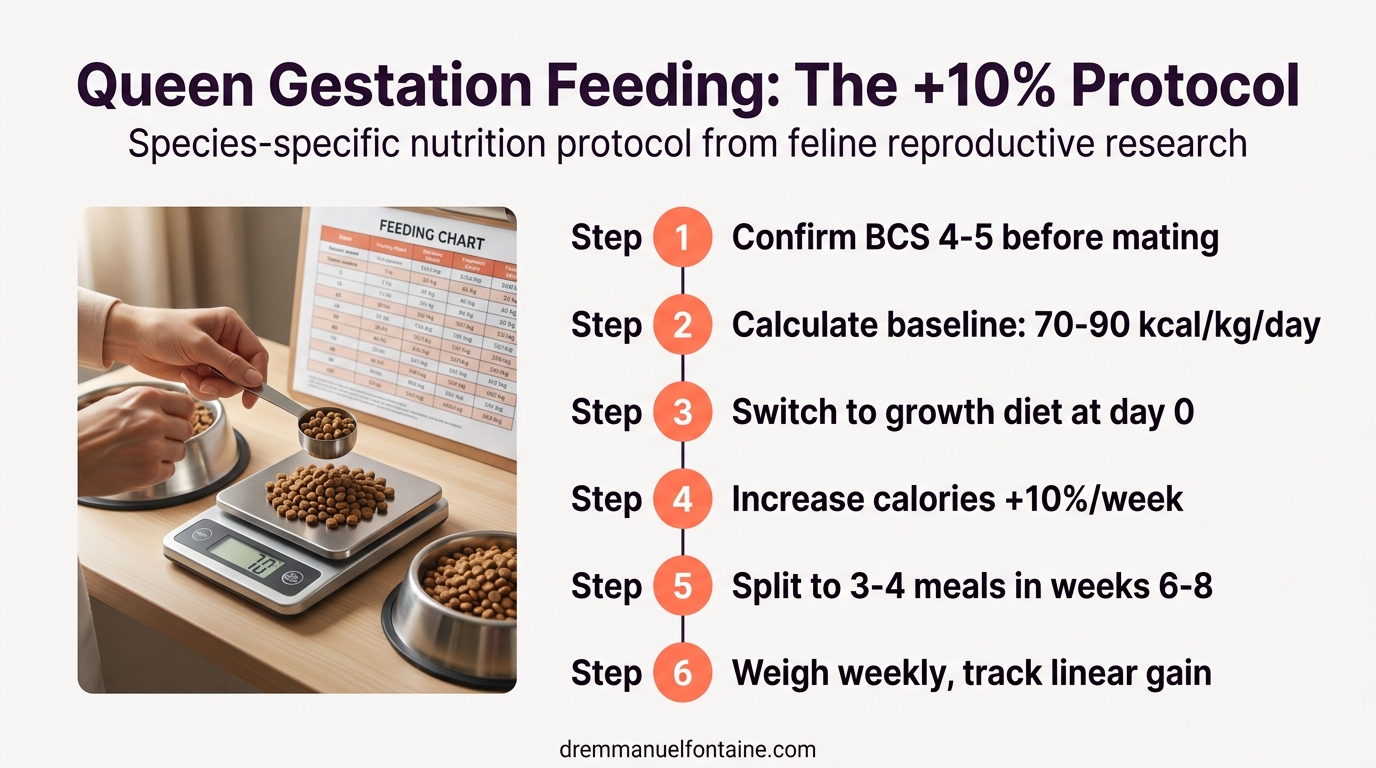
- A gradual energy increase of approximately 10% per week starting at the beginning of gestation is safe and recommended. Switch to a growth diet early. The risk is overfeeding beyond this gradual increase.
- Queens gain weight linearly throughout gestation. A healthy queen reaches 120–140% of her optimal body weight before parturition. Weight gain from day one is normal, not a warning sign.
- Weekly weigh-ins are your primary tool. Track weight to confirm steady linear gain and catch sudden spikes that signal overfeeding.
- BCS 4 to 5 is optimal for breeding. Higher scores increase baseline insulin resistance and embryonic loss risk.
- Include progesterone monitoring with your veterinarian if litter sizes are repeatedly small despite normal mating and good body condition.
- Flushing queens is a borrowed livestock protocol that does not apply to cats. Cat nutrition must be species-specific, with gradual increases rather than aggressive caloric surges.
Why Flushing Works in Livestock But Backfires in Queens
The Species-Specific Biology of Feline Progesterone
Progesterone in livestock is synthesized by the corpus luteum and sustained by luteinizing hormone (LH). When livestock consume more feed, their liver blood flow increases, which accelerates progesterone clearance. However, livestock possess a critical safeguard that cats lack: a high plane of nutrition triggers insulin and glucose surges that downregulate the liver enzymes responsible for breaking down progesterone. The liver clears progesterone faster, but simultaneously puts the brakes on the enzymes doing the clearing. The net result is that progesterone stays protected.
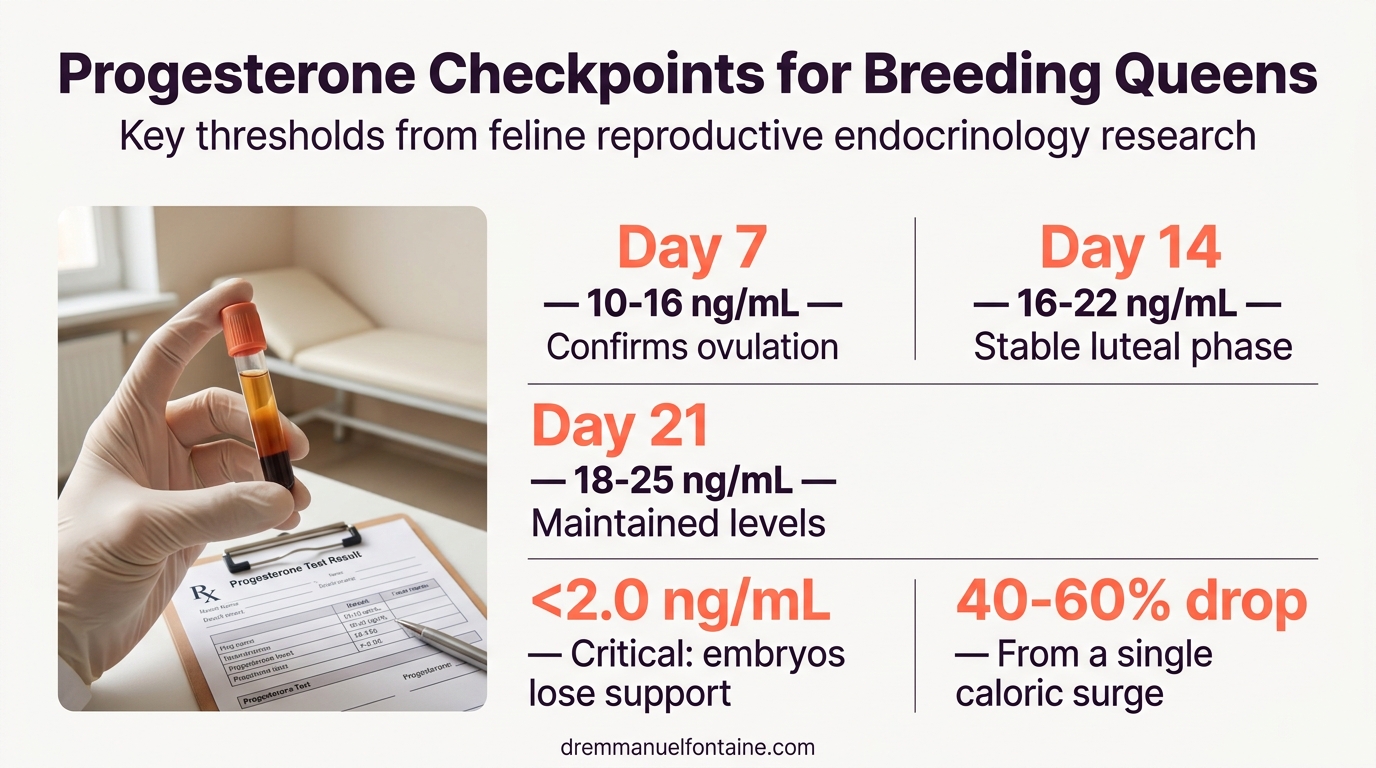
Cats are obligate carnivores with limited ability to respond to high carbohydrate loads. They lack the insulin-mediated feedback loop that suppresses those liver enzymes. When a queen is overfed, her liver blood flow increases and her progesterone-clearing enzymes stay fully active. Research shows this combination can cause circulating progesterone to drop by as much as 40–60% within hours of a large, calorie-dense meal. If progesterone falls below approximately 2.0 ng/mL, the uterine glands lose their support and embryos starve.
Your veterinarian can explain the full biochemistry. The practical takeaway: what works for cattle does not work for your breeding queen because her body cannot compensate for caloric surges the way livestock can.
| Aspect | Cats | Dogs | Livestock (Cattle/Sheep) |
|---|---|---|---|
| Progesterone source | Corpus luteum | Corpus luteum | Corpus luteum |
| Liver enzyme compensation | Absent: liver enzymes stay active during overfeeding | Partial: more robust than cats | Present: insulin suppresses liver enzymes |
| Flushing effect on litter size | Negative: triggers resorption | Minimal to neutral | Positive: supports larger litters |
| Response to caloric surge post-mating | Progesterone crash; embryonic loss risk | Tolerated without major loss | Compensated; litter size increase |
| Correct breeding nutrition strategy | Gradual +10%/week increase from day 1 | Gradual +10%/week increase from day 42 | Flushing is standard practice |
How Caloric Excess Triggers a Progesterone Crash
Progesterone synthesis in the corpus luteum is regulated by LH, but its circulating level depends on the balance between production and clearance. When a queen receives a sudden, large caloric increase, especially during early pregnancy, her hepatic blood flow surges. Because her liver enzymes are not suppressed by the insulin feedback loop that protects livestock, progesterone is cleared rapidly.
This is not a slow process. A large meal on day 8 post-mating can destabilize progesterone within hours. By day 15, when embryos are undergoing critical implantation, progesterone may have fallen enough to trigger resorption. The key distinction: it is the speed and magnitude of caloric increase that causes damage, not any caloric increase at all. A gradual 10% weekly increase starting from day one is metabolically tolerable. Dumping an extra 30–50% of calories in a single feeding change is not.
Prevention is easier than treatment. Work with your veterinarian to design a gradual feeding plan before mating, not after.
Embryonic Resorption: The Hidden Cost of Overfeeding
A queen that mates successfully, ovulates, and conceives will not necessarily carry all her embryos to term. Early pregnancy loss is common, and progesterone insufficiency is the primary driver. Resorption occurs when progesterone falls below the threshold needed to maintain the uterine lining. Embryos are absorbed. There is no discharge, no obvious sign.
Breeders often attribute small litters to genetics or low ovulation. Sometimes that is the case. But if a queen regularly conceives (proven by ultrasound at day 21 post-mating) and delivers significantly fewer kittens, resorption is likely. The most common modifiable cause in well-fed queens is metabolic disruption from aggressive caloric increases in the first three weeks after mating.
Work with your veterinarian to distinguish normal variation from chronic resorption. An ultrasound at day 21 gives you an idea of how many embryos are present. Compare that to birth count.
| Feeding Change | Progesterone Impact | Embryo Risk | Recommendation |
|---|---|---|---|
| Gradual +10%/week from day 1 | Stable: liver clearance stays within tolerance | Low: metabolically safe | Recommended protocol |
| Sudden +30–50% (flushing) | Crash: 40–60% drop within hours | High: resorption likely in first 3 weeks | Do not use in queens |
| No increase (maintenance only) | Stable but may not meet late-gestation demands | Low early; nutritional deficit possible later | Insufficient for full gestation |
| Free-choice feeding | Unpredictable: depends on intake patterns | Variable: some queens self-regulate, many do not | Not recommended for breeding queens |
| Caloric restriction during gestation | Drops due to negative energy balance | High: progesterone insufficiency from underfeeding | Do not restrict during gestation |
| Switch to growth diet at day 1 | Stable if portion-controlled | Low: appropriate energy density supports gradual increase | Recommended with portion control |
The Gradual-Increase Protocol for Breeding Queens
Setting the Right Caloric Baseline Before Mating
The foundation of good reproductive nutrition is starting from the right baseline. A queen at BCS 4 to 5 is optimal: you can feel her ribs easily, she has a visible waist, and her abdominal tuck is clear. At this condition, her basal metabolic rate is predictable, and her insulin signaling is stable enough to tolerate the gradual energy increases of pregnancy.
Calculate caloric intake based on body weight and maintenance. A typical rule is 70–90 kcal per kg per day for an intact adult cat. A 4 kg (8.8 lb) queen at BCS 4–5 needs roughly 280–360 kcal per day. This is your baseline for day 0. From this starting point, you will increase by approximately 10% each week throughout gestation.
If your queen is at BCS 6 or higher, consider a gentle pre-breeding weight loss program to bring her to BCS 4–5 before mating. A leaner queen with stable insulin signaling is better equipped to handle the metabolic demands of pregnancy.
The Gradual Increase: +10% Per Week From Day One
Mating occurs. Ovulation happens. Starting now, increase the queen’s daily caloric intake by approximately 10% each week. The simplest way to achieve this is to switch her to a high-quality growth diet at the beginning of gestation. Growth diets are more energy-dense, so portion sizes stay manageable even as caloric needs rise.
This gradual increase supports the linear weight gain that is normal in feline gestation. Queens gain weight steadily from the start of pregnancy, unlike dogs who show little change in the first few weeks. By parturition, a healthy queen typically weighs 120–140% of her pre-mating optimal body weight. This weight gain reflects fetal growth, placental development, increased blood volume, and mammary tissue development. It is expected and healthy.
The critical point: gradual and controlled is the key. A 10% weekly increase is metabolically tolerable. A sudden 30–50% jump is not. Feeding frequency should remain consistent: two to three meals per day at regular times. Irregular schedules introduce metabolic variability that can compound the problem.
| Queen Weight (kg) | Target BCS | Daily Kcal Baseline (Day 0) | Week 3 Target (+30%) | Week 6 Target (+60%) |
|---|---|---|---|---|
| 3.0 (6.6 lbs) | 4–5 | 210–270 kcal | 273–351 kcal | 336–432 kcal |
| 3.5 (7.7 lbs) | 4–5 | 245–315 kcal | 319–410 kcal | 392–504 kcal |
| 4.0 (8.8 lbs) | 4–5 | 280–360 kcal | 364–468 kcal | 448–576 kcal |
| 4.5 (9.9 lbs) | 4–5 | 315–405 kcal | 410–527 kcal | 504–648 kcal |
| 5.0 (11.0 lbs) | 4–5 | 350–450 kcal | 455–585 kcal | 560–720 kcal |
| 5.5+ (12.1+ lbs) | Reduce to 4–5 first | Reduce by 10–15% | Assess after weight loss | Assess after weight loss |
Managing Late Gestation and the Pre-Labor Appetite Drop
By late gestation (weeks 6–8), the queen’s stomach capacity is reduced by the growing uterus. Split her increased caloric load across three to four smaller meals rather than two large ones. This prevents discomfort and ensures consistent energy delivery without the metabolic spike of a single large meal.
Many queens reduce their appetite in the final days before labor. This is normal. Make food available but do not force intake. The queen’s body is preparing for parturition, and a slight decrease in eating is part of that process.
Work with your veterinarian on timing. If ultrasound or progesterone testing shows a concern at any point during gestation, your veterinarian can adjust the feeding plan or consider progesterone supplementation. The gradual-increase protocol gives you a solid foundation that can be fine-tuned based on individual response.
| Gestational Week | Weekly Caloric Increase | Cumulative Above Baseline | Diet Type | Meal Frequency |
|---|---|---|---|---|
| Week 1 | +10% | +10% | Switch to growth diet | 2–3 meals/day |
| Week 2 | +10% | +20% | Growth diet | 2–3 meals/day |
| Week 3 | +10% | +30% | Growth diet | 2–3 meals/day |
| Week 4 | +10% | +40% | Growth diet | 3 meals/day |
| Week 5 | +10% | +50% | Growth diet | 3 meals/day |
| Week 6 | +10% | +60% | Growth diet | 3–4 meals/day |
| Week 7–8 | Maintain or slight increase | +60–70% | Growth diet | 3–4 meals, smaller portions |
| Week 8–9 (pre-labor) | Queen may self-reduce | Variable | Growth diet available ad lib | Free access if appetite drops |
Monitoring Tools for Queen Nutrition and Pregnancy
Weekly Weigh-Ins: Tracking Linear Weight Gain
Your scale is your most important pregnancy monitoring tool. Weigh your queen at the same time each week, on the same scale, ideally in the morning before feeding. Record the result.
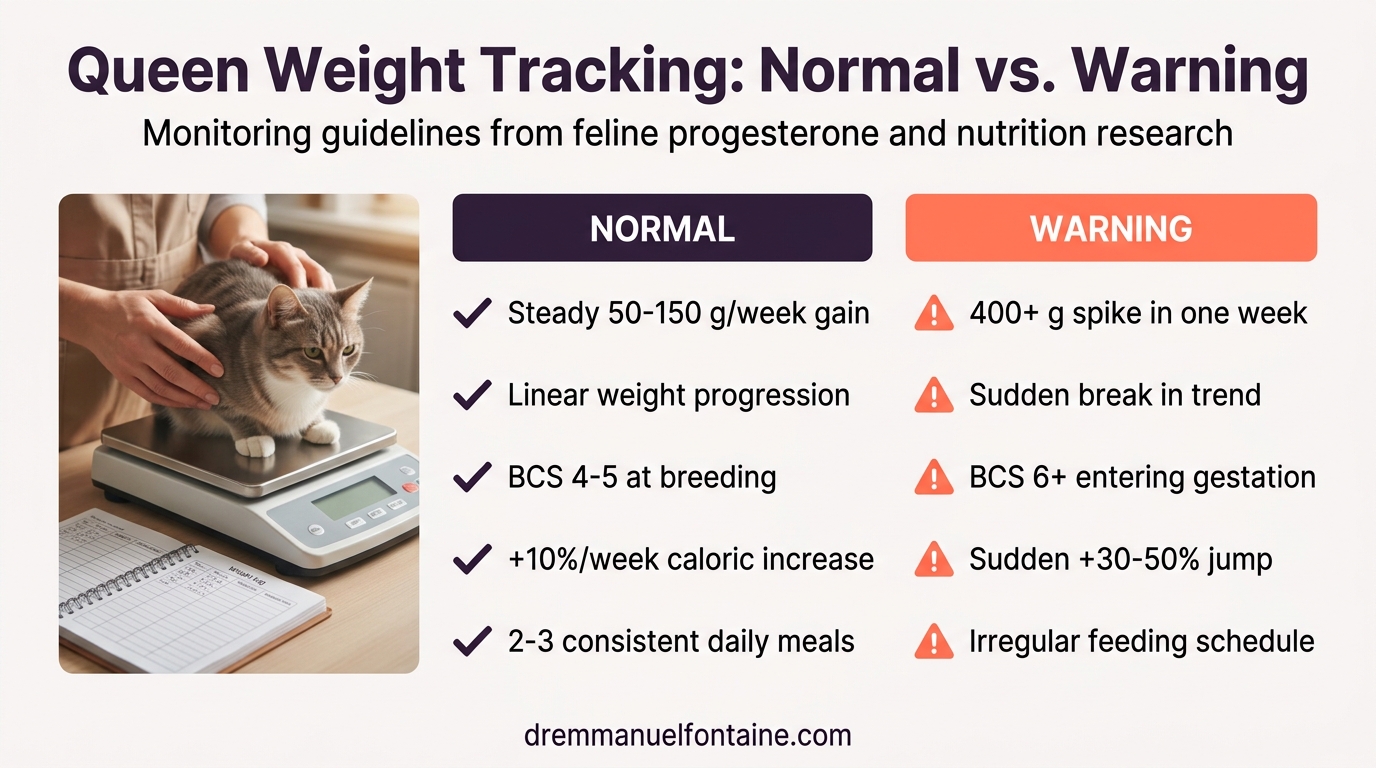
Queens gain weight linearly from the start of gestation. A healthy queen reaches 120–140% of her pre-mating optimal body weight by parturition. This means a 4 kg (8.8 lb) queen may weigh 4.8–5.6 kg (10.6–12.3 lbs) at term. The gain is steady and distributed across all nine weeks.
What you are watching for is the pattern of gain, not the absence of gain. Steady, gradual increases week over week confirm that your feeding protocol is working. Sudden spikes, where the queen gains 400+ g (14+ oz) in a single week, signal overfeeding and metabolic disruption. That is the red flag, not weight gain itself.
| Gestational Phase | Feeding Strategy | Expected Appetite | Warning Signs |
|---|---|---|---|
| Weeks 1–3 | Gradual +10%/week; switch to growth diet | Normal to slightly increased | Sudden large appetite spike (may indicate multiple large meals) |
| Weeks 4–5 | Continue +10%/week | Steadily increasing | Refusal to eat (consult vet) |
| Weeks 6–7 | Maintain elevated intake; split into 3–4 meals | High but limited by stomach capacity | Vomiting after meals (portions too large) |
| Week 8 (pre-labor) | Offer freely; queen self-regulates | May decrease 24–48 hours before labor | Complete food refusal >48 hours before expected date |
| Labor day | Remove food; water available | Absent during active labor | Eating during active labor is unusual; consult vet |
| Post-partum | Free-choice growth diet for lactation | Very high; lactation demands 2–3x maintenance | Failure to eat within 12 hours post-partum |
Body Condition Scoring for Breeding Queens
Body condition scoring (BCS) ranges from 1 (emaciated) to 9 (obese). Breeding queens should enter gestation at BCS 4 to 5. A BCS 4 queen is lean but muscular: you can feel ribs easily, she has a visible waist, and her abdominal tuck is clear. A BCS 5 queen has slightly more fat but remains athletic.
Queens at BCS 6 or higher enter a metabolically precarious state for breeding. Higher body fat increases baseline insulin resistance, reduces metabolic adaptability, and makes the queen more vulnerable to the progesterone crash described earlier. If your queen drifts toward BCS 6 between cycles, adjust portions downward and work with your veterinarian before the next breeding.
During gestation, BCS assessment becomes less reliable as the growing uterus changes body shape. This is why weekly weight tracking is more useful than BCS during pregnancy. Reserve BCS for pre-breeding assessment and post-weaning recovery evaluation.
| Gestational Week | Expected Weekly Gain (4 kg queen) | Cumulative Gain | Status/Action |
|---|---|---|---|
| Week 1 | 50–100 g | 50–100 g | Normal: linear gain beginning |
| Week 2 | 50–100 g | 100–200 g | Normal: steady progression |
| Week 3 | 75–125 g | 175–325 g | Normal: fetal development accelerating |
| Week 4 | 100–150 g | 275–475 g | Normal: fetal growth visible on ultrasound |
| Week 5 | 100–175 g | 375–650 g | Normal: significant fetal growth |
| Week 6–7 | 125–200 g | 500–1050 g | Normal: late gestation growth |
| Week 8–9 | 100–200 g | 800–1600 g | Normal: 120–140% of pre-mating weight at term |
| BCS | Description | Breeding Outcome | Pregnancy Complication Risk |
|---|---|---|---|
| BCS 4 (Ideal) | Lean; ribs easily felt, visible waist, clear tuck | Optimal litter size | Low: metabolically stable |
| BCS 5 (Acceptable) | Slightly rounded; ribs felt with mild pressure | Optimal litter size | Low to moderate: generally stable |
| BCS 6 (Elevated risk) | Rounded; ribs difficult to feel, waist barely visible | Reduced litter size (2–4) | Moderate: higher resorption risk from insulin resistance |
| BCS 7+ (High risk) | Obese; ribs not palpable, no visible waist | Significantly reduced (1–2); conception difficulties | High: consider pre-breeding weight management |
| BCS 3 (Underweight) | Ribs prominent, thin, exaggerated waist | Reduced litter size; poor post-partum recovery | Moderate: metabolic instability |
| BCS 2 or less | Severely thin, skeletal | Do not breed; achieve BCS 4–5 first | Very high: maternal and fetal risk |
Progesterone Monitoring With Your Veterinarian
Progesterone testing is the gold standard for confirming ovulation, assessing luteal function, and identifying insufficiency. A serum progesterone test is simple: a blood draw with results within 24 hours. If litter sizes are repeatedly small despite normal mating, good body condition, and a controlled feeding protocol, progesterone testing helps distinguish nutritional causes from hormonal ones.
Test at day 7 (should be 10–16 ng/mL, confirming ovulation), day 14 (should be 16–22 ng/mL, confirming stable luteal phase), and day 21 (should be 18–25 ng/mL, confirming maintained levels). Levels below expected ranges signal insufficiency. Queens that experience a progesterone crash from overfeeding will show falling levels at these checkpoints.
Work with your veterinarian to interpret results in context of your feeding protocol. A queen with stable progesterone but small litters suggests genetic or ovulation factors. A queen with falling progesterone may benefit from dietary adjustment or veterinary progesterone supplementation.
| Test Day | Expected Level (ng/mL) | Interpretation | Action |
|---|---|---|---|
| Day 7 | 10–16 | Normal: ovulation confirmed | Continue gradual feeding increase |
| Day 7 | <5 | Insufficient: ovulation may not have occurred | Recheck at day 14; consult vet |
| Day 14 | 16–22 | Normal: implantation progressing | Continue protocol; confirm embryo count on ultrasound |
| Day 14 | <14 | Concerning: early resorption possible | Review feeding speed; check for sudden caloric jumps |
| Day 21 | 18–25 | Normal: pregnancy progressing | Continue gradual increase through gestation |
| Day 21 | <16 | Insufficient: potential resorption risk | Work with vet on supplementation; review entire feeding protocol |
Warning Signs That Nutrition Is Affecting Fertility
Repeated Small Litters Despite Healthy Queens
A healthy queen with normal mating behavior, confirmed ovulation, and good body condition should deliver five to seven kittens. If your queen consistently delivers two to four kittens despite these positive indicators, chronic embryonic resorption is a potential cause, and nutrition is the most modifiable risk factor.
For confirmed resorption, review your feeding protocol. Was the caloric increase gradual, approximately 10% per week? Or did you introduce a large feeding change at some point? Remember the liver enzyme mechanism: any sudden caloric surge can trigger a progesterone crash. Work with your veterinarian to identify variables and adjust.
Weight Spikes That Signal Metabolic Disruption
Weight fluctuations are different from weight gain. Steady linear gain is expected and healthy. What signals trouble is a sudden spike: a queen that gains 400+ g (14+ oz) in a single week during early pregnancy. This kind of spike reflects overfeeding, not normal fetal growth.
A sudden weight spike early in gestation can also signal fluid retention or mild edema, both of which may indicate progesterone-related changes. In either case, early intervention prevents further loss. If you notice a jump in weight that breaks the linear pattern, review portion sizes, confirm you have not inadvertently increased beyond the 10% weekly target, and plan a progesterone test if not already done.
Track weekly weights consistently. The linear trend is your friend. Breaks in the line are the warning. As discussed in the monitoring section above, a 4 kg queen gaining 50–150 g per week in a smooth progression is on track. The same queen gaining 400 g in week 2 is not.
| Weekly Weight Change | Pattern | Metabolic Signal | Action |
|---|---|---|---|
| 50–150 g/week (steady) | Linear gain | Normal: consistent with gradual energy increase | Continue protocol |
| 150–250 g/week (moderate) | Slightly above expected | Monitor: may be normal for larger litters | Confirm portion sizes; no immediate concern |
| 250–350 g/week (elevated) | Steeper than expected | Possible overfeeding | Review portions; slow the rate of caloric increase |
| 400+ g in a single week | Spike (breaks linear pattern) | Overfeeding or fluid retention; resorption risk | Reduce portions; test progesterone; consult vet |
| Weight loss in any week | Decline | Underfeeding, illness, or stress | Assess appetite; consult vet immediately |
| Erratic (up-down-up pattern) | Unstable | Metabolic instability; feeding inconsistency | Standardize portions and timing; review diet |
When to Suspect Progesterone Insufficiency
Progesterone insufficiency presents with small litters, failure to carry pregnancies to term, or early pregnancy loss. If your feeding protocol follows the gradual-increase model and litter sizes remain small, progesterone testing becomes the next diagnostic step.
Indicators include repeated small litters despite confirmed ovulation, sudden weight spikes in early pregnancy despite controlled feeding, queens showing early labor or discharge before day 58 of gestation (normal is 58–70 days), and queens failing to show nesting behavior or milk production on schedule.
Once insufficiency is confirmed by testing, treatment options include refining the dietary protocol, progesterone supplementation (injections or oral forms prescribed by your veterinarian), or breeding management adjustments. This is where the partnership with your veterinarian becomes essential. The feeding protocol gives you control over the most modifiable risk factor. Your veterinarian handles the rest.
| Clinical Sign | Progesterone Insufficiency | Normal Pregnancy | Overfeeding Problem |
|---|---|---|---|
| Weight pattern weeks 1–3 | Erratic (large swings, 300+ g spikes) | Steady linear gain (50–125 g/week) | Excessive gain from overfeeding |
| Queen appetite | Variable; may drop mid-pregnancy | Increasing steadily | May be excessive if free-fed |
| Vaginal discharge before day 58 | Present (bloody or clear mucus) | Absent until labor | Not directly caused by feeding |
| Labor timing | Early (day 70) | On schedule (day 58–65) | Not directly caused by feeding |
| Nesting behavior timing | Reduced or delayed | Obvious and timely (days 60–62) | Not directly caused by feeding |
Conclusion
Flushing your queen is not a neutral decision. It is a direct intervention into her reproductive endocrinology. Where flushing works in livestock because their bodies compensate for increased progesterone clearance through enzyme suppression, the same aggressive protocol in cats triggers metabolic disruption leading to embryonic resorption and smaller litters.
The science does not say queens should stay on maintenance calories throughout pregnancy. Queens need more energy, and they need it from the start. A gradual increase of approximately 10% per week, supported by a switch to a growth diet, gives her developing kittens the nutrition they need without overwhelming her progesterone regulation. Queens gain weight linearly throughout gestation, reaching 120–140% of their optimal body weight before parturition. That weight gain is normal, expected, and healthy.
Monitor weekly weight for steady linear progression. Keep pre-breeding body condition at BCS 4–5. Work with your veterinarian on progesterone testing if litter sizes remain small. Your breeding queen has different reproductive endocrinology, different metabolic sensitivities, and different nutritional needs than livestock. Respecting those differences and building your protocols around feline biology rather than borrowed livestock practices is the foundation of consistent, healthy litters.
Get the next issue on Saturday morning
Every Saturday, my free newsletter brings you one piece of science on reproduction and newborn care in dogs and cats, written for breeders and their veterinarians. Read it in English, French, Spanish or Portuguese.
Free. Unsubscribe anytime.


