🇫🇷 Lire en Français | 🇪🇸 Leer en Español | 🇧🇷 Leia em português
Ask any breeder about whelping or queening and sooner or later you will hear the same word: unpredictable. The female who sailed through her first litter and struggled through her second. The textbook pregnancy that ended in surgery at two in the morning. After enough of those nights, in a kennel or a cattery, most of us settle into the same conclusion: birth is a lottery, and the only thing you can do is be ready for anything.
This year, that conclusion took a hit. Two 2026 papers, read side by side, say something far more interesting: a birth starts leaving clues long before the first contraction. Her weight. Her history. The size of the litter she carries. Even who she shares her space with in the last two weeks.
None of these decides the outcome on its own. But together they sketch it, early enough for you to act on it. And the first clue surprised me the most, because it comes from the least glamorous tool in the building: the scale.
TL;DR
- Heavier mothers had fewer newborns born alive, and stillbirths climbed with her weight, in Labradors with completely normal, supervised births.
- The likely reason is muscular. Fat in the uterine wall weakens contractions, and once labor stretched past its typical length, stillbirths roughly doubled, from about 6 to about 12 per 100.
- Weight without frame means little. Ask your veterinarian to put a body condition score on her at the planning visit, on the nine-point scale most clinics use.
- A female on her first litter had roughly twice the odds of a stillborn newborn compared with one on her second, and every extra newborn in the litter nudged the odds up by close to a fifth.
- Mothers housed with seven or more youngsters under a year old in their last two weeks had almost four times the odds of a stillborn newborn.
- Labors running past 11 hours carried nearly triple the odds of a stillborn newborn compared with births finished inside 6.
- The five-clue read: the scale, the history, the scan, the room and the clock.
The Scale Was the First Surprise
The first of the two papers looked at something every kennel and cattery already owns, and few of us read as an obstetric signal. It weighed the mother before her pregnancy, and then followed what happened at the birth.
Heavier mothers, fewer newborns born alive
A 2026 study followed Labrador litters through completely normal, supervised births, no complications, no surgery, and weighed every female before her pregnancy. The heavier the mother going in, the fewer of her newborns were born alive. It was one of the strongest links in the whole dataset, and stillbirths climbed with her weight as well.
Now the detail that makes this finding genuinely uncomfortable, and genuinely useful. These were healthy females. Not one of them was enrolled as overweight, because the study recorded weight, not body condition. Nobody had looked at any of these mothers and seen a risk. The scale saw it anyway.
| The study | The detail |
|---|---|
| Followed Labrador litters through normal, supervised births | No complications, no surgery |
| Weighed every female before her pregnancy | The heavier the mother, the fewer newborns born alive |
| Recorded stillbirths | Stillbirths climbed with her weight as well |
| Recorded weight, not body condition | Not one female was enrolled as overweight: the scale saw a risk nobody else had |
Why a few extra kilos weaken a birth
Why would a few extra kilos matter that much? Because the uterus is a muscle, and the explanation the researchers point to is muscular: in heavier mothers, fat works its way into the uterine wall, and a muscle marbled with fat contracts with less force. Weaker contractions run a slower birth.
In that same study, slow was expensive. Once labor stretched past its typical length, the share of stillborn newborns roughly doubled, from about six per hundred to about twelve. A drawn-out birth quietly starves the newborns still waiting, and nothing in that chain is specific to dogs.
| Link in the chain | What happens |
|---|---|
| A heavier mother | Fat works its way into the uterine wall |
| A uterine muscle marbled with fat | It contracts with less force |
| Weaker contractions | A slower birth |
| Labor past its typical length | Stillborn newborns roughly double, from about 6 to about 12 per 100 |
| A drawn-out birth | It quietly starves the newborns still waiting; nothing in that chain is specific to dogs |
A link, not a verdict
It is a link, not a verdict. No female loses her place in a program over a number on a scale. But the chain from the scale to the whelping box is short, and it starts months before the mating, which is exactly why it is worth reading early rather than discovering on the night.
| The weight finding is | The weight finding is not |
|---|---|
| A link between her weight and how her birth runs | A verdict on her |
| A chain that starts months before the mating | A reason for a female to lose her place in a program |
| Something you can read early | Something to discover on the night |
What Counts as Too Heavy? Define It, Do Not Guess It
The scale alone will not answer that question, and this is where the finding becomes something you can actually use. What matters is not how much she weighs, but how that weight sits on her frame, and that is something you can score.
Weight without frame means little
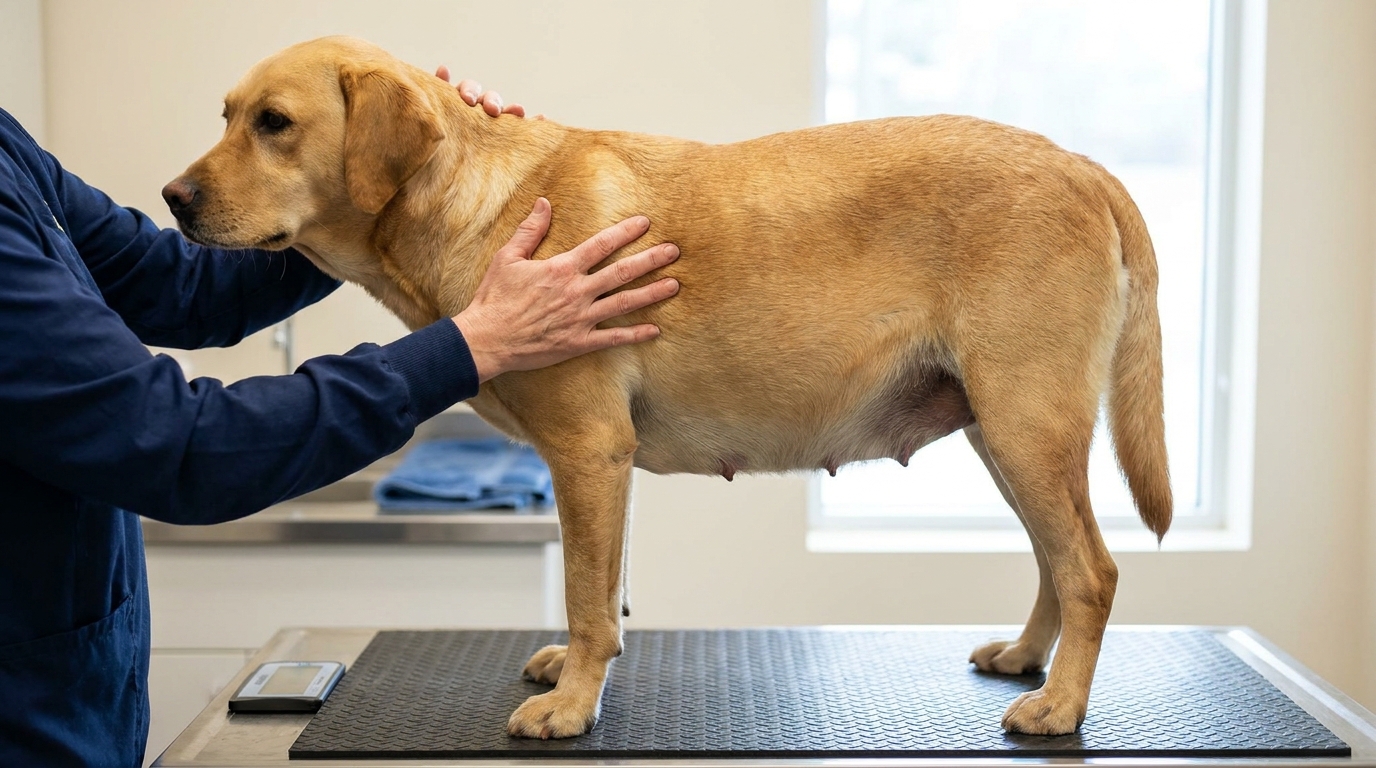
Weight without frame means little: a big-framed female outweighs a small one and can still be the leaner of the two. What matters is body condition, her weight relative to her frame. And the good news is that condition is something you can actually score, in dogs and in cats, with the same tool your veterinarian uses: the body condition score.
| What it tells you | |
|---|---|
| Weight alone | How heavy she is, without her frame |
| A big-framed female versus a small one | The heavier female can still be the leaner of the two |
| Body condition | Her weight relative to her frame |
| The score | The same tool your veterinarian uses, in dogs and in cats |
What your hands can already tell you
You can already feel most of the answer with your own hands: how easily the ribs come to a flat palm, whether she still has a waist, whether the belly line lifts or hangs. Every experienced breeder reads these signs, in a retriever or a ragdoll.
What is new is not the check. It is its purpose. Until this year, condition before a mating was about fitness, fertility, looks. The finding above turns that same read into an obstetric forecast: a signal about how her birth is likely to run, months before it starts.
| The read | What your hands check |
|---|---|
| The ribs | How easily they come to a flat palm |
| The waist | Whether she still has one |
| The belly line | Whether it lifts or hangs |
| Before this year | A read for fitness, fertility, looks |
| Now | An obstetric forecast: a signal about how her birth is likely to run |
Ask your veterinarian for a body condition score
So make it official. At the planning visit, ask your veterinarian to put a body condition score on her, on the nine-point scale most clinics use, and to tell you where she should sit before conception. If she has ground to cover, you have months to cover it calmly.
The study that opened this article never scored condition, and that is precisely the gap you can close in your own program: do not guess “she looks fine”. Score her.
| At the planning visit | Why |
|---|---|
| Ask for a body condition score, on the nine-point scale | A number instead of “she looks fine” |
| Ask where she should sit before conception | A target agreed with your veterinarian |
| If she has ground to cover | You have months to cover it calmly |
| Score her | It closes the gap the study left open |
The Rest of the Picture Arrives Before the Birth Too
The second paper is the one that turns this from a weight story into a preparation story. A 2026 survey of more than ten thousand newborns mapped what separates the litters that lose newborns from the litters that do not, and most of the separating factors are visible in advance.
Her history: the maiden earns your closest night
Her history is a clue. A female on her first litter carried roughly twice the odds of a stillborn newborn compared with one on her second. So the maiden earns your closest night, and a first-time queen every bit as much as a first-time bitch.
| Her history | What it means | What you do |
|---|---|---|
| First litter | Roughly twice the odds of a stillborn newborn | Give her your closest night |
| Second litter | The comparison point | |
| A first-time queen | Every bit as much as a first-time bitch | Give her your closest night too |
The scan: a big count means a longer birth
The scan is a clue too. Every extra newborn in the litter nudged the odds up by close to a fifth. So a big count on the ultrasound means planning for a longer, harder birth, not just more collars.
| The scan shows | What it means for the birth |
|---|---|
| Each extra newborn in the litter | Odds of a stillborn newborn nudged up by close to a fifth |
| A big count | Plan for a longer, harder birth |
| What not to do | Plan only for more collars |
The room: her own quiet space in the last two weeks
And then there is the finding I had never seen anywhere before, the one worth rearranging a room over. Mothers who spent their last two weeks of pregnancy housed with seven or more youngsters under a year old had almost four times the odds of a stillborn newborn, and more than four times the odds of losing newborns in the first weeks. The authors flag it as a first: nobody had shown this link before.
The likely reasons are ordinary ones. Young animals shed more germs, and a crowded, busy space is a stressful place to finish a pregnancy. But the practical move is simple and immediate: in the last two weeks, in a kennel or a cattery, the expecting mother gets her own quiet space, at a real distance from the puppy pen or the kitten room.
| In her last two weeks | Detail |
|---|---|
| Housed with seven or more youngsters under a year old | Almost four times the odds of a stillborn newborn |
| The same housing | More than four times the odds of losing newborns in the first weeks |
| The likely reasons | Young animals shed more germs; a crowded, busy space is stressful |
| The move | Her own quiet space, at a real distance from the puppy pen or the kitten room |
The Five-Clue Read
Not one of these clues dooms a litter, and not one guarantees it. Their value is what they do together: they turn “be ready for anything” into a specific plan for this female, this litter, this room. I call it the five-clue read: the scale, the history, the scan, the room, and the clock.
The four clues you read before the birth
The first four you read before the birth. Score her condition with your veterinarian at the planning visit, months out. Note her parity. Take the count from the scan seriously. Two weeks before term, give her a quiet space away from the youngsters.
| Clue | When you read it | What you do |
|---|---|---|
| 1. The scale | At the planning visit, months out | Score her condition with your veterinarian |
| 2. The history | Before the birth | Note her parity: a maiden earns your closest night |
| 3. The scan | Before the birth | Take the count seriously: a big litter means a longer birth |
| 4. The room | Two weeks before term | Her own quiet space, away from the youngsters |
The fifth clue: the clock
The fifth is the only one you read live. Write down the time of each birth as it happens, because the same survey found that labors running past eleven hours carried nearly triple the odds of a stillborn newborn compared with births finished inside six.
| Length of labor | Odds of a stillborn newborn |
|---|---|
| Finished inside 6 hours | The comparison point |
| Running past 11 hours | Nearly triple |
| What you do | Write down the time of each birth as it happens |
Agree on the phone call before the due date
Agree with your veterinarian, before the due date, on when a quiet stretch becomes a phone call, so that decision is already made before fatigue starts making it for you. That conversation belongs on the same list as the condition score, the parity note, the scan count and the quiet room: all of it decided in daylight, weeks before the night.
| Before the due date, with your veterinarian | On the night |
|---|---|
| Agree when a quiet stretch becomes a phone call | The decision is already made |
| Settle it while you are rested | Fatigue does not make it for you |
Conclusion
For most of my career, I answered questions about difficult births with the word everyone uses: unpredictable. I no longer give that word the whole territory. Somewhere next season there is a litter that will arrive safely because its breeder did something small and unglamorous weeks earlier: booked a condition score, moved a whelping box, gave a queen a quiet room.
Nobody will ever point at the puppy or the kitten that made it because of that. Prevention is invisible when it works. It just looks like a good night. These are general rules, and every female has her own context, so build the plan with the veterinarian who knows her.
The lottery shrinks every time you read one more clue. Read all five. You will find more on preparing the birth in my dog whelping resources and cat birth and queening resources.
The papers behind this article: the 2026 Labrador whelping study and the 2026 survey of more than ten thousand newborns. Each link opens the original paper.
Want the full version? Inside the Breeder Vault, the library where I add the expanded edition of my newsletter every week, you will find the expanded edition of Why heavier mothers lose more newborns.
Could you run the five-clue read, today, on the next female you plan to breed? Tell me in the comments below which clue you had never thought to read. I read every one.
And if you want the next article in your inbox, join my free newsletter. It arrives every Saturday, in English, French, Spanish and Portuguese.