🇫🇷 Lire en Français | 🇪🇸 Leer en Español | 🇧🇷 Leia em português
Not long ago, a video popped up in my Instagram feed. And honestly, it made me cringe.
Someone was explaining how and when to use antibiotics in newborn puppies. The message was simple: an over-the-counter antibiotic, presented as the go-to solution anytime there were signs of infection. A “game changer,” he said. That is where the problem starts. Not the person, the message.
Right now, across veterinary medicine, we are having serious conversations about antibiotic stewardship. I discussed it at a conference in Montreal earlier this year. The risk is not theoretical. Inappropriate use of antibiotics drives resistance, and resistance does not just affect our patients. It comes back to us.
In newborns, there is another layer, and it is even more critical. The gut microbiome is being built in the first days of life, and an antibiotic given without a clear reason can disturb it. There is also a third issue. When a newborn develops an infection, it rarely comes out of nowhere. It usually reflects a failure upstream: the mother, the milk or the environment.
So instead of asking “Which antibiotic should I use?”, what if the real question is “Why did this infection happen in the first place?” That shift changes everything. In this article, I walk you through why I worry about reflex antibiotics in newborn puppies and kittens, where their infections really come from, and the 5 questions I want every breeder to ask before an antibiotic decision is even on the table.
TL;DR
- “Just in case” antibiotics in newborn puppies and kittens are not free of consequences. They drive resistance and can disturb a gut microbiome that is still being built.
- Most early infections in newborns trace back to three sources: the mother, her milk and the nest.
- The mother is the closest source of bacteria for her litter. Plaque and tartar are best dealt with before breeding, because a dental cleaning is never done during pregnancy.
- Mastitis can begin within hours of whelping or queening, and it does not always look dramatic.
- The nest should be smart, not sterile. The mother’s saliva, bedding and grooming help seed a healthy newborn gut.
- A cold, weak or dehydrated newborn can let its own gut bacteria cross into the blood. Temperature, hydration, glucose and daily weight are your early warning system.
- The conversation with your veterinarian before the litter arrives is where antibiotic decisions stop being reflexes.
Why “Just in Case” Antibiotics Worry Me in Newborns
Here are the three reasons I worry about reflex antibiotics in newborn puppies and kittens.
Resistance does not stay with the patient
Antibiotic stewardship means using antibiotics only when they are truly needed, and using them well. It matters because inappropriate use drives resistance.
As I said in the introduction, resistance does not stay with the animal in front of us. It comes back to our patients, and it comes back to us. That is why your veterinarian is not just the person who chooses the antibiotic. Your vet is the partner who helps you decide whether an antibiotic is needed at all.
| The reflex | What it leads to |
|---|---|
| An antibiotic given without a clear indication | More pressure toward antibiotic resistance |
| An over-the-counter antibiotic used as the “go-to” | A treatment chosen before anyone asks why the newborn is sick |
| Resistance that develops in a kennel or cattery | A problem that comes back to our patients and to us |
| A decision made together with your veterinarian | An antibiotic used when a diagnosis calls for it |
The newborn gut is being built
In the first days of life, the gut microbiome is being built. This is not a detail. It is a foundational system that shapes immunity, metabolism and long-term health.
When we disrupt that process without a reason, we create what we call dysbiosis, an imbalance in the microbial ecosystem. In human medicine, dysbiosis has been linked to higher risks of allergies, asthma and chronic disease. So when an antibiotic is given to a newborn without a clear indication, we are not just treating a problem. We may be creating the next one.
There is a number from the kitten literature I keep returning to. Kittens treated with antibiotics during their first year of life are about 19 times more likely to develop chronic gut disorders later in life. We do not have a number quite that clean for puppies. The direction of the data is the same.
| Finding | Where it comes from | What it means for your litter |
|---|---|---|
| The gut microbiome is built in the first days of life | Newborn biology, dogs and cats | The first days are a window worth protecting |
| Dysbiosis is linked to allergies, asthma and chronic disease | Human medicine | Disturbing the young gut can have long-term effects |
| About 19 times more chronic gut disorders after antibiotics in the first year | Kittens | Antibiotics belong after a diagnosis, not before one |
| No number that clean yet | Puppies | The direction of the data is the same |
What changed in my own practice
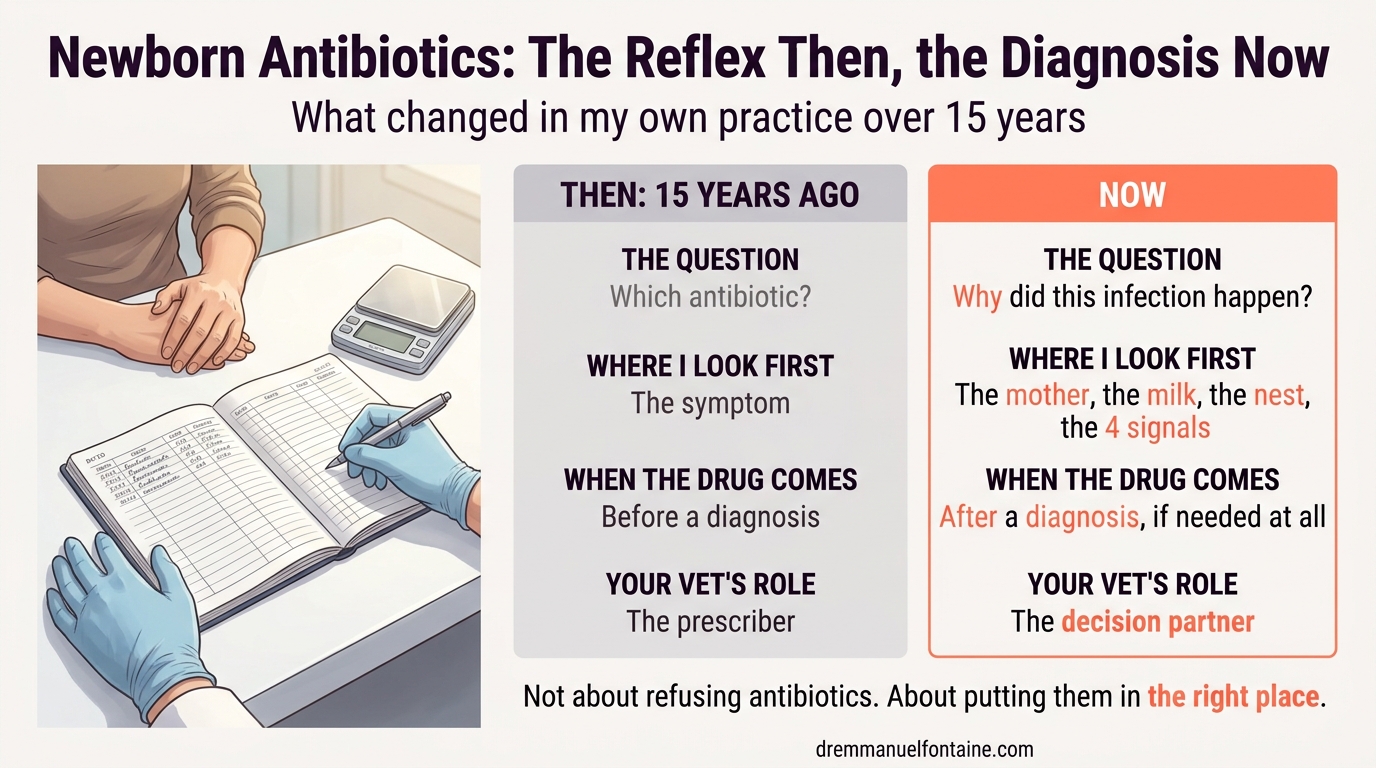
Fifteen years ago, when a sick newborn came across my consult table, the antibiotic was almost a reflex. A puppy with diarrhea got a course. A kitten that looked weak got a course. That was the standard of care. It was what I was taught.
Today, I look at the upstream picture first: the mother, the milk, the nest and the four signals you will discover below. The drug, if it is needed at all, comes after a diagnosis, not before one.
The shift was not about being stricter. It was about being more honest with myself. Most of what I treated with antibiotics, I could have prevented by paying closer attention upstream.
| Then: the reflex | Now: the diagnosis first | |
|---|---|---|
| The question I asked | “Which antibiotic?” | “Why did this infection happen?” |
| Where I looked first | The symptom | The mother, the milk, the nest, the four signals |
| When the drug came | Before a diagnosis | After a diagnosis, if needed at all |
| The veterinarian’s role | The prescriber | The decision partner |
Where Newborn Infections Really Come From
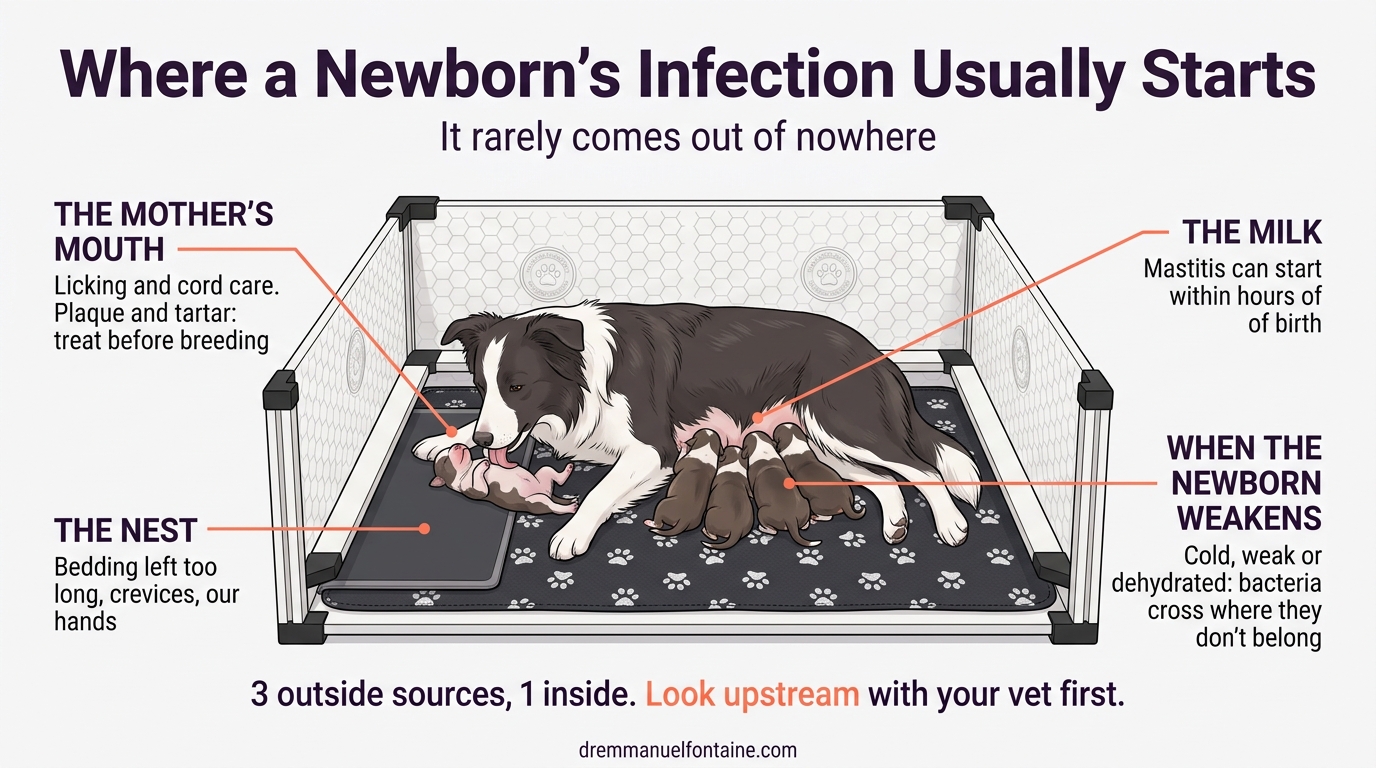
Most early infections in newborn puppies and kittens trace back to one of three sources: the mother, her milk or the nest. Each one gives you something concrete to check.
The mother: protector and carrier
The mother is the first source. Not because she is dangerous, but because she is busy. Her colostrum is the first immune system her newborns will have. Her body is also the closest, most active source of bacteria they will meet in the first hours of life.
Her mouth carries that bacterial load directly to her newborns when she licks them, when she stimulates them to urinate and defecate, and when she cuts the umbilical cord. The umbilical stump is a vessel that runs straight into the abdomen. If her dental health is poor, she is delivering bacteria along with maternal care.
That is why plaque and tartar are best dealt with, together with your veterinarian, before you breed her. A dental cleaning is never done on a pregnant dog or cat. Once she is bred, that window is closed.
| When the mother… | What reaches her newborns |
|---|---|
| Nurses them | Colostrum, their first immune protection |
| Licks them clean | Bacteria from her mouth, on the coat and face |
| Stimulates them to urinate and defecate | Bacteria from her mouth, at the perineum |
| Cuts or cleans the umbilical cord | Bacteria at the stump, which leads straight into the abdomen |
| Has plaque or tartar | A heavier bacterial load with every lick: clean her teeth before breeding, never during pregnancy |
The milk: a quiet route
The milk is the second route. Mastitis, an inflammation of the mammary gland, is usually bacterial. If a puppy or kitten nurses on infected milk, the infection goes straight in.
Mastitis can begin within hours of whelping or queening. It is one of the quieter problems in a kennel or cattery, because it does not always look dramatic. That is why it belongs on your watch list for the first three weeks. You catch it early or you catch it late, and early is much better for everyone in the room.
The question is not just whether the litter is nursing. It is whether what they are drinking is safe, because contaminated milk delivers bacteria into the gut of a newborn whose immune system is not yet ready for the fight.
| What to know about mastitis | Why it matters | What you do |
|---|---|---|
| It is usually bacterial | Infected milk carries bacteria straight into the newborn’s gut | Keep the milk on your list of possible sources |
| It can begin within hours of birth | It can start before you expect it | Check her mammary glands from day one, every day |
| It does not always look dramatic | A quiet start is easy to miss | Do not wait for an obvious sign |
| Early is better than late | The sooner it is caught, the better for mother and litter | Call your veterinarian at the first doubt |
The nest: smart, not sterile
Then there is the environment. The whelping or queening box is a microbial space, not a sterile one, and that is by design. But when bedding sits too long, when crevices trap moisture and biological material, and when our hands and clothing carry pathogens that newborns then meet through the skin, the eyes or the umbilical stump, the environment turns against the litter. I have a name for unchecked bedding: the silent assailant. Cleaning and disinfecting are different steps, and you do both, with intention.
A well-designed whelping setup makes this work easier. I have shared before why I like EZWhelp for breeders who want a practical, easy-to-clean, easy-to-monitor environment. They extend an automatic 10% discount on the entire order to anyone who purchases through my link. No code needed, it applies at checkout.
EZWhelp is an affiliate partner. If you purchase through my link, I earn a commission at no extra cost to you. I only recommend products I have evaluated and believe genuinely serve dog and cat breeders.
Here is the pivot that changed my own thinking. We used to think of the nest as something to keep clean, full stop. Today, we understand the gut microbiome in a way we simply did not before. Sterile is not the goal. Smart is the goal. The mother’s saliva, her bedding and her grooming are not contamination. They are how a healthy newborn gut gets seeded. Wipe them out with harsh disinfectants and you starve the very process you are trying to support.
| A smart nest | A nest working against the litter |
|---|---|
| Bedding changed before it sits too long | Bedding left in place: the silent assailant |
| Surfaces that are easy to clean and monitor | Crevices that trap moisture and biological material |
| Clean hands and clean clothing | Hands and clothing carrying pathogens to the skin, eyes and umbilical stump |
| Cleaning and disinfecting done as two deliberate steps | One quick wipe and hope |
| The mother’s grooming and scent respected | Harsh disinfectants that wipe out the seeding process |
When the Bacteria Are Already Inside the Newborn
This is the part that matters most when the question is whether an antibiotic is needed.
Bacteria in a newborn’s gut are normal
Newborn puppies and kittens already carry bacteria in their gut and in their mouth. That is normal. It is contained. It is the start of a microbiome they will spend the rest of their lives building.
The problem starts only when bacteria end up where they do not belong.
| What you find | Normal or not? |
|---|---|
| Bacteria in the newborn’s gut and mouth | Normal: the start of a lifelong microbiome |
| Infected milk or bedding left too long | Not normal: an outside source of infection |
| Bacteria in the blood | Not normal: a blood infection that needs your veterinarian |
Bacterial translocation: when bacteria cross the line
When a newborn becomes cold, weak, dehydrated or metabolically unstable, the bacteria in its gut stop staying put. They cross the gut wall and enter the bloodstream. There is a name for this, and it is worth knowing: bacterial translocation. The bacteria translocate, which means they move from where they belong to where they do not.
The blood infection that follows did not arrive from outside. It came from a newborn whose system weakened enough for its own bacteria to cross the line. Most early infections in the first week of life are environmental and metabolic failures wearing the costume of a germ.
| A newborn on the safe side | A newborn at risk of translocation |
|---|---|
| Warm | Cold |
| Hydrated | Dehydrated |
| Nursing and gaining weight | Weak, not nursing, not gaining |
| Metabolically stable | Metabolically unstable |
| Gut bacteria stay in the gut | Gut bacteria cross into the blood |
The four signals that catch it early
This is why temperature, hydration, glucose status and daily weight trends matter so much. They are not extra details. They are your early warning system. The thermometer, the scale and the glucometer often catch the problem long before any antibiotic ever needs to.
When one slips, the antibiotic question becomes more likely. When all four hold, it usually does not even arise. Record them, and let your veterinarian read them with you.
| Signal | What it tells you | Your role and your vet’s role |
|---|---|---|
| Body temperature | Whether the newborn is staying warm | You measure and record; your vet interprets |
| Hydration | Whether the newborn is getting enough fluid | You observe and record; your vet interprets |
| Blood glucose | Whether the newborn has the energy it needs | You record what your vet asks for; your vet interprets |
| Daily weight trend | Whether the newborn is nursing and growing | You weigh and record; your vet interprets |
5 Questions to Ask Before Antibiotics Enter the Conversation
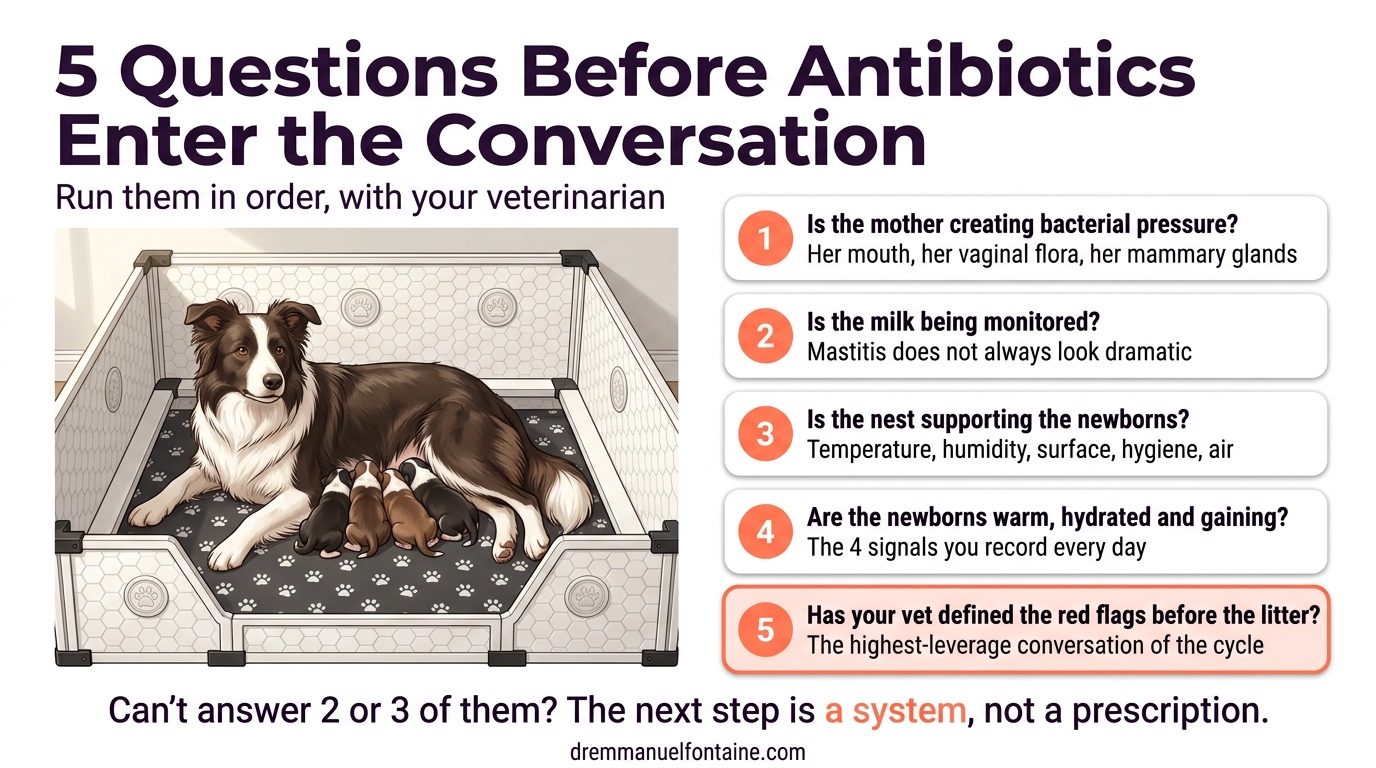
These are not protocol steps. They are the questions I now run through in my head, in order, before an antibiotic is even on the table. Answer them honestly, and you usually know the next move.
Questions 1 and 2: the mother and her milk
1. Is the mother creating bacterial pressure, before or after birth? The mother is the protector and the carrier. Her oral health, her vaginal flora and the state of her mammary glands all shape what her newborns are exposed to in their first hours. If you have not looked at her as a possible source, you have not finished the diagnosis.
2. Is the milk being monitored as a possible route of infection? As we saw earlier, mastitis does not always look dramatic. The question is not just whether the litter is nursing. It is whether what they are drinking is safe.
| Question | What you are really checking |
|---|---|
| 1. Is the mother creating bacterial pressure? | Her mouth (plaque and tartar, dealt with before breeding), her vaginal flora, her mammary glands |
| 2. Is the milk monitored as a route of infection? | Daily mammary checks from the first hours after birth, and a call to your vet at the first doubt |
Questions 3 and 4: the nest and the newborns
3. Is the nest supporting the newborns, or quietly working against them? Temperature, humidity, surface, hygiene and air quality all interact. A setup that looks fine at a quick glance can still be doing damage if any one of those layers is off. The nest is not just a place to put the litter. It is part of the immune system.
4. Are the newborns warm, hydrated and gaining consistently? Remember the four signals from the previous section. They tell you whether your litter is on the right side of the translocation line.
| Question | Working | Failing |
|---|---|---|
| 3. Is the nest supporting the newborns? | Temperature, humidity, surface, hygiene and air quality all in balance | One layer off, even if the box looks fine |
| 4. Are the newborns warm, hydrated and gaining? | All four signals holding | Any one signal slipping: call your vet with your records |
Question 5: the red flags you agree on with your vet
5. Has your veterinarian helped you define the red flags before the litter arrives? This is the question that most often gets skipped. The conversation with your vet before the litter is the highest-leverage moment in the whole cycle. Stewardship, thresholds, who acts and how: all agreed in advance. If that conversation has not happened, the antibiotic decision has a much higher chance of becoming a reflex.
If you find yourself unable to answer two or three of these questions confidently, the next step is not a prescription. It is a system.
| Agreed with your vet before the litter | What it changes when a newborn is sick |
|---|---|
| The red flags to watch for | You recognize them fast |
| The thresholds that trigger a call | You call at the right moment, not too late |
| Who acts, and how | No time lost deciding in the middle of the night |
| When an antibiotic is truly needed | The decision is a diagnosis, not a reflex |
Conclusion
This is not about refusing antibiotics. It is about putting them in the right place: after a diagnosis, not before one.
The most powerful tools you have sit upstream: the mother, the milk, the nest and the four signals. Deal with plaque and tartar before breeding. Watch her mammary glands from the first hours. Keep the nest smart, not sterile. And let the thermometer and the scale speak before anyone reaches for a drug.
Your veterinarian is the partner who helps you decide whether an antibiotic is needed at all, not just which one to use. Build that system with your vet before the litter arrives, and the antibiotic question will come up far less often. That is how you give every puppy and kitten in the box the strongest possible start.
If this article brought up a question about antibiotics in newborn puppies and kittens, leave it in the comments below. I read every one.
Get the next issue on Saturday morning
Every Saturday, my free newsletter brings you one piece of science on reproduction and newborn care in dogs and cats, written for breeders and their veterinarians. Read it in English, French, Spanish or Portuguese.
Free. Unsubscribe anytime.


